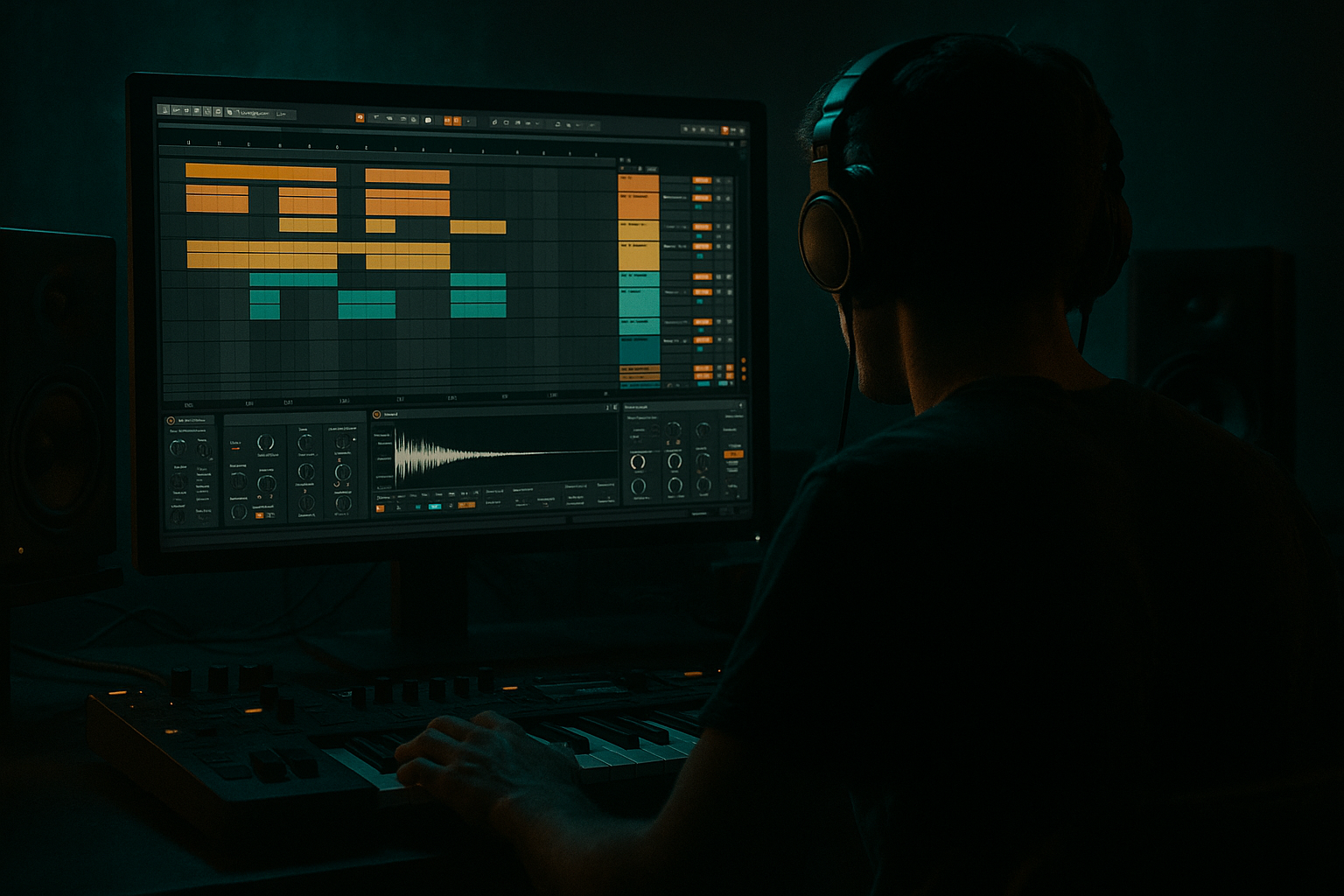
Main tutorial
```markdown
16-Bar Intro Structure (Drum & Bass) — Ableton Live Arrangement Lesson 🎛️🥁
1. Lesson overview
A strong 16-bar intro sets the mood, DJs can mix it cleanly, and your drop hits harder because the listener is ready. In drum & bass, intros are usually designed for:
- DJ-friendly mixing (clear beats/phrasing)
- Tension + expectation (subtle layering, automation)
- A smooth transition into the drop (energy ramps, not jumps)
- A tight break/hat groove (light at first, then fuller)
- A minimal kick + ghost snare to anchor the mix
- Atmosphere + FX (risers, noise, impacts)
- A filtered bass teaser (optional but very common)
- A clean handoff into bar 17 (the drop) with a pre-drop fill
- Bars 1–4: Atmos + light percussion
- Bars 5–8: Add groove + hints of snare/kick
- Bars 9–12: Energy ramp (more drums, bass tease, automation)
- Bars 13–16: Pre-drop tension (fills, riser, impact, filtering)
- 1.1.1 — Intro Start
- 5.1.1 — Layer Up
- 9.1.1 — Tension
- 13.1.1 — Pre-drop
- 17.1.1 — Drop
- Auto Filter
- Echo
- Reverb
- Utility
- Automate Auto Filter cutoff to open slightly from bars 9–16 for a subtle energy lift.
- Drum Rack (for hats)
- EQ Eight
- Saturator
- Utility
- EQ Eight
- Drum Buss
- Transient Shaper (if you have Live 12 tools) or use Drum Buss + Saturator to bring attack
- Bars 1–4: hats + atmos
- Bars 5–8: add break quietly, low energy
- Add a snare on bar 9, on beats 2 and 4 (standard DnB backbeat).
- Keep it filtered/quiet at first.
- Add a minimal kick pattern (not full drop rhythm).
- Example: kick on 1 only, or 1 and the “&” of 3.
- EQ Eight
- Drum Buss
- Reverb (very small)
- Automate snare volume up slightly from bar 9 → 13 (like +1 to +2 dB over time).
- Create Sub track with Operator:
- Play simple sustained notes (root notes only), low velocity.
- On Mid Bass track, use Wavetable:
- Auto Filter
- Saturator (Soft Clip ON)
- EQ Eight
- Utility
- Auto Filter
- Reverb
- Limiter
- Bar 16: mute the kick for a breath
- Bar 16.3–16.4: snare roll and open the filter fast
- Last beat: stop the break (silence = impact)
- Tape-stop style (optional): automate Transposition or use a short resample
- Glue Compressor
- EQ Eight
- Limiter only for safety while learning (don’t smash it)
- Atmos pad/drone
- Closed hats (light)
- Very subtle FX textures
- Add break loop (high-passed)
- Add occasional ride or shaker on offbeats
- Add snare on 2 & 4 (low-ish volume)
- Minimal kick pattern
- Bass tease with low-pass filter
- Add snare fill (last 1–2 bars)
- Riser + noise sweep
- Filter opens + small drum mute moment at bar 16
- Impact into bar 17
- No clear 4/8 bar phrasing: DnB listeners feel structure—use locators and build in blocks.
- Too much low end in the intro: Breaks + sub + FX rumble can ruin headroom and make the drop less impressive.
- Making the intro as loud/full as the drop: Save your biggest drums/bass for bar 17.
- Over-complicating drum patterns early: Bars 1–8 should be inviting, not overwhelming.
- Ignoring DJ mixability: If this is for DJ play, keep the intro beat clear and consistent (especially bars 9–16).
- Use minor-key atmos + tension notes: Add a subtle note a semitone above your root for unease (quietly!).
- Reese teaser without giving it away:
- Add gritty textures with stock tools:
- Make space for the drop hit:
- Break control = power:
- Can you clearly hear the energy increase every 4 bars?
- Does bar 17 feel like a reward?
- A great DnB 16-bar intro is built in 4-bar blocks with controlled layering.
- Start with atmos + light percussion, then add breaks, then anchor drums, then tension + FX.
- Use stock Ableton devices like Auto Filter, EQ Eight, Drum Buss, Glue Compressor, Saturator, Echo, Reverb for fast, pro results.
- Keep the intro cleaner and smaller than the drop—your drop will hit harder.
In this lesson you’ll build a classic 16-bar DnB intro in Ableton Live using stock devices, clear 8-bar phrasing, and simple but effective layering.
---
2. What you will build
A 16-bar intro at 172–176 BPM with:
Core structure (common DnB phrasing):
---
3. Step-by-step walkthrough
Step 0 — Session setup (Ableton Live)
1. Set tempo to 174 BPM.
2. In Arrangement View, set the loop brace to 1–17 (so you can hear the intro into the drop).
3. Create these tracks:
- Drums (Group)
- Kick
- Snare/Clap
- Hats
- Break (optional but very DnB)
- Bass (Group)
- Sub
- Mid/Tease
- Atmos
- FX (risers, impacts, noise)
Workflow tip: Group your tracks early (`Cmd/Ctrl+G`) so you can automate group volume/filter later.
---
Step 1 — Build the intro skeleton with locator markers 🧭
Add locators at:
This keeps you locked to 4-bar thinking, which is everything in DnB.
---
Step 2 — Atmos foundation (Bars 1–16) 🌫️
Goal: Create a bed that feels “rolling” even before drums.
1. On Atmos track, load Wavetable (stock) or Analog.
2. Choose a pad/noise preset (or make one quickly):
- Wavetable: basic wave + noise oscillator
3. Add a simple drone note (e.g., F or G to suit your tune).
Device chain (Atmos track):
- Mode: LP24
- Start cutoff: ~400–800 Hz
- Add a little resonance: 10–20%
- Time: 1/8 dotted or 1/4
- Feedback: 20–35%
- Filter inside Echo: low cut around 200 Hz
- Size: Medium/Large
- Decay: 3–6s
- Dry/Wet: 10–25%
- Turn on Mono Bass (if needed) and keep lows centered
Automation idea (key DnB move):
---
Step 3 — Intro percussion: light → rolling (Bars 1–8) 🎚️
Bars 1–4: hats only
1. Add a closed hat loop or program 16ths:
- Pattern: straight 1/16 hats, but add swing via Groove Pool
2. Add Groove:
- Use Groove Pool: Swing 16-65 (or similar)
- Amount: 20–40% (don’t overdo)
Hats track chain:
- High-pass around 200–400 Hz
- Slight dip if harsh around 6–10 kHz
- Drive: 1–3 dB
- Soft Clip: On (nice for crisp hats)
- Width: 120–150% (keep hats wide, but check mono)
Bars 5–8: add a break layer (classic jungle flavor)
1. Add a break sample (Amen-style or any break) on Break track.
2. Use Simpler in Slice Mode (or just loop it).
3. Keep it light—this is still intro.
Break track chain (tight + DJ-friendly):
- High-pass: 120–180 Hz (remove low mud)
- Drive: 5–15%
- Boom: 0 (usually off for breaks)
- Damp: adjust to reduce harshness
Arrangement:
---
Step 4 — Add anchor drums (Bars 9–12) 🥁
This is where the intro starts to feel like “the track is coming.”
Snare teaser
Kick teaser
Snare track chain:
- High-pass: 80–120 Hz
- Boost a touch around 180–220 Hz for body (if needed)
- Small presence boost 3–6 kHz
- Drive: 3–10%
- Crunch: 0–10% (careful)
- Decay: 0.4–0.8s
- Dry/Wet: 5–10%
Automation tip:
---
Step 5 — Bass tease (Bars 9–16) 🔊
DnB intros often tease the bass, but don’t fully reveal it.
Sub (optional in intro, but common)
- Oscillator A: Sine
- Add Saturator (Drive 2–5 dB) for audibility
Mid/Tease bass
- Choose a wavetable with movement (or basic saw)
- Add Auto Filter LP24 and automate cutoff
Mid Bass chain (teaser):
- LP24
- Cutoff closed at start (e.g., 150–300 Hz)
- Automate to open by bar 16 (e.g., 800 Hz–2 kHz)
- Cut below 120 Hz (leave that for sub)
- Width: 0–30% (keep bass fairly centered)
Important: If your drop bass is huge, keep intro bass simpler and quieter so the drop feels like a payoff.
---
Step 6 — FX + transitions (Bars 13–16) 🚨
This is your “pre-drop” tension. Don’t just add loudness—add expectation.
Add these FX elements:
1. Noise riser (FX track)
- Use Operator noise or a noise sample
- Automate Auto Filter cutoff rising
2. Impact / downlifter
- Place a short impact at 16.4 or exactly at 17.1 (depending on style)
3. Snare fill
- Common: 1/8 snares accelerating to 1/16 right before drop
Riser chain (stock + effective):
- HP12 rising from 200 Hz → 8 kHz
- Dry/Wet: 20–40%
- Catch peaks (especially with noise sweeps)
Classic pre-drop arrangement moves (choose 1–2):
---
Step 7 — Glue the intro with a simple “intro bus” 🎛️
On your Drums Group, add:
- Attack: 3 ms
- Release: Auto
- Ratio: 2:1
- Aim for 1–2 dB gain reduction max
- Tiny low-shelf cut if boomy (e.g., -1 dB at 120 Hz)
On the Master (keep it gentle):
---
A practical 16-bar example (copy this!)
Bars 1–4
Bars 5–8
Bars 9–12
Bars 13–16
---
4. Common mistakes ❌
---
5. Pro tips for darker/heavier DnB 🖤
Make a mid-bass layer, low-pass it, automate cutoff slightly, then swap to the full patch at the drop.
- Redux (very lightly) on atmos or breaks for edge
- Saturator + EQ Eight to shape aggressive highs
In bar 16, automate:
- Drum Group Utility gain down by ~1 dB for a beat
- Reverb sends up (wash) then hard cut at the drop
High-pass breaks and control harshness around 7–10 kHz so your drop cymbals don’t feel painful.
---
6. Mini practice exercise 🎯
Goal: Make two different 16-bar intros using the same drop.
1. Duplicate your intro arrangement.
2. Version A (DJ-friendly):
- Bars 9–16: solid backbeat (snare 2 & 4), minimal fills
- Less FX, more groove consistency
3. Version B (Cinematic/dark):
- Bigger atmos, more risers, more filter automation
- Bar 16: a clear drum dropout + snare fill
Check yourself:
---
7. Recap ✅
If you want, tell me your subgenre (liquid / rollers / jump-up / jungle) and what your drop drums sound like, and I’ll suggest a matching 16-bar intro blueprint.
```

