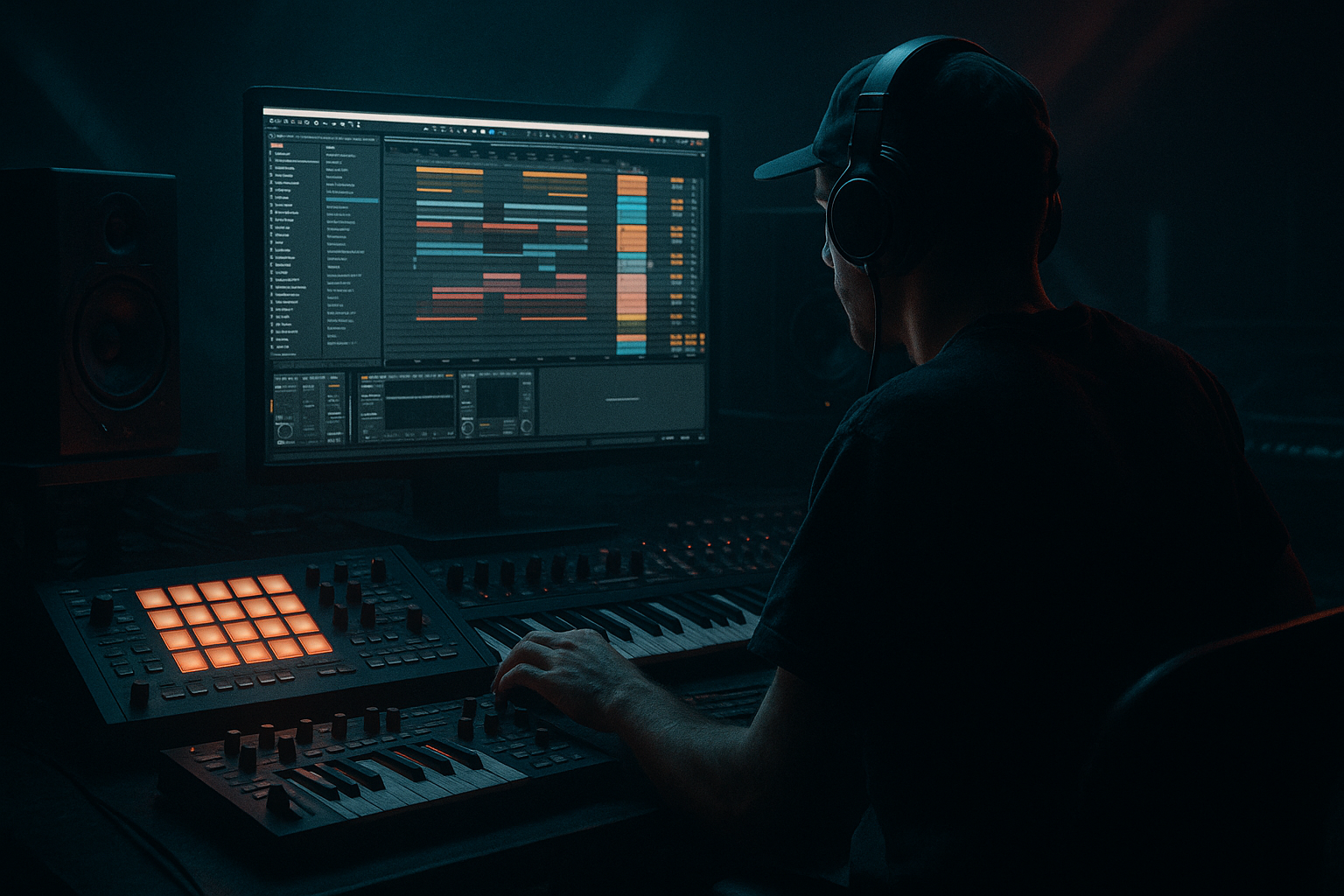
Main tutorial
90s Sampler Tone Emulation (DnB) — From Scratch in Session View (Ableton Live) 🎛️🔥
1. Lesson overview
In this lesson you’ll recreate that 90s sampler vibe—think Akai S950 / S1000, early Emu, crunchy jungle breaks, slightly dull top end, gritty mids, and punchy-but-not-hi-fi transients—using only stock Ableton Live devices and Session View workflows.
We’ll focus on the core behaviors of old samplers:
- Lower sample rates / bandwidth limits
- Aliasing + crunchy transients
- 12-bit-ish quantization / companding feel
- Nonlinear input stage (soft clip / saturation)
- Noise floor + subtle instability
- Resampling culture: printing audio and re-chopping
- Trigger clips in Session View
- Print “hot” through a crunch chain
- Re-import the printed audio
- Re-slice and re-sequence for rolling DnB 🥁
- Purpose: emulate “hot input” into a sampler and soften peaks.
- Settings:
- Purpose: bit depth + sample rate reduction (the heart of the vibe).
- Settings (breaks):
- Settings (bass stabs / reese resample):
- Purpose: shave extreme highs + tame mud.
- Settings:
- Purpose: “printed to hardware” punch.
- Settings:
- Purpose: quick level trim, width control.
- Settings:
- `Amen_90s_12bit_DS3_LP12k_8bars`
- 2-step kick/snare patterns
- Fills and edits
- Re-triggering ghost snares
- Clip Loop Brace
- Duplicate small regions (1/8, 1/16)
- Use Clip Envelope → Transposition for pitchy “sampler” riffs
- Use Clip Envelope → Volume for gated stutters
- Kick: on 1 and “and of 2” (classic stepping feel)
- Snare: on 2 and 4
- Add ghost snares at low velocity around 1.3, 2.3, 3.3 (varies by groove)
- Use Groove Pool → try MPC 16 Swing 54–58
- Apply lightly (20–40%) so it doesn’t go sloppy
- Route your Drum Rack output into 90s PRINT BUS and print a “second generation” pass
- Set 90s PRINT BUS Audio From → BASS SOURCE
- Record 4–8 bars while tweaking filter cutoff slightly
- Simpler (Classic mode) or Sampler (if you have Suite)
- Mode: Classic
- Voices: 1 (mono)
- Glide: 30–80 ms (optional)
- Filter: Low-pass, add a little resonance
- Amp Envelope: short decay for stabs
- A: Clean-ish break
- B: Resampled break (crunch)
- C: Fill / edit clip
- D: Bass stab groove
- E: No-drum intro atmos / noise
- Over-Redux’ing the entire mix: Keep the sampler chain for elements (breaks, stabs), not your master.
- No gain staging into the chain: Old samplers sound best when you hit the input (Saturator first), then reduce with Utility after.
- Low-pass too low: If you cut at 6–8 kHz you might kill the break’s “air” and cymbal timing cues. Try 10–14 kHz first.
- Chopping without groove: Perfect grids can feel dead. Use Groove Pool or manual micro-timing.
- Printing without naming/organizing: Session View gets messy fast—rename clips with settings so you can recreate winners.
- Parallel grime return: Create a Return track with:
- Second-generation resample: Print the printed break again (yes, twice). Keep it subtle—this is where the “brown” happens.
- Midrange control for weight: If your break gets harsh, cut 3–5 kHz slightly on the resampled version and layer a cleaner top loop quietly.
- Mono the low end: On bass prints, use Utility → Width 0% below ~120 Hz (use EQ Eight in M/S or split into bands).
- Pitch tricks: Old jungle often pitched breaks down:
- You built a Session View resampling rig that mimics 90s sampler behavior.
- The key chain was: Saturator → Redux → EQ Eight → Drum Buss → Utility
- You printed breaks and bass into audio, then re-chopped and re-sequenced for authentic jungle/DnB energy.
- The real magic is the workflow: print, commit, rework—that’s the 90s mindset. 🎚️
You’ll end up with a reusable Session View “resample lab” you can drop into any DnB project. 🧪
---
2. What you will build
You’ll build a Session View performance + resampling setup with:
A) “90s Sampler Print Bus” (audio track)
A dedicated audio track that receives audio from your break/bass clips and prints them through a sampler-style chain.
B) Two sound sources (clip-based, very DnB)
1. A breakbeat track (Amen-ish / think tight jungle edits)
2. A bass stab / reese layer (short, resampled, gritty)
C) A workflow that mirrors 90s methods
---
3. Step-by-step walkthrough
Step 0 — Session View prep (fast routing template)
1. Create these tracks:
- AUDIO 1: BREAK SOURCE
- MIDI 1: BASS SOURCE (or audio if you already have stabs)
- AUDIO 2: 90s PRINT BUS
- AUDIO 3: RESAMPLED CLIPS (where you drag printed takes)
2. Set up the Print Bus:
- On AUDIO 2: 90s PRINT BUS, set Audio From to:
- Option A (clean + controlled): Audio From → “BREAK SOURCE” (or “BASS SOURCE”) when printing one at a time
- Option B (full vibe): create a Group/Return later—start simple first.
- Set Monitor to IN
- Arm 90s PRINT BUS for recording
3. Turn on Global Quantization: 1 Bar (top middle in Live).
This makes clip launching tight—very DnB friendly.
---
Step 1 — Get a break playing (and make it launch-ready) 🥁
1. Drop a classic break (Amen, Think, Hot Pants, etc.) into BREAK SOURCE as a clip.
2. In Clip View:
- Warp: ON
- Warp mode: start with Beats
- Preserve: Transients
- Envelope: set to around 30–60 depending on how sharp you want it
(Lower = crunchier/looser; Higher = tighter/cleaner)
3. Set clip launch behavior:
- Launch Mode: Trigger
- Quantization: Global
Now you can loop it while we “samplerize” it.
---
Step 2 — Build the “90s Sampler Tone” device chain (stock only) 🎚️
Put this chain on 90s PRINT BUS (Audio Effects). Order matters.
#### Device Chain (recommended starting point)
1) Saturator
- Drive: +3 to +8 dB
- Soft Clip: ON
- Output: adjust so you’re not redlining master (but don’t be afraid of hot into the chain)
2) Redux
- Bits: 12 (start here)
- Downsample: 2.00 to 4.00
- Filter: ON
- Bits: 10–12
- Downsample: 2.00–6.00 (push harder for nastiness)
3) EQ Eight (bandwidth limiting like older converters)
- High Cut (Low-pass): around 10–14 kHz, 12 dB/oct (adjust to taste)
- Optional: gentle dip at 250–400 Hz if it gets boxy (1–3 dB)
- Optional: tiny presence bump at 2–4 kHz if the break loses bite (0.5–2 dB)
4) Drum Buss (glue + crunch)
- Drive: 5–20%
- Crunch: 5–25%
- Boom: OFF or very low for breaks (Boom can blur rolls)
- Transient: -5 to +10 (depends on how snappy you want it)
5) Utility (gain staging + mono tricks)
- Gain: adjust so recorded prints aren’t clipping too hard
- Optional: Width 80–100% (keep breaks mostly centered for classic DnB drive)
✅ You now have a “sampler print chain.” The sound should feel less hi-fi, slightly grainy, with tighter mid punch.
---
Step 3 — Print the break through the chain (Session View resampling workflow) 🎞️
1. On 90s PRINT BUS, create an empty clip slot and hit Session Record (or record-arm and press record into a clip slot).
2. Launch your break clip. Record 4–16 bars.
3. Stop recording. You now have a printed clip on the Print Bus.
Pro workflow: Rename clips immediately:
Drag that printed clip into RESAMPLED CLIPS.
---
Step 4 — Re-chop like it’s 1994 (fast jungle method) ✂️
There are two great Ableton-native approaches:
#### Option A: Slice to Drum Rack (classic)
1. Right-click the printed break clip → Slice to New MIDI Track
2. Slicing preset:
- Slice by: Transients
- Create one slice per: Transient
- Slicing preset: Built-in → None (you’ll process after)
Now you have a Drum Rack with pads mapped to slices. This is perfect for:
#### Option B: Warp + clip envelopes (super quick)
Stay audio-based and do jungle edits with:
---
Step 5 — Build a rolling DnB drum loop in Session View 🏎️
1. Create a MIDI clip driving the sliced Drum Rack (if you used slicing).
2. Start with a minimal roller:
3. Add swing:
4. Print again (optional but very authentic):
This is how you get that deeply familiar jungle dirt—generation loss by design.
---
Step 6 — 90s-style bass stab/resample in Session View 🐍
You can do this from scratch with stock instruments and the same Print Bus.
#### Make a quick stab/reese source
1. On MIDI 1: BASS SOURCE, load Operator:
- Algorithm: two oscillators summed
- Osc A: Saw
- Osc B: Saw (detune slightly)
- Detune: small (Operator “Coarse/Fine” or use Unison if available via Wavetable—Operator is fine)
2. Add Auto Filter on the bass track:
- Mode: Low-pass 24
- Cutoff: 200–800 Hz (move it while resampling)
- Drive: small (if available)
3. Create a 1-bar MIDI clip with a classic DnB note:
- Try F or G (common for weight), short stabs on offbeats
#### Print the bass through the 90s chain
Then drag the printed bass into:
##### In Simpler (for the 90s “one-shot” vibe)
Now you can play the resampled bass like a hardware hit.
---
Step 7 — Arrangement ideas from Session View to Arrangement View 🎬
Once you have 4–8 solid clips:
Record a performance:
1. Hit Arrangement Record
2. Launch clips like a DJ:
- 16 bars intro (filtered break)
- 16 bars drop (full resampled break + bass)
- Every 8 bars: trigger a fill clip
3. After recording, tighten transitions with:
- Reverb throws (Return track with Reverb)
- Tape-stop-ish moments (use Frequency Shifter + automation or short pitch drops)
---
4. Common mistakes
---
5. Pro tips for darker/heavier DnB 🌑
- Saturator (Drive 8–12) → Redux (Bits 10–12, Downsample 3–6) → EQ Eight (LP 10–12k)
Send snares/amen tops into it lightly (5–20%). Adds “shadow” without losing punch.
- Transpose break -2 to -5 semitones, then tighten with Warp (Beats mode). Instant darker tone.
---
6. Mini practice exercise (20–30 minutes) ⏱️
1. Pick one break and create three printed versions:
- A: Bits 12 / Downsample 2 / LP 14k
- B: Bits 12 / Downsample 4 / LP 12k
- C: Bits 10 / Downsample 4–6 / LP 10k (gnarly)
2. Slice each to Drum Rack.
3. Make one 8-bar roller using version A for main hits and version C only for ghost notes/fills.
4. Print the final drum loop again through the Print Bus at lighter settings (Downsample 2, Bits 12).
5. Export that loop and save the rack + print chain as presets.
Goal: You should hear depth and grit without losing the drive of the groove.
---
7. Recap ✅
If you tell me what style you’re aiming for (early jungle, techstep, modern rollers with 90s tone, etc.), I can suggest specific break choices, clip launch scenes, and a tighter “drop” scene layout in Session View.

