Main tutorial
1. Lesson Overview
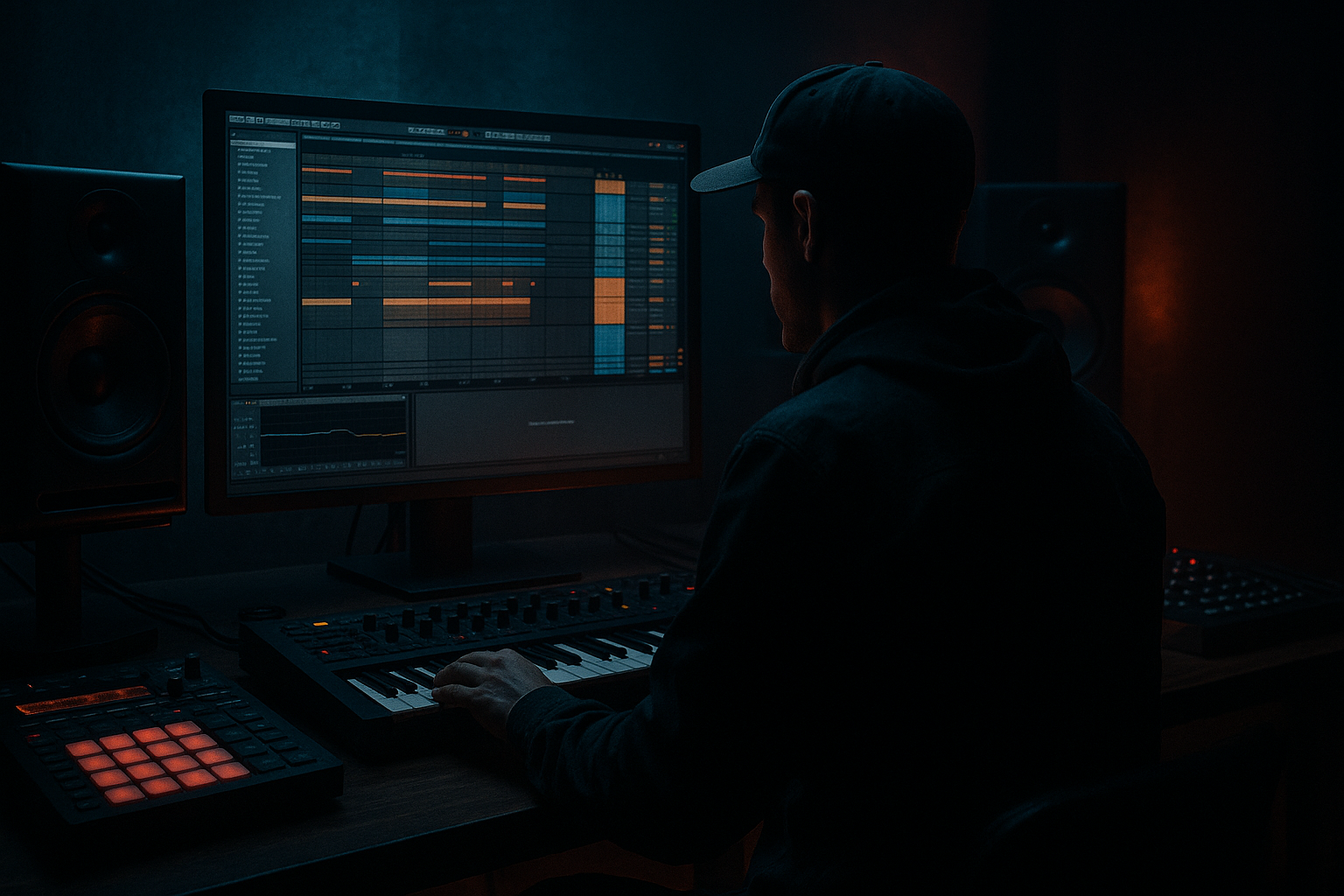
This lesson teaches you how to make "A Little Sound oldskool DnB jungle arp in Ableton Live 12 using Session View to Arrangement View". It’s an intermediate Arrangement exercise: you’ll design a classic chopped, rolling jungle-style arp using only Ableton stock devices (Wavetable, Arpeggiator, Note Length, Velocity, Filter, Saturator, etc.), create multiple Session clips and variations, perform/automate them in Session View, then record that performance into Arrangement View and tidy it up into a usable section of a Drum & Bass arrangement at ~170 BPM.
2. What You Will Build
- A short, repeatable oldskool DnB/jungle arp patch (Wavetable) with rhythmic movement (Arpeggiator + Note Length + LFO-filter movement).
- Several Session clip variations (full arp, filtered arp, pitched arp, chopped arp).
- A live Session-to-Arrangement performance: launch scenes, tweak mapped macros and effects, and record the performance into Arrangement View for use in a track.
- Set Live’s BPM to 170 (typical for oldskool DnB/jungle).
- Create a new Live Set. Create a MIDI track and name it “Jungle Arp”.
- Load a Wavetable instrument (Ableton stock).
- Recording without global quantize or wrong clip quantization: launches can be late/early. Set Clip Launch Quantization to 1 Bar for scene-based recording.
- Not mapping macros: trying to automate device parameters directly during performance is clumsy — map to Macros to capture tidy automation.
- Too much low end in the arp: failing to high-pass or EQ sub-bass out will clash with bassline. Use EQ Eight to cut below ~80 Hz.
- Overusing saturation/Redux: too much lo-fi can blur the arp. Use subtle settings and automate increases only at transitions.
- Forgetting Retrig in Arpeggiator: if envelopes don’t retrig when you expect, turn on Retrig so the envelope restarts each note.
- Recording into Arrangement but not arming automation recording: ensure the Arrangement Record button is active when performing macros, otherwise only clip content is recorded.
- Use tiny pitch variations: place an instance of “Pitch” MIDI effect set to +0.5 or -0.5 semitones with low chance in a chain to emulate detuned old hardware.
- Create a second track with the same arp patch but different processing (heavy bitcrush + gated tremolo) and alternate between them in Session; this gives arrangement contrast when you record to Arrangement.
- For rapid “jungle” chop feel, automate Note Length in clip envelopes to go from long to very short over a couple bars.
- Use a Return track with Redux and heavy delay and send the arp briefly for a “ragga” or “skank” moment — automate the send in Arrangement for dramatic effect.
- Bounce CPU-heavy Wavetable to audio after you’re happy, then edit audio with transient chopping and manual stutters to get authentic jungle stabs.
- Use the Follow Actions to make an unattended background arp evolve during arrangement playback, then record a live performance of only the macro changes to capture human feeling.
- Tempo: 170 BPM.
- Build: In Session, create 4 clips for the Jungle Arp track: Base (1 bar), Filtered (1 bar), Pitched (1 bar up a 5th), Chopped (1 bar short notes). Put them into a Scene and set Clip Launch Quantize to 1 Bar.
- Map Cutoff to Macro 1, Arp Rate to Macro 2.
- Arm Arrangement Record, launch the Scene and perform: start with Base (2 bars), move to Filtered (2 bars with cutoff down), then introduce Pitched for 1 bar while increasing Saturator via Macro, then finish with Chopped into the drop. Stop recording.
- Edit the recorded clip in Arrangement to make a tight 8-bar section; add sidechain compression and a subtle delay send on the last bar to lead into the drop.
- Design a punchy Wavetable arp and make it rhythmic with Arpeggiator + Note Length + Velocity.
- Build multiple clip variations in Session View and map macros for expressive control.
- Record your Session performance into Arrangement (enable Arrangement Record) so your macro moves and clip launches become automation lanes you can refine.
- Use EQ, Saturator, delays, and subtle Redux for that oldskool jungle character, and apply sidechain so the arp sits with the drums and bass.
3. Step-by-Step Walkthrough
Preparation
Design the arp sound (Wavetable)
1. Oscillators:
- Osc 1: choose a saw wave (Use a bright wavetable position). Set Unison to 3–6 voices and slightly detune (0.10–0.25). This gives the thick, vintage stab sound.
- Osc 2: set to a square or a sub sine (lower octave) and mix low, just to give body.
2. Filter and envelope:
- Use the main filter (MG Low or State-Variable) set to Low Pass; cutoff around 1–2 o’clock (listen and adjust).
- Increase Filter Envelope amount moderately so the filter opens on each note (Env amount ~5–8).
- Set Envelope Attack fast (0–10 ms), Decay medium-short (300–600 ms), Sustain low to medium, Release short.
3. Add movement:
- Set LFO 1 to modulate Filter Cutoff gently with a synced Rate of 1/8 or 1/4 and low depth — this breathes the arp.
- Turn on Portamento/Glide (mono mode not required if using arpeggiator in poly) or add a tiny glide if you want slewing between notes.
MIDI effect chain (make it rhythmic and jungle)
4. Create a MIDI Effect Rack above Wavetable:
- Insert “Arpeggiator” first. Settings:
- Rate: 1/16 (enable Triplet if you want swung jungle flavor, or keep straight for rolling DnB).
- Style: Up (or Up/Down for variation).
- Gate: ~65–80% (shorter for choppy stabs).
- Octave Range: 1–2 (try 2 for classic oldskool jumps).
- Retrig: on (so envelopes retrigger).
- Add “Note Length” after Arpeggiator: set to shorten notes to ~50–70% for percussive pluck feel.
- Add “Velocity” MIDI effect: set Range and Random to introduce dynamic variation; also use Drive to raise velocities for saturation later.
- Optional: Add “Random” with small Amount or “Pitch” with small shift to get slight key variation on some clips.
Add basic effects (audio)
5. On the Jungle Arp track, after Wavetable chain:
- EQ Eight: roll off sub under ~80 Hz so the arp doesn’t clash with bass.
- Saturator: Soft Clip, Drive ~3–5 dB for grit.
- Auto Filter (or Filter Delay): map cutoff to a Macro for live filtering.
- Ping Pong Delay (mix low ~8–15%) with sync to 1/8 or 1/16 dotted/triplet for space.
- Redux (bit-reduction) lightly for lo-fi jungle texture — keep subtle.
Prepare Session clips
6. Create your base MIDI clip:
- In Session slot, create a 1-bar MIDI clip (or 2-bar) and input a short two- or three-note chord/interval (e.g., root + fifth + octave) that the Arpeggiator will turn into a rolling pattern. For jungle arp, a simple 2-note pattern with octaves works well.
- Set Clip Launch Quantization to 1 Bar (in the lower left or global quantize).
- Duplicate this clip into 4–6 slots in the same track to create variations.
7. Make variations:
- Clip A: Base arp (no extra processing).
- Clip B: Filtered arp — use clip automation or map Macro 1 (filter cutoff) and set Macro low for this clip. Alternatively, open the clip’s Envelope view and draw an automated filter cutoff if the device macro is mapped to a device parameter.
- Clip C: Pitched arp — transpose the MIDI notes up 5–7 semitones or transpose the track up in the Clip Transpose box.
- Clip D: Chopped arp — reduce Note Length to very short, or use clip-level repeat (legato notes on grid) to create staccato.
- Clip E: Dropout/half speed — set clip to half rate (play 1/2 speed) or change Arpeggiator rate to 1/8 for a breathing moment.
8. Use Follow Actions (advanced, useful for Arrangement performance):
- For a clip you want cycling automatically, set Follow Action to “Next” after 2 or 4 bars, and set Probability to 100%. This makes a Session scene evolve without manual triggering. Make one clip with Follow Actions that cycles through two variations to create unpredictability.
Map macros for performance
9. Macro assignments:
- Map Wavetable Filter Cutoff to Macro 1.
- Map Saturator Drive to Macro 2.
- Map Arpeggiator Rate (or Gate) to Macro 3 for instant rhythmic changes.
- Optionally map LFO amount to Macro 4.
- Name macros (Cutoff, Drive, Rate, LFO) and color them so you can perform them in Session.
Perform in Session and record into Arrangement
10. Create a Scene in Session View for your arp section: place your Jungle Arp clips across one Scene row (or launch the clips individually).
11. Start the main Arrangement record:
- Option A (recommended for full control): press Arrangement Record (top transport) then start launching Scene/Clips. Your clip launches and any automated parameter movements you make on mapped macros will be recorded into Arrangement as automation.
- Option B (Clip to Arrangement): you can also press the Session Record button to capture into the Clip Recorder, but Arrangement Record is simpler for recording macros into Arrangement View.
12. Performance tips during recording:
- Launch a base clip, then after a couple bars bring in filtered variation (lower Macro 1).
- Use Macro 3 to switch Arp rate briefly (e.g., triplet feel for 2 bars).
- Bring Saturator macro in for a build to add grit on the drop.
- Stop recording when you’ve captured the full section (8–32 bars depending on the arrangement you want).
13. Edit in Arrangement:
- Go to Arrangement View and locate your recorded arp lanes.
- Consolidate (Cmd/Ctrl-J) and trim clips into arrangement sections (intro, build, drop).
- Tidy automation lanes: smooth breakpoints, extend automation where needed.
- Split and duplicate for structure: copy the 8-bar arp phrase to create a 16-bar loop and add variation by disabling or duplicating clips with different macro states.
Mix considerations (quick)
14. Sidechain: add Compressor after Saturator, enable sidechain to a Kick or a dedicated sidechain bus; set ratio ~4:1 and quick attack/release so the arp pumps subtly on kicks.
15. Sends: send some to Return tracks — a longer reverb send (low mix) and a timed delay send — to keep main arp tight and give depth on send.
4. Common Mistakes
5. Pro Tips
6. Mini Practice Exercise
Goal: Create an 8-bar arp phrase that evolves into a drop
7. Recap
You just completed a focused, intermediate Arrangement lesson on "A Little Sound oldskool DnB jungle arp in Ableton Live 12 using Session View to Arrangement View". Key points:
Now try the Mini Practice Exercise and then expand it into a full intro-to-drop section by duplicating, automating sends, and adding drum fills in Arrangement.

