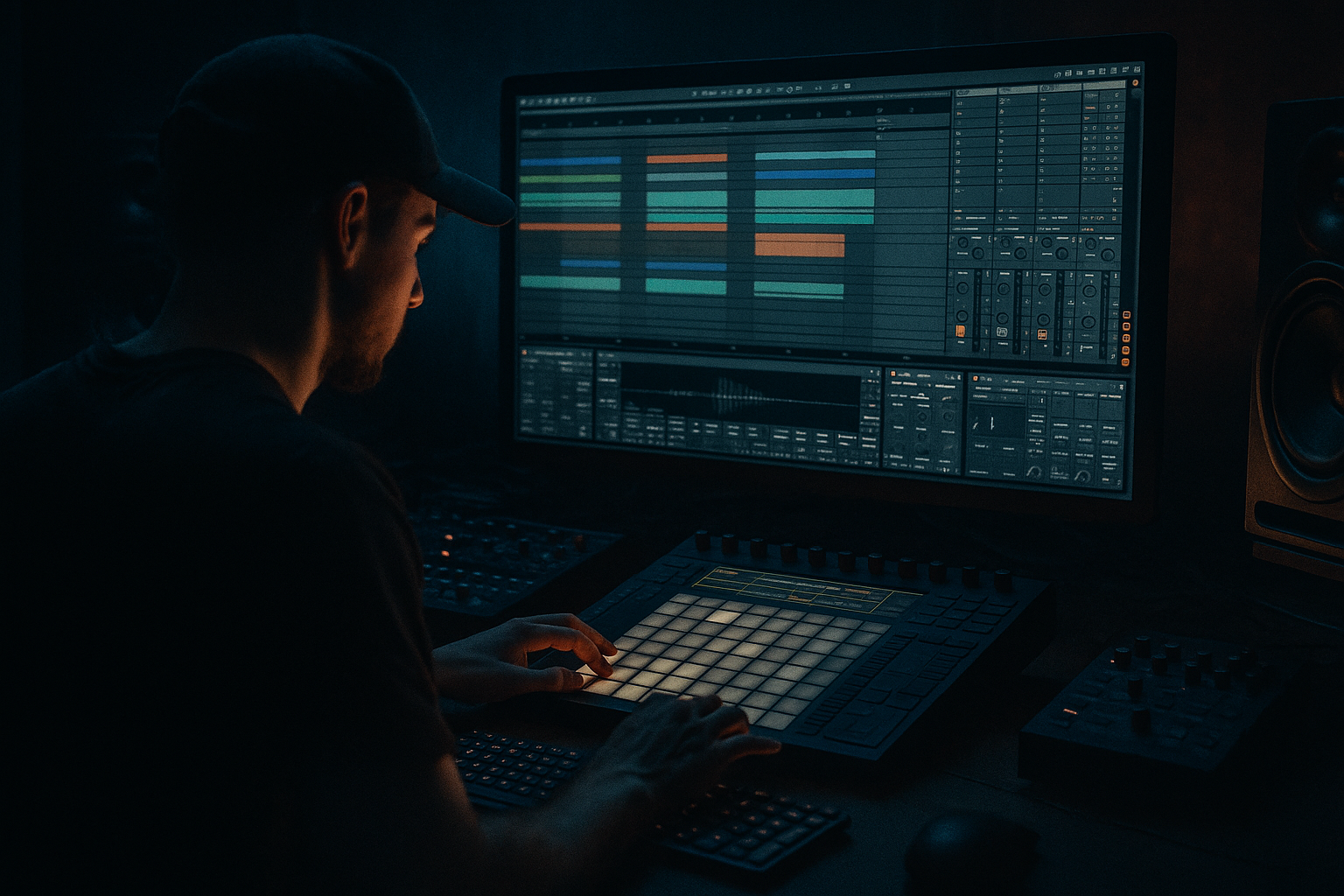
Main tutorial
```markdown
Accent Logic for Convincing Break Edits (DnB in Ableton Live) 🥁⚡
1) Lesson overview
In drum & bass, the edit isn’t just chopping a break—it’s recreating the drummer’s accent logic so the groove feels alive. Beginners often slice breaks perfectly on the grid… and it still sounds flat. Why? Because accents (velocity + tone + timing) are the “human” parts that make breaks roll.
In this lesson you’ll learn a simple, repeatable system to:
- identify where accents belong in a DnB/jungle break,
- program ghost notes vs. hits,
- use Ableton stock devices to make accents sound different (not just louder),
- build a convincing 16-bar rolling break edit.
- A 2-bar edited break loop with believable accent patterns
- A Drum Rack-based workflow so each slice has its own processing
- A 16-bar arrangement with variation and fills (classic DnB phrasing)
- A darker/heavier version using saturation + transient control
- Anchors: strong hits that define the groove (often kick/snare)
- Leading accents: hits that point into the snare (energy + forward motion)
- Ghost notes: very quiet hits that add movement (especially ghost snares)
- Kick-ish hit: beat 1
- Snare-ish hit: beat 2
- Kick-ish hit: beat 3
- Snare-ish hit: beat 4
- Tier A (Anchors): Velocity 105–127
- Tier B (Support accents): Velocity 80–105
- Tier C (Ghost notes): Velocity 25–60
- Push some hats/shuffles slightly late: +5 to +12 ms
- Keep main snare pretty tight (or slightly late for weight): +0 to +6 ms
- Keep kick fairly tight: 0 to +4 ms
- Bars 1–4: main loop (stable)
- Bars 5–8: add a few extra ghost notes or hat accents
- Bars 9–12: add a small “turnaround” edit (tiny stutter or extra snare pickup)
- Bars 13–16: bigger variation/fill into the next section
- Last 1/2 bar: snare double (two hits with velocities 90 then 120)
- Last 1 bar: roll using 1/16 slices but with tiered velocities (don’t machine-gun at 127)
- Tiny reverse: duplicate a snare slice, reverse it, fade in, place before the snare
- Beat Repeat (super DnB if subtle)
- Convincing break edits come from accent logic: anchors + support accents + ghosts.
- Use velocity tiers so the pattern has shape.
- Make accents realistic by tying velocity to tone (Simpler filter) and response (Velocity device).
- Add subtle micro-timing (Groove Pool or tiny manual nudges).
- Arrange over 16 bars with small, intentional variations—DnB is all about evolving loops.
---
2) What you will build
By the end you’ll have:
---
3) Step-by-step walkthrough
Step 0 — Project setup (so everything behaves like DnB)
1. Set tempo to 172–176 BPM (start at 174).
2. Create an Audio Track and drag in a break (Amen, Think, Hot Pants, any classic).
3. Warp settings:
- Click the clip → Warp: ON
- Mode: Beats
- Preserve: Transients
- Set Transient Loop Mode to Forward (default) for clean chops
✅ Goal: transients stay punchy when sliced.
---
Step 1 — Slice the break to a Drum Rack (best workflow for accents)
1. Right-click the audio clip → Slice to New MIDI Track
2. Settings:
- Slicing preset: Built-In → Slice to Drum Rack
- Slice by: Transients (usually best)
- If it over-slices, undo and try 1/16 for a cleaner beginner start.
Now you have a MIDI track with a Drum Rack full of slices.
Why this matters: Each slice can have its own velocity response, filter, saturation, envelope, etc.—perfect for accent logic.
---
Step 2 — Understand “accent logic” (the DnB rule-of-thumb)
In rolling DnB/jungle, your break usually has:
A beginner-friendly 2-step skeleton (one bar) is:
But the break feel comes from what happens between those anchors: low-velocity ghosts and occasional accented pickups.
---
Step 3 — Program a 2-bar break edit using velocity tiers 🎚️
1. Make a 2-bar MIDI clip on the sliced track.
2. In MIDI editor, enter hits roughly matching the original break (or just build around a 2-step).
Now apply velocity tiers (this is the core accent logic):
- Main snare hits, main kick hits
- Hats, shuffles, extra snares that “answer” the groove
- Ghost snares, tiny hat taps, quiet funk
Practical move:
Select all notes → set to ~85.
Then manually push anchors to 115–125 and pull ghosts down to 35–50.
✅ You should see clear tall spikes (anchors), medium notes (groove), and tiny notes (ghosts).
---
Step 4 — Make accents sound different, not just louder (stock devices)
Velocity alone is only half the story. Real drummers change tone when they hit harder. Let’s mimic that.
#### Option A: Use Drum Rack “Velocity” device per slice (best control)
1. In Drum Rack, click a snare slice pad.
2. Add MIDI Effects → Velocity before the Simpler on that chain.
3. Settings to try:
- Mode: Random OFF (for now)
- Drive: +10 to +25 (makes louder hits push harder)
- Out Hi: 127
- Out Low: ~10–20
Now your playing/programming maps more dynamically into the sample.
#### Option B: Use filter movement on accents (tone shift = realism)
1. On the same slice chain, open Simpler (Slice mode uses Simpler per pad).
2. Turn on Filter:
- Type: LP24
- Frequency: 6–12 kHz (start around 9 kHz)
- Resonance: low (0.20–0.40)
3. Map Velocity → Filter Freq (in Simpler):
- Increase the velocity modulation so harder hits are brighter.
This is huge for believable breaks: louder = brighter.
---
Step 5 — Add micro-timing swing (don’t quantize everything)
DnB breaks often feel “ahead/behind” in tiny amounts.
Two safe beginner ways:
#### Way 1: Groove Pool (quick + musical)
1. Open Groove Pool.
2. Drag in a groove like:
- Swing 16-65 (subtle)
- or MPC 16 Swing variants
3. Apply groove to the MIDI clip:
- Timing: 10–25%
- Velocity: 0–10% (careful—your accent tiers matter)
- Random: 0–5%
#### Way 2: Manual nudges (surgical, very DnB)
✅ Goal: “roll” without sounding messy.
---
Step 6 — Glue the edit so it feels like one drummer
Now that slices have different dynamics, glue them with light bus processing.
On the Drum Rack (or group the track) add:
1. Drum Buss
- Drive: 3–8
- Crunch: 0–20% (go easy)
- Boom: 0–10% (often OFF for breaks—depends)
- Transients: +5 to +20 if you want more snap
2. Glue Compressor
- Attack: 3 ms
- Release: Auto
- Ratio: 2:1
- Aim for 1–3 dB gain reduction
Optional:
3. EQ Eight
- High-pass around 30–50 Hz (remove rumble)
- Dip harshness around 3–6 kHz if it bites
---
Step 7 — Arrangement ideas (make it feel like DnB, not a loop) 🧩
Create a 16-bar phrase (classic for drops):
Easy DnB fill ideas:
Stock tools:
- Interval: 1 Bar
- Grid: 1/16
- Chance: 5–15%
- Gate: 40–70%
Use it on a return track or automate on fills only.
---
4) Common mistakes
1. Everything at the same velocity → instantly robotic.
2. Ghost notes too loud → groove turns into clutter. Keep ghosts felt, not heard.
3. Over-quantizing → breaks lose their “push/pull.”
4. No tonal change with accents → sounds like volume automation, not performance.
5. Over-slicing → too many tiny slices = unstable groove (and phasey tails).
6. Too much bus distortion early → you flatten the dynamic accent work you just did.
---
5) Pro tips for darker/heavier DnB 🖤🔩
1. Parallel smash for attitude
- Create a Return track with Drum Buss + Saturator + Compressor
- Saturator: Analog Clip, Drive 6–12
- Compressor: fast-ish (Attack 1–3 ms), GR 5–10 dB
- Send break lightly (-20 to -10 dB send)
Keeps accents while adding density.
2. Accent the “lead-in” to snare for menace
- Add a slightly louder pre-snare hit (Tier B) on the 1/16 before beat 2 and/or 4
- Then keep the actual snare as Tier A
That “pull” into the snare feels aggressive and rolling.
3. Control harshness without killing energy
- Use EQ Eight dynamic style manually: automate a small dip around 4–7 kHz only in loud sections, or
- Use Auto Filter low-pass a touch on the whole break during dense drops.
4. Transient shaping for modern punch
- Drum Buss Transients +10 to +25
- If it gets clicky, pull back and add a tiny high shelf cut around 10–12 kHz.
---
6) Mini practice exercise (10 minutes) ⏱️
1. Slice a break to Drum Rack.
2. Build a 1-bar loop with:
- 2 anchor snares (beats 2 and 4)
- 2 kick-ish hits (beats 1 and 3)
- 4–8 ghost notes scattered (quiet)
3. Assign velocities:
- Anchors: 120
- Support: 95
- Ghosts: 40
4. Add in Simpler:
- Filter ON (LP24)
- Set velocity → filter frequency so loud hits are brighter
5. Apply Groove:
- Timing 15%, Random 3%
6. Duplicate to 16 bars and add one fill in bar 16.
Checkpoint: If you mute the bass and it still feels like DnB, you’re winning.
---
7) Recap
If you want, tell me which break you’re using (Amen/Think/etc.) and your subgenre (liquid, rollers, jump-up, jungle), and I’ll suggest a specific accent map for that break.
```

