Main tutorial
Lesson Overview
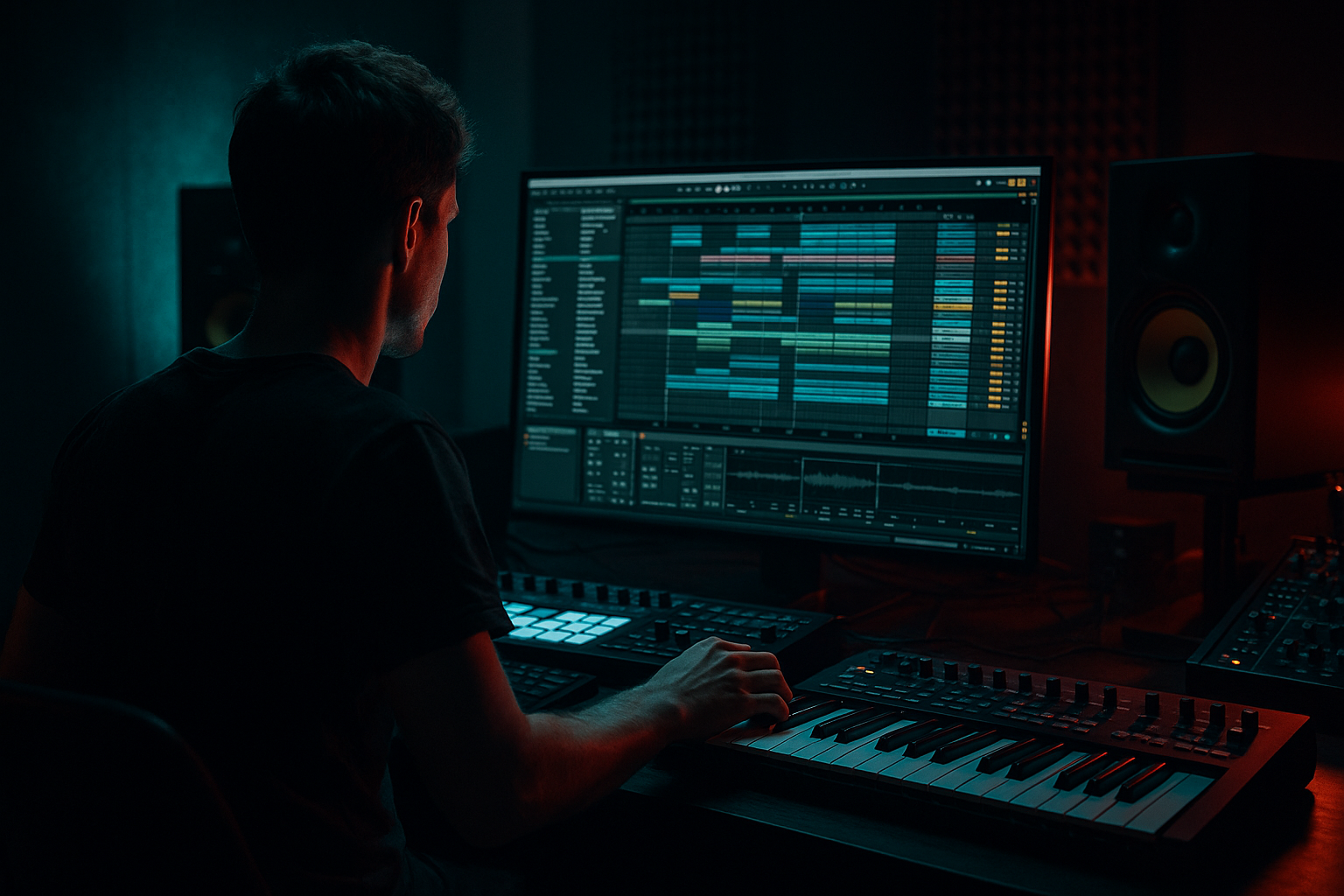
This advanced lesson teaches advanced kick snare midi patterns and setup in Ableton Live 12 for Drum & Bass. You’ll learn how to build tightly integrated kick/snare instruments in Drum Rack (layering, velocity zones, chain selector), create expressive MIDI patterns (ghost notes, rolls, micro‑timing), and set up signal routing and stock-device processing so your kicks and snares cut through a DnB mix at 170–180 BPM. Everything uses Ableton Live 12 stock devices and MIDI tools with concrete clip and device settings you can apply immediately.
What You Will Build
- A Drum Rack pad setup for kick and snare with layered samples and velocity‑zone swapping.
- MIDI racks that generate advanced DnB kick/snare patterns: syncopated kicks, snappy mains snares, dynamic ghost hits, and programmable snare rolls using MIDI effects.
- Routing and stock-device processing chains (EQ Eight, Drum Buss, Saturator, Glue) for clarity and punch, plus parallel returns for transient shaping and short ambience.
- Insert a MIDI track > Instruments > Drum Rack.
- Drag one kick sample into a pad (preferably a short, punchy transient sample) and one snare sample into another pad (tight top + tail sample). We’ll layer them later.
- Open the Chain List (click the little button at top left of Drum Rack).
- For the Kick pad: duplicate the pad (right‑click > Duplicate Pad) to create two kick chains (Kick_A transient, Kick_B sub/body).
- For the Snare pad: create three chains:
- How this works: different velocity ranges trigger different chains so one MIDI note velocity triggers one or multiple layers depending on overlap. Use small overlap (e.g., 60–80) so loud hits stack both top+low layers.
- Use Simpler or Sampler in each chain. For Kick_B (sub), in Simpler set Loop Off, filter lowpass ~100–200 Hz to remove click, and adjust Release to 120–200 ms for body sustain.
- For Snare_Top, shorten the decay (Release 70–140 ms), increase Attack a few ms if you want smoother transient.
- Map velocity to volume within Simpler: Simpler has a Velocity → Volume knob (normally active), so maintain dynamic response.
- Insert MIDI Effects before Drum Rack:
- Create a MIDI clip (double-click the clip slot). Use grid 1/16 and switch to 1/32 for quick hits/ghosts.
- Kick placement ideas:
- Snare patterns:
- Use Velocity editing in the clip (select notes and drag the small velocity bars) so main snare is 100–127, ghost snare 10–40, and supporting snare/body 50–80.
- Place an Arpeggiator MIDI effect before Drum Rack.
- Program the snare roll note in a separate clip on the snare lane. Settings to try:
- Automate the Arp’s Rate or turn Arp on/off via device on/off mapping to a clip/automation lane to trigger rolls only on certain bars.
- To humanize kick/snare feel use the Groove Pool (bottom left).
- Example: apply a groove with Timing +20 to snares and Timing -5 to kicks to create a slightly laid‑back backbeat.
- Kick chain (in Drum Rack chain output) — insert:
- Snare chain:
- Group routing:
- If kick and snare clash, put a Utility on the sub chain and use a fast compressor sidechained to the kick (or vice versa) but in DnB typically keep the snare independent—use EQ to carve space (e.g., scoop 100–150 Hz from snare, boost kick at 60–80 Hz).
- Use FFT spectrum (Spectrum device) to monitor energy collisions between kick and snare.
- Create multiple MIDI clips with varied kick/snare patterns and assign them to scenes for easy switching during arrangement or performance.
- Use a MIDI Effect Rack with chain selector macros to switch between different pattern generators or velocity maps on the fly.
- Over‑layering subs that phase cancel: avoid pitching or slightly detune sub layers; use spectrum analysis and phase invert if necessary.
- Too much randomness on kick pitch: even tiny pitch variation ruins sub stability—keep pitch randomness for snares only.
- Making ghost snares too loud: ghost hits must sit below the main snare; keep velocities 10–40 and high‑passed to remove low energy.
- Using long reverbs on kicks: avoid long tails on kicks; kicks need tight decay, use short reverb only if tightly gated.
- Overcompressing the group: glue compression is good, but too much kills punch—start light and increase only if needed.
- Use overlapping velocity ranges intentionally: let main snare and low body overlap slightly so loud hits become layered automatically.
- Use Drum Rack chain’s “Pitch” macro (map Simpler transpose to a macro) to create pitch shifts for fills—automate quickly during rolls.
- For snare rolls that build energy, automate Simpler’s filter cutoff or Resonator’s decay across the roll to increase brightness/tail.
- Commit rarely: duplicate your Drum Rack pad and commit processing when you like a specific sound—keep the original for later edits.
- Save a Kick/Snare Rack preset with your favorite chain layouts and modulations for future sessions.
- Set BPM to 174. Build the following in one 4‑bar loop:
- Export the 4-bar loop and compare it to a commercial DnB loop to evaluate punch and presence.
Step-by-Step Walkthrough
Note: set BPM to 174–176 (common DnB range). Keep the grid at 1/16 for placement and enable triplet/1/32 when needed.
1) Create the Drum Rack and initial pads
2) Layering with Drum Rack chains and velocity zones
- Select Kick_A chain: in the Chain zone, set Velocity range to 1–90.
- Select Kick_B chain: set Velocity range to 91–127.
- Load a subby, longer kick sample into Kick_B (or a Simpler set to Classic mode with looped body).
- Snare_Top (tight transient, Vel 70–127)
- Snare_Low (body/room, Vel 40–127)
- Snare_Ghost (softer crack or clap for ghost hits, Vel 1–69)
3) Fine-tune Sampler/Simpler envelopes (stock devices)
4) Create MIDI-effect racks to control layering from a single velocity input
- Velocity (MIDI Effects > Velocity): set Out Hi/Lo to shift note velocities to ensure ghost hits trigger correctly. Example: for ghost‑note patterns, create a Macro to offset velocity by -30 to force chain switching for particular patterns.
- Note Length: occasionally shorten MIDI note length for sharper transients (useful for tight kicks).
- Random: set Chance to 0–10% and Vari to 1–3 semitones only if you want subtle pitch variation for humanization—keep low for kick/sub stability.
5) Program advanced MIDI patterns (clip programming)
- Basic DnB skeleton: Kick on 1.1.000 and a syncopated kick at bar 1.2.3 (meaning second 16th’s offbeat—visually place the second kick on the 3rd 16th in the bar).
- Advanced: use a 16th/32nd subdivision: 1.1, 1.2.3 (slightly before the 2), and a late kick on 1.3.4 to create forward motion. Use low‑velocity secondary kicks to keep groove but not overpower.
- Main snares on 1.2.000 and 1.4.000 (classic DnB backbeat).
- Add ghost snares: place 16th or 32nd ghost hits immediately before a main snare (e.g., 1.1.4 or 1.2.3) with very low velocities (10–35). These give bounce.
- Micro‑rolls: for fills, place a cluster of snare notes at 1/64 or 1/128 with ascending velocities or humanized velocities to taste.
6) Use MIDI Arpeggiator for programmable snare fills/rolls
- Rate: 1/64 or 1/32
- Gate: 30–60% (short for dense rolls)
- Steps: 1
- Style: Up or Random for variation
7) Grooves and micro‑timing
- Extract groove from a break (File > Extract Groove from an audio loop) or use built‑in grooves (MPC swing, or a quarter/16th swing).
- Drag a groove to your kick clip and a different groove (or the same with different Timing/Quantize set) to your snare clip to create natural push/pull between them.
- For tiny manual adjustments: nudge the snare clip notes by 10–25 ms late (or use Groove Timing set to negative for kick and positive for snare) to create late snare feel common in DnB.
8) Processing chains (stock devices)
- EQ Eight: highpass everything below 20 Hz, slight dip around 200–300 Hz if muddy.
- Drum Buss: Drive 4–6, Boom 0–10% for sub warmth, Transients +2 to keep punch.
- Compressor (Glue or Compressor): fast attack (2–5 ms), release synced to 1/16, ratio 3:1 to glue transient without killing attack.
- Optional Saturator: soft clip on medium drive for bite (apply to transient chain only).
- EQ Eight: highpass around 60–80 Hz (remove rumble), boost 200–400 Hz if you need body, 2–5 kHz presence for crack.
- Transient Shaper (or use Drum Buss Transients): increase attack 10–20% for snap; reduce sustain a bit for tightness.
- Short, bright reverb on a return track (send ~10–20% to create space). Subtle pre-delay 10–20 ms, decay 200–300 ms.
- Create a Drum Group that receives both Kick and Snare (route both Drum Rack pad outputs to group tracks or just use the Drum Rack’s two chains routed to their own audio tracks: right‑click pad > Extract Chains). Insert a dry Drum Buss on the group for glue, and route parallel processing via Send for transient shaping.
9) Sidechain and headroom (kick-snare interaction)
10) Variation and performance
Common Mistakes
Pro Tips
Mini Practice Exercise
1) Kick on 1.1.000 and a syncopated low‑velocity kick at 1.2.3; another low kick at 1.3.4.
2) Snare on 1.2.000 and 1.4.000. Add a 1/32 ghost snare right before each main snare (one 1/32 note ahead), velocity 18–28.
3) Program a 1/64 snare roll on bar 4 beat 4 using the Arpeggiator (Rate 1/64, Gate 45%). Automate the Arp’s Rate to slow to 1/32 at the end of the roll.
4) Map velocity zones so ghost snares trigger Snare_Ghost chain only and main snare triggers Snare_Top+Snare_Low stacks.
5) Process: add Drum Buss to snare chain (Drive 3), EQ Eight to carve 120 Hz out, and short reverb return (decay 220 ms) at 12% send.
Recap
This lesson covered advanced kick snare midi patterns and setup in Ableton Live 12: layered Drum Rack chains with velocity zones, MIDI effects (Velocity, Note Length, Arpeggiator) to create ghost hits and rolls, micro‑timing using Groove Pool and nudges, and stock-device processing chains (EQ Eight, Drum Buss, Saturator, Glue/Compressor) to sculpt punch and space. Use the velocity/chain techniques and the MIDI pattern strategies in the Mini Practice Exercise to lock your kick and snare into a professional Drum & Bass context.

