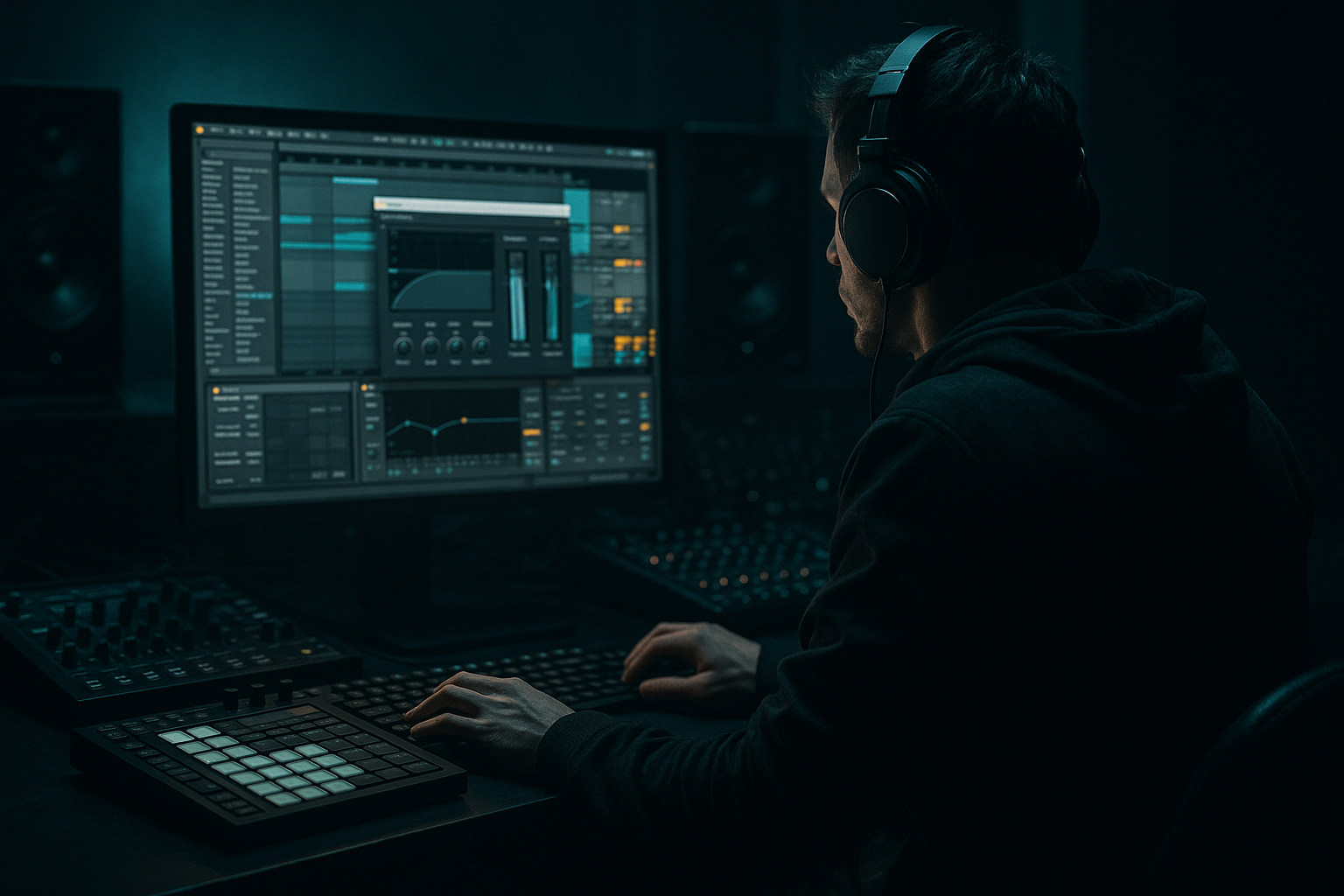
Main tutorial
Advanced Limiter Setup for Drum & Bass Demo Masters (Ableton Live)
Teacher tone: energetic, clear, professional — ready to level up your demo masters. 🎧⚡️
This is an advanced, practical Ableton Live tutorial focused on finishing demo masters for Drum & Bass / Jungle / rolling bass music. You’ll get concrete device chains, settings, workflows, automation suggestions, and arrangement tips specific to DnB energy and bass behavior.
---
1. Lesson overview
Goal: Create a reliable, loud-yet-dynamic demo master in Ableton Live using stock devices, with a limiter strategy that preserves low-end impact, transient snap for breakbeats, and stereo width while keeping true-peaks safe for streaming/demo delivery.
Outcomes:
- A two-stage limiting workflow that’s transparent but punchy.
- Master chain recipes using Utility, EQ Eight, Multiband Dynamics, Saturator, Glue Compressor, and Limiter.
- Concrete settings and automation patterns for drops and breakdowns.
- LUFS / True Peak targets and export considerations for demo submissions.
- Demo integrated LUFS: around -8 to -9 LUFS (loud demo — not retail release)
- True Peak ceiling: -1.0 dBTP (ceiling in Master Limiter: -1.0 dB)
- Aim for final limiter gain reduction ideally 2–6 dB; up to 8 dB for aggressive demo, but watch distortion.
- Controls and shapes the sub and mid-bass with Multiband Dynamics and Utility mono-sum below ~100 Hz.
- Adds harmonic weight and punch with controlled saturation.
- Glues the mix gently with Glue Compressor.
- Uses a two-limiter approach: a mild “character” limiter/clipping stage + a transparent final brickwall limiter with lookahead for peak control.
- Automation lanes for limiter gain/ceiling and band processing across arrangement sections (drops vs breakdowns).
- Device: Ableton Limiter (or push Saturator clip before if you prefer soft-clip).
- Purpose: Slightly catch the biggest transients and add character.
- Settings:
- Target GR: 1–4 dB average, higher on aggressive demo tracks.
- Device: Ableton Limiter (final)
- Settings:
- Target GR on Limiter B: typically 2–6 dB across the loudest sections for a demo, with peaks hitting max occasionally.
- Export bit depth: 24-bit for demos if sharing WAV. If rendering to 16-bit, enable dithering in Export dialog (Triangular).
- Sample rate: Keep project sample rate (44.1 or 48 kHz). For mastering, many prefer 48k or 44.1k depending on target.
- Final check: Listen on multiple systems (studio monitors, headphones, small speakers, and phone).
- Over-limiting: Crushing everything with >8–10 dB of final limiter gain reduction makes drums lifeless and dull. Keep GR moderate (2–6 dB).
- Ignoring mono bass: Wider sub-bass causes phase issues and weak translates; always mono-sum sub below ~100 Hz.
- Too-short limiter release: Causes audible pumping on rolling DnB basslines. If you hear pumping, lengthen release.
- Skipping multiband control: Single-band compression on master often wrecks subs; use Multiband Dynamics to tame low band independently.
- Not automating: Applying one static limiter setting across the entire arrangement is lazy — different sections need different limiting behavior.
- Checking only on studio monitors: A demo must translate—test on earbuds, car, boom-box.
- Not leaving headroom for mastering (if passing to a mastering engineer): If sending for mastering, render with -6 dB headroom and no final limiter. For in-house demo masters, you may push louder but mark it.
- Sub mono & stereo top: Keep 0–100 Hz mono (Utility Width 0%). Widen above 400–600 Hz with Stereo Width automation or Haas trick in higher bands, but keep mids focused.
- Multiband sidechain low band: Send a short transient (kick or snare bus) to the low band sidechain so the low band ducks slightly on hits — this keeps the low punch intact without losing continuous weight.
- Saturation on mids, not subs: Place Saturator after a high-pass to prevent coloring the sub; instead, duplicate the master, high-pass the duplicate at 120–150 Hz, saturate duplicate, and blend back in.
- Use asymmetric clipping for crunch: Use Saturator’s “Analog Clip” or the “Soft Clip” option to add a hair of asymmetrical distortion — it thickens bass and makes snare hits cut.
- Heavy but controlled limiter work: For darker demos, allow Limiter A to do slightly more GR (up to 6–8 dB) for punch; keep Limiter B for safety and to tame inter-sample peaks. Watch for harsh high end—tame with a tiny high shelf cut (0.5–1.5 dB at 8–12 kHz) if necessary.
- Emphasize transient snap: Add transient emphasis on drum bus prior to master (e.g., parallel compression on drum bus) so drums remain punchy after limiting.
- Use Glue Compressor on drum subgroup: compress drums before master chain to unite breakbeats — less gain reduction needed on the master limiter.
- Render two masters: dynamic (-10 LUFS) and loud (-8 LUFS) and compare.
- Test on headphones and phone; note where transients collapse or bass gets muddy; go back adjust Multiband low band attack/release.
- Use a staged limiting approach: control lows (Multiband Dynamics) → tasteful saturation → glue compression → character limiter → final brickwall limiter. 🔁
- Keep sub mono and tame low band independently. Use Multiband Dynamics for musical GR on low band (attack ~10–30 ms, release ~100–200 ms).
- Final Limiter settings: Ceiling -1.0 dB, Lookahead 3–6 ms, Release 60–200 ms. Target GR 2–6 dB for loud demos; avoid crushing >8 dB.
- LUFS targets for demos: around -8 to -9 LUFS (loud demo). Use a LUFS meter (Youlean recommended) for accuracy.
- Automate limiter gain/threshold and low band settings across arrangement sections to keep drops massive and breakdowns dynamic.
- Always test on multiple playback systems and leave alternative “dynamic” masters for different purposes.
Quick targets:
---
2. What you will build
A master bus chain specifically tuned for Drum & Bass that:
Device chain (top → bottom in Master track, i.e., audio flows top to bottom):
1. Utility (gain staging / mono low control)
2. EQ Eight (surgical cleanup / HP filter)
3. Multiband Dynamics (tighten lows, control mid transients)
4. Saturator (harmonic excitement, gentle drive)
5. Glue Compressor (mix glue)
6. Limiter A (character / soft-clip style — mild)
7. Limiter B (final brickwall — ceiling and final lookahead)
8. Metering device (use a LUFS plugin externally or Ableton's meters for RMS; compare with references)
You’ll duplicate this chain to create two masters (Dynamic Master + Demo Master) for quick A/B.
---
3. Step-by-step walkthrough
Prereqs: Ableton Live (Live 10+ recommended, Live 11 preferred). Familiarity with routing and automation.
Step A — Prep & Headroom
1. Set your master Utility to -3 dB to ensure headroom for limiting. (Utility > Gain: -3.0 dB) 🧰
2. Check your mix peaks in Arrangement View. Ensure the master doesn't clip pre-chain.
Step B — Low-End and Mono Safety
1. Insert EQ Eight (lin-phase not required here; use default).
- HP filter: 18–30 Hz (slope 24 dB/oct) — this removes inaudible subs that eat headroom.
- Light dip around muddy area if needed (e.g., 200–350 Hz) -2 to -4 dB.
2. Utility (either at top or after EQ) — force mono below 100 Hz:
- Use “Width” automation: set Width = 0% for freq < 100 Hz, 100% above. If you don’t want L/R automation per frequency, keep Utility at 0% Width and automate an extra Utility after a frequency-split (see Multiband step).
Step C — Multiband dynamics for DnB low control
1. Add Multiband Dynamics. Set crossover points:
- Low / Mid: 120 Hz
- Mid / High: 1.2 kHz
2. Low band settings (control sub & bass influence):
- Threshold: -8 to -16 dB (adjust to taste so GR ≈ 2–6 dB on kicks/snare-bass transients)
- Ratio: 3:1 to 6:1
- Attack: 10–30 ms (let transient through for punch)
- Release: 120–200 ms (musical release matching DnB tempo)
- Makeup: as needed (prefer no big makeup; rely on later stages)
3. Mid band settings (glue mids & tame growl):
- Threshold: -6 to -12 dB, Ratio 2:1 to 4:1, Attack 5–15 ms, Release 80–150 ms
4. High band (control harshness of hats/snare top):
- Gentle compression or limiter style (threshold -6 to -10 dB, ratio 2:1–3:1, attack 0.5–5 ms to catch peaks)
Tip: If your basslines have sub transients that clash with kicks/snare, use Multiband Dynamics’ sidechain per band (if you need kick ducking only in low band).
Step D — Harmonic excitement (Saturator)
1. Insert Saturator (Soft Clip or Analog Clip mode).
- Drive: small amount (0.5 – 3 dB of drive) for subtle harmonic weight.
- Dry/Wet: 15–35%
- Curve: Keep it gentle to avoid excessive mids. Saturate mainly mid-to-high band content; you can place Saturator after Multiband and automate or use frequency-split via an EQ or Utility.
Step E — Glue Compressor (for “mix glue”)
1. Use Glue Compressor:
- Ratio: 2:1 to 4:1
- Attack: 5–15 ms (allow transients)
- Release: Auto or 0.2–0.6 s
- Threshold: set so gain reduction = ~1–3 dB on average (watch transients)
- Make-up: as necessary but avoid pushing master into excessive limiting
Step F — Two-Limiter Strategy (Limiter A + Limiter B)
Rationale: Stage limiting. Limiter A shapes character/soft-clip; Limiter B acts as final brickwall that ensures ceiling and safe true-peak-ish control.
Limiter A (Character stage)
- Ceiling: -0.3 dB
- Lookahead: 1–3 ms
- Release: 40–120 ms
- Gain: +0.5–2 dB (use sparingly)
Limiter B (Final brickwall)
- Ceiling: -1.0 dB (safe for encoding; adjust to -1.5 dB for extra headroom) 🔒
- Lookahead: 3–6 ms (helps control inter-sample peaks)
- Release: 60–200 ms (longer tends to be smoother)
- Gain: adjust to hit LUFS target — apply automation per section rather than cranking static gain
Step G — Metering & LUFS
1. Ableton’s meters give RMS/peak; for accurate LUFS use a third-party LUFS meter (Youlean Loudness Meter is free) on the master after Limiters. If you insist on stock, use Spectrum + Meter readings and compare with reference tracks.
2. Target integrated LUFS for demos: -8 to -9 LUFS (loud demo). If you want conservative dynamic demo: -10 to -12 LUFS.
Step H — Arrangement-specific automation (critical for DnB)
1. Create two Master chains in Ableton: “Demo Master — Loud” and “Reference Master — Dynamic”. Route track output to both (use sends/returns or return tracks + group busses).
2. Automate Limiter B Gain or Limiter A Gain for sections:
- Drop/Chorus: +1.0 dB to reach desired loudness (watch GR).
- Breakdown: lower Gain / raise Ceiling to preserve dynamics.
3. For long drops with heavy low-end, automate Multiband Dynamics low band threshold to let sub breathe during breakdowns.
Export step:
---
4. Common mistakes
---
5. Pro tips for darker/heavier DnB
Emoji reminder: darker/heavier = punch + grit, not smearing. 💀🔥
---
6. Mini practice exercise
Objective: Build a loud demo master for a DnB track and export a demo-ready WAV at -8 LUFS, -1 dBTP.
Steps:
1. Load your finished arrangement (final mix).
2. Set Master Utility to -3 dB.
3. Insert EQ Eight: HP at 22 Hz; small dip -3 dB at 250 Hz if mud exists.
4. Insert Multiband Dynamics and set crossovers: 120 Hz / 1200 Hz. Configure Low band: Threshold so GR = 3–5 dB on the kick. Attack 12 ms, Release 150 ms.
5. Insert Saturator (Soft Clip), Drive 1.2, Dry/Wet 25%.
6. Insert Glue Compressor: Ratio 3:1, Attack 10 ms, Release Auto. Aim for 1–3 dB avg GR.
7. Insert Limiter A: Ceiling -0.3 dB, Lookahead 2 ms, Release 80 ms. Apply Gain +1 dB until Limiter A shows 1–4 dB GR on drops.
8. Insert Limiter B: Ceiling -1.0 dB, Lookahead 4 ms, Release 100 ms. Increase Gain until integrated LUFS reads -8 LUFS (use Youlean or your LUFS meter). Target GR 2–6 dB.
9. Export WAV 24-bit, Dither if downconverting to 16-bit, label as “DemoMaster_v01”.
Tasks:
Timebox: 45–90 minutes including listening tests.
---
7. Recap
You’re now equipped to make demo masters that hit hard, translate, and keep the character of your DnB mixes intact. Go build, tweak, and compare to your favorite jungle/DnB reference tracks. If you want, send me a screenshot of your master chain and LUFS readout and I’ll point out exact values to tweak. 🚀

