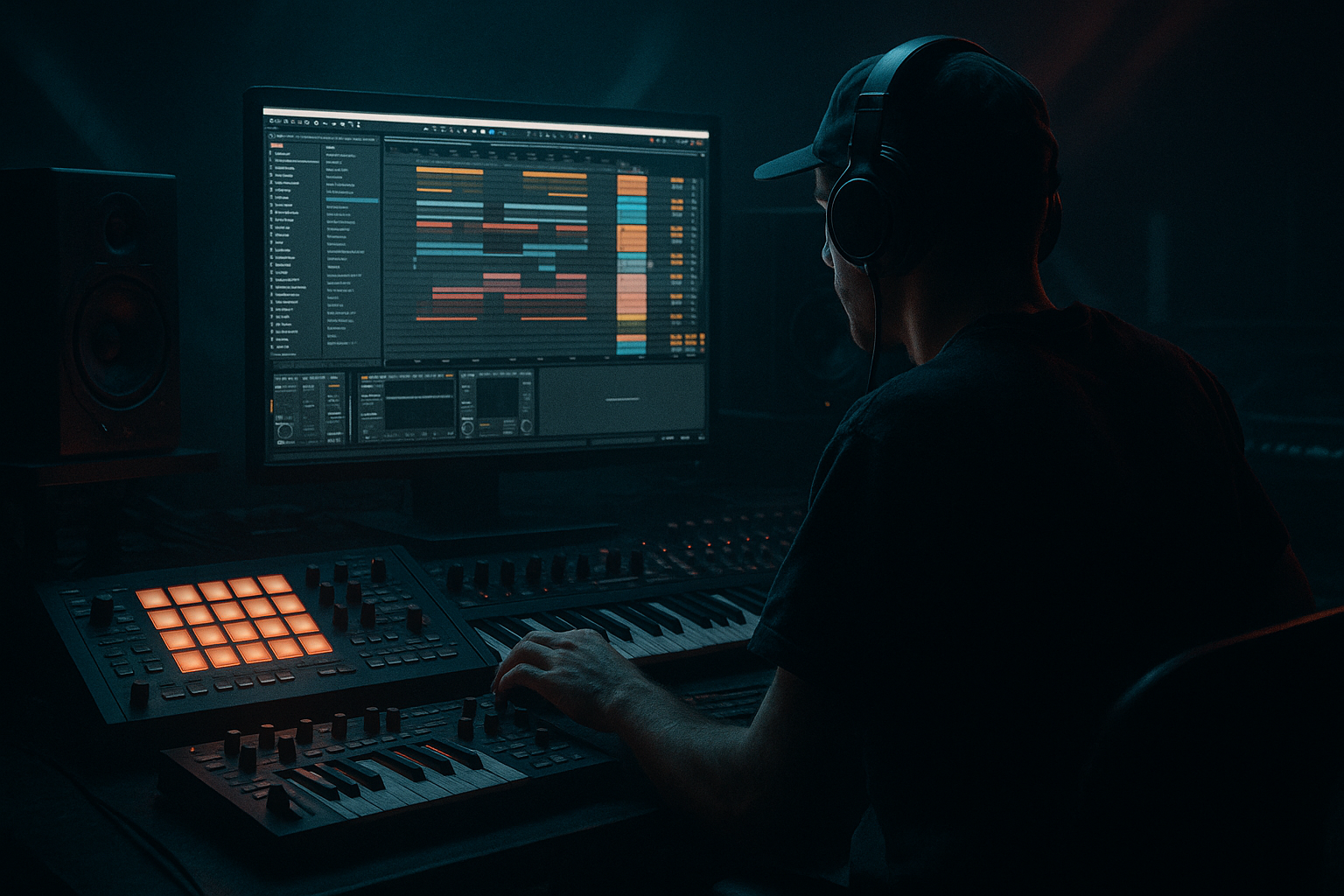
Main tutorial
Airy Risers from Field Recordings (Session View) — Ableton Live for DnB 🎛️🌫️
1) Lesson overview
In drum & bass, the best risers don’t always come from synth presets—they come from real-world texture: wind, train brakes, crowd noise, doors, rain, room tone. In this lesson you’ll turn a field recording into an airy, tension-building riser using Session View so you can audition variations fast and “perform” your build-ups like a DJ.
You’ll learn:
- How to prep a field recording for risers
- How to build multiple riser variations in Session View
- How to use stock Ableton devices for air, motion, width, and tension
- How to print and arrange your riser into a rolling DnB drop
- A Riser Track with 3–6 riser clips (8 or 16 bars)
- Each clip will be a different “take”: brighter, wider, more distorted, more filtered, etc.
- A clean workflow to launch clips in Session View and record the best performance into Arrangement
- A riser that sits in a 170–175 BPM DnB/jungle context, leading into a drop with energy and space
- Wind / trees / distant traffic (smooth broadband noise)
- Subway / train interior (constant tone + movement)
- Rain / shower / kettle steam (sparkle + noise)
- Crowd / room tone (wide, “human” air)
- Set loop brace to 8 bars (good for quick builds) or 16 bars (for long tension).
- Turn Loop: ON.
- Global Quantization (top of Live): 1 Bar
- Clip Launch Quantization: 1 Bar
- Add Auto Filter after EQ Eight:
- Clip Envelope: Auto Filter Frequency rising
- Mix: 15–35%
- Pre-Delay: 25 ms
- Size/Decay: big, but control the low end with EQ after.
- EQ Eight (post FX cleanup)
- EQ HP envelope + gentle Auto Filter sweep
- Little to no distortion
- Reverb send increases in last 4 bars
- Mode: `Ensemble`
- Amount: 10–25%
- Rate: 0.2–0.6 Hz
- Width: 120–200%
- Preset-ish starting point:
- Drive: 3–8 dB
- Soft Clip: ON
- Dip 3–6 kHz if needed
- Interval: 1 Bar
- Grid: 1/8 → 1/16 (automate faster at the end)
- Chance: 10–25% early, 30–60% in the last 2 bars
- Clip Envelopes > `Clip` > `Transpose`
- Ramp from -12 semitones up to 0 over 8/16 bars
- Try Texture Warp Mode
- Bars 1–8: airy riser + hats gradually opening
- Bars 9–12: add snare build (or ghost snare roll)
- Bars 13–15: tension peak (more width + less low end)
- Last 1/2 bar: quick mute or reverse reverb tail
- Drop: hard cut the riser on beat 1 for impact
- Too much low end in the riser → fights the sub and makes the drop feel smaller. High-pass aggressively.
- Reverb drowning everything → use pre-delay, high-pass your reverb return, and automate sends.
- No dynamic movement → a riser needs evolving filter/pitch/width, not just “louder noise.”
- Clipping from layered FX → watch the track meter; add a Limiter at the end temporarily while designing.
- Over-warping artifacts → if it sounds crunchy in a bad way, try a different warp mode or less stretching.
- Make it “air” but sinister: Use Auto Filter Band-Pass with higher resonance and automate it into the upper mids, then cut abruptly at the drop.
- Add parallel grit: Create Return `C - GRIT` with Overdrive or Saturator, then blend in 5–15%.
- Sidechain the riser to the kick/snare:
- Pre-drop silence = power: Mute the riser for the last 1/8 or 1/4 note before the drop (or hard gate it). The drop hits harder.
- Use subtle phasing movement: Phaser-Flanger at low mix (5–10%) adds unease without screaming “effect.”
- Field recordings are perfect for organic, airy DnB risers.
- Session View lets you build multiple clip-based riser variations and perform the best transitions.
- Key tools: EQ Eight (HP automation), Auto Filter, Hybrid Reverb, Chorus-Ensemble, Saturator, Beat Repeat.
- For rolling DnB, keep the riser bright, moving, and low-cut, then cut hard at the drop for maximum impact.
---
2) What you will build
By the end you’ll have:
---
3) Step-by-step walkthrough
Step 0 — Set up your DnB project
1. Set tempo: 174 BPM (classic rolling tempo).
2. Make these tracks:
- Audio Track: `FIELD RISER`
- (Optional) Return Tracks: `A - REVERB`, `B - DELAY` (for shared ambience)
Session View mindset: You’ll create different riser clips vertically, then audition them while your drums/bass loop plays.
---
Step 1 — Choose the right field recording (and why)
Great sources for airy risers:
Drag your field recording into `FIELD RISER`.
Tip: Pick something with a steady texture (not too many sudden loud spikes). Spikes can be cool later, but they complicate a clean riser.
---
Step 2 — Warp & clip setup (Session View)
1. Double-click the audio clip to open Clip View.
2. Turn Warp: ON.
3. For noisy/ambient recordings, start with:
- Warp Mode: `Complex` (or `Complex Pro` if you need it)
4. Set Seg. BPM if needed so it behaves predictably—doesn’t have to match perfectly, but avoid weird stretching artifacts.
Create a riser-length clip:
Clip Launch settings (important for DnB timing):
This means you can switch riser variations on the bar—tight and musical. ✅
---
Step 3 — Clean the source (so it layers with drums)
Add devices on `FIELD RISER`:
Device chain (starter):
1. EQ Eight
- High-pass: enable filter 1, set to HP 24 dB
- Frequency: 150–300 Hz (remove rumble that fights your bass/sub)
- Optional: small dip around 2–4 kHz if harsh
2. Gate (optional, only if there’s too much constant hiss)
- Threshold: adjust until it tightens without chopping
- Attack: 1–5 ms
- Release: 80–200 ms
You’re aiming for “airy and controlled,” not “raw phone recording fighting the mix.”
---
Step 4 — Turn it into a riser using Automation inside the clip 🎚️
In Session View, you can automate per-clip using Clip Envelopes.
1. In Clip View, open Envelopes.
2. Choose Device > `EQ Eight` > `1 Frequency` (your HP filter frequency).
3. Draw a ramp:
- Start: 200 Hz
- End: 2–6 kHz over 8 or 16 bars
This creates that classic “lifting” effect as the low end disappears and the perceived brightness rises.
Now add motion with a filter sweep:
- Mode: High-Pass or Band-Pass
- Resonance: 15–30% (don’t go too whistly yet)
- Start: 300–800 Hz
- End: 6–12 kHz
DnB-friendly trick: Make the last 1 bar ramp faster (a steeper curve) to “snap” into the drop.
---
Step 5 — Add “air” and space without washing out the mix 🌫️
Option A: Return track workflow (clean + consistent)
1. Create Return `A - REVERB`
2. Put Hybrid Reverb on it:
- Algorithmic (or Convolution with a short airy IR)
- Decay: 2.5–6.0 s
- Pre-Delay: 20–40 ms (keeps the transient/front clear)
- High Cut: 8–12 kHz (avoid harsh fizz)
3. Send your riser to A: start -inf and automate up.
Option B: Insert workflow (more “sound design”)
On the riser track add Hybrid Reverb directly:
After reverb, add:
- HP at 250–500 Hz
- Gentle shelf up at 10 kHz if you want more air
---
Step 6 — Create multiple riser clip variations (Session View power) 🎛️
Duplicate your clip vertically 3–6 times (Cmd/Ctrl+D). Each one is a variation you can launch live.
Here are practical variations:
#### Variation 1: “Clean Air Lift”
#### Variation 2: “Wide Jungle Mist”
Add Chorus-Ensemble (subtle):
Keep it subtle—you want width, not wobble.
#### Variation 3: “Tense Metallic Air”
Add Corpus (very low mix):
- Type: `Tube` or `Beam`
- Tune: match your track key if possible
- Dry/Wet: 5–15%
Automate Dry/Wet up slightly toward the end.
#### Variation 4: “Crunch Rise (for heavier drops)”
Add Saturator:
Then post-EQ tame harshness:
#### Variation 5: “Stuttered Build (DnB energy)”
Use Beat Repeat:
This creates that rolling pre-drop “panic” without needing extra samples.
---
Step 7 — Add tension with pitch and time tricks (tastefully)
Pitch envelope (easy win):
This can sound massive on wind/traffic textures.
Texture stretch (for dreamy air):
- Grain Size: 80–200 ms
- Flux: 10–30%
This can turn a basic recording into a cinematic wash—great for liquid or atmospheric rollers.
---
Step 8 — Record your Session View performance into Arrangement 🎬
1. Create a simple loop of your drums/bass (even a placeholder) so you can audition in context.
2. Press Global Record (top transport).
3. Launch different riser clips as your build plays.
4. Stop recording—now you’ve “performed” the best riser transitions into Arrangement View.
Arrangement idea (classic DnB build):
---
4) Common mistakes
---
5) Pro tips for darker/heavier DnB 🖤
Use Compressor on the riser with Sidechain ON from the drum bus.
Settings: Ratio 4:1, Attack 2–10 ms, Release 80–150 ms.
This keeps the build punchy and “breathing.”
---
6) Mini practice exercise ✅
1. Find one field recording (30–90 seconds).
2. Create 4 riser clips in Session View, each 8 bars.
3. Each clip must include:
- HP filter automation (EQ Eight or Auto Filter)
- One “movement” effect (Chorus/Phaser/Beat Repeat/Corpus)
- Reverb send automation (or Hybrid Reverb mix automation)
4. Record a performance into Arrangement where you:
- Launch Clip 1 for bars 1–4
- Clip 2 for bars 5–6
- Clip 3 for bar 7
- Clip 4 for bar 8 (final tension)
5. Render the build and listen right before the drop: does it create space for the sub?
---
7) Recap
If you tell me your subgenre (liquid, neuro, jump-up, jungle) and the type of field recording you’ve got, I can suggest a specific device chain and envelope shapes that match it.

