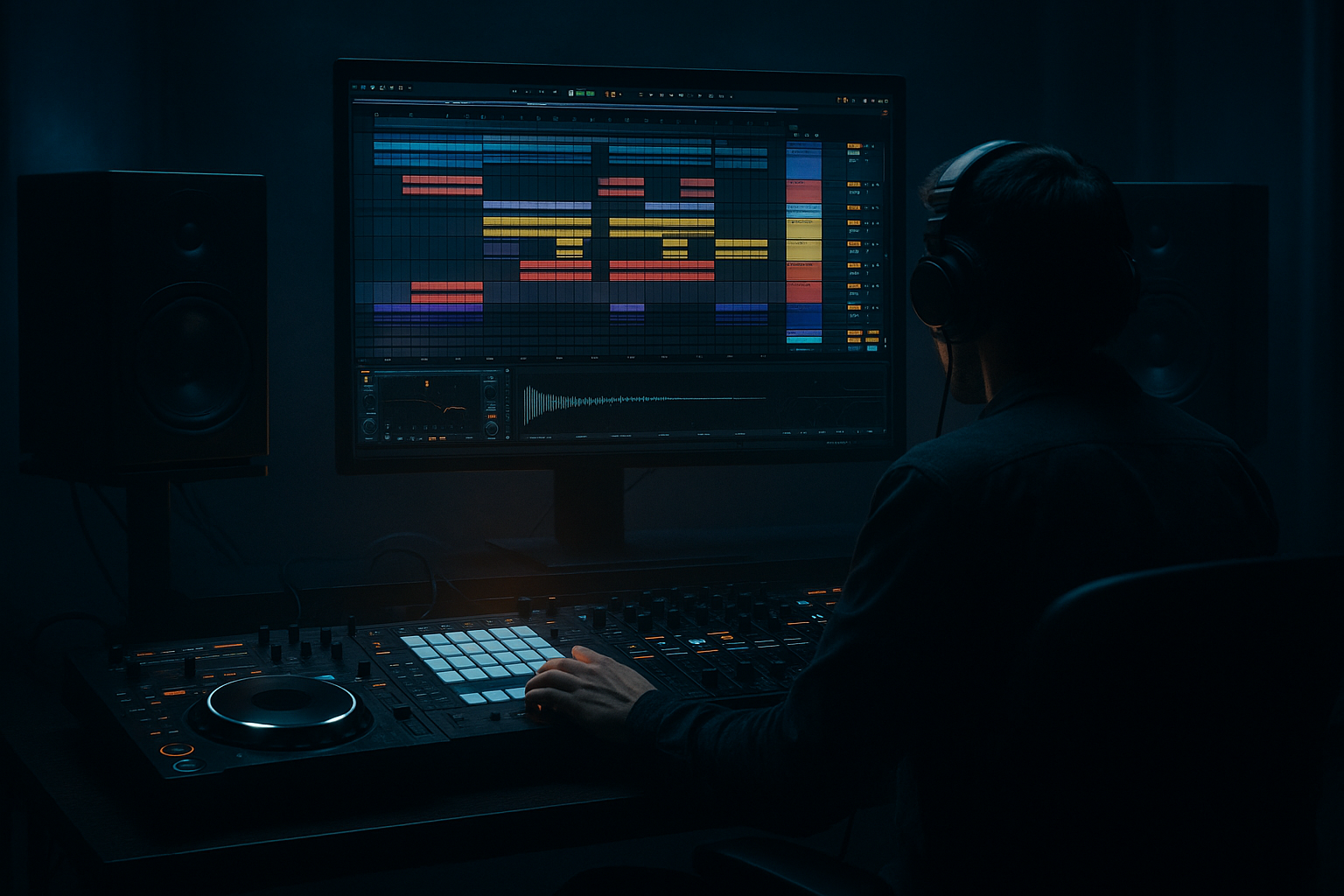
Main tutorial
Amen Break Chopping (90s Rave Flavor) — Ableton Live (Intermediate) 🔥🥁
1. Lesson overview
You’re going to take a classic Amen break and chop it the 90s jungle/DnB way: tight slices, punchy transients, deliberate timing shifts, and rave-style edits (re-trigs, stutters, and fills). We’ll do it inside Ableton Live using stock tools—fast workflow, authentic feel, and mix-ready results.
Key goals:
- Get the Amen warped cleanly without killing its groove
- Slice it into playable chops in Drum Rack
- Program rolling DnB patterns (think 94–97 era energy)
- Add rave edits + gritty movement with stock effects
- Make it sit with a modern DnB mix while keeping vintage flavor
- A Drum Rack Amen kit with your own curated slices (kicks/snares/ghosts/hat tails)
- A 16–32 bar drum arrangement: main loop + variation + fills
- A 90s rave “edit” section: stutters, reverses, and classic stop-starts
- A basic processing chain to make it slap: glue, crunch, and controlled dynamics
- Most Amens are 1 bar or 2 bars at their original tempo.
- Right-click → Warp From Here (Straight) on the first downbeat.
- Adjust the end marker so it loops perfectly at 1 bar or 2 bars.
- If the groove feels “off,” don’t quantize every hit—Amen swing is part of the magic.
- Consolidate a clean region: select the best 1–2 bars → Cmd/Ctrl + J.
- Open Drum Rack → click a pad → open its Simpler.
- For key slices (kick, snare):
- Rename important pads (Kick, Snare 1, Snare 2, Ghost, Hat tail, Ride-ish).
- 2–3 snares (main crack + alt snare + ghost)
- 1–2 kicks
- a few hat/ride tails
- a few “texture” bits (the messy little bits are your jungle spice)
- Put a kick on 1.1
- Put a snare on 1.2 and 1.4 (DnB backbeat)
- Add a second kick (or ghost kick) around 1.3.3 (taste-dependent)
- Sprinkle short slices (ghost snares / hat tails) on 16th notes leading into the snare hits.
- Use a few off-grid nudges:
- Main snare: ~110–127
- Ghosts: ~30–70
- Hats/tails: ~50–90
- Duplicate your 2-bar clip to make 8 bars.
- On bar 8 (or bar 4), do a fill:
- At the end of a 4- or 8-bar phrase, delete everything for 1/8 or 1/4 of a bar.
- Let a snare hit ring, then silence. Classic tension move.
- Duplicate the snare slice to an audio track:
- Place the reversed snare right before your main snare.
- Create a Return Track “Amen Crush”
- Add:
- Send your Amen to it lightly (-18 to -10 dB send) for bite.
- Bars 1–8: Main groove (cleaner)
- Bars 9–16: Add extra ghost notes + occasional stutter
- Bars 17–24: Swap to an alternate chop pattern every 2 bars (variation keeps it rolling)
- Bars 25–32: Fill-heavy: reverse hits, stop-start, denser re-trigs into the drop/transition
- Automate Drum Buss Drive up slightly in the last 2 bars
- Automate a high-pass filter (EQ Eight) sweeping up to ~200 Hz for tension, then snap back
- Over-warping the break: If every transient is pinned to the grid, the Amen loses its swagger. Warp the bar length right, then keep micro-timing alive.
- Too many slices firing at full velocity: Jungle rolls because ghosts are quiet. If everything is loud, it’s just chaos.
- Harsh top end: The Amen can get brittle fast. Watch 6–10 kHz with EQ Eight; use saturation instead of boosting highs.
- No arrangement variation: A 2-bar loop for 64 bars isn’t “90s hypnotic,” it’s “unfinished.” You need edits and fills.
- Over-compressing: Crushing the break too hard can remove the snare crack. Use parallel crush instead.
- Layer a clean snare under the Amen snare (very low blend)
- Make the Amen “talk” with transient shaping
- Resample and re-chop
- Dark movement with Phaser-Flanger (subtle)
- Mono the low end
- Warp the Amen cleanly (don’t sterilize it).
- Slice to Drum Rack and curate the best hits.
- Program DnB roll using ghosts + velocity + micro-timing.
- Add 90s rave attitude with stutters, reverses, and dropouts.
- Use stock Ableton tools (EQ Eight, Drum Buss, Glue, Saturator, Groove Pool) for punch and character.
- Arrange in phrases—variation is the genre.
---
2. What you will build
By the end, you’ll have:
Tempo target: 165–175 BPM (we’ll assume 170 BPM).
---
3. Step-by-step walkthrough
Step 1 — Prepare the Amen and warp it correctly 🎯
1. Drag an Amen break audio file onto an Audio Track.
2. Set project tempo to 170 BPM.
3. In the clip view:
- Enable Warp
- Set Warp Mode: Beats
- Start with Preserve: Transients
- Envelope: try 40–70 (higher = tighter, more choppy; lower = smoother)
Find the correct loop length
Optional (often great):
---
Step 2 — Slice to a Drum Rack (the jungle workflow) ✂️
1. Right-click the audio clip in Session/Arrangement → Slice to New MIDI Track.
2. In the dialog:
- Slice By: Transients (good start)
- Create one slice per: Transient
- Warp Slices: ON
- Mode: Built-in (Simpler/Sampler inside Drum Rack)
Now you’ve got a Drum Rack where each pad triggers a slice.
Clean up the slices
- In Simpler: set Mode: One-Shot
- Turn Snap on (helps avoid clicks)
- Add a tiny Fade Out (1–5 ms) if needed
- Adjust Start slightly to emphasize transient bite
Pro workflow tip:
Group slices into “roles.” Keep:
---
Step 3 — Program a classic rolling Amen pattern 🏃♂️
Create a MIDI clip on the sliced track: start with 2 bars.
A very usable starting skeleton (2-step foundation):
Now the important part: the Amen roll comes from ghosts + tails + slight re-ordering.
Build the roll:
- Select 2–4 ghost notes → nudge a few ms late (Alt + arrow in some setups, or just drag with grid off)
- Don’t swing everything; swing just the little stuff.
Velocity makes it real
Use the MIDI Velocity lane aggressively. Jungle lives in micro-dynamics.
---
Step 4 — Add the 90s rave edits (stutters, reverses, dropouts) 🚨
This is where it becomes “rave” instead of “clean loop.”
#### A) Stutter/re-trigger fills (1/16 to 1/32)
- Take a snare slice and repeat it: 1/16 → 1/32 near the end of the phrase.
- Vary velocity upward for intensity.
Extra authentic:
Use different snare slices alternating for the stutter: A-B-A-B.
#### B) Stop-start breaks
#### C) Reverse hit into the snare (stock + fast)
- Right-click → Freeze Track (if needed) → Flatten or simply resample the snare to audio
- Reverse it (Clip view: Reverse)
If you want to stay in Drum Rack only: resample the snare tail into a new pad and reverse it as audio.
---
Step 5 — Tighten timing without killing the vibe (Groove Pool) 🕺
Don’t hard-quantize everything.
1. Open Groove Pool.
2. Try a shuffle groove like Swing 16 (subtle!) or extract groove from the original Amen:
- On the original audio clip: right-click → Extract Groove
3. Apply groove to your MIDI clip:
- Timing: 10–25%
- Velocity: 0–15%
- Random: 0–10%
4. Commit only if needed. Keep it adjustable while arranging.
---
Step 6 — Stock processing chain for punch + grit (very usable) 🧱
Put this chain on the Drum Rack track to get that glued, crunchy 90s energy without destroying transients.
Suggested chain (in order):
1. EQ Eight
- HP filter around 25–35 Hz (clean rumble)
- Small dip 250–450 Hz if boxy
- Optional presence boost 3–6 kHz (careful—Amen gets harsh fast)
2. Drum Buss
- Drive: 5–20% (taste)
- Crunch: 5–15
- Boom: 0–20 at ~50–70 Hz (only if your kick needs weight)
- Transients: +5 to +20 for snap
3. Glue Compressor
- Attack: 3–10 ms
- Release: Auto or 0.1–0.3 s
- Ratio: 2:1
- Aim for 1–3 dB of gain reduction
4. Saturator (optional but great)
- Mode: Analog Clip
- Drive: 1–4 dB
- Turn on Soft Clip for extra safety
5. Utility
- If needed: reduce width a bit (Width 80–100%)
Keep the core break mostly centered; stereo chaos can smear your roll.
Parallel crush (classic trick)
- Overdrive (Drive ~20–50%)
- Compressor (fast attack, high ratio)
- EQ Eight (HP at 150 Hz to keep low end clean)
---
Step 7 — Arrange it like a proper jungle/DnB tune 🧩
A great Amen chop is also about when you change it.
Simple 32-bar blueprint:
Automation that screams “rave”:
---
4. Common mistakes
---
5. Pro tips for darker/heavier DnB 🖤
- Add a separate snare sample on 2 and 4.
- HP the Amen slightly higher (e.g., 70–120 Hz) so the sub/kick space is clean.
- Drum Buss Transients up a bit, then tame harshness with EQ.
- Once you’ve processed it, resample the whole loop to audio, then slice again. This is how you get that “printed” character.
- Put Phaser-Flanger on a return.
- Filter the return (HP around 300 Hz).
- Blend lightly for swirling grit in the highs.
- Use Utility (Bass Mono below ~120 Hz if available in your version; or use EQ Eight M/S techniques) so your kick/bass stays solid.
---
6. Mini practice exercise (15–25 minutes) 🧠
1. Slice an Amen to Drum Rack via Transients.
2. Build two 2-bar patterns:
- Pattern A: clean roll, minimal edits
- Pattern B: heavier ghosts + one stutter fill at the end
3. Arrange 16 bars:
- Bars 1–8: A
- Bars 9–12: A with one small variation every 2 bars (swap a snare slice)
- Bars 13–16: B + stop-start in bar 16
4. Add this processing chain: EQ Eight → Drum Buss → Glue Compressor
5. Export a quick bounce and listen on low volume:
Can you still hear the main snare clarity and ghost groove?
---
7. Recap ✅
If you want, tell me your Ableton version and whether you’re aiming more ’94 jungle (raw + chaotic) or rolling neuro-leaning (tight + heavy), and I’ll give you a specific 8-bar MIDI chop map to copy.

