Main tutorial
```markdown
Amen: Drop Arrange for Heavyweight Sub Impact in Ableton Live 12 (DnB) 🔥
1. Lesson overview
You already know how to program an Amen and make a sub. This lesson is about arranging the drop so the sub hits like a truck—without wrecking headroom or losing the Amen’s aggression.
We’ll build a drop “impact system” using timing, space, filters, automation, and sidechain discipline—all inside Ableton Live 12 stock devices.
Focus: Arrangement + mixing moves that make the sub feel louder (not just turn it up).
Style: Jungle / rolling DnB with Amen pressure and clean low-end. 🥁🔊
---
2. What you will build
A 32-bar drop section with:
- A tight Amen break that stays forward without masking the sub
- A heavy sub bass that feels bigger through contrast + automation
- A drop impact moment (first 2 beats) that translates on club systems
- A rolling groove with micro-variation every 4–8 bars so it doesn’t loop-fatigue
- A clean low-end workflow: sub mono, controlled dynamics, and sidechain clarity
- Bars 1–8: Main hook (full impact)
- Bars 9–16: Variation (remove/replace 1 element)
- Bars 17–24: Second statement (bigger or different)
- Bars 25–32: Outro / transition to next phrase
- EQ Eight: high-pass around 200–350 Hz (steeper slope)
- Optional Saturator: Soft Clip on, Drive 2–6 dB
- Turn AMEN TOP down low; it’s for crispness without low-mid clutter.
- Sidechain input: AMEN (or a dedicated ghost kick track)
- Ratio: 4:1
- Attack: 1–3 ms
- Release: 60–120 ms (match groove)
- Threshold: aim for 2–6 dB reduction on the loudest hits
- Auto Filter on SUB
- Enable Sidechain (in Live 12 it’s available in more places; if you don’t see it, stick to Compressor)
- Use a low-shelf or low-pass movement to tuck sub briefly on hits
- Strong ducking for bar 1 impact
- Slightly reduced ducking after bar 4 (automation) so the drop “opens up”
- High-pass the Amen and any music with Auto Filter rising to ~300–600 Hz
- Reduce reverb tails (Return track automation)
- Consider a 1/4 or 1/2 bar silence of the Amen right before the drop hits
- Beat 1: Sub hits + Amen but keep hats/extra percussion muted for the first 1–2 beats
- Beat 3 or bar 2: Bring in hats/shaker layer
- Bar 5: Add a crash or ride to lift
- Add a tiny Amen fill (reverse a slice or stutter)
- Then hard reset to the groove at bar 5/9
- Amen micro-chops: replace 1 snare hit with a different slice every 4 bars
- Ghost note switch: add a quiet 16th note snare ghost on bar 7
- Sub pattern call/response: same root, different rhythm in bars 9–16
- Mute trick: mute the Amen TOP layer for 1 bar, then bring it back (sudden “darkness”)
- Tape-stop or pitch drop on a single Amen hit (Resample + transpose)
- Avoid stacking multiple low-mid sources when the sub is most exposed.
- If you use a Reese, high-pass it around 120–200 Hz and keep it wide, while the sub stays mono.
- Instrument: Wavetable or Operator (saw)
- EQ Eight: HP 150 Hz
- Chorus-Ensemble (subtle width)
- Saturator or Roar (if you want nastier tone)
- Utility: Width 120–160% (NOT on sub)
- Layering low end in the Amen (Boom on Drum Buss, too much 120–250 Hz) → masks sub and kills impact.
- Sub notes too long through busy drum moments → constant bass = no perceived punch.
- No contrast at the drop (everything on at once) → feels flat even if loud.
- Sidechain release out of time → groove feels like it’s “sucking” randomly.
- Wide sub (stereo plugins on sub, unmono’d) → weak in mono/club systems.
- Over-filling the Amen every bar → fatigue + less headroom for the bass.
- Automate the sub saturation, not just volume:
- Use “negative space” hits:
- One-note intimidation:
- Parallel grit on breaks:
- Pitch automation on Amen fills:
- Heavy sub impact is arrangement + contrast, not just turning the bass up.
- Split the Amen (full + top layer) to keep break energy without low-mid clutter.
- Use Operator + Saturator + Utility (mono) for a stable club-ready sub.
- Sidechain timing and drop staging (less then more) is the secret sauce for that first-hit slam.
- Build variation every 4–8 bars so the drop keeps rolling like real jungle/DnB.
---
3. Step-by-step walkthrough
Step 0 — Session setup (fast + correct)
1. Tempo: 170–174 BPM (try 172 BPM).
2. Time signature: 4/4.
3. Warp mode: For Amen audio, use Complex Pro for big edits or Beats for tight transient chopping (often best for Amen slices).
4. Set up tracks:
- Track 1: AMEN (audio)
- Track 2: AMEN TOP (audio or resampled layer)
- Track 3: SUB (MIDI)
- Track 4: MID BASS / REESE (optional)
- Return A: SHORT ROOM
- Return B: DELAY DUB (optional)
---
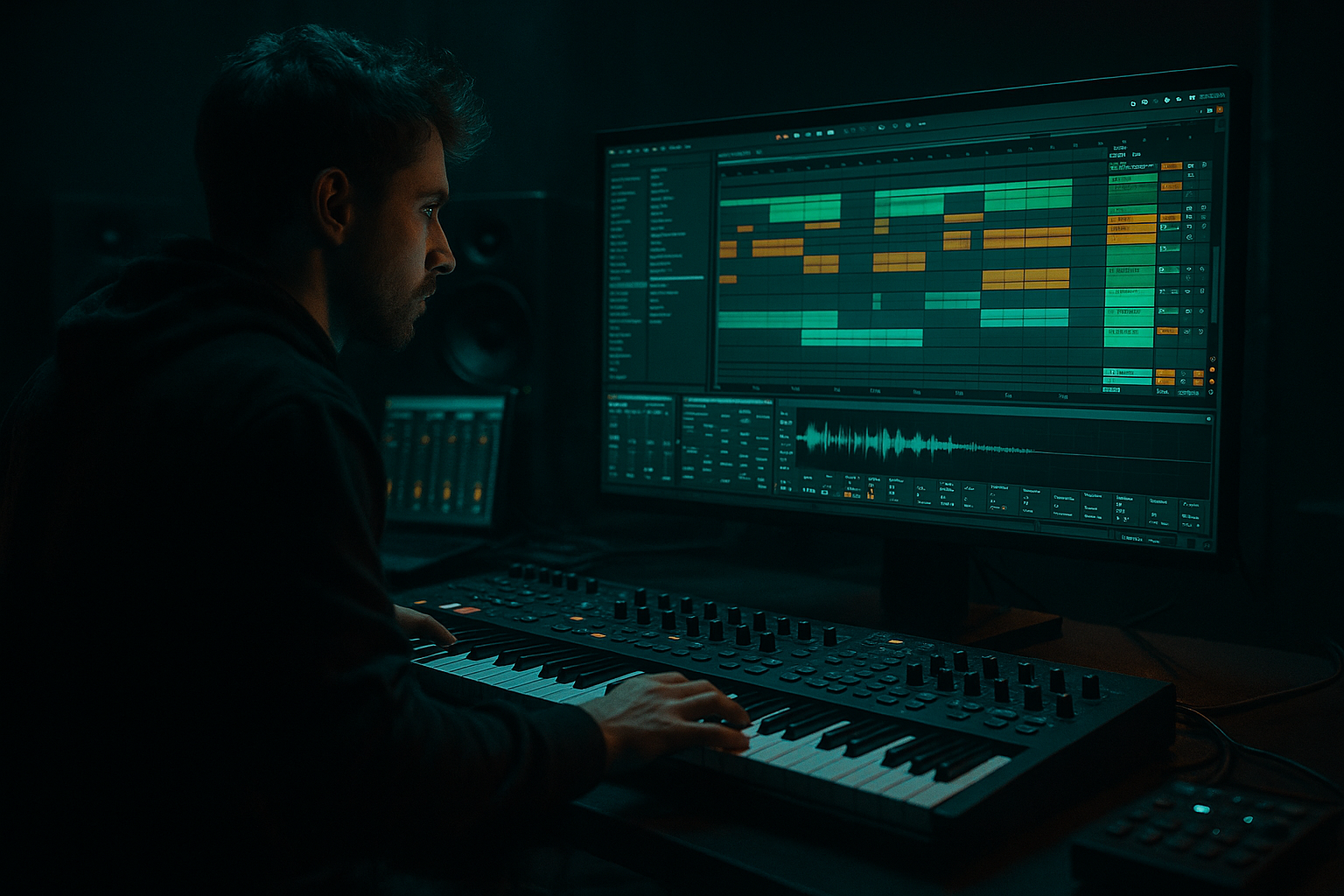
Step 1 — Build a drop skeleton (arrangement before sound design)
We’ll lay out a classic DnB drop in 32 bars:
Ableton tip: Use Locators at 1, 9, 17, 25.
You’re creating contrast markers—this is what makes the sub feel “eventful.”
---
Step 2 — Prep the Amen so it punches and leaves low-end room
#### A) Basic Amen chain (AMEN track)
On AMEN add:
1. EQ Eight
- High-pass: 30–40 Hz (24 dB/oct)
- Gentle dip around 180–300 Hz if it muddies the bass
- Optional: small shelf +1 to +2 dB at 7–10 kHz for air (don’t overdo)
2. Drum Buss
- Drive: 5–15% (taste)
- Boom: Off (important—don’t add fake low that fights the sub)
- Crunch: 5–15
- Transients: +5 to +20 (helps Amen snap)
3. Glue Compressor
- Attack: 3 ms
- Release: Auto (or 0.3s)
- Ratio: 2:1
- Aim: 1–3 dB gain reduction to “hold it together”
#### B) Make an “Amen Top” layer (helps sub impact)
Create AMEN TOP by duplicating the Amen and making it only top-end:
This trick leaves more space for the sub while keeping the break loud and exciting.
---
Step 3 — Build a proper sub that translates (SUB track)
Use Operator for a clean sub (fast, stable, classic).
1. Create a MIDI clip with a simple rolling pattern:
- Start with long notes for the first 2 bars of the drop (impact)
- Then move into shorter, syncopated notes to roll with the Amen
2. Operator settings
- Oscillator A: Sine
- Envelope:
- Attack: 0–5 ms
- Decay: 300–700 ms (depends on note length)
- Sustain: -inf if you want plucks, or 0 dB for sustained
- Release: 80–180 ms (avoid clicks, keep it tight)
3. Audio Effects on SUB
- EQ Eight
- Low-pass at 120–180 Hz (24 dB/oct) to keep it pure
- Optional tiny dip around 50–70 Hz if it blooms too much
- Saturator
- Drive: 1–4 dB
- Soft Clip: On
- Goal: add upper harmonics so the sub is audible on smaller systems without turning it up.
- Utility
- Width: 0% (mono sub)
- Gain staging: keep it controlled; don’t clip your master.
---
Step 4 — Sidechain arrangement (not just compression)
We’ll make the kick/snare hits carve space so the sub feels louder.
#### Option A: Compressor sidechain (classic)
On SUB add Compressor:
#### Option B: Auto Filter duck (clean + punchy)
Sometimes Auto Filter sidechain feels cleaner than compression:
Arrangement mindset:
Automate the Compressor threshold or Dry/Wet across the drop to create growth.
---
Step 5 — The “Drop Impact Moment” (first 2 beats) 💥
This is where heavyweight DnB gets its authority. We’ll use space and contrast.
#### A) Remove noise right before the drop
In the 1 bar before drop (the last bar of the buildup):
#### B) Make bar 1 hit harder with “less, then more”
At the drop (bar 1):
This staging makes the sub feel bigger because the ear has fewer competing transients at the start.
#### C) Classic jungle trick: “Amen fill into reset”
At the end of bar 4 or 8:
This creates perceived loudness and forward motion.
---
Step 6 — 4/8-bar variation so the drop rolls (without losing sub focus)
Pick one variation per 8 bars. Keep it disciplined.
Variation ideas rooted in jungle/DnB:
Ableton workflow: Consolidate a 2-bar Amen edit, then duplicate and only change 1–2 hits per phrase.
---
Step 7 — Control the low end in the arrangement (not only mixing)
To keep sub heavyweight:
Mid bass / Reese chain (optional)
Key idea: Sub = center + clean. Mid bass = width + character.
---
Step 8 — A/B your drop impact quickly (your “club reality check”)
Do these checks:
1. Mono check: Put Utility on the Master → Width 0%.
- Sub should remain strong.
- Amen should still cut.
2. Low-volume check: Turn monitors down.
- Can you still “follow” the sub rhythm? If not, add slight saturation (not volume).
3. Spectrum check: Use Spectrum on the Master.
- Watch 40–80 Hz consistency.
- If it spikes wildly, tighten sub note lengths or sidechain timing.
---
4. Common mistakes
---
5. Pro tips for darker/heavier DnB 🕶️
Slightly more Saturator drive in bars 17–24 can feel like the system got louder.
Muting the Amen for 1/8 or 1/4 right before a sub hit can make it slam.
Keep sub mostly on one root note for 8 bars; add movement with rhythm and fills, not pitch.
Send Amen to a Return with Overdrive + EQ Eight (HP 500 Hz) and blend quietly for menace without mud.
Transpose a single fill down -2 to -5 semitones for that dark jungle “drop shadow.”
---
6. Mini practice exercise (20 minutes) ⏱️
1. Take a 2-bar Amen loop and make:
- Version A: straight loop
- Version B: one fill at the end of bar 4 (duplicate pattern to 4 bars)
2. Create a sub line with:
- Bars 1–2: sustained notes
- Bars 3–4: syncopated shorter notes
3. Arrange an 8-bar drop:
- Bar 1: no hats (Amen only + sub)
- Bar 2: add hats
- Bar 5: add Amen TOP layer + crash
- Bar 8: add a fill + reset
4. Bounce a quick export and listen on:
- headphones
- phone speaker (you should still perceive the sub rhythm via harmonics)
---
7. Recap
If you want, tell me your drop tempo + whether you’re going “clean roller” or “filthy techy”, and I’ll suggest a specific 32-bar drop map (with exact mute points and fill placements) for your track.
```

