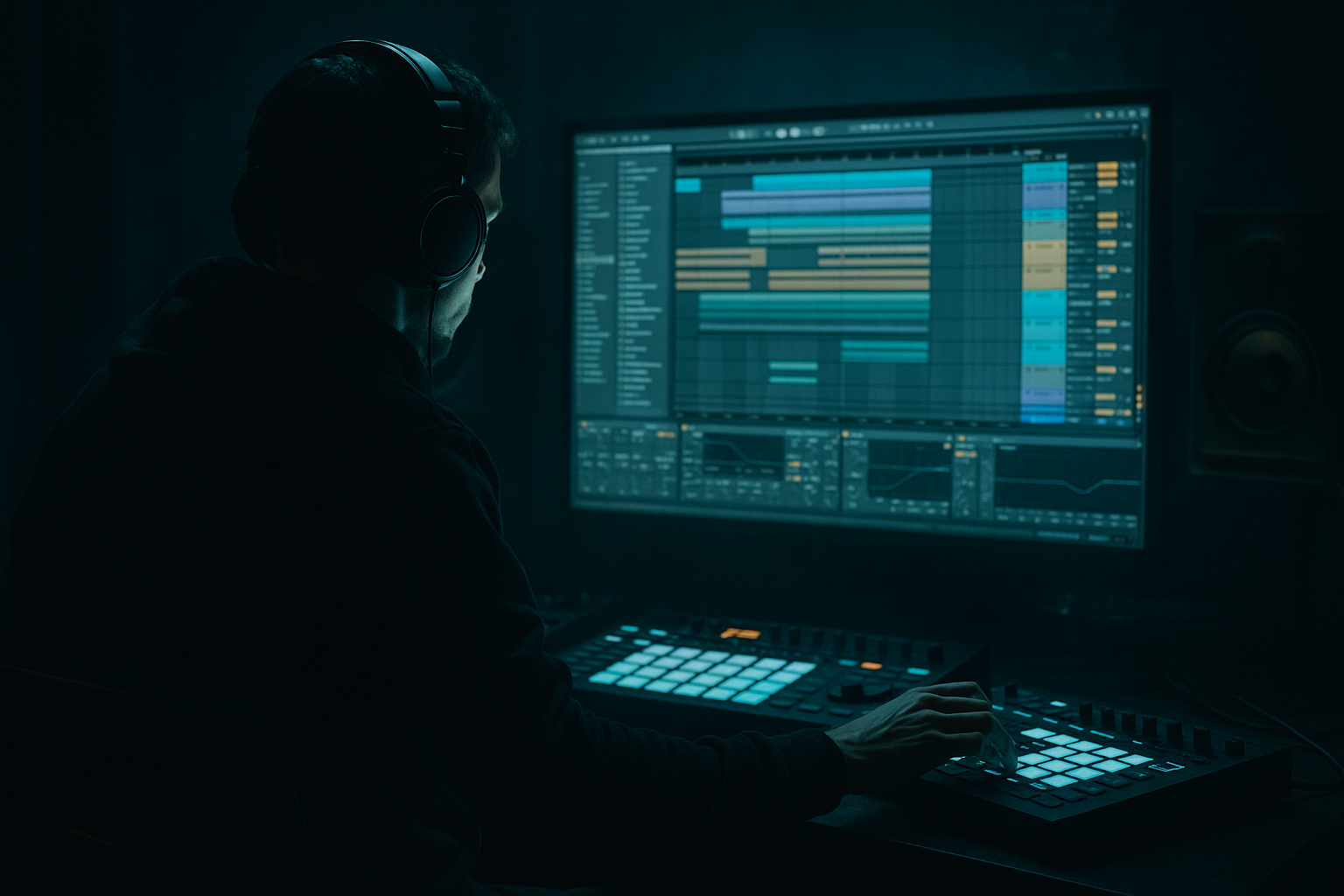
Main tutorial
Lesson Overview
In this lesson, you’ll build a classic Amen jungle sub-sine bass arrangement in Ableton Live 12 that feels functional, heavy, and easy to expand into a real DnB track. The focus is not just making a sub sound nice in isolation — it’s about making it work with an Amen break, sit correctly in the arrangement, and carry the energy of a jungle or darker rollers tune.
This technique matters because in Drum & Bass, the low end is doing a lot of work. A sub-sine gives you the foundation: it keeps the tune grounded, supports the drums, and creates contrast when the Amen break gets chopped, filtered, or dropped out. In jungle and rollers especially, the bass line often acts like the “engine” of the arrangement. If the sub is too busy, too wide, or too uncontrolled, the whole groove gets messy fast. If it’s too static, the tune loses movement. The goal is to find the sweet spot: solid mono sub, clear phrasing, and strategic wideness in the upper bass or texture layers.
We’ll keep this beginner-friendly, but the workflow is the same kind of decision-making used in real DnB sessions: build a strong loop, shape the bass for the drop, then arrange it with tension, break edits, and automation so the tune feels like it’s going somewhere.
What You Will Build
By the end of this lesson, you’ll have:
- A tight Amen break-based drop loop
- A clean sub-sine bass line that hits in time with the drums
- A widened upper layer or texture that adds stereo energy without damaging the low end
- An 8-bar arrangement idea that can become an intro, drop, or switch-up
- Simple automation moves for filters, width, and energy changes
- A workable DnB arrangement template you can reuse for jungle, rollers, or darker bass music
- Making the sub too loud
- Widening the low end
- Using too many notes in the bass line
- Arranging with no contrast
- Over-processing the break
- Ignoring mono compatibility
- Not leaving headroom
- Add a slightly distorted upper bass layer using Saturator or Drum Buss for more edge, but keep the sub clean.
- Use frequency-cut automation on the bass layer to create a build that feels darker and more aggressive.
- Try a half-bar bass drop-out before the snare on the return into the drop. That silence makes the re-entry hit harder.
- Use Resonators or very light Echo on atmospheric elements, not the sub, to create tunnel-like tension.
- If you want a more neuro or darker rollers feel, add subtle pitch movement or small filter modulation to the upper bass layer only.
- Use Drum Buss on the Amen group carefully: a little Drive and Transient can make the break smack harder without flattening it.
- Keep the sub note lengths tight. In heavier DnB, long overlapping subs can blur the groove.
- For a more underground jungle vibe, let the break breathe and make the bass phrase feel like it’s chasing the drums rather than overpowering them.
- Keep the true sub mono, simple, and controlled
- Use a widened upper layer for character, not for low-end weight
- Make the bass answer the Amen break instead of fighting it
- Arrange in phrases of 8 and 16 bars for real DnB flow
- Use automation, dropouts, and break edits to create tension and release
- Check mono compatibility and leave headroom for a clean, heavy mix
Musically, the result should feel like a rolling jungle drop: the Amen break is driving, the bass is answering, and the stereo field opens up in the higher frequencies while the sub stays firmly centered.
Step-by-Step Walkthrough
1. Set up a clean DnB project and load your Amen break
Start with Ableton Live 12 at 174–176 BPM. For this lesson, use 174 BPM, which is a very common jungle and DnB tempo.
Create:
- 1 audio track for the Amen break
- 1 MIDI track for the sub-sine
- 1 return track for reverb or delay if needed
- Optional 1 extra MIDI or audio track for a widened bass layer
Drop your Amen break onto the audio track and warp it so it plays tightly to the grid. If you’re using a sliced break, keep the edits simple at first. Focus on getting a solid 1- or 2-bar loop that feels like a proper DnB groove.
For beginner-friendly arrangement work, loop 2 bars of the break and make sure the kick/snare pulse feels strong before adding bass. In jungle, the break is part of the hook, so your bass should complement the rhythm, not fight it.
2. Build the sub-sine with a simple synth patch
On your MIDI track, load Operator. It’s one of the best stock devices for clean subs in Ableton.
Start with:
- Oscillator A: Sine wave
- Turn off extra oscillators for now
- No filter needed at first
- Volume envelope: short attack, medium release
Useful starting settings:
- Attack: 0–5 ms
- Decay: 150–300 ms if you want a little pluck
- Sustain: full or near full
- Release: 50–150 ms
Write a simple bass MIDI pattern underneath the Amen. In DnB, a sub-sine often works best when it’s rhythmically supportive rather than overly melodic. Try notes that sit on the first beat, off-beats, or answer the snare.
Beginner tip: use just 2–4 notes in the first pass. For example, if your break feels like it’s “pushing forward,” place the bass note after the snare hit so it feels like a response.
Why this works in DnB: the Amen break is busy and syncopated, so the sub needs to be clear, simple, and locked to the groove. Simplicity gives the drums space and makes the low end feel bigger.
3. Keep the sub mono and controlled
The low end in DnB should stay centered. On the sub track, use Utility after Operator and set Width to 0% or keep it mono with no stereo expansion. This is crucial.
If the sub is too wide, it will lose focus on club systems and can phase out when summed to mono. DnB speakers and sound systems punish messy low-end width.
Add EQ Eight after Utility if needed:
- High-pass only if there’s unwanted rumble below 20–30 Hz
- Leave the fundamental intact
- Cut any muddy resonance if you accidentally added it later
If your sub is too loud, lower the track fader before reaching for heavy EQ. In DnB, balance is often better than processing.
4. Add a widened upper layer without touching the true sub
To create width while protecting the low end, duplicate the MIDI pattern onto a second track or layer it inside a Group.
On the new layer, you can use:
- Operator with a sine or saw-based tone
- Analog for a slightly thicker character
- Wavetable if you want a more modern movement
Keep this layer out of the sub range:
- High-pass around 120–180 Hz
- If it sounds harsh, smooth it with EQ Eight
- Add Saturator for gentle grit
- Add Chorus-Ensemble very lightly if you want stereo spread
Example settings:
- Saturator Drive: 2–6 dB
- Chorus-Ensemble Amount: low, just enough to widen
- EQ Eight low cut: around 150 Hz
This layer gives you the “body” or “growl” above the sub while the true low end stays mono. In darker DnB, this can be a subtle reese-like texture, a filtered buzz, or a short bass stab that follows the same rhythm.
5. Shape the bass phrase around the Amen break
Now arrange the bass so it talks to the break. Don’t just loop the same bar forever. In DnB, phrase variation is huge.
Try this simple 8-bar idea:
- Bars 1–2: break + sub only
- Bars 3–4: add widened bass layer
- Bars 5–6: drop the bass out for 1 beat or half a bar, then bring it back
- Bars 7–8: add a small variation or fill before looping
On the MIDI clip, create a call-and-response feeling:
- Short note after the snare
- Longer note on the downbeat
- A rest before the next hit
- One higher note at the end of the phrase for tension
Keep the movement subtle. You’re not trying to write a bass melody like pop music — you’re building pressure and release for the drop.
Musical context example: in a jungle intro, the Amen break may be filtered and atmospheric at first, then the bass enters on bar 9 with the full snare cracking through. In a roller, you might bring the bass in earlier and keep the pattern more repetitive, with only small switch-ups every 8 bars.
6. Use Arrangement View to create clear drop structure
Switch from Session View to Arrangement View and lay out a basic tune structure. Even as a beginner, thinking in 8-bar and 16-bar phrases will make your DnB feel much more finished.
A simple structure:
- Intro: 16 bars — filtered break, atmospheres, no full sub yet
- Build: 8 bars — bass hints, drum tension, automation rises
- Drop 1: 16 bars — full break + sub + widened layer
- Breakdown: 8 bars — strip back the low end
- Drop 2: 16 bars — bring bass back with variation
- Outro: 16 bars — DJ-friendly drums and reduced bass
For a beginner, even arranging just 32 bars is enough to learn the mechanics.
In the arrangement, make sure the low end is not playing nonstop. The contrast between “full” and “empty” is what makes the drop hit harder. This is especially true in jungle, where the Amen break can carry energy while the bass enters and exits like a weapon, not wallpaper.
7. Automate filters and energy shifts
Use automation to make the bass and break feel alive. Ableton Live 12’s Arrangement View makes this easy.
Good beginner automation targets:
- Auto Filter cutoff on the widened bass layer
- Operator pitch envelope or overall pitch for tiny movement
- Utility gain for bass dropouts
- Reverb send on break fills
- Filter Frequency on the Amen break for intro/build sections
A few useful moves:
- Filter the bass layer lowpass in the intro, then open it at the drop
- Mute the sub for 1/2 bar before a switch-up
- Automate a tiny volume lift of 1–2 dB on the bass layer in the second 8 bars
- Cut the break low end in the intro, then restore it for the drop
Keep automation musical, not excessive. In DnB, small changes can feel massive because the tempo is fast and the groove is dense.
8. Glue drums and bass with bus processing, lightly
If your break and bass are separate tracks, group them or route them to a drum/bass bus for gentle shaping.
On the group, try:
- Glue Compressor with just a little gain reduction
- Attack: 10–30 ms
- Release: Auto or moderate
- Aim for 1–2 dB of reduction, not smashing
If the bass is fighting the kick/snare, use EQ Eight on the bass layer to carve space rather than over-compressing everything. You want the Amen to stay punchy and alive.
For lighter workflow management, color-code:
- Drums
- Sub
- Bass texture
- FX / atmos
- Arrangement markers
That helps you move fast when you start editing the drop later.
9. Check the low end in mono and fine-tune the balance
Use Utility on your master or bass group to check mono compatibility. Temporarily collapse the mix to mono and listen:
- Does the sub stay strong?
- Does the widened layer disappear in a good way?
- Do the drums still punch?
The sub should remain stable. The width should live mostly in the upper layer, FX, or atmosphere. If the bass gets hollow in mono, reduce stereo effects or lower the widened layer.
A practical target: keep the sub fundamentally centered below about 100–120 Hz and let any stereo character live above that.
If your mix feels crowded, pull the bass down slightly rather than boosting the drums too much. In DnB, headroom matters. Leave space for later mastering and for the transient edge of the break.
Common Mistakes
- Fix: lower the sub track fader first. A loud sub can sound impressive alone but destroys the drop balance.
- Fix: keep the true sub mono. Only widen the upper layer or texture.
- Fix: simplify to 2–4 notes and focus on rhythm. Amen breaks already bring a lot of movement.
- Fix: remove the bass for short moments, especially before a drop or switch-up.
- Fix: keep the Amen character intact. If the break loses punch, you’ve probably gone too far with compression or EQ.
- Fix: test in mono early, not at the end.
- Fix: keep the master from clipping and avoid driving every track too hard.
Pro Tips for Darker / Heavier DnB
Mini Practice Exercise
Spend 10–20 minutes making a mini 8-bar loop:
1. Load an Amen break and set the project to 174 BPM.
2. Create a sub-sine in Operator with a mono Utility after it.
3. Write a bass pattern with only 3 notes maximum.
4. Add a second bass layer that is high-passed above 150 Hz and give it light Saturator drive.
5. Arrange the loop into 8 bars with one small dropout and one automation move.
6. Toggle mono and listen for low-end problems.
7. Export a rough bounce and write down one thing that feels strong and one thing that needs cleaning.
If you finish early, create a second version where the bass enters one bar later. Compare which version feels more powerful.
Recap
If you can make a small Amen + sub-sine loop feel strong, balanced, and arranged with intention, you’re already building the core language of jungle and darker DnB.

