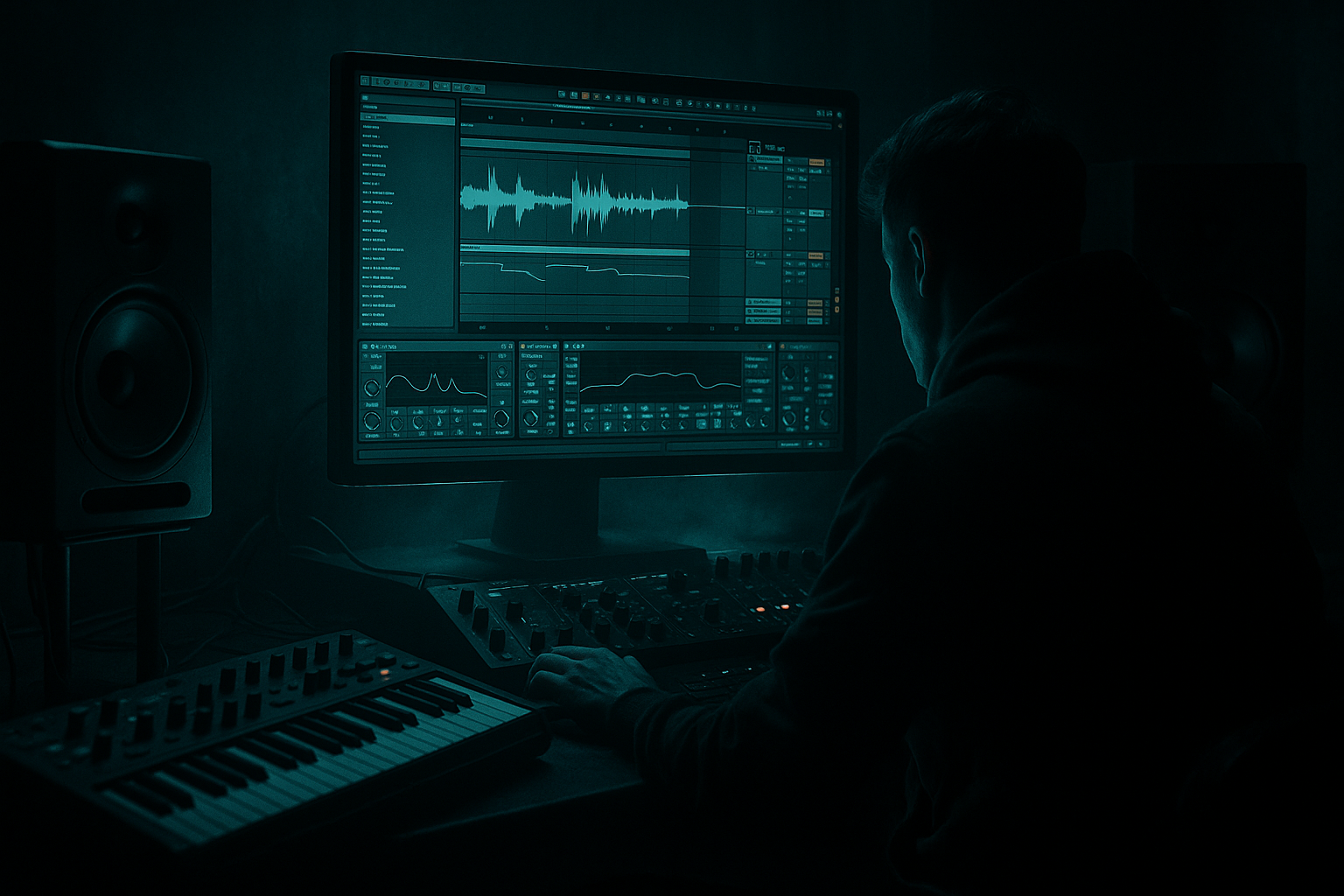
Main tutorial
Amen Masterclass: Percussion Layer Distort in Ableton Live 12 (DnB Groove) 🥁🔥
1. Lesson overview
In drum & bass, the Amen break isn’t just a loop—it’s a driving engine. This lesson focuses on a modern, rolling technique: creating a distorted percussion layer that sits under your Amen to add bite, urgency, and movement without turning the main break into a fizzy mess.
You’ll learn how to:
- Split the Amen into a clean “core” + dirty “perc layer”
- Distort the perc layer with stock Ableton devices
- Shape transients, glue, and preserve groove
- Make it hit in a rolling 170–176 BPM context
- punchy transients
- clean-ish top and snare crack
- groove preserved
- band-limited (mostly mids/highs or mids)
- heavily saturated/distorted
- transient-managed so it doesn’t “spit”
- blended in parallel for weight and aggression
- Toggle `Amen - Perc Dirt` Track Delay (bottom of mixer in Live)
- Hit the Ø phase button? (Ableton doesn’t have a global phase flip per track by default, but you can use Utility and switch Phase Invert L/R if needed.)
- `Amen - Core`: your main groove level
- `Amen - Perc Dirt`: bring up until you notice energy, then pull back 1–2 dB
- Mute/unmute the perc layer rapidly.
- If the groove collapses when muted → you pushed it too loud.
- If nothing changes → it’s too quiet or too filtered.
- Bars 1–8: Core only
- Bar 9: bring Perc Dirt in at -inf → ramp to target over 1 bar
- Bars 9–16: full blend (drop feels “wider”)
- Perc Dirt only on every 2nd bar (automate track volume)
- Makes the groove breathe and creates perceived variation without new samples
- Verses: Drive lower (20–25%)
- Drop: Drive higher (30–45%)
- Fills: quick spikes for hype
- Make the dirt mid-focused:
- Use multiband control (stock):
- Add subtle “room” for menace:
- Sidechain the dirt to the snare transient (micro-ducking):
- Keep an Amen Core clean and punchy.
- Build a band-limited Perc Dirt layer and distort it hard using Saturator + Roar + Drum Buss.
- Control harshness with EQ Eight, Damp, and transient shaping.
- Blend in parallel, then glue on the Group bus.
- Use automation to make the dirt arrangement-aware (verse vs drop vs fills).
---
2. What you will build
A two-layer Amen system:
Layer A — Core Amen (clean/controlled):
Layer B — Distorted Perc Layer (dirty/energized):
End result: classic jungle motion with modern DnB weight 😈
---
3. Step-by-step walkthrough
Step 0 — Project setup (DnB-ready)
1. Set tempo to 174 BPM (classic roller range).
2. Create two audio tracks:
- `Amen - Core`
- `Amen - Perc Dirt`
3. Drag your Amen break onto `Amen - Core`.
4. Duplicate the clip to `Amen - Perc Dirt`.
> Tip: Start with a decent Amen recording. The technique works on lo-fi ones too, but you’ll get a cleaner blend with a solid source.
---
Step 1 — Warp correctly (don’t kill the groove)
On both clips:
1. Turn on Warp
2. Set Warp mode to Complex Pro or Beats
- Beats is usually best for breaks.
3. In Beats mode:
- Preserve: Transient
- Envelope: 50–80 (start at 65)
Now check the downbeat is aligned and the loop cycles cleanly.
✅ Goal: tight timing without flattening swing.
---
Step 2 — Make the Core Amen punchy (but not harsh)
On `Amen - Core`, build this device chain:
#### Device chain (Core)
1. EQ Eight
- HP filter: 30 Hz (24 dB/oct)
- Small cut if needed: 300–450 Hz (2–4 dB) to reduce box
- Optional: tiny shelf up at 8–10 kHz (+1 to +2 dB) if dull
2. Drum Buss
- Drive: 5–15%
- Crunch: 0–10% (keep subtle)
- Boom: Off (or very low; we’re not doing sub here)
- Transients: +10 to +25
- Damp: adjust to avoid harshness (try 10–30%)
3. Glue Compressor
- Attack: 3 ms
- Release: Auto
- Ratio: 2:1
- Gain reduction: 1–3 dB
- Soft Clip: On
- Make-up: to taste
✅ Goal: a controlled, rolling Amen that still breathes.
---
Step 3 — Build the Distorted Perc Layer (the fun part) ⚙️😤
On `Amen - Perc Dirt`, we’re going to remove the low end, emphasize percussion presence, then distort hard.
#### Device chain (Perc Dirt)
1. EQ Eight (band-limit first)
- HP filter: 180–300 Hz (24 dB/oct)
- LP filter: 7–10 kHz (12 dB/oct)
This prevents distortion from turning into wideband fizz.
- Optional: slight boost 2–4 kHz (+2 dB) to bring “stick” and grit forward.
2. Saturator
- Type: Analog Clip (great for DnB)
- Drive: +6 to +12 dB
- Output: pull down to match level
- Soft Clip: On
- Color: On (try it—often adds bite)
3. Roar (Live 12 weapon of choice)
- Mode: Distort or Overdrive
- Drive: start 20–40%
- Tone: slightly darker than you think (prevents harsh hats)
- Filter in Roar (if using): set to band-pass-ish focus around 1–6 kHz
- Mix: 30–60% (don’t go 100% yet)
4. Drum Buss (post-drive control)
- Drive: 5–20%
- Crunch: 10–35% (this is your “hair”)
- Transients: -5 to -20 (important: stop spikes)
- Damp: 20–50% to tame brittle highs
5. Gate (tighten the dirt so it “talks” rhythmically)
- Threshold: set so tail noise closes between hits
- Return: 0–5 ms
- Attack: 0.1–1 ms
- Hold: 5–20 ms
- Release: 30–80 ms
✅ Goal: the layer sounds like aggressive, compressed “shrapnel percussion,” but still follows the Amen rhythm.
---
Step 4 — Phase, timing, and groove alignment
Because both layers come from the same sample, they should align—but distortion and devices can shift perception.
Do this:
Try -5 ms to +5 ms and listen:
- Slightly negative can add snap
- Slightly positive can add thickness/drag
Also:
✅ Goal: when both layers play, it should sound bigger, not hollow.
---
Step 5 — Blend like a producer (parallel mindset)
Set levels like this starting point:
A good trick:
---
Step 6 — Group + bus process for “record-like” cohesion
1. Select both Amen tracks → Group (Cmd/Ctrl+G)
2. On the Amen Group, add:
#### Amen Group chain
1. EQ Eight
- Tiny dip 3–6 kHz if harsh (1–2 dB)
- HP 25–35 Hz (clean rumble)
2. Glue Compressor
- Attack: 10 ms (let transients through)
- Release: Auto
- Ratio: 2:1
- GR: 1–2 dB
- Soft Clip: On
3. Limiter (safety, not loudness)
- Ceiling: -0.3 dB
- Don’t smash—just catch peaks.
✅ Goal: one unified break sound that still has internal motion.
---
Step 7 — Arrangement ideas (rolling DnB use cases) 🎛️
Try these in a 32-bar loop:
A) Drop impact
B) Call/response density
C) Energy automation
Automate Roar Drive on the perc layer:
---
4. Common mistakes 🚫
1. Distorting full-range audio
- If you don’t high-pass and low-pass pre-distortion, you get harsh broadband fizz and muddy lows.
2. Too much transient
- Distortion + sharp transients = crackly, cheap “click.”
- Use Drum Buss Transients negative on the dirt layer.
3. Perc layer too loud
- If your snare loses identity and becomes noise, you’ve buried the core.
4. Over-warping
- Over-tightening transients can remove that Amen swing.
- Keep warp edits minimal.
5. Ignoring hats
- The Amen’s hat content can become painful when distorted. Filter darker than you think.
---
5. Pro tips for darker/heavier DnB 😈⚫
HP 250–400 Hz, LP 6–8 kHz, and push 1–3 kHz slightly for aggressive “metal” presence.
Add Multiband Dynamics after Roar on the perc layer.
Gently control the high band to stop spikes:
- High band threshold a bit lower, 1–3 dB GR on peaks.
Very short Hybrid Reverb on the dirt layer only:
- Decay: 0.2–0.5 s
- High cut: 5–8 kHz
- Mix: 5–12%
This makes it feel like a grimy warehouse loop without washing out the core.
Put Compressor on the perc layer keyed from the core track:
- Fast attack, medium release
- Just 1–2 dB duck on the snare hit
Keeps snare clarity while maintaining grit.
---
6. Mini practice exercise 🎯
Goal: Create 3 versions of the perc dirt layer for different sections.
1. Duplicate `Amen - Perc Dirt` twice:
- `Dirt A (Verse)`
- `Dirt B (Drop)`
- `Dirt C (Fill)`
2. Settings targets:
- Verse: Roar Drive 20–25%, LP 8–10 kHz, lower volume
- Drop: Roar Drive 30–45%, slightly more 2–4 kHz, louder blend
- Fill: automate a 1-bar “overcook”: Roar Drive up + Gate tighter
3. Arrange over 32 bars:
- 1–16 Verse dirt
- 17–32 Drop dirt
- Every 8 bars: Fill dirt for 1 bar
Deliverable: bounce the Amen Group and A/B it against a reference roller.
---
7. Recap ✅
If you want, tell me the vibe (liquid roller, jungle tearout, techstep, neuro-ish) and I’ll suggest a tighter Roar/Saturator setup and EQ targets for that specific lane.

