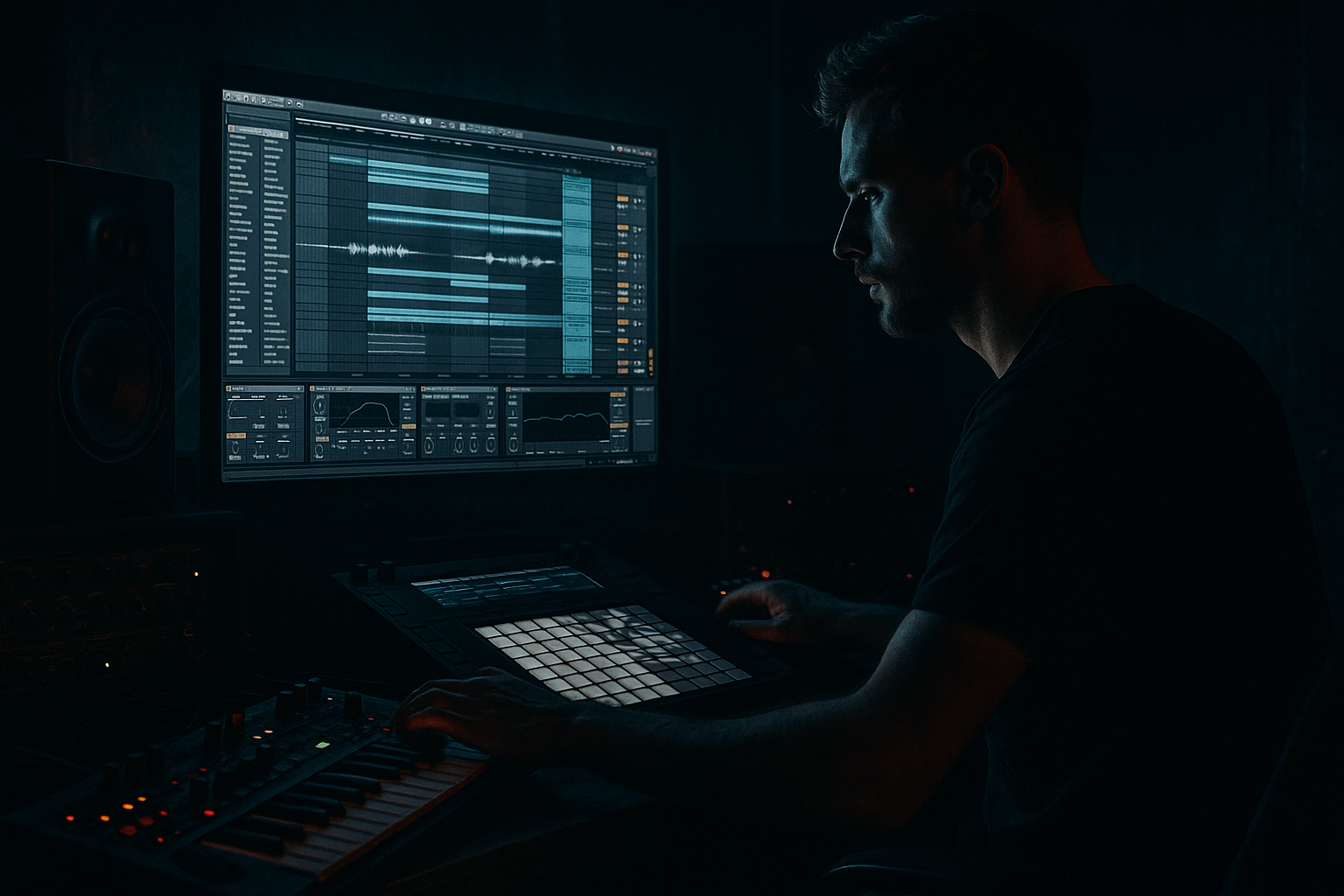
Main tutorial
Amen: Ragga Cut Warp for Smoky Warehouse Vibes (Ableton Live 12)
Skill level: Beginner
Category: Basslines (with a tight link between Amen edits + bass groove)
Vibe goal: dusty, rolling, smoky warehouse jungle/DnB energy 😮💨
---
1) Lesson overview
In this lesson you’ll take an Amen break, warp it in a very specific “ragga cut” way (tight chops + deliberate timing push/pull), and then build a rolling DnB bassline that locks to the edits. You’ll learn:
- How to warp the Amen so it stays nasty, not sterile
- How to do ragga-style cuts (quick repeats, stops, reverses) that feel human
- How to shape a sub + mid bass that fits that warehouse haze
- How to arrange a clean 16–32 bar loop like real DnB/jungle
- A 170–174 BPM drum loop driven by a warped Amen with ragga-style cut moments
- A two-layer rolling bass:
- A mini arrangement:
- Turn on the metronome and loop 1–2 bars.
- If the snare drifts, add warp markers only where needed.
- Place markers at the main snare hits (typically beat 2 and 4 vibes, depending on the Amen slice).
- Nudge the markers so snares land cleanly on the grid.
- Do not add a warp marker on every tiny hit—keep it loose.
- Switch Warp Mode to Complex with Formants OFF for a slightly smeared, smoky vibe.
- Or keep Beats but move into the next step for texture.
- A new MIDI track with a Drum Rack full of slices.
- Your original Amen audio stays intact (nice for layering).
- Use 1/8 and 1/16 repeats, quick stops, and one reverse hit.
- Put a strong kick-ish slice on 1.1
- Put a snare slice on 1.2 and 1.4 (bar 1)
- Repeat for bar 2
- LP12, cutoff 10–14 kHz, resonance low.
- Osc 1: Sine
- Osc 2: OFF
- Filter: OFF
- Voices: 1 (Mono)
- Glide: OFF (for tight rolling)
- Hit on 1.1, 1.1.3, 1.2.3, 1.3, 1.3.3, 1.4.3
- Repeat bar 2 with one variation (remove one hit or move it earlier)
- Note length: 1/8 to 1/16, keep it bouncy
- Velocity: consistent for sub (you want stability)
- Algorithm: A only (simple)
- Osc A: Saw (or Sine into saturation)
- Filter: ON
- Assign LFO to filter frequency:
- Delete some notes so the mid plays in the gaps of the busiest drum hits.
- Or shift a note slightly later (a few ms) for a lazy, smoky push-pull.
- Same idea, but a bit more GR is okay (3–7 dB) because mids can breathe more.
- `AMEN SLICES`: low-pass with Auto Filter slowly opening (automate cutoff)
- No sub for first 4 bars; bring sub in quietly bars 5–8
- Add a dub delay send on occasional hits (see below)
- Full Amen + sub + mid
- Add your best ragga cut at the end of bar 16 (mini fill)
- Add one extra reverse slice
- Change bass rhythm slightly (remove one note, add one note)
- Darken with filter automation for a “lights out” moment
- Hybrid Reverb
- EQ Eight after
- Echo
- Optional Saturator after Echo for grime
- Warping every transient: makes the Amen stiff and weird. Warp the anchors (main snares), not every ghost hit.
- Over-bright Amen: warehouse vibes are usually darker—too much 10–16 kHz makes it modern/shiny instead of smoky.
- Sub not mono: if your sub has stereo width, it’ll collapse badly in clubs. Utility to 0% width.
- Bass fighting the snare: if the snare doesn’t crack, increase sidechain or shorten bass notes around snare hits.
- Too much reverb on the whole break: send only selected hits—stutters, reverses, small fills.
- Parallel grime on Amen: duplicate `AMEN SLICES` → on the copy, heavy Saturator + Redux + low-pass, then blend quietly for grit.
- Use Roar (if available in your Live version): subtle drive modes can add serious warehouse character fast. Keep mix low.
- Ghost-note bass: add very quiet 1/16 sub taps before big notes (like little pickups). It increases roll without adding more drums.
- Shorter mid-bass notes = heavier groove: long notes can smear with Amen edits; keep mids punchy.
- Micro-timing: nudge a few ragga cut stutters slightly late for swagger (a couple ms). Don’t overdo it.
- Warp the Amen with restraint: lock the main hits, keep the human chaos.
- Use Slice to New MIDI Track to create playable Amen chops.
- Ragga cuts = stutters + stops + a reverse placed musically, not randomly.
- Build bass in two layers: mono sub + gritty mid, then sidechain to the Amen.
- Keep it smoky with controlled highs, selective reverb, and a bit of dirt 😮💨
Ableton Live 12 stock devices only ✅
---
2) What you will build
By the end you’ll have:
- Sub (clean, mono, consistent)
- Mid bass (gritty, filtered, movement)
- 8-bar intro (filtered drums + tease)
- 16-bar drop (full Amen + bass)
- 8-bar variation (extra cuts + bass switch)
---
3) Step-by-step walkthrough
Step 0 — Project setup (fast + correct)
1. Set tempo to 172 BPM.
2. Set meter 4/4.
3. Create tracks:
- Audio Track: `AMEN`
- MIDI Track: `SUB`
- MIDI Track: `MID BASS`
- (Optional) Return A: `REVERB`
- (Optional) Return B: `DUB DELAY`
---
Step 1 — Get your Amen and prep it (so it warps well)
1. Drop an Amen break audio file onto the `AMEN` track.
2. Right-click the clip → Warp: ON.
3. In Clip View, set:
- Seg. BPM: (Ableton will guess—fine)
- Warp Mode: start with Beats
- Preserve: 1/16 (good for Amen transients)
- Transient Loop Mode: Off (cleaner for chopping)
Why Beats mode first? It keeps punch while letting you chop without smearing. If it gets too clicky later, we’ll soften.
---
Step 2 — Warp the Amen like a junglist (tight but not robotic)
You want the Amen to feel driven at 172, but not grid-perfect. Here’s a beginner-safe method:
1. Find the first downbeat (kick at the start).
2. Right-click → Set 1.1.1 Here.
3. Right-click → Warp From Here (Straight).
Now check timing:
Warp marker approach (important):
If it sounds too “clean”:
---
Step 3 — Convert to slices (your ragga cut playground)
1. Right-click the Amen clip → Slice to New MIDI Track.
2. In the dialog:
- Slicing preset: Built-in → Slicing
- Slice by: Transient
- ✅ Create one-slice-per-hit style mapping.
This creates:
Rename the sliced track: `AMEN SLICES`.
---
Step 4 — Program “ragga cuts” (the signature)
Set a loop of 2 bars and make a pattern that feels like a sound system selector moment 🎚️
A beginner-friendly ragga cut recipe:
#### 4A) Basic DnB skeleton (if your slices are chaotic)
In `AMEN SLICES`, create a MIDI clip 2 bars long:
Don’t stress if your slices aren’t “kick/snare perfect”—pick the ones that feel like those roles.
#### 4B) Ragga cut moves (do these 3 things)
1. Stutter a vocal-ish/hat-ish slice
- Pick a slice with a bright edge (hat or ghost snare).
- Add 3–6 hits at 1/16 right before a snare (e.g., at 1.1.4 to 1.2).
2. Drop-out stop (1/8 of silence)
- Delete one hit right before a snare so it “sucks in” then slams.
- Example: remove a slice on 1.3.4.
3. Reverse one slice for tension
- In the Drum Rack, find the slice’s Simpler.
- Turn on Reverse (in Simpler).
- Use it once at the end of bar 2 (e.g., 2.4.3).
That’s already “ragga cut” energy without needing crazy technique.
---
Step 5 — Make it smoky: tone shaping the Amen (stock chain)
On `AMEN SLICES`, add this device chain:
1. EQ Eight
- HP filter at 30 Hz (24 dB/oct)
- Gentle dip 250–400 Hz (−2 to −4 dB) to reduce cardboard
- Small boost around 6–9 kHz (+1 to +3 dB) if dull
2. Saturator
- Drive: 2–6 dB (taste)
- Soft Clip: ON
- (Optional) Analog Clip mode for grit
3. Drum Buss 🥁
- Drive: 5–15%
- Crunch: 5–25%
- Boom: OFF or very low (you’ll handle sub separately)
- Damp: 10–30% to darken
4. Redux (optional for warehouse dust)
- Downsample: 2–8 (subtle)
- Dry/Wet: 5–15%
Pro move: Put Auto Filter after saturation and slightly low-pass to taste:
---
Step 6 — Build the rolling sub bass (simple, powerful, correct)
Create a MIDI clip on `SUB` that supports the Amen groove.
#### 6A) Instrument choice
Use Wavetable (stock) for clean sub:
#### 6B) Sub pattern (classic rolling feel)
Make a 2-bar bassline using short notes with space.
Use root notes like F, G, A# (pick a key, e.g., F minor).
Example rhythm idea (not exact notes):
Settings:
#### 6C) Sub processing chain
On `SUB` add:
1. EQ Eight
- Low-pass around 120–180 Hz (keep it pure)
2. Compressor (optional)
- Ratio 2:1
- Attack 15–30 ms
- Release 80–150 ms
- Just 1–3 dB GR to even hits
3. Utility
- Width: 0% (mono sub)
- Gain to taste
---
Step 7 — Add a mid bass layer that talks to the cuts (warehouse growl)
On `MID BASS`, use Operator or Wavetable. Here’s a beginner-safe Operator patch:
#### 7A) Operator (quick dirty mid)
- Type: LP24
- Freq: 200–800 Hz (we’ll modulate)
- Res: low-medium
Add movement:
- Rate: 1/8 or 1/4
- Amount: small (subtle wobble)
#### 7B) Mid bass processing chain
1. Saturator
- Drive 4–10 dB
- Soft Clip ON
2. Auto Filter
- LP12 or BP12
- Map cutoff to a Macro (if using an Instrument Rack)
3. EQ Eight
- High-pass at 120 Hz (get out of the sub’s way)
- Dip harshness 2–4 kHz if needed
4. Glue Compressor (optional)
- Ratio 2:1
- Attack 3–10 ms
- Release Auto
- 1–4 dB GR
#### 7C) Make it “answer” the Amen
Copy the `SUB` MIDI to `MID BASS`, then:
---
Step 8 — Sidechain the bass to the Amen (clean + rolling)
You want the Amen to punch through without killing bass weight.
On `SUB`:
1. Add Compressor
2. Turn Sidechain ON
3. Audio From: `AMEN SLICES`
4. Start settings:
- Ratio: 4:1
- Attack: 2–10 ms
- Release: 80–140 ms
- Threshold: adjust for 2–5 dB gain reduction on snare/kick moments
On `MID BASS`:
---
Step 9 — Arrangement idea (simple but authentic)
Make a 32-bar sketch:
Bars 1–8 (Intro):
Bars 9–24 (Drop):
Bars 25–32 (Variation):
---
Step 10 — Warehouse space (returns that don’t wash the drums)
Create Return tracks:
Return A: Reverb (smoke)
- Algorithmic or Convolution “Warehouse/Hall” style
- Predelay: 15–30 ms
- Decay: 1.2–2.5 s
- HP at 250–400 Hz
- LP at 6–10 kHz
Send only small bits of Amen stutters/reverse hits. Keep main snare relatively dry.
Return B: Dub Delay
- Time: 1/8 dotted or 1/4
- Feedback: 20–40%
- Filter: band-limit (HP ~300 Hz, LP ~6–8 kHz)
---
4) Common mistakes
---
5) Pro tips for darker/heavier DnB
---
6) Mini practice exercise (15–20 minutes)
1. Make a 2-bar Amen slice loop at 172 BPM.
2. Add exactly three ragga cut moments:
- One 1/16 stutter (3–6 hits)
- One 1/8 stop (silence)
- One reverse hit
3. Build a sub bass with only two notes (e.g., F and G), but make it roll using rhythm.
4. Export a 16-bar audio bounce of your drop and listen on:
- headphones
- laptop speakers (check snare presence)
- mono (Utility on master temporarily)
---
7) Recap
If you tell me your chosen key (e.g., F minor) and whether you want more jungle (busy edits) or more minimal roller (steady groove), I can give you a ready-to-program 16-bar MIDI pattern for both bass layers.

