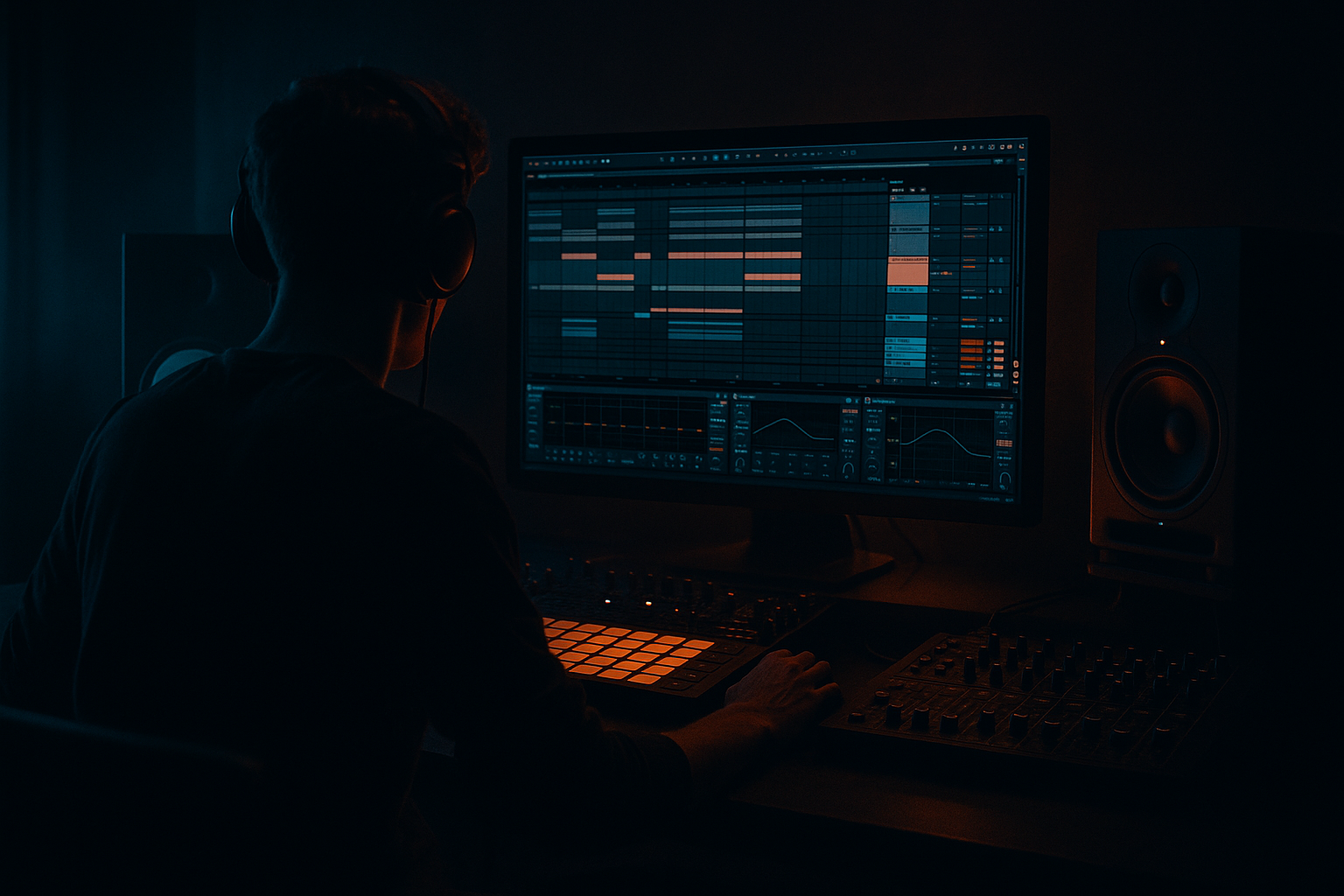
Main tutorial
Amen: Reese Patch Slice Without Losing Headroom in Ableton Live 12 (DnB/Jungle) 🎛️🥁
Skill level: Beginner
Category: Vocals (we’ll treat the Amen slice like a “vocal-style” audio phrase: transient-rich, dynamic, and easy to overload)
---
1. Lesson overview
You’re going to learn a clean, reliable workflow for slicing an Amen break and layering it with a reese patch while keeping your mix punchy and your master meters under control. In drum and bass, the Amen has sharp transients and wide-band energy—pair that with a reese (often heavy in low-mids) and it’s very easy to smash your headroom without noticing until your limiter is crying. 😅
We’ll build a headroom-safe chain using only stock Ableton Live 12 tools, and I’ll show you how to arrange it in a rolling way that feels authentic to jungle/DnB.
---
2. What you will build
By the end, you’ll have:
- A sliced Amen in a Drum Rack (easy to rearrange for jungle edits)
- A reese bass (either from Wavetable or your own patch) that is rhythmically “sliced”/gated to follow the Amen vibe
- A headroom-safe gain staging approach using:
- A simple bus structure for tight DnB mixing
- Add Utility after the Drum Rack (or on the track)
- Osc 1: Saw (or “Basic Shapes” → saw-ish)
- Osc 2: Saw (detune a bit)
- Unison: 2–4 voices (don’t go crazy yet)
- Detune: small-medium (enough to growl)
- BREAKS BUS (Amen + any extra tops)
- BASS BUS (Reese + Sub if you add one)
- EQ Eight: HPF 25–30 Hz
- Glue Compressor: 1–2 dB GR max
- Utility: trim overall level
- EQ Eight: control low-mid buildup
- Glue Compressor (optional): slow-ish
- Utility: trim to keep bass consistent
- Bars 1–4: Amen only (introduce groove)
- Bars 5–8: Add reese (simple sustained notes + sidechain)
- Bars 9–12: Add Amen edits (retrigger 1–2 slices for fills)
- Bars 13–16: Drop variation
- Make the Amen gritty without louder peaks:
- Split your bass into SUB + MID for control:
- Use subtle notch EQ to carve space for the snare crack:
- Short reverb on Amen tops only (not full break):
- Clip safely, don’t smash:
- Slice the Amen to Drum Rack and turn it down early (Utility -6 dB is a great start).
- Control transients with Glue Compressor and avoid unnecessary low-end in the break.
- Build a reese with Wavetable, keep it quiet initially, and tame peaks with Saturator soft clip.
- “Slice” the reese musically using sidechain or rhythmic gating (Auto Pan @ 0° phase).
- Mix through buses for easy control and better headroom.
- Keep the master limiter as a seatbelt, not the engine.
- Utility (gain + width)
- EQ Eight (cleanup)
- Glue Compressor (control peaks)
- Drum Buss (optional weight)
- Limiter (only for safety, not loudness)
---
3. Step-by-step walkthrough
Step 0 — Set up a DnB-ready project template 🏁
1. Set tempo to 170–176 BPM (try 174 BPM).
2. On the Master, do not start with a limiter for loudness.
- Put a Limiter on the Master only as a safety:
- Ceiling: `-1.0 dB`
- Leave it mostly doing 0–1 dB gain reduction max.
Goal: keep your master peaking around -6 dB while building. That’s your headroom.
---
Step 1 — Import the Amen and prepare it for slicing 🥁
1. Drag an Amen break (WAV/AIFF) onto an Audio Track.
2. Click the clip → enable Warp.
3. Choose Warp Mode:
- For breaks: Beats mode is a great start
- Settings:
- Preserve: `Transients`
- Envelope: `~40–70%` (higher = tighter, can get choppy)
4. Right-click the clip → Slice to New MIDI Track.
- Slicing preset: `Transient`
- Create one slice per: Transient
- This creates a Drum Rack with slices mapped across pads.
✅ Headroom move: before you even process anything, lower the Drum Rack’s output:
- Gain: `-6 dB` to start
Why? Amen transients are spicy—this prevents accidental clipping when you start layering.
---
Step 2 — Make the Amen punchy but controlled (peak management) 🎯
On the Amen Drum Rack track, add this device chain (in this order):
1. EQ Eight
- HPF (low cut): `30 Hz`, 24 dB/oct (removes useless sub rumble)
- Optional: small dip if it’s boxy
- `250–400 Hz`, `-2 to -4 dB`, Q ~1.2
2. Glue Compressor (gentle control)
- Attack: `3 ms` (lets snap through)
- Release: `Auto` or `0.1–0.3s`
- Ratio: `2:1`
- Aim for 1–3 dB gain reduction on the loudest hits
- Keep Makeup modest (or off)
3. Drum Buss (optional)
- Drive: `2–6%`
- Boom: Off at first (Boom can eat headroom fast)
- Transient: `+5 to +15` if you want more crack
4. Utility (final trim)
- Set track peaks to around -10 to -6 dB on the channel meter.
Rule of thumb: your break should feel loud relative to itself but not loud on the meter.
---
Step 3 — Build a reese that won’t destroy your headroom 🐊
Create a MIDI Track for the reese. Use Wavetable (stock) for a classic DnB base.
Wavetable basic reese starter:
Add these devices after Wavetable:
1. EQ Eight (pre-clean)
- HPF: `25–30 Hz` (keep sub controlled)
- Optional: dip harshness
- `2–4 kHz` if it’s biting too hard
2. Saturator
- Mode: `Soft Sine` or `Analog Clip`
- Drive: `2–6 dB`
- Turn on Soft Clip (great for taming peaks)
3. Auto Filter (movement)
- Filter type: LP24
- Frequency: map to macro / automate (e.g., `200 Hz–2 kHz`)
- Res: low (0.2–0.5)
4. Utility
- Gain: start at `-10 dB` (seriously—reese adds up fast)
- Width: if it’s wide, keep lows mono:
- Use EQ Eight Mid/Side or just set Width 80–100%
- (We’ll handle sub separately if needed.)
✅ Headroom move: Keep the reese channel peaking below the Amen at first. In rolling DnB, the break gives perceived loudness; the bass provides weight.
---
Step 4 — “Slice” the reese to match the Amen groove (without clipping) ✂️
We want that classic rhythm where bass hits breathe around the break.
#### Option A (Beginner-friendly): Sidechain ducking (clean + common in DnB)
1. On the Reese track, add Compressor (not Glue).
2. Enable Sidechain.
3. Audio From: Amen Drum Rack track (or a dedicated ghost kick if you have one)
4. Settings:
- Ratio: `4:1`
- Attack: `1–5 ms`
- Release: `60–140 ms` (sync by feel—shorter = more pumping)
- Lower Threshold until you get 3–6 dB gain reduction on hits
This effectively “slices” the bass around transients, preserving headroom and clarity.
#### Option B: Hard gating “slice” feel using Auto Pan (classic trick) ⚡
1. Add Auto Pan on the Reese track.
2. Turn Phase to `0°` (so it becomes a tremolo/gate).
3. Set Shape closer to square for choppiness.
4. Set Rate: try `1/8` or `1/16` synced.
5. Adjust Amount: `30–80%`
This gives rhythmic chopping without raising peaks.
---
Step 5 — Route to buses for easy control (major headroom saver) 🧼
Create two Group tracks:
On each bus, do gentle control:
BREAKS BUS chain:
BASS BUS chain:
- Often a small dip around `200–350 Hz` helps
- Attack 10 ms, Release Auto, 1–2 dB GR
✅ Now you mix mainly with the two bus faders. Much safer than fighting 10 tracks.
---
Step 6 — Arrangement idea: rolling 16-bar jungle/DnB loop 🧩
Try this classic structure:
- Pull out kick slice for 1 beat, add a reese filter sweep, then slam back in
Amen edit tip: in the Drum Rack MIDI clip, move a couple of snare/kick slices earlier/later by a 1/16 for shuffle—instant jungle flavor.
---
4. Common mistakes 🚫
1. Starting too loud
If your break is already near 0 dB, every layer forces you into limiting.
2. Boosting low end on both break and reese
Break rumble + reese sub = headroom disappears.
3. Using limiter as a “mix fix”
If your master limiter is doing 6–10 dB reduction, you’re not mixing—you’re crushing.
4. Too much stereo in the bass
Wide low end sounds huge alone but collapses in a mix and eats headroom.
5. Over-saturating before EQ
Saturation adds energy—clean first, then saturate with intention.
---
5. Pro tips for darker/heavier DnB 🕶️
Use Saturator with Soft Clip and keep output trimmed with Utility. Grit ≠ louder.
- SUB track: clean sine (Operator), mono, limited movement
- MID reese track: aggressive processing, can be wider
This keeps low-end headroom stable and the mid growl exciting.
If the reese masks the Amen snare, try a small dip in the reese around `180–220 Hz` or wherever the snare body sits.
Duplicate Amen → EQ out lows → add Reverb (short)
Keeps the groove dark and tight without washing the kick.
Ableton Saturator Soft Clip on bass/break buses can catch spikes more musically than hard limiting—just trim gain after.
---
6. Mini practice exercise (10–15 minutes) ⏱️
1. Slice an Amen to Drum Rack using Transient.
2. Set the Amen track Utility to -6 dB.
3. Create a Wavetable reese and set Utility to -10 dB.
4. Add sidechain compression on the reese from the Amen (aim 4 dB ducking).
5. Build a 4-bar loop:
- Bar 1–2: straight Amen
- Bar 3: add a small Amen fill (move 2 slices)
- Bar 4: filter the reese down then open on the 1
Check: Master should peak around -6 to -3 dB, limiter barely working.
---
7. Recap ✅
If you want, tell me what style you’re aiming for (classic jungle, techstep, modern neuro-ish roller) and I’ll suggest an exact 16-bar MIDI pattern for the Amen slices + a matching reese rhythm.

