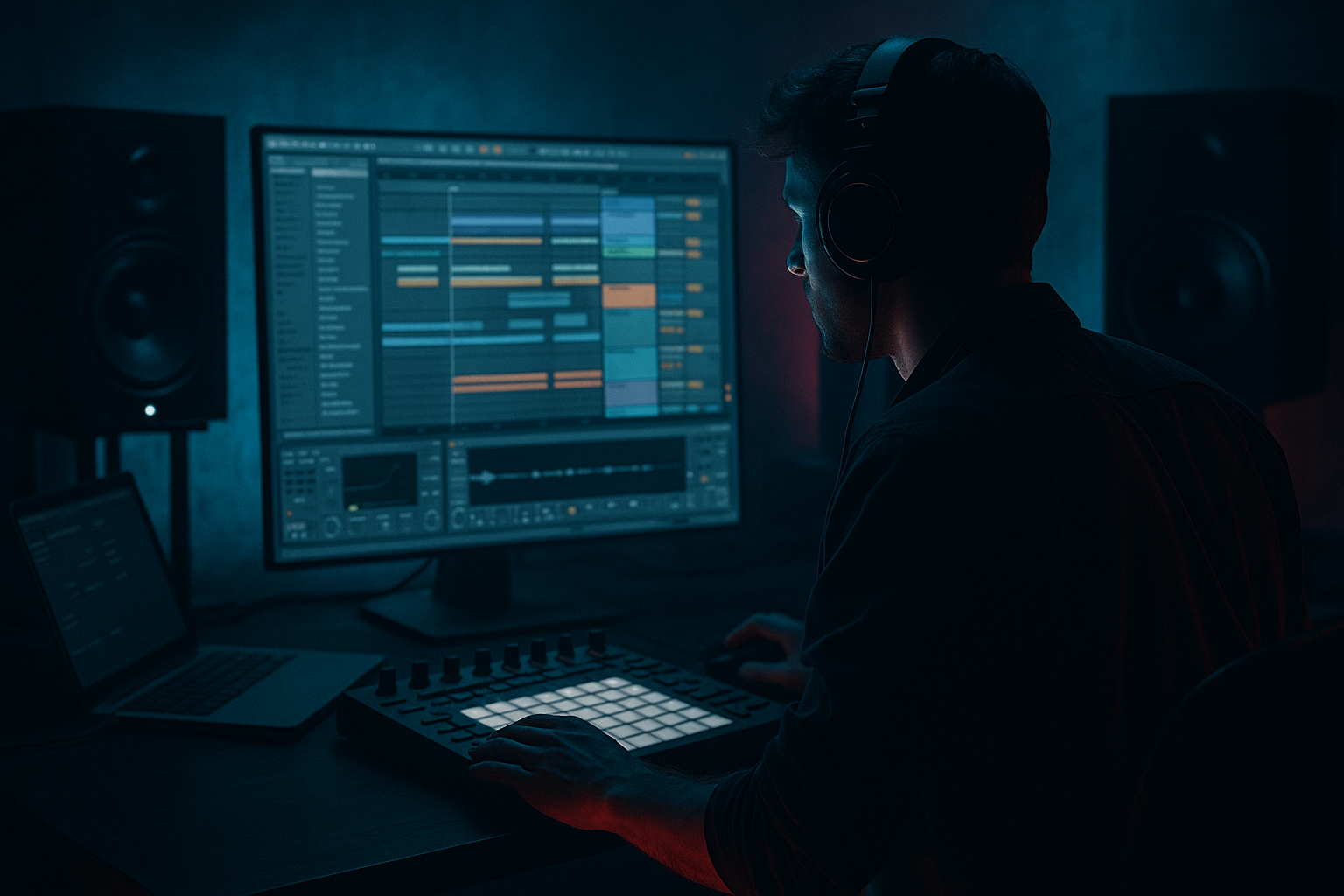
Main tutorial
Amen Ride Groove Carve: Oldskool Rave Pressure (Ableton Live 12) 🥁⚡
Category: Mixing (with groove/arrangement decisions that behave like mixing)
Skill level: Advanced (you already chop, resample, and mix breaks—this is about surgical groove control and ride dominance.)
---
1. Lesson overview
Oldskool jungle pressure often comes from the Amen’s “ride-ish” high-mid energy (the noisy, metallic, constant forward motion) being carved, steered, and automated so it drives the groove without turning into harsh fizz.
In Ableton Live 12, we’ll build a mix-centric workflow where you:
- Extract and shape the Amen’s ride presence
- Lock it into your modern DnB drum stack
- Control harshness dynamically
- Create rave-era tension/release using automation and arrangement moves
- Provides snare crack + ghost momentum
- Kept controlled and clean-ish so it doesn’t smear your sub/bass
- A dedicated high band designed to feel like constant, urgent ride/noise
- Shaped with dynamic EQ, saturation, transient shaping, and sidechain
- Automated to create oldskool rave lift in drops and switches
- Tempo: 160–174 BPM (try 172 for modern jungle roll)
- Project bit depth/sample rate: whatever you run—just be consistent.
- Drum group: Put all drums in a Group: `DRUMS`
- Inside, create tracks:
- Zoom in on transients (snare hit is easiest).
- If needed, use Track Delay (bottom of mixer) on `AMEN_RIDE`:
- Pick the setting where the ride energy adds instead of “tearing” the transient.
- Sidechain: SNARE (or a dedicated snare trigger)
- Ratio: 4:1
- Attack: 0.1–1 ms
- Release: 60–140 ms (time it to the groove)
- Threshold: aim for 2–6 dB GR only when snare hits
- 16 bars intro: filtered ride layer, low level
- 32 bar main: ride layer fully on
- 8 bar pre-switch: automate extra bite + more sidechain
- Switch/drop: momentary ride mute for 1 bar → slam back in (huge perceived impact)
- On `AMEN_RIDE` compressor sidechain from BASS BUS
- Ratio 2:1, fast attack, release 80–150 ms
- Only 1–3 dB GR
- On `AMEN_RIDE`, use EQ Eight in M/S mode:
- Making the ride layer full-range: If it still has lows/low mids, it’ll cloud the whole drum+bass relationship. Band-limit aggressively.
- Static harshness: If it’s bright, don’t only EQ—use dynamic control (Multiband Dynamics / compressor) so peaks don’t rip heads off.
- Over-gluing the drum buss: Too much Glue Compressor = dead break vibe.
- No snare priority: If the ride layer isn’t ducking around the snare, you lose that classic “snare owns the room” feeling.
- Ignoring automation: Oldskool pressure is movement. If it’s the same for 64 bars, it’ll feel like a loop, not a rave record.
- Push distortion lower, tame brightness after:
- Add “airless aggression” with a tighter LPF:
- Resample the ride layer and re-chop:
- Use Redux lightly for era vibe (but in parallel):
- Gate the ride for “machine pressure”:
- Split the Amen into Body and Ride pressure layers.
- Band-limit the ride layer hard, then saturate + transient shape it.
- Control harshness with dynamic processing, not only static EQ.
- Use sidechain to snare to keep rave-era impact and clarity.
- Automate EQ/filter/drive so the groove evolves like a proper jungle arrangement.
---
2. What you will build
A two-layer Amen system:
1) Amen Body (low/mid punch)
2) Amen Ride Layer (high-mid “pressure”)
You’ll end with a drum buss that feels like 94–97 urgency, but still translates like modern rolling DnB.
---
3. Step-by-step walkthrough
Step 0 — Session setup (fast but important)
- `AMEN_FULL`
- `AMEN_RIDE`
- `KICK` (your modern kick)
- `SNARE` (your modern snare)
- `HATS/FX` (optional)
> Goal: Amen gives vibe; your kick/snare provide modern impact.
---
Step 1 — Get the Amen groove “right” before mixing 🎯
On `AMEN_FULL`:
1. Drop your Amen loop (or chopped phrase) into Arrangement.
2. Warp mode: Complex Pro is okay for quick; Beats can be punchier.
- For classic break handling, try Beats → Preserve: Transients, then adjust.
3. Groove Pool:
- Extract groove from the Amen (right-click clip → Extract Groove).
- Apply that groove to your kick/snare MIDI (or audio) at 30–60%.
- Set Random: 0–5 (tiny humanization only).
Advanced note: You’re “mixing the feel.” If the groove relationship is wrong, no EQ will save it.
---
Step 2 — Split the Amen into Body vs Ride (the carve approach) 🪚
Duplicate `AMEN_FULL` → rename duplicate to `AMEN_RIDE`.
#### On `AMEN_FULL` (Body layer)
Insert this chain (in order):
1) EQ Eight
- HP filter: 24 dB/oct @ 120–180 Hz (depends how much low junk is in the break)
- Gentle dip: -2 to -4 dB around 300–500 Hz if boxy
- Optional: tiny shelf down -1 to -2 dB @ 8–12 kHz to leave room for the Ride layer
2) Drum Buss
- Drive: 3–8
- Crunch: 0–10 (keep subtle; we’re not frying the whole loop yet)
- Damp: adjust until harshness tucks back (5–12 kHz region typically)
- Boom: usually OFF here (let your sub and kick own the lows)
3) Glue Compressor
- Attack: 10 ms
- Release: Auto or 0.3 s
- Ratio: 2:1
- Aim for 1–3 dB GR on peaks
This keeps the Amen punchy, but not dominating the top end.
#### On `AMEN_RIDE` (Ride pressure layer)
This is the star. Build it like a band-limited weapon:
1) EQ Eight (band-limit hard)
- HP: 24 dB/oct @ 1.2–2.5 kHz (move until it feels like “ride/noise only”)
- LP: 12–24 dB/oct @ 10–14 kHz (don’t let it become pure air hiss)
- Add a bell boost: +2 to +6 dB @ 4–7 kHz, Q ~ 0.7–1.4
(find the metallic “rave blade”)
2) Saturator
- Mode: Analog Clip (or Soft Sine for smoother)
- Drive: 3–10 dB
- Output: trim to unity
- Turn on Soft Clip if it gets spitty
3) Drum Buss (for transient “stick”)
- Drive: 2–6
- Crunch: 10–25 (this is where the “cheap sampler” vibe can live)
- Damp: pull down until it’s aggressive but not sandpaper
- Transients: +5 to +20 (depends on how sharp you want the tick)
4) Multiband Dynamics (tame harsh spikes dynamically)
- Use it like a de-harsher:
- High band (e.g., 4 kHz–20 kHz): set to compress on peaks
- Threshold: so it grabs 2–5 dB on loud ride hits
- Ratio: 2:1–4:1
- Attack: 1–5 ms
- Release: 40–120 ms
5) Auto Filter (movement + arrangement control)
- Filter type: Band-Pass or High-Pass
- Add subtle envelope or automation later for builds
> This layer should feel like: forward motion + urgency + oldskool spray, not like a modern closed hat.
---
Step 3 — Phase/Timing alignment (don’t skip) 🧠
Because you duplicated audio, things might align—but warping, fades, or edits can cause tiny offsets.
- Try -5 ms to +5 ms micro nudges.
---
Step 4 — Sidechain the Amen ride to your snare (classic rave pump) 🔥
On `AMEN_RIDE`, add Compressor:
This makes the snare feel louder without raising snare level—very “rave system” behavior.
Optional: also sidechain lightly to the KICK (1–3 dB GR).
---
Step 5 — Create “pressure lanes” with automation (the real oldskool trick) 🎛️
Oldskool intensity is often arrangement automation, not just static EQ.
Automate these on `AMEN_RIDE`:
1. EQ Eight bell gain @ 4–7 kHz
- Verses/rollers: +1 to +3 dB
- Drops/peaks: +4 to +6 dB
2. Auto Filter cutoff
- Build-ups: gradually open from ~2 kHz → 7 kHz
- Drop: snap open, then subtly ride it
3. Saturator drive
- Add 1–3 dB more in the last 8 bars before a switch
Arrangement idea (very jungle):
That 1-bar removal is shockingly effective.
---
Step 6 — Drum buss glue without killing the ride 🧩
On the `DRUMS` group, do gentle buss processing:
1) EQ Eight
- Tiny low shelf cut if needed: -1 to -2 dB @ 60–100 Hz (only if kick/sub is messy)
- Tiny harsh dip: -1 to -3 dB @ 5–8 kHz if the ride is too hot overall
2) Glue Compressor
- Attack 30 ms (let transients through)
- Release Auto
- Ratio 2:1
- GR 1–2 dB max
3) Limiter (optional, safety)
- Ceiling: -0.3 dB
- Only catching occasional peaks (1–2 dB)
If you clamp the drum buss too hard, you’ll flatten the “spray” and it stops feeling like a break.
---
Step 7 — Make it sit with bass (masking control) 🧱
Ride pressure fights bass harmonics around 2–6 kHz (especially reese/top bass).
Two practical solutions:
Option A: Sidechain ride to bass (very subtle)
This keeps bass “speaking” without turning ride down.
Option B: Mid/Side carve on the ride
- Cut Mid slightly at 4–6 kHz (so vocals/lead/bass presence lives)
- Leave Sides brighter for width and rave wash
---
4. Common mistakes 🚫
---
5. Pro tips for darker/heavier DnB 🕷️
Saturate the ride layer for density, then filter/EQ to keep it dark but urgent. Dark doesn’t mean dull—think “black metal sheen,” not “blanket.”
Try LPF at 9–11 kHz with a steeper slope; boost around 4.5–6.5 kHz for bite.
Freeze/Flatten `AMEN_RIDE`, then slice tiny sections (1/16–1/32) and re-order for controlled chaos. This gives that techstep/jungle edge.
Put Redux on a Return track:
- Downsample: small amount (e.g., 2–8)
- Bit reduction: subtle
Blend return 5–15% into drums for crunchy lineage.
Use Gate keyed by a fast 1/16 hat trigger (ghost MIDI) so ride becomes rhythmic texture rather than constant hiss.
---
6. Mini practice exercise 🎓
Goal: Make a 32-bar loop that “levels up” every 8 bars without adding new drum samples.
1) Build the two-layer Amen setup above.
2) Create automation across 32 bars on `AMEN_RIDE`:
- Bars 1–8: Filtered (Auto Filter cutoff low), ride -6 dB
- Bars 9–16: Open cutoff, ride -3 dB
- Bars 17–24: Add +2 dB at 5–6 kHz + slightly more saturation
- Bars 25–32: Strongest sidechain to snare + 1-bar mute at bar 31 beat 4 → slam back at 32
3) Print (resample) the `DRUMS` group to audio and check:
- Is the snare still the loudest “event”?
- Does the ride feel like it’s pushing forward rather than hissing?
---
7. Recap ✅
If you want, tell me what tempo and what style you’re aiming for (94 jungle, techstep, modern rollers, or crossbreed), and I’ll suggest exact cutoff points and automation shapes that fit that substyle.

