Main tutorial
Lesson Overview
This lesson is about building a darkside Amen intro that feels like a real DnB record in motion, not just a loop with a break on it. You’re going to rebuild the opening energy around the Amen break, shape it into a controlled intro, and arrange it in Ableton Live 12 so it can lead cleanly into a drop, or hold its own as a moody DJ-friendly opening section.
This technique lives right at the front of a tune: the intro, breakdown-to-drop transition, or first 16–32 bars before the main impact. In darker DnB, that intro has to do several jobs at once: set mood, imply tempo and swing, leave space for the DJ to mix, and plant enough rhythmic identity that the listener knows the tune has attitude before the bass even fully arrives.
Musically, this matters because a dark Amen intro is one of the fastest ways to establish jungle heritage, urgency, and tension without overloading the arrangement. Technically, it matters because the Amen is dense in the mids and transients, so if you rebuild it carelessly you’ll get clutter, phase smear, and a weak low-end handoff when the bass enters. Done properly, the intro gives you movement without chaos, and a top layer that feels raw while still leaving room for the drop.
This best suits dark jungle, rollers with jungle DNA, half-time-to-half-step hybrid intros, neuro-leaning DnB openings, and ominous club cuts. By the end, you should be able to hear a finished intro that feels like: gritty, suspenseful, groove-led, and ready to hand off into a heavy drop without sounding disconnected.
What You Will Build
You will build a 16- or 32-bar darkside Amen intro in Ableton Live 12 using a rebuilt break, a restrained bass hint, atmosphere, and controlled automation.
The finished result should have:
- a brittle, old-sample Amen character with enough punch to feel alive
- tight rhythmic edits that create motion without turning into clutter
- a dark, tunnel-like atmosphere that frames the break
- a bass presence that teases the drop rather than fully revealing it
- enough polish to sit as a real intro section, not just a sketch loop
- DJ usability: the first bars should feel mixable, and the transition into the drop should be clear
- Make the Amen feel older than the track around it. A slightly degraded break tone against a cleaner bass line creates instant contrast. Use mild saturation and controlled EQ rather than fake lo-fi fog.
- Let the snare define the phrase. In darker DnB, the snare is often the emotional anchor. If the intro needs more menace, don’t just add more hits—make the snare land with space around it.
- Use call-and-response between break and bass tease. A short Amen answer can leave room for a bass stab, then the bass can answer back. That push-pull is a huge part of jungle-to-dark DnB energy.
- Keep octave discipline. If your intro bass starts creeping too high, it stops feeling like pressure and starts sounding like a lead. Keep the sub lane low and use midrange only as a hint.
- Build tension with subtraction. Removing one ghost note, one hat, or one tail right before the drop can feel heavier than adding another fill. In DnB, space is often the loudest effect.
- Resample for identity, not for convenience. One printed bar of a processed Amen can give the intro a signature rhythmic fingerprint. Use it as a transition detail, not as a crutch.
- Check the intro on the drop boundary with your master chain bypassed and engaged. If the handoff only works when the limiter is helping, your arrangement is doing too much of the heavy lifting in the wrong place.
- Use only stock Ableton devices
- Use only one Amen source
- Limit yourself to two bass layers maximum
- No more than one atmosphere layer
- Work in 8-bar phrases
- a 16-bar intro with:
- Can you identify the main phrase change at bar 9?
- Does the bass stay out of the way of the snare?
- Does the last bar create clear expectation for the drop?
- If you mute the atmosphere, does the intro still work rhythmically?
Success sounds like a section where the Amen is doing the talking, the atmosphere is pressing in around it, and the bass only steps forward where it counts. You should feel tension building bar by bar, with a clear sense of “something is coming” rather than just “this loop repeats.”
Step-by-Step Walkthrough
1. Start with a stripped arrangement shell
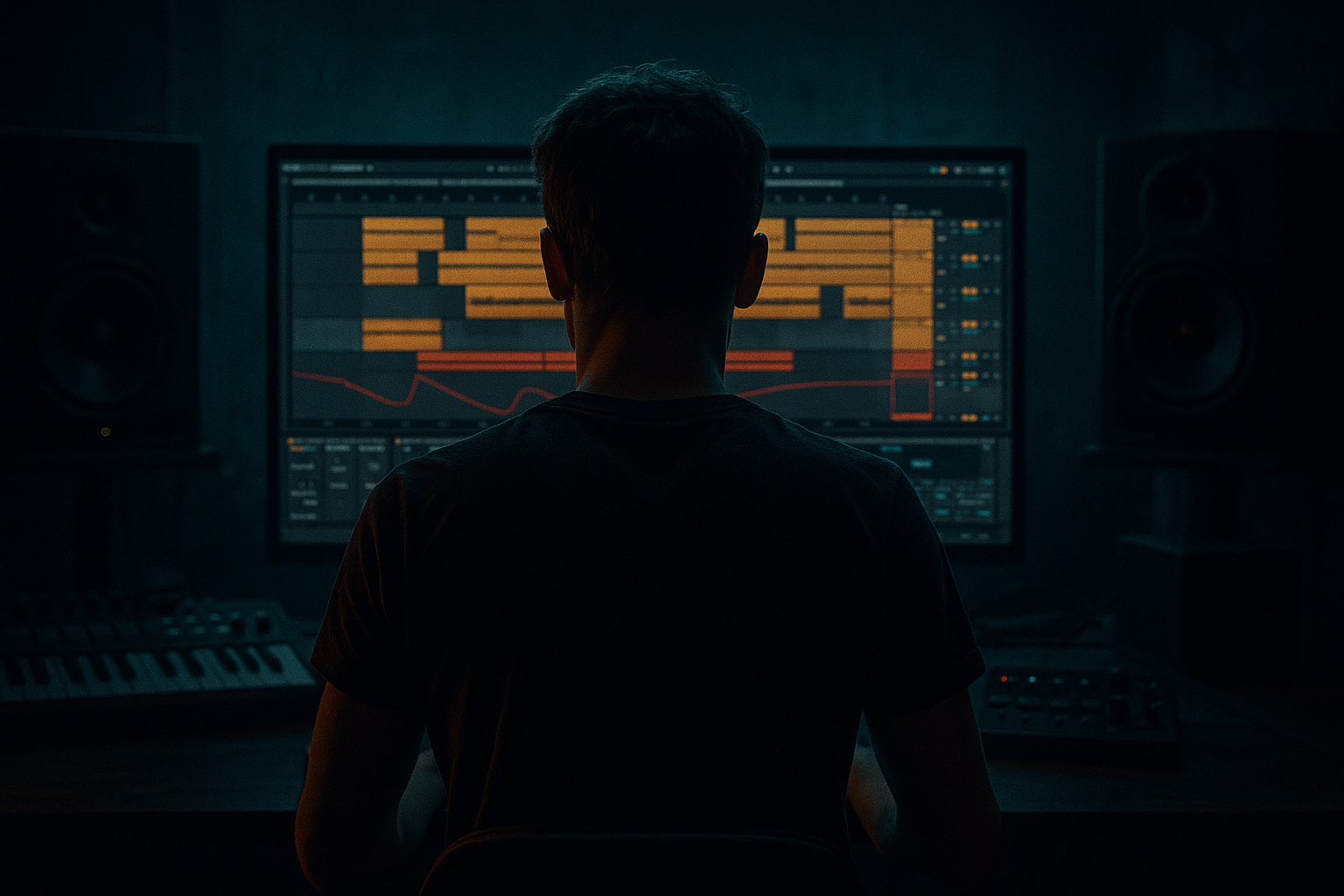
In Arrangement View, set up a clean 16-bar or 32-bar intro space. Put markers at bar 1, 9, 17, and 33 so you can think in DJ-friendly phrases from the start. This matters because dark DnB intros work best when they feel like proper sections, not random clip piles.
Build three lanes only at first:
- an Amen break lane
- an atmosphere/noise lane
- a bass tease lane
If you can keep the first pass this simple, you’ll make stronger choices later. The biggest workflow trap in DnB is overbuilding before the groove has a shape.
2. Find or create the Amen source and chop it into useful pieces
Drag an Amen break into Simpler or straight into an audio track, then slice around the most usable hits: kick, snare, ghost snare, hat, and any sharp crackle or tail you want to preserve. The goal is not to preserve the full break in one unbroken loop; it’s to rebuild the break as a pattern with intention.
A practical starting move:
- keep the first snare where it naturally gives the phrase identity
- isolate one clean kick for anchor points
- retain a couple of ghost hits for shuffle
- trim tails so the loop doesn’t smear across the bar
In Ableton, use clip gains and fades to control the chopped samples before you process them. This makes the edit cleaner than trying to fix everything downstream.
What to listen for: the break should still feel like one human performance, even though you’re rebuilding it. If every hit feels disconnected, the groove will lose its jungle identity.
3. Rebuild the rhythm with a dark intro logic, not a full drum roll
For a darkside intro, do not run the full Amen at full density from bar 1. Start with a reduced pattern: one anchor snare, one or two ghost hits, and selective kicks. Let the listener “discover” the break over the first 8 bars.
A useful structure:
- bars 1–4: sparse break fragments, mostly hats and ghost detail
- bars 5–8: add the main snare identity
- bars 9–12: add more kick punctuation and one extra break slice
- bars 13–16: introduce tension before the drop
This works in DnB because the intro needs arrival arc. If you give away the full rhythm immediately, you reduce the payoff later.
If your groove feels stiff, use Ableton’s Groove Pool with a subtle swing source and apply a modest amount only to the chopped break, not the whole mix. Keep the top end crisp. Too much swing on the full intro can make the drop feel late.
4. Shape the break with a simple stock-device chain
On the Amen drum bus, try this stock chain:
EQ Eight → Drum Buss → Saturator
Suggested starting points:
- EQ Eight: high-pass around 25–35 Hz to remove sub rubbish, and gently cut 250–400 Hz if the break feels boxy
- Drum Buss: drive lightly, around 5–15%, with Boom very restrained or off if the break already has enough low end
- Saturator: soft clip or mild drive, often in the 1–4 dB range of added harmonics rather than obvious distortion
Why this works in DnB: the Amen already has character. You’re not trying to redesign it, you’re trying to make the attack readable on club systems while keeping the old-school abrasion.
What to listen for: the snare should get more presence and the ghost hits should become audible without the break turning crunchy in a bad way. If the hats start spitting, back off the saturation before the EQ.
5. Create a bass tease that belongs to the intro, not the drop
Add a bass layer that hints at the drop’s language without fully occupying the space. For a darkside intro, this is often a single-note sub pulse, a filtered reese fragment, or a distant growl stab.
Two valid options here:
A. Sub-only tease
- Use Operator or Wavetable for a sine/sub tone
- Keep it low, short, and sparse
- High-pass any processing above the fundamental’s useful range
- Let it hit on the snare gaps or at phrase starts
B. Filtered reese tease
- Use Wavetable or a resampled detuned layer
- Low-pass aggressively so the top of the reese stays hidden
- Automate the filter open slightly across 8 bars
- Keep the stereo width narrow or mono in the intro
Decision point:
- Choose A if you want a cleaner, more ominous intro that preserves maximum drop contrast.
- Choose B if you want a more neuro/darker club tone with more midrange pressure before the drop.
In either case, the bass should feel like a shadow, not the main event.
6. Check the intro against the drums immediately
This is where a lot of producers go wrong: they design the Amen in isolation and only later discover the bass and kick are fighting the same pocket. Put your intro in context with at least a placeholder kick/snare backbone or the first bars of your actual drop drums.
Ask:
- Does the Amen snare still land clearly?
- Does the bass tease leave enough room for the kick fundamental and snare crack?
- Can the intro be mixed by a DJ without the low end becoming uncertain?
If the kick is getting masked, use EQ Eight on the bass tease and clear a small pocket around the kick’s impact area. If the snare feels dull, reduce midrange haze around 300–700 Hz in whatever atmosphere is sitting above it.
Stop here if the intro already feels strong with drums alone. Print or commit the break bus to audio if the pattern and tone are working, because overdrawing MIDI edits can kill momentum in a DnB session.
7. Add atmosphere as framing, not decoration
Dark Amen intros need air, but not polite ambient wash. Use a texture bed that sounds like pressure: rain noise, vinyl hiss, metallic room tone, reversed reverb, or a low rumble layer.
A practical chain for atmosphere:
Audio track with texture → EQ Eight → Reverb → Auto Filter
Suggested settings:
- EQ Eight: high-pass around 150–300 Hz so the texture doesn’t muddy the break
- Reverb: short-to-medium decay, often around 1.2–2.5 s depending on density
- Auto Filter: slow opening movement across 8 or 16 bars
Keep the atmosphere behind the break, not on top of it. The intro should feel like the room is darkening around the groove, not like a pad track with drums added later.
If the texture is too wide and eats the center, narrow it or reduce stereo spread. In darker DnB, the center must stay available for kick, snare, and later bass weight.
8. Automate tension with simple, deliberate moves
Use automation to shape the intro over 8- or 16-bar phrases. Don’t automate everything; automate the parts that define the section’s emotional shift.
Strong candidates:
- low-pass opening on the bass tease
- reverb send increasing slightly into the transition
- break bus saturation rising a touch before the drop
- atmosphere filter opening or closing depending on the mood
- a short delay throw on the last Amen hit before the switch
A useful phrasing example:
- bars 1–8: restrained, filtered, minimal bass
- bars 9–12: more break detail, slight filter opening
- bars 13–16: tension rises, last snare or fill gets a delay tail
- bar 17: drop impact
This gives the listener a clear runway. In DnB, clarity of phrase is what makes heaviness feel bigger.
What to listen for: the transition should feel inevitable. If the final bar sounds like “just another loop,” you need a more obvious tension move in the last 1–2 bars.
9. Use one resampled movement layer if the intro needs more identity
If the intro still feels too static, resample one bar of the Amen with processing, then re-edit that audio into a fill or turnaround. This is a very DnB-friendly workflow because it creates bespoke movement from your own material.
Example:
- route the Amen bus to a new audio track
- print one bar with the break processing and automation
- reverse a small slice, or cut the tail of a snare into the next bar
- place the result as a fill at bar 8 or 16
This can create a darker, more original opening gesture than a generic riser. It also keeps the intro rooted in the break itself, which is exactly what makes it feel authentic.
If the resample sounds too washed out, commit less reverb or shorter tails. The fill should punch through, not blur into a cinematic cloud.
10. Finish the intro with a clear transition into the drop
The intro must hand off cleanly into the main section. In a dark DnB tune, that usually means one of three endings:
- a hard cut to the drop
- a short stop followed by the first kick/snare of the drop
- a fill that empties the center, then the bass slams in
Keep the last 1–2 bars slightly more sparse than you think. That negative space makes the drop feel louder. If you overfill the final bars, the first drop bar loses impact and the DJ mix gets messy.
A useful final check is to solo the intro ending into the first bar of the drop. If the handoff feels like two different ideas stitched together, revise the last phrase so the transition is rhythmically and tonally connected.
Common Mistakes
1. Using the full Amen loop from the first bar
- Why it hurts: the intro loses tension and sounds more like a loop than an arrangement.
- Fix: start with a reduced slice pattern and add density in 4- or 8-bar phases.
2. Over-processing the break into white noise
- Why it hurts: the ghost notes, snare character, and swing get flattened.
- Fix: reduce Saturator/Drum Buss drive, then use EQ Eight to cut mud instead of adding more distortion.
3. Letting the bass tease fight the kick or snare
- Why it hurts: the low end becomes unclear and the intro stops translating on club systems.
- Fix: keep the intro bass narrow, high-pass unnecessary lows, and check the loop with your actual drum backbone.
4. Making the atmosphere too wide and loud
- Why it hurts: the center image gets crowded and the break loses definition.
- Fix: high-pass the texture, pull it back in level, and keep the main drum/bass energy centered.
5. Skipping phrase planning
- Why it hurts: the intro feels random and the drop doesn’t land as a proper event.
- Fix: work in 8- or 16-bar blocks and assign one job to each phrase, such as “introduce,” “build,” “peak,” and “release.”
6. Not checking mono compatibility
- Why it hurts: reese layers, wide ambience, or stereo FX can disappear or hollow out in clubs.
- Fix: keep sub and core drum hits centered, and reduce width on any intro bass that depends on phasey stereo movement.
7. Trying to keep every edit in MIDI forever
- Why it hurts: the session gets cluttered and the groove stops evolving.
- Fix: commit winning break processing to audio when the feel is right, then continue arranging from that printed version.
Pro Tips for Darker / Heavier DnB
Mini Practice Exercise
Goal: Build a 16-bar darkside Amen intro that can realistically lead into a drop.
Time box: 15 minutes
Constraints:
Deliverable:
- a rebuilt Amen pattern
- one bass tease
- one atmosphere bed
- one transition fill into bar 17
Quick self-check:
Recap
A strong darkside Amen intro in Ableton Live 12 is built from controlled break reconstruction, careful phrase planning, and deliberate tension management. Keep the Amen readable, let the bass tease rather than dominate, use atmosphere as framing, and shape the section in 8- or 16-bar blocks so the drop feels earned.
The big win is this: movement without clutter, menace without mush, and a handoff that makes the drop hit harder because the intro knew when to hold back.

