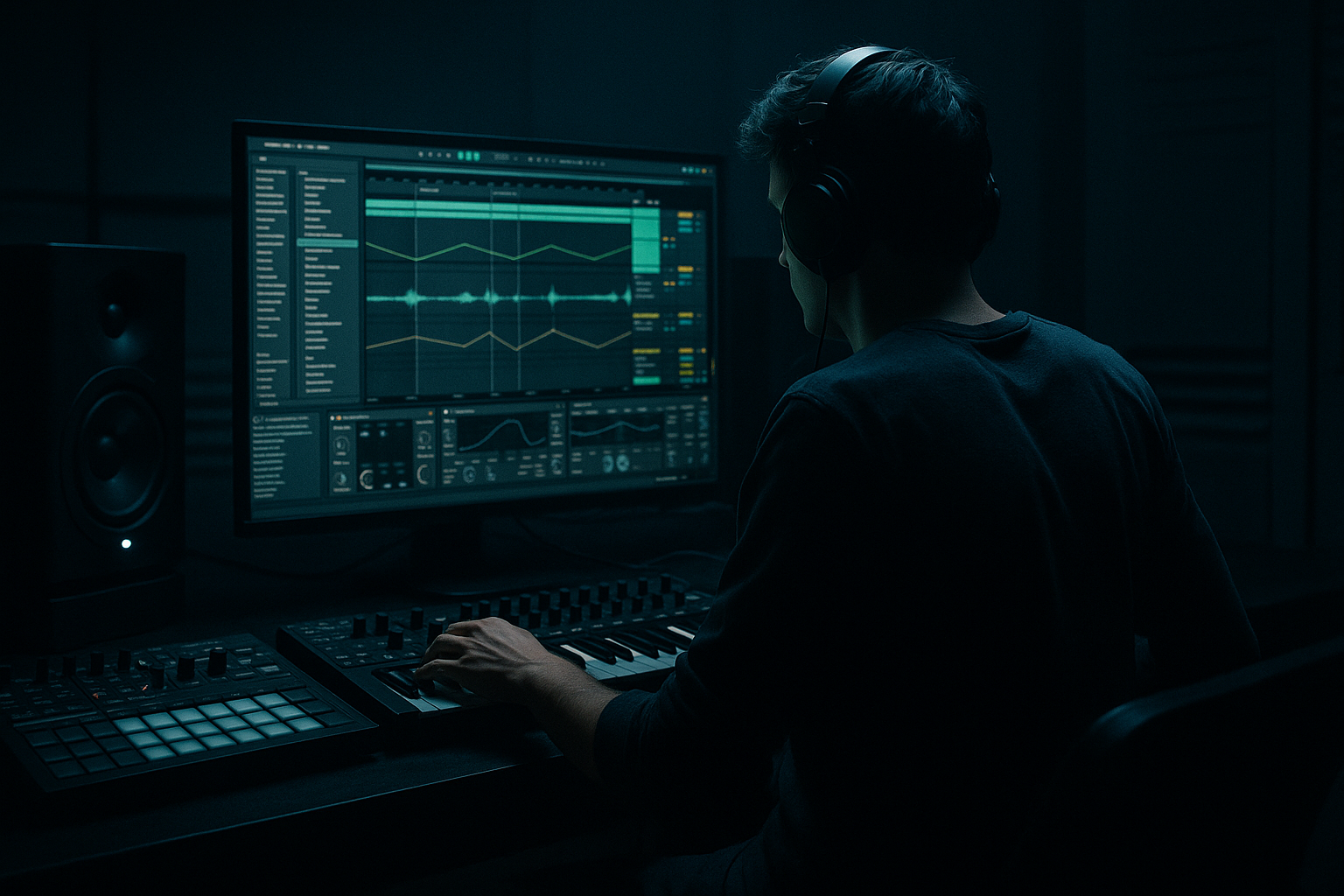
Main tutorial
Lesson Overview
This lesson is about building an Amen Science top-loop distort in Ableton Live 12: a top-layer break treatment that keeps the Amen’s jungle identity intact while pushing it into a more aggressive, club-ready DnB lane. The goal is not to destroy the break into static chaos. It’s to create a controlled, distorted top loop that adds grit, forward motion, and density above your kick, snare, and sub.
In a DnB track, this technique usually lives in the drum top layer: above the main kick/snare, underneath FX sparkle, and often interacting with the main bass hook or reese. It works especially well in dark rollers, jungle-influenced halftime, techno-DnB, neuro-adjacent drum writing, and hard club tools where the drums need character without stealing low-end authority.
Why it matters musically: a good top-loop distort can make a loop feel like it’s breathing, chewing, and spitting instead of just playing back. Why it matters technically: the top loop creates movement and urgency without adding sub clutter, and it gives you a place to apply aggression without wrecking the core drum transient structure.
By the end, you should be able to hear a top loop that feels raw, stable, and intentional: crunchy enough to cut, edited enough to stay in time, and shaped enough to sit around the kick, snare, and bass rather than fighting them. A successful result should feel like the break is infected with heat, but still usable in a proper DnB arrangement.
What You Will Build
You will build a distorted Amen top loop that functions as a DJ-useful, mix-ready drum layer for a DnB drop.
Sonically, it should have:
- a cracked, broken-air texture from the Amen’s hats, rides, and ghost detail
- clipped or saturated edge without turning into white-noise mush
- enough transient shape to reinforce the snare and forward groove
- controlled stereo width so the top end feels wide, but the core remains mono-safe
- a rhythmic feel that drives hard on offbeats and ghost notes, not just on the backbeat
- a hype layer above the main drums
- a tool for switch-up energy in 8- or 16-bar phrasing
- a texture that can evolve between the first drop and second drop
- something you can chop, automate, or resample into fills and transitions
- Push the distortion before filtering if you want a more brutal, torn texture; filter after if you want the grit to feel more controlled and DJ-clean.
- For menace, let the Amen top loop sit slightly behind the snare transient, not directly on top of it. A tiny bit of space can make the whole groove feel more ominous.
- If the bassline is very active, simplify the top loop to only its strongest hat/snare fragments. In heavier DnB, less top-loop information often reads as more power.
- Use resampling with subtle clip automation to create evolution across 8 or 16 bars. Small increases in drive at phrase endings can feel huge in a club.
- In neuro-leaning material, keep the top loop mostly mono-compatible and rhythmically stable, then let the bass provide the extreme movement. That separation makes the whole mix feel more expensive.
- For underground roller pressure, try a darker print with the top loop rolled off above 10–12 kHz, then bring brightness back only in fills or transition bars.
- If you want a more ruthless edge, duplicate the loop and make one copy extremely short and dirty, then tuck it low in the mix as a texture rather than a full-time feature.
- Use only Ableton stock devices.
- Keep the loop as a top layer only: no sub information below roughly 180 Hz.
- Make exactly two versions: one cleaner and one dirtier.
- The loop must work over a kick, snare, and bass part.
- A printed 4-bar top loop in two variants:
- Mute the loop. Does the drop lose urgency but keep its core punch?
- Switch to mono. Does the loop still feel present without collapsing?
- Does the snare still dominate the backbeat, or has the loop taken over?
- high-pass the source and protect the low end
- distort in stages, not all at once
- keep the groove readable after processing
- check the loop in context with kick, snare, and bass
- make deliberate stereo choices and verify mono
- commit the winner to audio and arrange it by phrase
In the track, it should act as:
Polish level: it should be finished enough to use in a release draft, not a sketchy sound-design experiment. The success criterion is simple: when you mute it, the drop should lose grime and urgency; when you unmute it, the groove should feel more alive without losing punch or low-end clarity.
Step-by-Step Walkthrough
1. Start with the right Amen source and isolate the top-function
Load an Amen break into an Audio Track and slice it into a clean loop at your project tempo. For this lesson, choose a section where the hats, ride bleed, and ghost snare texture are strong. You do not need the full-range break as-is; you need the part that can survive distortion and still read as a groove.
In Ableton Live, trim the clip so the loop is tight and musical. If there’s too much kick weight in the source, either:
- use EQ Eight and high-pass around 180–250 Hz to turn it into a true top loop, or
- duplicate the break and keep one copy as the top loop while the other remains the full break.
Why this works in DnB: the top loop can take more abuse than the main drum foundation. Leaving the sub and punch to the main kick/snare or drum layer keeps the mix cleaner and lets you push the amen harder.
What to listen for: after the high-pass, you should still hear the shape of the break—the rhythm, ghost notes, and hat swing. If it turns thin and static, you’ve filtered too aggressively or chosen the wrong slice.
2. Decide: A) raw chop or B) lightly re-grooved chop
This is your first creative decision point.
A) Raw chop: keep the Amen as a continuous audio loop, then distort it as a whole. This gives a more old-school, torn, continuous texture. It’s strong for jungle pressure and hazy roller grime.
B) Lightly re-grooved chop: use Warp and cut the loop into a few musical regions so you can nudge the ghost hits or re-order tiny details. This works better if the loop needs to lock to a modern, straighter DnB grid.
In Live, if you choose B, keep changes minimal. Don’t over-edit the Amen into a robotic pattern; the point is to preserve the organic push-pull.
Trade-off: A is better for character and speed. B is better for precision and arrangement control. If your kick/snare are already very programmed, A often sounds more alive. If your drop is hyper-tight neuro or techy DnB, B gives you more control.
3. Build a stock-device distortion chain that preserves the groove
Put these devices on the top loop in this order:
EQ Eight → Saturator → Drum Buss → Utility
Suggested starting ranges:
- EQ Eight: high-pass 180–250 Hz, gentle dip around 3–5 kHz if the hats get brittle, small shelf if needed above 8–10 kHz
- Saturator: Drive around 2–6 dB, Soft Clip on if it helps stabilize peaks
- Drum Buss: Drive modestly, Boom mostly off or very low for a true top loop, Crunch lightly if you want extra rasp
- Utility: reduce width if the source is too smeary; test mono compatibility here
Don’t slam everything at once. The point is layered aggression, not instant flattening.
What to listen for: the loop should get denser and dirtier, but the snare accents and hat motion should still be readable. If the distortion turns the groove into a constant hiss, back off the drive or raise the high-pass point slightly.
4. Shape the transient attack so the loop stays percussive
After distortion, use Drum Buss or a small amount of Transient shaping via Amp-like saturation behavior from the distortion chain to keep the loop from becoming a flat sheet of noise. If Drum Buss is doing too much, reduce Drive and use it more as a tone shaper than a crusher.
Useful settings to try:
- Drum Buss Drive: light to moderate
- Transients/attack emphasis: enough to let the snare crack through
- Damp if the top becomes fizzy around the upper highs
- Keep Boom minimal unless you’re intentionally making the top loop part of a bigger drum bus texture
If the loop loses punch after distortion, your fix is usually not “more distortion.” It’s often less low-mid residue and a more careful transient balance.
Stop here if the loop no longer reads as a break. If it sounds like random noise with no internal phrasing, you’ve gone too far and need to pull back the distortion or restore more dry signal.
5. Create motion with filtering and resampling, not endless modulation
For Amen Science, movement should feel musical and edited, not like a synth patch wobbling for its own sake. Automate EQ Eight or Auto Filter to create subtle section movement:
- low-pass or band-limit for breakdowns: roughly 6–10 kHz for a darker section
- reopen in the drop with a gradual rise in brightness
- automate a small narrow dip if one hat frequency gets painful
A strong workflow here is to resample the treated loop to audio after you find a sound that works. Commit the chain to audio, then chop that printed loop into 1-bar or half-bar variations.
Why this works: resampling forces decisions. In DnB, especially at advanced level, a printed top loop is easier to arrange, easier to automate in sections, and less likely to drift into endless tweak mode.
Workflow efficiency tip: once the loop feels good, freeze/flatten or resample it immediately into a new track called something clear like “Amen Top Print.” This keeps your project lighter and makes later arrangement moves faster.
6. Lock it against the drums and bass in context
Now play the loop with your kick, snare, and bass. This is where the idea either becomes a real DnB tool or stays a cool loop in isolation.
Check:
- Does the snare still hit with authority, or is the top loop crowding its transient?
- Does the loop add urgency between the kick/snare anchors, or does it smear the pocket?
- Does the bass still have room in the low-mid region?
If the top loop competes with the snare crack, try a narrow dip around 2–4 kHz. If it fights the bass’s upper harmonics, reduce density around 200–500 Hz and keep the top loop more airy.
For heavier rollers, the loop should feel like it’s leaning forward into the snare, not sitting on top of it. If it pulls the groove backward, shorten the clip, reduce sustain, or strip out one repeated hat hit.
What to listen for: the best version makes the whole drop feel faster without actually increasing BPM. That’s the sign the top loop is adding motion correctly.
7. Choose your stereo strategy deliberately
This is where many top-loop chains go wrong. You want width, but not chaos.
Two valid options:
A) Narrow and brutal
- Use Utility to keep the loop fairly centered
- Best if the drop is very bass-heavy, dark, or minimal
- Good for neuro-influenced tunes where the sides belong to FX and bass movement
B) Wide but controlled
- Keep high-frequency content slightly wider
- Best if the track needs more air, jungle openness, or rave shimmer
- Useful when the main bass is very mono and the drums need space around it
If you go wide, check mono. If the loop loses too much presence in mono, reduce width or pull back any stereo-enhancing processing. Top loops can sound huge in stereo and suddenly feel weak in a club if the core hat/snare energy disappears in mono.
Mix-clarity note: the kick, sub, and snare fundamentals should survive the top loop’s processing. The loop should be a frame, not the picture.
8. Program phrasing so it functions like a DJ tool
Think in 4-bar and 8-bar language. A strong Amen top loop in DnB shouldn’t just repeat forever. It should support arrangement moves:
- bars 1–4: dry or moderately distorted loop
- bars 5–8: introduce a tighter filter or more crunch
- bar 9 or bar 17: mute a fragment for a fake-out
- second 8 bars: swap the ending hit or add a reverse slice
For a club-oriented arrangement, let the top loop answer the bass. If the bass line has a strong phrase on bars 1 and 3, leave space there and let the top loop fill the gaps on the “and” placements or ghost spaces.
A simple arrangement example: in the first drop, keep the Amen top loop mostly straight. In the second drop, print an extra distorted pass and chop a 1/2-bar stutter at the end of every 8 bars. That gives the DJ-friendly first half clarity and the second-half evolution.
This is what a successful result should feel like: the listener should feel momentum and grime building without losing the ability to follow the kick, snare, and bass relationship.
9. Add one controlled transition layer, not a stack of clutter
To make the top loop hit harder in the arrangement, layer one transition element only if it serves the phrase:
- a short reverse Amen slice
- a filtered snare pickup
- a one-bar noise swell with Auto Filter
- a tiny delayed fill printed from the same loop
Keep it tight. The idea is to punctuate the loop, not bury it under FX.
If you want a stronger drop lead-in, automate the top loop through a narrow band-pass for the last bar before the drop, then open it back out on impact. That gives you a clear tension-and-release function without destroying the identity of the break.
10. Commit the winner and build variations
Once one version is clearly working, commit it. This is the moment to create:
- a cleaner variation for breakdowns
- a more distorted variation for the main drop
- a chopped fill version for turnarounds
- maybe one version with less high end for the second drop intro
Don’t keep all of these live in one chain if the sound is already doing the job. Print them. A committed top loop is faster to arrange, easier to mix, and more likely to make the track feel finished.
A versus B recap: if you need maximum grime, commit the rawer printed pass. If you need more mix polish, commit the cleaner version and automate distortion toward the ends of phrases rather than across the whole loop.
Common Mistakes
1. Distorting the entire Amen full-range
- Why it hurts: the kick and lower snare body get smeared, and the loop starts fighting the bass.
- Fix: high-pass first with EQ Eight around 180–250 Hz and distort only the top loop layer.
2. Over-brightening the hats
- Why it hurts: the loop becomes harsh, fatiguing, and cheap-sounding in a club.
- Fix: use a gentle dip around 3–5 kHz or tame the top shelf above 8–10 kHz.
3. Too much stereo widening
- Why it hurts: the loop sounds impressive solo but weakens in mono and steals focus from the drums.
- Fix: pull width back with Utility and re-check mono before keeping the widening.
4. Flattening the transient with excessive saturation
- Why it hurts: the groove loses its bounce and the break stops reading as a break.
- Fix: reduce Drive, back off Drum Buss, and restore more dry signal.
5. Looping too many bars without variation
- Why it hurts: the track stalls and the Amen stops functioning as a DJ tool.
- Fix: create 4-bar or 8-bar phrase changes, even if they’re tiny, such as a filtered bar or a missing ghost hit.
6. Letting the loop fight the snare
- Why it hurts: the main backbeat loses authority and the drop feels smaller.
- Fix: carve a narrow pocket around the snare crack, usually somewhere in the 2–4 kHz region, and reduce any overhanging transient residue.
7. Leaving the top loop uncommitted for too long
- Why it hurts: endless tweaking slows arrangement and makes the project feel unfinished.
- Fix: resample the winning version and move forward with printed audio.
Pro Tips for Darker / Heavier DnB
Mini Practice Exercise
Goal: build one usable Amen Science top-loop distort that can sit in an actual DnB drop.
Time box: 15 minutes.
Constraints:
Deliverable:
- Version A: tighter, cleaner, more mix-friendly
- Version B: harsher, more aggressive, more second-drop-ready
Quick self-check:
Recap
The best Amen Science top-loop distort in Ableton is not about wrecking a break. It’s about shaping a break into a controlled layer of tension, grit, and forward motion.
Remember the essentials:
If it sounds like a dirty, breathing top layer that makes the drop hit harder without clouding the mix, you’re doing it right.

