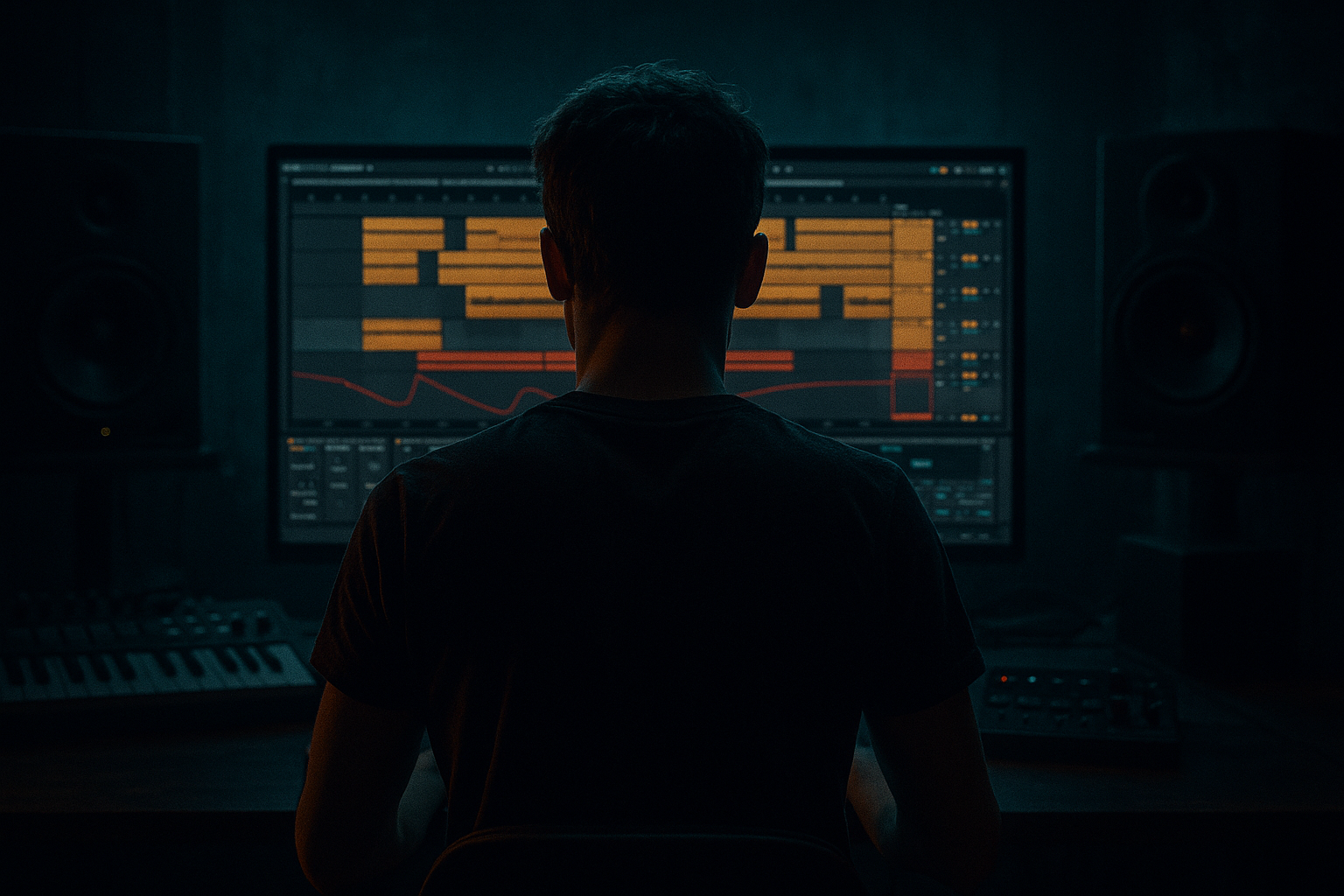
Main tutorial
Amen Science Chop Widen Tutorial (Automation‑First) — Ableton Live 12 (Advanced, Resampling) 🥁🧪
1) Lesson overview
In this lesson you’ll build a modern “Amen science chop” workflow for drum & bass/jungle using an automation-first mindset in Ableton Live 12. The goal is to create tight, evolving, stereo-wide amen edits that still hit hard in mono—then resample them into new audio to lock in vibe and make further chopping fast. 🎛️
Key themes:
- Automation-first: you’ll write movement before you commit.
- Widening with intent: stereo width on select layers/moments, not the whole break.
- Resampling as sound design: freeze the best moments into new material.
- A clean chopped Amen rack (tight transients, controlled tails)
- A “science” automation lane set (pitch, filter, width, reverb throws, bit reduction)
- A widened “air” layer that sits above a mono-solid core
- A resampled, print-ready amen loop pack (4–16 bars) you can reuse in rolling DnB arrangements
- In the Drum Rack, pick the main kick/snare slices and tighten their start times in Simpler (Sample tab) so transient hits immediately.
- Turn Warp OFF inside Simpler unless you need it (you usually don’t for micro-slices).
- Add Utility
- In Arrangement View, draw a 2–4 bar MIDI pattern triggering slices.
- Use classic Amen logic:
- Bar grid 1/16:
- Utility → Width
- Auto Filter → Frequency
- Reverb (send or insert) throw
- Drum Buss → Transients
- Saturator → Drive
- Redux (on AIR only)
- Pitch dives (best done in Simpler per slice, or via clip transposition if resampling)
- Gate pumping
- Freeze `Amen AIR (Wide)` and `Amen CORE (Mono)` separately.
- Flatten both, then blend them as audio.
- `Amen_ScienceWide_174bpm_8bar_v01`
- Take the resampled audio and Slice to Drum Rack again for “second-generation” edits—this is where wild DnB fills come from.
- Intro (16 bars): filtered AIR, minimal CORE hits, lots of space
- Drop (32 bars): full CORE + controlled AIR width automation (don’t max it constantly)
- Mid-section (16 bars): switch to a different resample (variation)
- Second drop: bring back the best resample + heavier processing
- Widening the low end: if your AIR chain has lows, your mix will get phasey and weak in mono.
- Too much constant width: if everything is wide, nothing feels wide. Use width like seasoning.
- Over-warping the Amen: heavy warp markers can kill the groove and transient snap.
- Printing without headroom: resample peaks too hot and you’ll bake in distortion you can’t undo.
- Too many “science” moments: the ear needs a stable groove to feel the edits as exciting.
- Parallel distortion on CORE: duplicate CORE, smash with Roar (if available) or Saturator + Overdrive, low-pass at 6–8 kHz, blend quietly.
- Rumble control: if the Amen has nasty low-mid mud, use Multiband Dynamics (gentle) or dynamic EQ moves (EQ Eight with automation).
- Stereo discipline: keep CORE near-mono; widen only AIR above ~250–400 Hz.
- Transient hierarchy: if you have a big reese and kick, keep Amen kick slices lighter—let the break be texture + snare attitude.
- Print variations: resample 3–5 versions:
- You built a CORE (mono punch) + AIR (wide texture) Amen system.
- You wrote automation first (width, filter, throws, grit) to “perform” science chops.
- You resampled the performance into fresh audio for faster, cleaner second-stage chopping.
- You kept it DnB-functional: groove first, edits second, stereo with discipline. ✅
---
2) What you will build
You’ll end up with:
---
3) Step-by-step walkthrough
A. Session setup (DnB-ready foundation)
1. Tempo: set to 170–176 BPM.
2. Create tracks:
- `Amen CORE (Mono)`
- `Amen AIR (Wide)`
- `Amen RESAMPLE (Audio)`
3. Turn on Warp globally (Preferences), and set your default Warp mode for drums to Beats.
Pro workflow tip: Color-code your tracks and name them aggressively. When you’re printing/resampling a lot, clarity is speed. ⚡
---
B. Import & prep the Amen (clean slicing + consistent timing)
1. Drop your Amen (or any classic break) onto Amen CORE.
2. In Clip View:
- Warp: ON
- Warp Mode: Beats
- Preserve: Transients
- Envelope: 0% (keeps it tight)
- Adjust Start Marker so the first kick is exactly on 1.1.1.
3. Consolidate a clean loop:
- Select 1–2 bars that loop perfectly → Cmd/Ctrl + J.
Optional (advanced): If the break is messy, use Warp Markers to lock key hits (kick/snare) to the grid, but don’t over-warp ghost notes—keep swing.
---
C. Slice to a Drum Rack (chop control + science edits)
1. Right-click the clip → Slice to New MIDI Track.
2. Settings:
- Slice by: Transient
- Create one slice per: Transient
- Slicing preset: Built-in → “Slice to Drum Rack” (default is fine)
3. Now you have a Drum Rack on a new MIDI track. Rename it `Amen CHOPS`.
Clean up slices quickly (advanced):
---
D. Build the “CORE vs AIR” layering (mono punch + stereo spice)
We’ll duplicate the Chop track into two processing lanes.
1. Duplicate `Amen CHOPS` twice:
- `Amen CHOPS - CORE`
- `Amen CHOPS - AIR`
2. Route them into groups:
- Group CORE chain into `Amen CORE (Mono)`
- Group AIR chain into `Amen AIR (Wide)`
#### CORE chain (keep this mostly mono + punchy)
On `Amen CHOPS - CORE`, add:
1. EQ Eight
- HPF at 30 Hz (24 dB/oct)
- Small dip 250–400 Hz (‑2 to ‑4 dB) if boxy
2. Drum Buss
- Drive: 5–15%
- Crunch: 10–25%
- Boom: 0–10% (careful—Amen already has low bump)
- Transients: +5 to +20
3. Saturator
- Mode: Soft Sine
- Drive: 2–6 dB
- Output: trim to match level
Mono control:
- Width: 0–30% (yes, narrow/mono the core)
- Gain adjust to taste
#### AIR chain (stereo width + movement, but filtered)
On `Amen CHOPS - AIR`, add:
1. EQ Eight
- HPF at 200–400 Hz (steep-ish, 24 dB/oct)
- Optional: gentle shelf boost 6–10 kHz (+1 to +3 dB)
2. Auto Filter
- Mode: Band-Pass or High-Pass
- Add resonance 10–25%
3. Chorus-Ensemble (Ableton stock; great for width)
- Mode: Ensemble
- Rate: 0.15–0.40 Hz
- Amount: 20–40%
- Width: 120–200% (yes, over 100 can be cool here)
4. Utility
- Bass Mono: ON
- Width: automate (we’ll do this next)
Why this works: You’re widening only the top/texture, while the core remains punchy and mono-safe. Classic DnB engineering. ✅
---
E. Automation-first “Science Chop” movement (write the tricks before resampling) 🧬
You’re going to create macro-style movement with automation lanes that “perform” the break.
#### 1) Create a performance clip (MIDI edits)
- Keep snare on 2 and 4 most of the time
- Add ghost notes and stutters before snares
- Use one or two signature “science moments” per bar (don’t spam)
DnB pattern idea (1 bar starting point):
- Kick-ish slice on 1
- Snare on 2
- Kick/ghost around 2e / 2a
- Snare on 4
- Add a 1/32 or 1/16 stutter leading into 4
#### 2) Automation lanes to write (CORE + AIR)
In Arrangement View, automate these on the group tracks, not per slice (faster + cohesive):
On `Amen AIR (Wide)` group:
- Verses: 80–110%
- Fills / “science” hits: jump to 150–200% briefly (1/8–1/4 bar)
- Sweep up into snare fills (e.g., 800 Hz → 6 kHz over 1/2 bar)
- Use Reverb or Hybrid Reverb on a Return track
- Automate Send amount on select snare chops only (1/16–1/8 bursts)
On `Amen CORE (Mono)` group:
- Punch up on downbeats: +10 to +20
- Pull back during busy fills: 0 to +5
- Micro-boost into drops: ramp +1–2 dB over 2 bars
#### 3) “Micro-variation” automation tricks (the science part)
Add one or two of these (tastefully):
- Downsample: automate between 0.0 → 2.0 for glitchy bursts
- Bit Reduction: 0 → 3–5
- For a signature “yoi” style pitch: automate Transpose -2 to -7 semitones for a single chop moment, then snap back
- Use Auto Pan set to Phase 0° (acts like tremolo)
- Rate: 1/8 or 1/16
- Amount: automate from 0% → 40% on fills
Automation-first rule: Write movement like you’re “DJing” the break—then print it. 🎚️
---
F. Resampling workflow (print the magic, then go deeper) 🎧
Now we commit your automation + width into fresh audio.
#### Option 1: Resample internally (fast)
1. Create `Amen RESAMPLE` audio track.
2. Set Audio From:
- Choose `Amen CORE (Mono)` + `Amen AIR (Wide)` via:
- Route both groups to a new Amen BUS group, or
- Set them to Sends Only and capture the master (less ideal)
3. On `Amen RESAMPLE` set Audio From: Amen BUS → Post FX.
4. Arm `Amen RESAMPLE`.
5. Record 8–16 bars while your automation plays.
#### Option 2: Freeze/Flatten (clean prints per track)
After recording: Consolidate the best 4–8 bars (Cmd/Ctrl + J). Name it something like:
---
G. Post-resample tightening (make it mix-ready)
On `Amen RESAMPLE`:
1. EQ Eight
- HPF 25–35 Hz
- If harsh: dip 7–10 kHz (‑1 to ‑3 dB, wide Q)
2. Glue Compressor
- Attack: 3–10 ms
- Release: Auto
- Ratio: 2:1
- Aim: 1–3 dB gain reduction max
3. Limiter (safety, not loudness)
- Ceiling: ‑0.8 dB
- Only shaving peaks
Now re-chop (advanced):
---
H. Arrangement ideas (rolling DnB context)
Try a classic structure:
DnB trick: Automate width down right before a drop, then snap wide on the first hit. The contrast feels huge. 🔥
---
4) Common mistakes
---
5) Pro tips for darker/heavier DnB 🕶️
- “Dry/tight”
- “Wide/airy”
- “Redux/glitch”
- “Reverb throws”
- “Distorted dark”
---
6) Mini practice exercise (15–20 minutes) ⏱️
1. Build CORE + AIR chains as above.
2. Write a 4-bar Amen chop pattern.
3. Automate:
- AIR Utility Width: 90% → 180% on the last 1/2 bar of every 4 bars
- Auto Filter sweep on AIR into bar 4
- One Reverb throw on a snare in bar 4
4. Resample 8 bars.
5. Slice the resample again and create one new 2-bar fill using only second-gen slices.
Deliverable: Export a 16-bar loop with two different fills (bars 8 and 16).
---
7) Recap
If you want, tell me your target substyle (jungle, neuro, jump-up, rollers) and I’ll suggest a specific Amen chop MIDI grid, plus a bus chain that fits that vibe.

