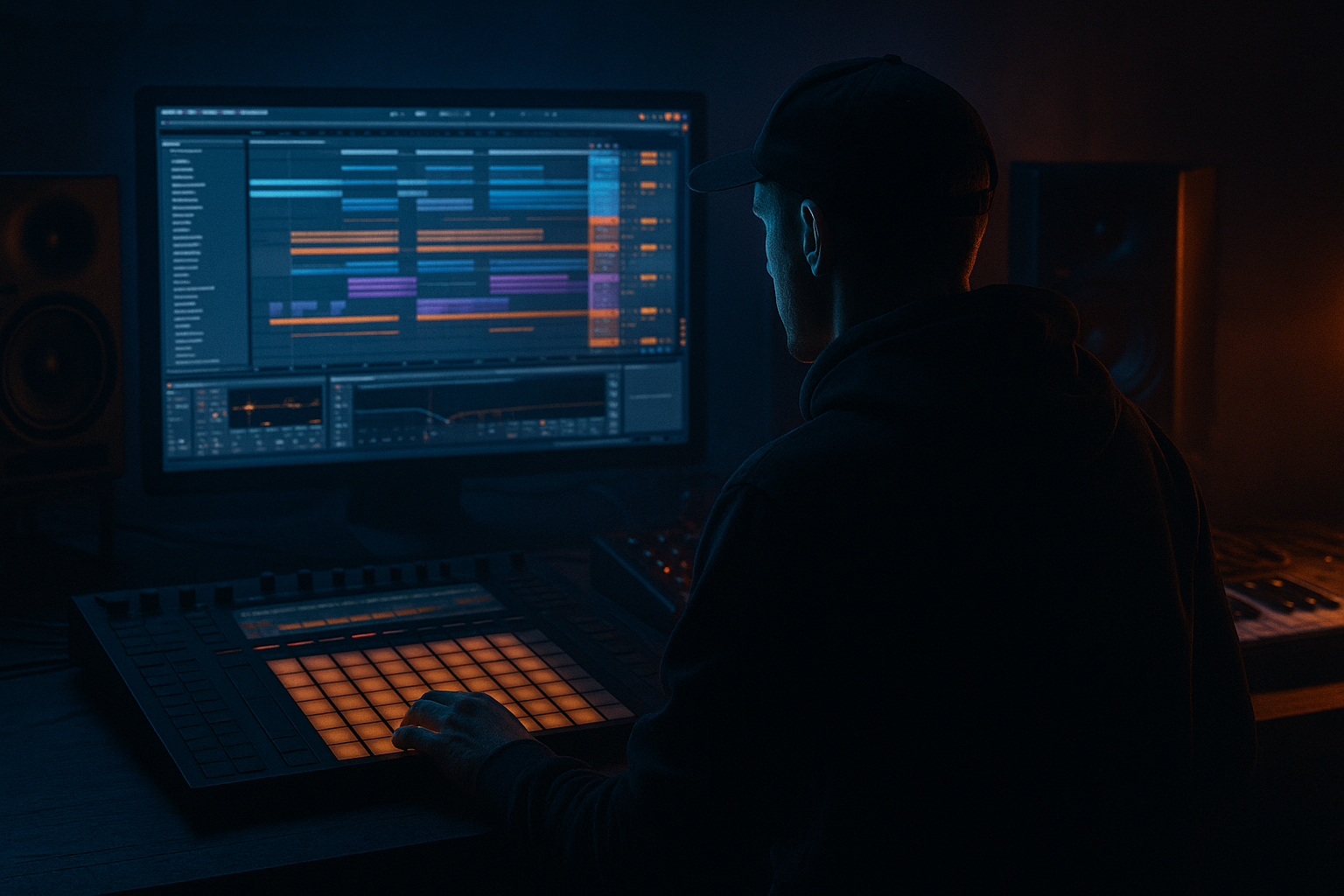
Main tutorial
Lesson Overview
An Amen break is one of the most important rhythmic signatures in jungle and Drum & Bass, but by itself it can feel too dry, too familiar, or too “looped” if you want a deep atmosphere. In this lesson, you’ll learn how to layer an Amen variation in Ableton Live 12 so it sits inside a darker jungle-style bed of texture instead of sounding like a loop pasted on top of the track.
The goal is to build a layered Amen setup that has:
- a clean rhythmic core
- a second layer for grit and ghost detail
- a texture layer for deep jungle atmosphere
- enough space for sub bass and other elements to breathe
- one main Amen loop with controlled transients
- one additional layer for crackle, grit, and chopped detail
- one atmospheric layer for space and depth
- subtle movement from filtering and reverb automation
- a drum bus that feels cohesive and ready for a bassline underneath
- one Audio Track for your main Amen loop
- one Audio Track for your atmospheric layer
- one Return Track for shared reverb if you want extra space later
- turn Warp on
- use Beats mode for punchy drum preservation
- try Preserve: Transients
- set Transient Loop Mode off if the loop starts smearing
- slice the loop at strong drum hits
- mute or remove one or two original hits
- duplicate a snare or ghost hit into a new position
- leave some space so the break still breathes
- keep the first kick
- shift one snare slightly later for tension
- remove a busy ghost note in bar 2
- repeat a short fill at the end of the phrase
- in an 8-bar intro, let the Amen play almost full
- in the first 16-bar drop, remove a few hits so the sub has space
- in a switch-up, bring the full variation back with more reverb or distortion
- EQ Eight
- Saturator
- Auto Filter
- EQ Eight: high-pass around 150–250 Hz to remove low-end clutter
- Saturator: Drive around 3–8 dB
- Auto Filter: low-pass around 6–10 kHz to dull the top slightly, or sweep it later with automation
- snare crack
- ghost notes
- tiny shuffle sections
- a fill end
- add Reverb
- add EQ Eight
- add Auto Filter
- optionally add Utility
- Reverb Size: around 35–70%
- Decay Time: 2.5–6 seconds
- Dry/Wet: 15–35%
- EQ Eight: high-pass around 250–400 Hz
- Auto Filter: low-pass around 4–8 kHz
- keep only a few slices of the Amen
- let tails wash out
- place the layer behind the main drum groove
- use it mainly in intros, breakdowns, or the first half of a drop
- on the main Amen: high-pass around 70–120 Hz
- on the grit layer: high-pass around 150–250 Hz
- on the atmosphere layer: high-pass around 250–400 Hz
- use Utility on the atmospheric layer and set Width to 80–100%
- if the low end feels smeary, set Bass Mono behavior by keeping the low frequencies removed and the remaining texture controlled
- Glue Compressor
- Saturator
- EQ Eight
- Glue Compressor: Ratio 2:1, Attack 10 ms, Release Auto, Gain Reduction around 1–3 dB
- Saturator: Drive 1–4 dB
- EQ Eight: gentle cut around 200–350 Hz if the layers get boxy
- Auto Filter cutoff on the atmosphere layer
- Reverb Dry/Wet on the ghost layer
- Saturator Drive on the grit layer
- Clip Gain for drum fills or drop intensification
- open the filter over 8 bars during an intro
- increase reverb slightly in the last 2 bars before the drop
- push saturation a little harder on the last hit of a phrase
- lower the atmosphere layer during the main drop, then raise it in the switch-up
- bars 1–8: atmosphere layer slowly opens
- bars 9–16: main break becomes more present
- bars 17–24: reverb drops off so the groove hits harder
- Intro: atmosphere layer + filtered Amen fragments
- Build: main Amen enters with high-pass filtering on bass
- Drop 1: full drum layers, sub bass, and restrained atmosphere
- Switch-up: remove the grit layer for 4 bars, then bring it back
- Breakdown: reverb-heavy Amen ghost layer
- Drop 2: tighter, drier version of the break with more bass weight
- intro = mystery
- drop = impact
- switch-up = variation
- breakdown = tension
- second drop = payoff
- high-pass the layered Amen tracks more aggressively
- keep sub energy for the bass synth or dedicated sub track
- treat one layer as main
- one as grit
- one as atmosphere
- lower each layer and let the bus do the work
- keep the main layer dry
- use reverb mainly on the atmospheric copy
- automate reverb only in transitions
- keep Glue Compressor reduction light
- use Saturator gently
- compare bypass/on often
- use Utility
- keep the important rhythmic information centered
- don’t rely on stereo width for the main transient hits
- Layer a very low-volume distorted copy of the Amen with high-pass filtering around 300 Hz to add grime without adding clutter.
- Use Auto Filter in band-pass mode on the atmospheric layer for a more haunted, tunnel-like feel.
- Add Subtle Saturator drive on the Amen Bus for density, but stop before the snare loses snap.
- For a darker neuro-leaning edge, automate tiny filter movements rather than huge sweeps. Small movement feels more controlled and premium.
- If the groove feels too static, shift a ghost note slightly ahead or behind the grid. Even a tiny timing change can create that human jungle swing.
- Use call-and-response thinking: let the Amen variation answer your bassline. For example, leave a hole in bar 4 so the bass can speak, then bring the break fill back in bar 5.
- For heavier drops, mute the atmospheric layer on the first hit, then bring it back after 1 or 2 bars. That contrast makes the drop feel bigger.
- Use scene-based arrangement thinking: clean intro version, mid-intro filter version, full-drop version, and switch-up version all from the same Amen source.
- 4 bars of atmosphere only
- 4 bars of dry break
- 4 bars with grit + dry break together
- 4 bars with all layers, then mute the atmosphere for the final bar
- does the break feel deeper when layered?
- is the bass space clear?
- does the atmosphere support the rhythm instead of washing it out?
- Start with a clean Amen loop and make a small variation, not a total rebuild.
- Use duplicate layers for grit and atmosphere.
- High-pass the layered versions so the sub stays clean.
- Glue the layers together on a bus with light compression and gentle saturation.
- Automate filtering and reverb for tension and release.
- Keep the main rhythm punchy, and let the atmospheric layers add depth without clutter.
This technique matters because in DnB, especially jungle, rollers, and darker bass music, the drums are not just keeping time — they are part of the atmosphere. A well-layered Amen can make a track feel alive, haunted, dusty, and moving, while still staying tight enough for club playback.
You’ll use Ableton stock tools like Drum Rack, Simpler, EQ Eight, Saturator, Utility, Auto Filter, Glue Compressor, and Reverb to shape the break into a modern, mix-ready jungle element. The approach is beginner-friendly, but the result can sound very serious when done cleanly. 🔥
What You Will Build
By the end of this lesson, you’ll have a small Ableton drum group built around a variation of the Amen break that includes:
Musically, this will feel like a deep jungle intro or first-drop bed: the break is recognizable, but it’s been broken apart and layered so it feels more cinematic and underground. Think of a section that could sit before a sub-heavy call-and-response drop, or as the rhythmic base for a roller with spooky ambience.
You’ll also end up with a reusable workflow for future DnB projects: load break, duplicate, process differently, blend, and automate.
Step-by-Step Walkthrough
1. Start with a clean Drum Rack or audio track setup
Open a new Ableton Live 12 set and create:
If you already have an Amen sample, drag it directly into the audio track. If you want to work more surgically, drop it into Simpler inside a Drum Rack later, but for beginner workflow, start with audio first. That keeps the shape of the break easy to understand.
Set the project tempo around 170–174 BPM for classic jungle/rollers energy. If you’re aiming darker and heavier, 172 BPM is a strong middle ground.
Useful starting move:
Why this works in DnB: the Amen is all about transient detail. If the timing is sloppy or the hit shape gets mushy, the break loses the bounce that makes it work in fast tempo music.
2. Make the Amen variation by chopping the loop
Double-click the Amen clip to open it in the Clip View and begin making a variation. You do not need to recompose the whole break — just change enough to make it feel like your own version.
Beginner-friendly approach:
A simple variation idea:
If you want to be more precise, use Cmd/Ctrl + E to split the clip at transient points, then rearrange the pieces. Keep the pattern musical, not random.
Arrangement context example:
3. Create a second layer for grit and jungle dust
Duplicate the Amen track. This second version is not for full-volume impact — it is for texture. Rename it something like Amen Grit.
On this duplicate, add:
Suggested settings:
Now shorten or edit this layer so it hits only the most interesting bits:
You can also reduce the clip volume by -6 to -12 dB so it supports the main break instead of competing with it.
This layer gives you that jungle “dusty room” feeling. The listener perceives more movement and age in the break, which makes it feel deeper and less flat.
4. Build an atmospheric layer with reverb and filtering
Create a third audio track and duplicate the Amen again, but this time treat it as atmosphere. This layer should sound like a ghost of the break, not the break itself.
On this track:
Suggested settings:
Turn the clip volume way down, often -12 to -18 dB lower than the main loop.
What to do musically:
You can also automate the Auto Filter cutoff so the atmospheric layer opens slightly before a drop. This creates tension without needing a big riser.
Why this works in DnB: fast music can feel harsh if everything is dry and forward. A reverb-treated break layer gives the track depth while keeping the rhythm connected to the jungle source material.
5. Tighten the low end so the break and bass can coexist
Even though the Amen is mostly midrange and transient energy, it can still clash with your bass if the low end is not controlled. On each Amen-related track, use EQ Eight to clean out unnecessary bass.
Basic DnB cleanup:
If the kick in the break feels too heavy for your sub, cut a little more around 120–180 Hz on the break layer. Don’t overdo it — you want impact, not a thin drum loop.
For stereo discipline:
If your bassline is already active, keep the Amen variation slightly trimmed in the low mids so the sub has room. In DnB, the sub should feel stable and intentional, not like it is fighting the drum loop.
6. Glue the layers together on a drum bus
Route the three Amen layers into a Group Track called Amen Bus. This is where the “layered” concept becomes a single instrument.
On the bus, try:
Suggested starting settings:
The idea is not heavy compression. You just want the layers to feel like one drum source instead of three separate ones.
If the transient punch starts disappearing, reduce compression or increase the attack a little. If the break feels too chaotic, a small amount of bus glue helps a lot.
7. Add movement with automation, not endless extra sounds
Now make the Amen variation feel alive over time. In jungle and darker DnB, atmosphere often comes from movement rather than huge sound design.
Good automation targets:
Simple automation ideas:
A strong beginner move is to automate just one thing per section. For example:
This keeps the arrangement clear and DJ-friendly.
8. Shape the arrangement like a real DnB tune
Now place the Amen variation in a real arrangement context.
A simple structure:
For beginners, this is a great way to think:
If your track is more roller-oriented, keep the Amen variation steadier and let the bassline do more of the talking. If it’s more jungle and atmospheric, let the ghost layer carry more ambience.
Common Mistakes
Overloading the low end
A lot of beginners leave too much bass in the break layers. That makes the kick and sub fight each other.
Fix:
Making every layer too loud
If all three Amen layers are loud, the result becomes messy and tiring.
Fix:
Too much reverb on the main groove
Big reverb can make the Amen feel far away and weak in a fast track.
Fix:
Ignoring transient punch
Heavy saturation and compression can flatten the break.
Fix:
Not checking mono compatibility
Wide atmosphere is cool, but if the break collapses badly in mono, the track can lose power.
Fix:
Pro Tips for Darker / Heavier DnB
Mini Practice Exercise
Spend 10–20 minutes building three versions of the same Amen variation:
1. Version A: Dry and punchy
- main break only
- EQ cleanup
- no reverb
- aim for tight groove
2. Version B: Gritty layer
- duplicate the break
- high-pass
- add Saturator
- cut a few hits so only texture remains
3. Version C: Atmosphere layer
- duplicate again
- add Reverb and Auto Filter
- lower the volume
- automate the filter opening over 4 bars
Then arrange them in this order:
Listen back and ask:
If you want, repeat the exercise with a different Amen variation and try a more roller-style or more jungle-style result.
Recap
That’s the core of a deep jungle Amen layer in Ableton Live 12: rhythm first, atmosphere second, clarity always.

