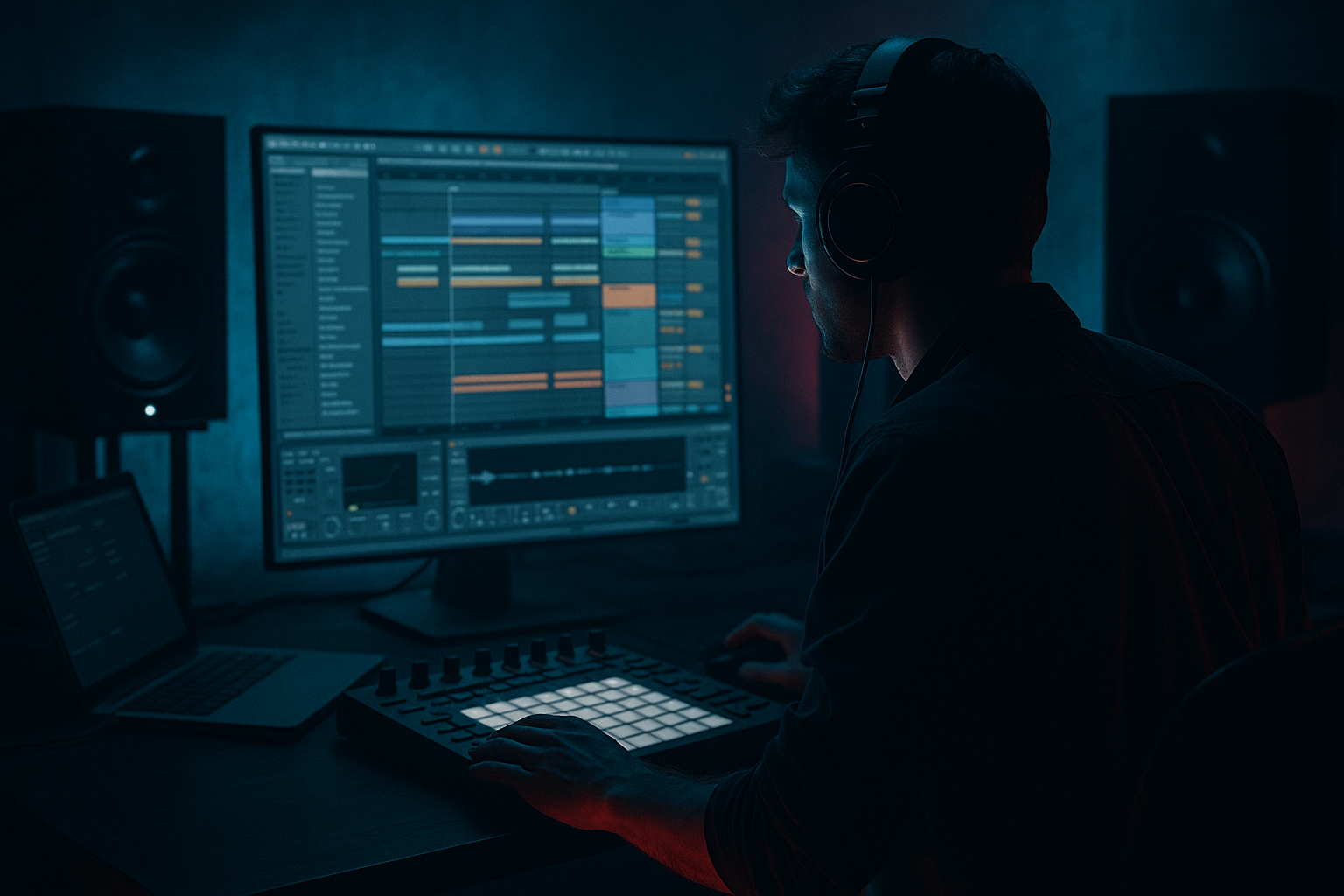
Main tutorial
```markdown
Analog-Feeling Bass Tones Masterclass (Ableton Live) — Clean Routing for DnB 🔊
1. Lesson overview
In drum & bass, “analog-feeling” bass usually means stable low-end + subtle motion + harmonics that read on small speakers, without turning into messy distortion soup.
This lesson shows you a clean, repeatable routing system in Ableton Live that lets you design warm, weighty basses (rollers, foghorn-ish sustains, jungle subs) while keeping sub control, mid character, and modulation easy to manage.
Skill level: Intermediate
Focus: Sound design + routing discipline + DnB-ready arrangement moves ⚙️
---
2. What you will build
You’ll create a 3-lane bass architecture:
1. SUB (mono, clean)
- Solid sine/triangle fundamentals, glued and stable.
2. MID (character + movement)
- Saturation, filtering, chorus/unison vibes, resampling-friendly.
3. TOP (optional bite + presence)
- Controlled high-mid grit for audibility on phones/laptops.
All three feed a BASS BUS for final glue/sidechain.
You’ll end with:
- A rolling Reese-ish bass (classic DnB movement)
- A clean sub that never fights the kick
- A routing template you can reuse every session ✅
- Tempo: 172–175 BPM
- Create a simple drum loop (kick + snare + hats) so you can hear how bass sits.
- Add a Reference Track (muted) if you like, but keep focus on your routing.
- Algorithm: A only
- Osc A: Sine (or Triangle if you want more natural harmonic content)
- Octave: -1 (sometimes -2 depending on key)
- Level: -6 dB to start (leave headroom!)
- Osc 1: choose something classic like Basic Shapes (saw/square region)
- Osc 2: Basic Shapes too (detune + slight offset)
- Unison: 2–4 voices, Amount ~ 20–40%
- Detune: 10–20 (small = wider but still “solid”)
- Glide/Portamento: On, ~ 40–80 ms for slur between notes (DnB flavor)
- Filter 1: MS2 or PRD (Ableton’s analog-style models)
- Cutoff: start around 200–800 Hz
- Resonance: 10–25%
- Drive: 2–6 dB (careful)
- Envelope amount: small (you want movement, not a pluck unless desired)
- Duplicate `BASS - MID` and change processing, or
- Use a simpler source like Operator with a saw wave.
- Bar 1: full bass (SUB + MID)
- Bar 2: remove TOP, or open filter less
- In MIDI, place a bass note slightly before the snare (very small offset) OR use shorter notes leading into beat 2/4.
- Keep SUB notes clean and consistent; do the rhythmic tricks mainly in MID.
- MID lane: slowly open cutoff over 8 bars in the drop.
- Reset at phrase boundaries (classic DnB energy control).
- Letting SUB have stereo width: instant weak low-end in clubs. Keep it mono.
- Not high-passing MID/TOP: you’ll get phase fights and muddy lows.
- Over-saturating everything: if every lane is destroyed, nothing feels big.
- Sidechain too short/too long:
- Ignoring gain staging: if you clip inside chains, you’ll chase problems with EQ.
- Tune the sub to the key: if your tune is in F, notes around F (43.65 Hz) behave differently than G (49 Hz). Choose bass notes that hit.
- Use controlled odd harmonics:
- Add “airless” darkness:
- Midrange focus for heaviness:
- Parallel distortion (clean routing version):
- You built a DnB-ready analog-feeling bass system using clean routing:
- You used stock Ableton devices like Operator, Wavetable, EQ Eight, Saturator, Glue Compressor, Utility, Auto Filter for professional results.
- You learned arrangement/resampling habits that match real DnB workflows.
---
3. Step-by-step walkthrough
Step 0 — Session setup (DnB-friendly)
---
Step 1 — Build the routing skeleton (clean from the start) 🧠
1. Create three MIDI tracks:
- `BASS - SUB`
- `BASS - MID`
- `BASS - TOP` (optional)
2. Create one Audio/MIDI track (doesn’t matter which) called:
- `BASS BUS`
3. Set routing:
- On each bass lane, set Audio To → BASS BUS
- On `BASS BUS`, route Audio To → Master
4. Color code:
- SUB = dark blue
- MID = purple
- TOP = orange
- BUS = red
(It sounds minor, but it speeds up decisions.)
Why this matters: You can process each band correctly, then “glue” it together on the bus without destroying the sub.
---
Step 2 — SUB lane: clean, mono, confident 🧱
On `BASS - SUB`, load Operator (stock).
Use it like a “hardware-ish” sub oscillator.
Operator settings:
Add devices (in this order):
1. EQ Eight
- HP filter at 20–25 Hz (24 dB/oct) to remove rumble.
- Optional gentle dip if the note blooms too much around 45–60 Hz (depends on key).
2. Saturator (subtle!)
- Mode: Soft Sine (great for “analog rounding”)
- Drive: 1–3 dB
- Output: match loudness (don’t fool yourself)
3. Utility
- Width: 0% (mono)
- Gain: adjust so sub is steady but not clipping
✅ Goal: The sub should sound “boring” solo… and insane in the mix.
---
Step 3 — MID lane: the analog-feeling “soul” (movement + harmonics) 🌪️
On `BASS - MID`, load Wavetable (stock) for modern control, but we’ll shape it to feel analog.
Wavetable core settings:
Filter section (key to analog vibe):
Add devices (in this order):
1. EQ Eight
- HP at 80–120 Hz (24 dB/oct).
This is critical: MID lane must not compete with sub.
2. Saturator
- Mode: Analog Clip or Soft Sine
- Drive: 4–10 dB (use your ears)
- Turn on Soft Clip if needed
- Keep the output matched
3. Auto Filter (movement)
- Filter: LP 12 or LP 24
- Map Cutoff to an LFO:
- Rate: 1/8 or 1/4 (sync)
- Amount: small-to-medium
- This creates that rolling, breathing bass motion.
4. Chorus-Ensemble (optional, subtle)
- Use lightly; this is where “warm width” lives.
- If it starts sounding phasey, reduce amount or move it to TOP lane instead.
5. Utility
- Width: 80–120% (only mids/highs are here anyway)
- Use Gain to balance against sub
✅ Goal: MID should provide “audible bass” on small speakers and add character without muddying the fundamental.
---
Step 4 — TOP lane: controlled bite (optional) ⚔️
On `BASS - TOP`, you can either:
Core concept: TOP is presence, not fizz.
Device chain suggestion:
1. EQ Eight
- HP at 250–400 Hz
- Optional gentle shelf boost around 2–5 kHz if needed
2. Amp (stock) or Pedal
- Amp: choose a cleaner model first, then push
- Pedal: try Overdrive with modest Drive
Keep this lane quieter than you think.
3. Redux (very subtle, optional)
- Bit reduction can add “hardware grit,” but go easy:
- Bits: 10–12
- Downsample: off or minimal
(Too much = instant sandpaper.)
4. Utility
- Width: 120–160% (optional)
- If mono compatibility suffers, reduce width.
✅ Goal: You should miss it when it’s muted but not really “hear a separate layer.”
---
Step 5 — The BASS BUS: glue + sidechain + safety net 🧰
On `BASS BUS`, use this clean chain:
1. EQ Eight
- Very gentle shaping only.
- If needed: tiny dip around 200–350 Hz to reduce boxiness.
2. Glue Compressor
- Attack: 3–10 ms
- Release: Auto or 0.1–0.3s
- Ratio: 2:1
- Aim for 1–3 dB gain reduction on peaks
3. Saturator (bus tone)
- Drive: 1–4 dB
- Mode: Soft Sine / Analog Clip
- This “finishes” the bass like a console stage.
4. Compressor (Sidechain from kick) 🥁
- Sidechain: Kick track
- Attack: 0.1–1 ms
- Release: 50–120 ms (adjust to groove)
- Ratio: 4:1
- Threshold: set for 2–6 dB gain reduction
- Tip: Tune release so the bass returns between kick hits in a rolling way.
5. Limiter (safety, not loudness)
- Ceiling: -0.5 dB
- Only catching occasional spikes.
✅ Result: You can push character in MID/TOP while SUB stays clean, and the bus keeps everything moving with the drums.
---
Step 6 — DnB arrangement moves (make it musical) 🎛️
Try these standard rolling-bass ideas:
A) Call & response (2-bar loop)
This creates momentum without adding new sounds.
B) “Push” notes into the snare
C) Automate filter cutoff per 8 bars
---
Step 7 — Quick resampling workflow (fast, pro, CPU-friendly) 💾
Once your bass loop is working:
1. Create a new Audio track: `BASS RESAMPLE`
2. Set Audio From → BASS BUS
3. Record 8–16 bars of bass.
4. Now you can:
- Slice/warp for edits
- Reverse stabs
- Add fills without re-rendering heavy synth chains
This is very DnB: design → resample → rearrange.
---
4. Common mistakes
- Too short = clicky pumping
- Too long = bass never returns; groove loses weight
---
5. Pro tips for darker/heavier DnB 🖤
- Triangle sub + mild saturation can feel thicker than pure sine.
- Low-pass TOP around 6–10 kHz so it stays menacing, not fizzy.
- Often the “weight” of heavy DnB lives in 150–400 Hz (carefully!).
Try subtle emphasis there on MID, while SUB stays pure.
- Create a return track `BASS DIRT` with heavy saturation/amp.
- Send only MID/TOP to it (not SUB).
- Blend low for controlled brutality.
---
6. Mini practice exercise (20–30 minutes) ⏱️
1. Create the full routing (SUB/MID/TOP → BASS BUS).
2. Write a 2-bar rolling pattern:
- Use repeated notes with a couple of pitch steps (classic roller).
3. Build:
- SUB with Operator (sine/triangle)
- MID with Wavetable (unison + analog-style filter)
4. Add:
- Sidechain on BASS BUS
- Gentle bus saturation
5. Export two versions:
- A: with TOP lane
- B: without TOP lane
Compare on headphones and small speakers. Which translates better?
---
7. Recap ✅
- SUB = mono + stable
- MID = movement + harmonics
- TOP = optional bite
- BASS BUS = glue + sidechain + safety
If you want, tell me what sub key your track is in (e.g., F/G/G#) and whether you want roller, fog/reese, or jump-up stab vibes — I’ll tailor a specific patch and MIDI pattern.
```

