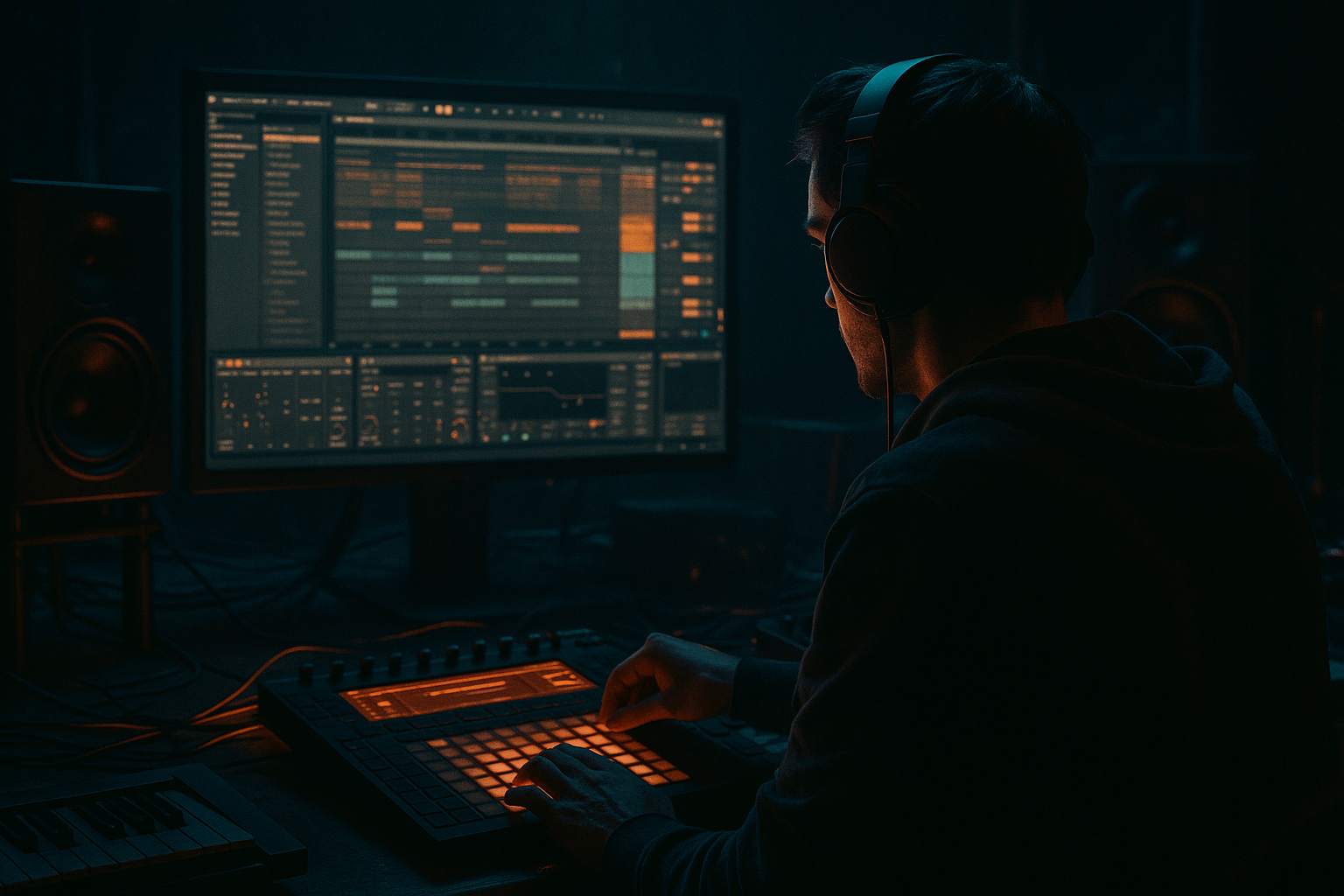
Main tutorial
Apache Ableton Live 12 Transition Framework for Smoky Warehouse Vibes
Jungle / Oldskool DnB Resampling Tutorial 🎛️🥁
---
1. Lesson overview
In this lesson, you’ll build a transition framework in Ableton Live 12 designed for smoky warehouse, jungle, and oldskool DnB energy. The goal is to make your tracks feel like they sweep, drop, and morph with attitude rather than just “change sections.”
We’ll focus on resampling, which is a huge part of authentic DnB workflow. Instead of relying only on preset risers or basic sweeps, we’ll create our own gritty transition material by:
- resampling drums, breaks, and bass
- mangling audio with stock Ableton devices
- layering reverse tails, impacts, and noise
- building tension before drops and breakdowns
- arranging transitions so they feel like a rave system in a damp warehouse 🏭
- A resampled drum-fill loop
- A reverse atmosphere swell
- A bass-impact transition hit
- A filtered “suck-in” build
- An 8-bar arrangement framework for intro → tension → drop
- jungle break sections
- oldskool rewind-style transitions
- rolling DnB drop entries
- warehouse-style atmosphere changes
- Set tempo to 170–174 BPM
- A classic starting point: 172 BPM
- a breakbeat loop
- kick/snare layer
- ride or shaker for movement
- Wavetable, Operator, or Analog
- low-pass filter
- short amp envelope
- subtle saturation
- filter pull-down into a drop
- reverse swell into a drum hit
- break fill into sub hit
- delay throw into re-entry
- tape-stop style energy collapse
- atmosphere opening up before the drop
- cutting the break
- moving a few snare hits
- adding a ghost kick
- reversing one percussion hit
- Resampling if you want to capture the full master output
- Audio From your drum break track if you only want the drums
- Audio From: Drum Break Audio Track
- Monitor: In
- consolidate the best part with Cmd/Ctrl + J
- trim silence
- make sure transient starts cleanly
- warp only if necessary
- High-pass around 30–40 Hz
- Slight dip around 250–400 Hz if muddy
- Gentle boost around 2–5 kHz if you want snare crack
- Drive: 2 to 6 dB
- Turn on Soft Clip
- Keep an eye on output level
- Drive: 5–20%
- Crunch: subtle, around 10–15%
- Transients: slightly up if you want more hit
- Boom: use carefully; too much can make the fill floppy
- Downsample lightly if you want grit
- Try 10–14 bit feel, but don’t destroy the transient completely
- automate cutoff from low to high
- try a low-pass filter
- resonance around 15–30%
- Decay: 1.5–4 seconds
- Dry/Wet: 10–25%
- High Cut: lower for smoky texture
- Pre-delay: around 10–25 ms
- Duplicate your resampled fill
- Reverse it
- Fade it in before the impact
- Select the clip
- Use Reverse in Clip View
- Auto Filter
- Echo or Delay
- Utility to control width
- Auto Filter: low-pass opening slowly
- Echo: sync at 1/8 or 1/4
- Feedback: 20–35%
- Utility width: widen slightly only on the swell
- Play a short low note
- Print it to audio
- Chop the cleanest transient
- Add a tiny tail of saturation or delay
- EQ Eight
- Saturator
- Glue Compressor
- Utility
- High-pass everything below 25–30 Hz
- If muddy, cut a bit at 150–250 Hz
- Drive up until it feels weighty
- Soft Clip on
- Attack: 10–30 ms
- Release: Auto or 0.1–0.3 s
- Ratio: 2:1
- Just a few dB of gain reduction
- Keep the sub mono
- Width at 0% for the low-end hit if needed
- cutoff from open to closed
- resonance slightly up during the tension bar
- then snap open on the drop
- Bar 7: filter starts closing
- Bar 8 beat 1–3: filter mostly closed
- Bar 8 beat 4: impact hit
- Bar 9: filter fully opens on drop
- vinyl crackle
- field recording
- room tone
- crowd noise
- distant machinery hum
- rain or wind textures
- EQ Eight
- Auto Filter
- Reverb
- Echo
- Chorus-Ensemble if you want movement
- high-pass the atmosphere at 120–200 Hz
- low-pass if it competes with hats and cymbals
- automate it louder in breaks, lower in drops
- Full drum groove
- Bass rolling
- Atmosphere low in the background
- Start closing the filter
- Remove or thin out a drum element
- Introduce a reversed swell
- Add the resampled drum fill
- Increase reverb send
- Bass briefly ducks or stops
- Impact hit or bass stab
- Short silence or near-silence for tension
- Then drop opens full force on the next phrase
- Full drums
- Bass returns
- Atmosphere reopens
- Maybe a ride or amen accent comes in
- resample one version with more reverb
- resample another version with more saturation
- create a third with reversed tail only
- chop your fill into tiny segments and rearrange them
- a dry fill
- a wet fill
- a distorted fill
- a reverse-only swell
- EQ Eight
- light compression
- Saturator
- Drum Buss
- Redux
- Hybrid Reverb
- Echo
- Auto Filter
- filter cutoff
- drive
- reverb wet/dry
- delay feedback
- stereo width
- either fill
- or reverse swell
- or bass hit
- or impact blast
- reduced brightness in the atmosphere
- filtered delays
- rough room reverb
- subtle distortion on FX
- automate feedback up briefly
- filter the repeats
- then cut it suddenly before the drop
- one with a cleaner oldskool jungle feel
- one with a heavier warehouse DnB feel
- Resample your own drums, bass, and FX
- Use Auto Filter, Saturator, Drum Buss, Echo, Reverb, and Utility
- Build transitions in layers:
- Arrange transitions over 4 or 8 bars
- Use space, silence, and automation to make the drop feel bigger
- a one-page cheat sheet
- a MIDI/audio track template
- or a device rack preset blueprint for Ableton Live 12.
This is beginner-friendly, but very much rooted in real DnB production practice.
---
2. What you will build
By the end, you’ll have a reusable transition toolkit with:
This framework will work especially well for:
Think of it as a transition rack for your track: every time you need to move into a new section, you have a gritty, coherent set of sounds ready to go.
---
3. Step-by-step walkthrough
Step 1: Set up a simple DnB project
Start with a blank Ableton Live 12 set.
#### Tempo
#### Create these tracks:
1. Drum Break Audio Track
2. Bass Audio/MIDI Track
3. Atmosphere Track
4. Transition Resample Track
5. Return Track for Reverb/Delay if needed
If you’re working in Session View first, that’s fine. But for transitions and arrangement, Arrangement View will help you see the energy curve clearly.
---
Step 2: Build a rough jungle/DnB foundation
Before transitions matter, you need a context for them.
#### Basic drum layer
Use:
If you have a break sample, drop it into an audio track and loop 2 or 4 bars.
#### Basic bass layer
Use a rolling bass patch with:
You don’t need a finished bassline. Just something that gives your transition framework a place to land.
---
Step 3: Create the transition idea first
For smoky warehouse DnB, transitions usually feel like one of these:
We’ll build a three-part transition:
1. Tension rise
2. Impact or fill
3. Drop re-entry
---
Step 4: Resample your own drum fill
This is the heart of the lesson 🔥
#### A. Make a drum fill source
Take your breakbeat and create a short fill at the end of an 8-bar phrase.
You can do this by:
Keep it raw. Jungle transitions often sound best when they feel slightly unstable.
#### B. Route the drum break to a resample track
Create a new audio track called Resample Fill.
Set its input to:
or
For beginners, I recommend:
Now record a 1-bar or 2-bar fill.
#### C. Edit the resampled audio
After recording:
If it sounds too sterile, don’t worry. We’ll dirty it up next.
---
Step 5: Process the resampled fill for smoky character
Add this stock Ableton chain to the resampled fill:
#### Suggested device chain
1. EQ Eight
2. Saturator
3. Drum Buss
4. Redux or Erosion
5. Auto Filter
6. Reverb or Hybrid Reverb
#### Recommended settings
##### EQ Eight
##### Saturator
##### Drum Buss
##### Redux
##### Auto Filter
Use this for transition movement:
##### Reverb / Hybrid Reverb
This makes the fill sound like it’s coming from an echoing warehouse space rather than a clean studio room.
---
Step 6: Build a reverse swell from the resample
Now let’s make the transition feel like it’s pulling the listener into the drop.
#### Option A: Reverse the fill
In Ableton:
#### Option B: Resample the reverb tail
This is more advanced, but very useful:
1. Put a big reverb on the fill
2. Record the reverb tail to a new audio track
3. Reverse that tail
4. Place it before the fill
This creates a whooshy inhale effect that sounds much more custom than a stock riser.
#### Process the reversed swell
Add:
Suggested settings:
---
Step 7: Create a bass impact transition hit
DnB transitions often hit harder when the bass tells the listener the drop is coming.
#### Make a short bass hit
Use your bass synth or resample a bass note:
#### Process it
Use:
##### EQ Eight
##### Saturator
##### Glue Compressor
##### Utility
This bass impact can land right before the drop or on the last snare of the build.
---
Step 8: Make a filter-suck transition with automation
This is one of the easiest and most effective transition techniques.
#### On your drum bus or music bus:
Add Auto Filter.
Automate:
Example automation shape:
This works especially well in oldskool DnB because the arrangement often feels like it’s being carved by the filter, not just edited by clips.
---
Step 9: Add a warehouse atmosphere layer
Smoky warehouse vibes need more than drums and bass. You need air.
#### Create an atmosphere track
Use:
Process it with:
#### Best practice
The atmosphere should feel like the club is breathing around the beat.
---
Step 10: Arrange the transition framework in 8-bar sections
Here’s a practical arrangement idea for a DnB drop transition:
#### Bars 1–4
#### Bars 5–6
#### Bar 7
#### Bar 8
#### Drop bar 1
This kind of structure gives your music that classic anticipation → release feeling that jungle and oldskool DnB do so well.
---
Step 11: Use resampling to create variation
Do not reuse the exact same transition every time.
Instead:
Try printing:
Then combine them differently across sections.
This keeps the track from sounding copy-pasted and helps transitions feel alive.
---
Step 12: Build a reusable transition rack
For long-term workflow, create an Audio Effect Rack on your resample track with chains like:
#### Chain 1: Clean
#### Chain 2: Grit
#### Chain 3: Space
Map macros to:
Now you can quickly shape different transition moments without rebuilding the chain every time.
---
4. Common mistakes
1. Overloading the transition
Beginners often add too many effects at once.
If everything is loud and huge, nothing feels huge.
Fix: Use one primary transition element per moment:
2. Using only preset risers
Stock risers can work, but in DnB they often sound generic.
Fix: Resample your own drums, atmosphere, and bass movement.
3. Too much sub in the transition
If your transition hit has too much sub, it can blur the drop.
Fix: High-pass non-bass transition material and keep the deepest sub controlled.
4. No automation movement
A static fill just sits there.
Fix: Automate filter cutoff, reverb send, delay feedback, and volume.
5. Dirty sound with no transient control
Resampling can create great grit, but it can also kill the punch.
Fix: Use Drum Buss, EQ Eight, and careful clipping to keep hits defined.
6. Transitions not matching the groove
If your fill ignores the break rhythm, it can feel disconnected.
Fix: Build fills that respect the 2-step or breakbeat pulse of the track.
---
5. Pro tips for darker/heavier DnB
Tip 1: Resample your whole drum bus
Send your full drum group to a resample track and print a few bars.
Then slice it and use micro-chops as transition accents. This is very effective for gritty jungle energy.
Tip 2: Use silence as a weapon
A one-beat or half-beat gap before the drop can feel massive in DnB.
Let the room breathe for a split second. That’s where the weight lands.
Tip 3: Layer an Amen-style ghost fill
Even if your main drums are modern, a tiny chopped break fill can make the transition feel oldskool and alive.
Tip 4: Keep the sub mono
Especially before a drop.
Use Utility to collapse low-end if needed.
Tip 5: Darken the space, not just the drums
Smoky warehouse vibes come from:
Tip 6: Use Echo creatively
Ableton Echo is great for dubby DnB throws:
That gives you a proper rave-tail effect 😎
---
6. Mini practice exercise
Goal
Build a 4-bar transition using only stock Ableton devices and your own resampled audio.
Steps
1. Create a 2-bar breakbeat loop at 172 BPM
2. Print it to audio with Resampling
3. Reverse the second bar and place it before the fill
4. Add Auto Filter and automate the cutoff downward
5. Add Saturator and Drum Buss to thicken the fill
6. Record a bass hit and place it on the last beat before the drop
7. Add a short reverb tail and bounce it to audio
8. Reverse the tail and layer it underneath the transition
9. Arrange the final 4 bars so the drop lands cleanly after a moment of tension
Challenge
Make two versions:
Compare them and notice how much the saturation, reverb, and silence change the emotional impact.
---
7. Recap
You now have a practical transition framework for smoky warehouse jungle and oldskool DnB in Ableton Live 12.
Key takeaways:
- tension
- fill
- impact
- release
If you keep resampling and reprocessing your own material, your transitions will start sounding more original, more textured, and much more like authentic jungle/DnB culture. Keep it raw, keep it rolling, and let the warehouse breathe 🥁🔥
If you want, I can also turn this into:

