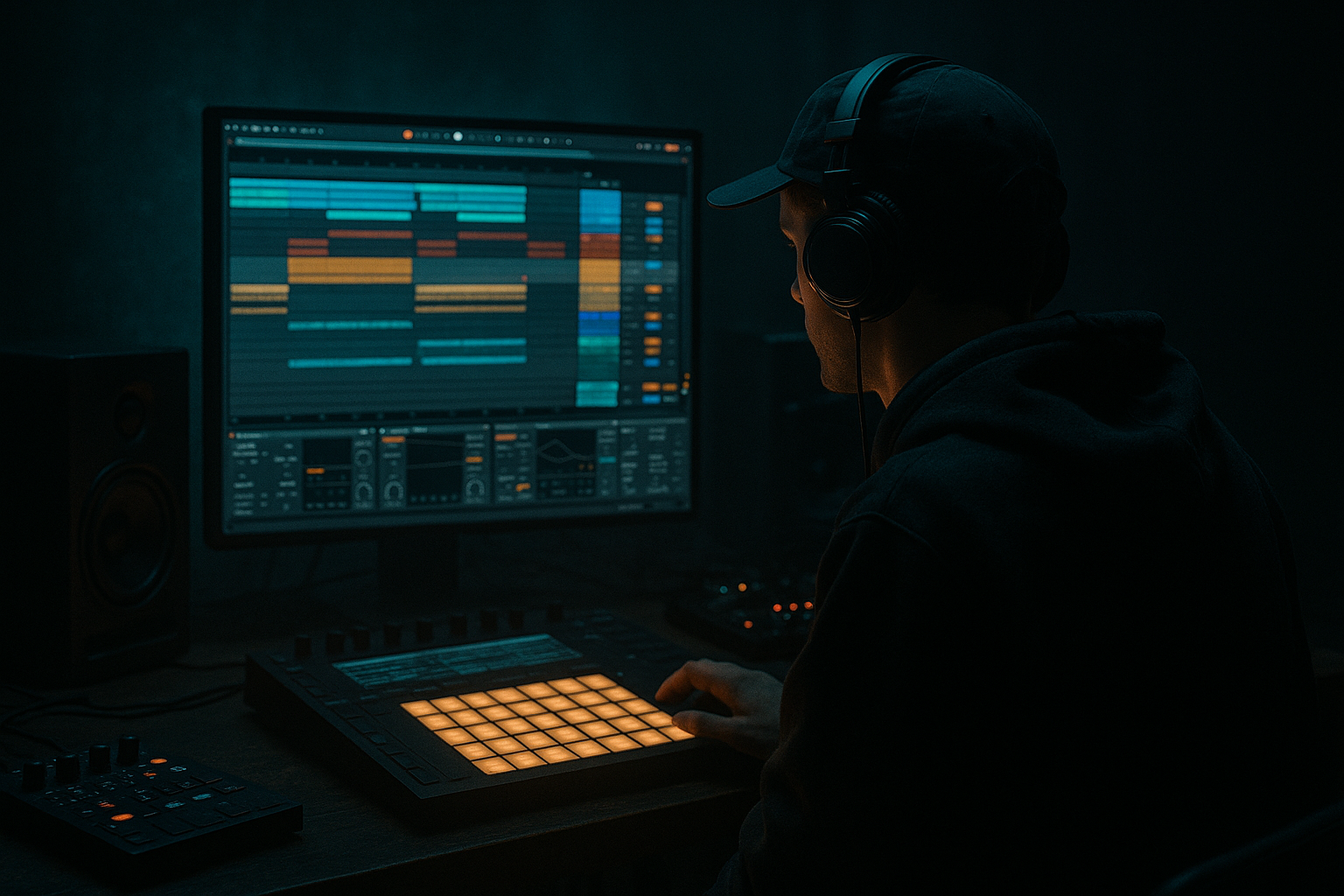
Main tutorial
Apache Guide: Fill Humanize in Ableton Live 12 for Jungle / Oldskool DnB Vibes 🥁🌫️
1. Lesson overview
In jungle and oldskool drum & bass, the “Apache guide” fill is a short, iconic break fill idea inspired by the energy of classic breakbeat records—usually a quick turnaround fill that feels raw, human, and slightly unstable in the best possible way.
In this lesson, you’ll learn how to create a humanized fill in Ableton Live 12 that sounds like it belongs in:
- classic jungle
- rolling 90s DnB
- dark breakbeat intros
- halftime-to-amen switchups
- tension-building pre-drop moments
- groove
- swing
- small timing differences
- velocity variation
- little imperfections that make the break feel alive
- a 4-bar break loop
- a humanized Apache-style fill in bar 4
- velocity and timing variation for realism
- optional ghost notes and snare flams
- a version that works for jungle, oldskool DnB, or heavier darkstep-adjacent material
- Drum Rack
- Simpler
- MIDI editing tools
- Groove Pool
- Velocity
- Random
- Auto Pan or subtle modulation where useful
- EQ Eight
- Drum Buss
- Saturator
- optional Redux for texture
- 160–174 BPM for jungle / oldskool DnB
- 168 BPM is a sweet spot for this exercise
- use a chopped break in Simpler or Sampler
- program your own break hits in Drum Rack
- Kick
- Snare
- Ghost Snare
- Closed Hat
- Open Hat
- Ride or Ride Bell
- Rimshot / percussion
- Break slice FX or chopped amen layers if you have them
- Kick on strong offbeats or break-derived placements
- Snare on 2 and 4, with extra ghost hits around them
- Hats filling the gaps
- Keep it loose, not too grid-perfect
- snare flams
- quick tom-like movement
- break slice stutters
- syncopated ghost notes
- a tiny push before the next drop
- beat 4 of bar 4
- last 2 sixteenths of bar 4
- the last half beat before the drop
- Kick on the “1” or a pickup before the fill
- Snare on the “e” or “&” of 4
- Ghost snare before and after the main snare
- Hat or percussion burst in 16th notes
- Optional rimshot for extra swagger
- Main snare: keep close to grid, but not dead-center
- Ghost notes: often best slightly late
- Percussion bursts: some early, some late
- Do not randomize everything equally
- Main snare: 105–127
- Supporting snare/flam: 60–95
- Ghost notes: 25–55
- Hats: 40–85 depending on role
- make the first ghost slightly quieter
- make the lead snare hit hardest
- reduce velocity on repeated hat notes
- let the final hit “snap” louder than the preceding ones
- place two ghost snares very close before the main snare
- make them progressively louder
- keep the main snare strongest
- Timing: 20–40%
- Random: 5–15%
- Velocity: 10–25%
- Base: 100%
- duplicate one hat note and delete the next
- swap the order of two ghost hits
- shorten one percussion note slightly
- leave a tiny gap before the final snare
- Top layer: crisp snare or rimshot
- Body layer: mid snare or clap
- Texture layer: break slice, vinyl crackle hit, or short percussion
- Low layer: short tom, low percussion, or filtered kick
- Drum Buss for extra weight
- EQ Eight to remove mud
- Saturator for bite
- Transient shaping via drum sample choice and envelope control in Simpler
- set Warp carefully or turn it off if the audio already fits
- use Classic mode for rougher playback behavior
- adjust Start and Envelope for punch
- Redux: very light bit reduction
- Saturator: soft clip or warm drive
- Vinyl Distortion if you want grit
- Echo for a tiny dubby tail on the last fill hit
- Every 4 bars: short fill
- Every 8 bars: more detailed turnaround
- Before a drop: bigger Apache-style fill
- Before a breakdown: stripped-down drum fill with atmosphere
- automate a low-pass filter opening
- increase reverb send on the final snare
- cut the bass for the last half beat
- add a short FX hit or reverse cymbal before the fill
- filter the pad down during the fill
- add a short reverb swell behind the last snare
- automate a vinyl noise layer slightly louder
- let a dark drone swell into the next section
- Saturator
- Drum Buss
- maybe a little Overdrive
- Version A: cleaner oldskool jungle fill
- Version B: darker, heavier fill with distortion and filtered ambience
- Which one feels more human?
- Which one drives the drop better?
- Which one fits your bassline more naturally?
- build the fill in a short turnaround zone
- use manual timing offsets instead of perfect quantization
- vary velocity like a real drummer
- add flams, ghost notes, and drag behavior
- use Groove Pool lightly for swing
- layer drums carefully for impact
- process with stock Ableton devices like Drum Buss, Saturator, EQ Eight, Auto Filter, Redux
- shape the arrangement so the fill leads the track forward
- a bar-by-bar MIDI example
- an Ableton Live 12 rack chain
- or a dark jungle fill template you can copy into your project.
The main goal is not to make the fill perfectly quantized. You want:
We’ll build it using Ableton stock tools and focus on a practical workflow you can reuse in real DnB projects.
---
2. What you will build
By the end, you’ll have:
We’ll use:
---
3. Step-by-step walkthrough
Step 1: Set up the project for jungle feel
Start with a tempo in the classic range:
Create these tracks:
1. Drums — breakbeat or one-shot drums
2. Bass — can be added later, but keep space in mind
3. Atmosphere / pad — optional for context
4. FX — risers, vocal chops, impacts
For now, focus on the drum track.
---
Step 2: Build a basic break foundation
You can either:
For this lesson, use Drum Rack because it makes humanizing and fill editing easier.
#### Suggested Drum Rack layout
Load these on separate pads:
#### Basic groove pattern
Create a 2-bar loop:
If you’re doing oldskool DnB, even a simple snare-led break can work great. The fill will bring the character.
---
Step 3: Add the Apache-style fill zone
Pick the last half bar or last 1 beat of bar 4 in your loop as the fill area.
A classic Apache-inspired fill often includes:
#### Good fill placement options
Try these zones:
This keeps the fill functional and musical instead of cluttered.
---
Step 4: Program the fill with MIDI, not just audio
If you want control and humanization, MIDI is the fastest route.
#### Example fill idea in 1 bar
In bar 4, program:
A good oldskool DnB fill often feels like it’s falling forward into the next phrase.
---
Step 5: Humanize timing manually
This is the most important part of the lesson.
Do not leave the fill perfectly on-grid. Instead, make tiny shifts.
#### In Ableton Live 12:
1. Double-click your MIDI clip.
2. Select the fill notes.
3. Use nudge or drag notes slightly off-grid.
4. Keep movements small:
- snare hits: shift by 5–15 ms late or early
- ghost notes: shift slightly more than main hits
- hats/percussion: vary timing in tiny amounts
#### Practical timing rules
The point is to create intentional instability.
---
Step 6: Use velocity like a drummer would
Velocity is what makes the fill breathe.
#### Suggested velocity ranges
#### Humanizing strategy
Instead of copying the same snare repeatedly:
This makes the fill feel played by a person, not drawn by a machine.
---
Step 7: Add flam and drag behavior
A very effective Apache-style detail is the flam.
#### How to create a flam in Ableton
1. Duplicate a snare note.
2. Place the duplicate just before the main hit.
3. Offset it by a tiny amount:
- around 10–30 ms
4. Lower the velocity of the early hit.
This creates a classic drummer-like lift.
#### Drag effect
For a drag:
This works especially well before a drop or phrase change.
---
Step 8: Use Groove Pool for swing and pocket
Ableton’s Groove Pool is perfect for DnB humanization.
#### How to use it
1. Open Groove Pool.
2. Load a groove from:
- a swing preset
- extracted groove from a break loop
3. Apply it lightly to the fill clip.
#### Recommended groove settings
Start subtle:
For jungle, too much groove can make things sloppy. You want bounce, not drunken timing.
---
Step 9: Add micro-variation with note duplicates and deletes
A real human fill is rarely symmetrical.
Try this:
This “slightly uneven” editing style is a big part of classic jungle energy.
---
Step 10: Layer the fill for impact
A good Apache-style fill usually benefits from layers.
#### Layer ideas
#### Ableton devices that help
Be careful: the fill should cut through, not become a wall of noise.
---
Step 11: Make it feel oldskool with break processing
For true jungle flavor, process the fill like it came from a sampler.
#### In Simpler
If you’re using a break slice:
#### For texture
Add subtle:
A little grime goes a long way in jungle. Dirty is good. Muddy is not.
---
Step 12: Arrange the fill musically
A fill works best when it has a clear job in the arrangement.
#### Common DnB placement ideas
#### Arrangement trick
Use automation to help the fill land:
This creates that classic tension-release motion.
---
Step 13: Humanize the atmosphere around the fill
Since this lesson is in the Atmospheres category, don’t think only about drums.
A fill feels bigger when the space around it reacts.
Try this:
This makes the fill feel like part of the whole track, not just a drum event.
---
4. Common mistakes
1. Over-quantizing everything
If every note hits perfectly on the grid, the fill sounds robotic. Jungle thrives on looseness.
2. Randomizing timing too much
Humanized does not mean messy. Tiny movement is enough.
3. Making ghost notes too loud
Ghost notes should support the main hit, not compete with it.
4. Using too many samples in the fill
A fill loses power when it becomes crowded. Keep the idea focused.
5. Ignoring the bass
A great fill can get buried if the sub or bassline plays through it too strongly.
6. Too much reverb
Oldskool DnB can be spacious, but the fill still needs punch and clarity.
---
5. Pro tips for darker/heavier DnB
Tip 1: Use contrast
If the main groove is tight and heavy, make the fill slightly more loose and chaotic. That contrast creates energy.
Tip 2: Filter the fill into darkness
Put Auto Filter or EQ Eight on the fill bus and automate a darker tone as the fill builds, then snap it open on the drop.
Tip 3: Add low tom or tribal percussion
A hidden low tom under the snare fill can give it that cinematic jungle menace.
Tip 4: Distort the return, not the whole drum bus
Send the fill to a parallel return with:
Blend it underneath for aggression without destroying the main transient.
Tip 5: Use call-and-response
Let the fill answer the bassline or atmospheric stab. In dark DnB, the best fills feel like a response in the arrangement.
Tip 6: Keep the sub out of the way
Before the fill, automate the bass down or mute it briefly so the drums feel huge and exposed.
---
6. Mini practice exercise
Exercise: Build a 4-bar Apache-style fill turnaround
#### Goal
Create a 4-bar loop where bar 4 contains a humanized fill that leads into a drop or loop restart.
#### Steps
1. Program a 3-bar drum groove.
2. In bar 4, add:
- one flam snare
- two ghost snares
- one percussion hit
- one final main snare
3. Offset the ghost notes by small amounts.
4. Vary velocities across every note.
5. Apply a light groove from Groove Pool.
6. Add a small Drum Buss drive on the fill only.
7. Automate a filter opening or reverb swell into the next bar.
#### Challenge version
Make two versions:
Listen back and ask:
---
7. Recap
To create a humanized Apache-style fill in Ableton Live 12 for jungle and oldskool DnB:
The magic is in the balance:
tight enough to hit hard, loose enough to feel human 🔥
If you want, I can also turn this into:

