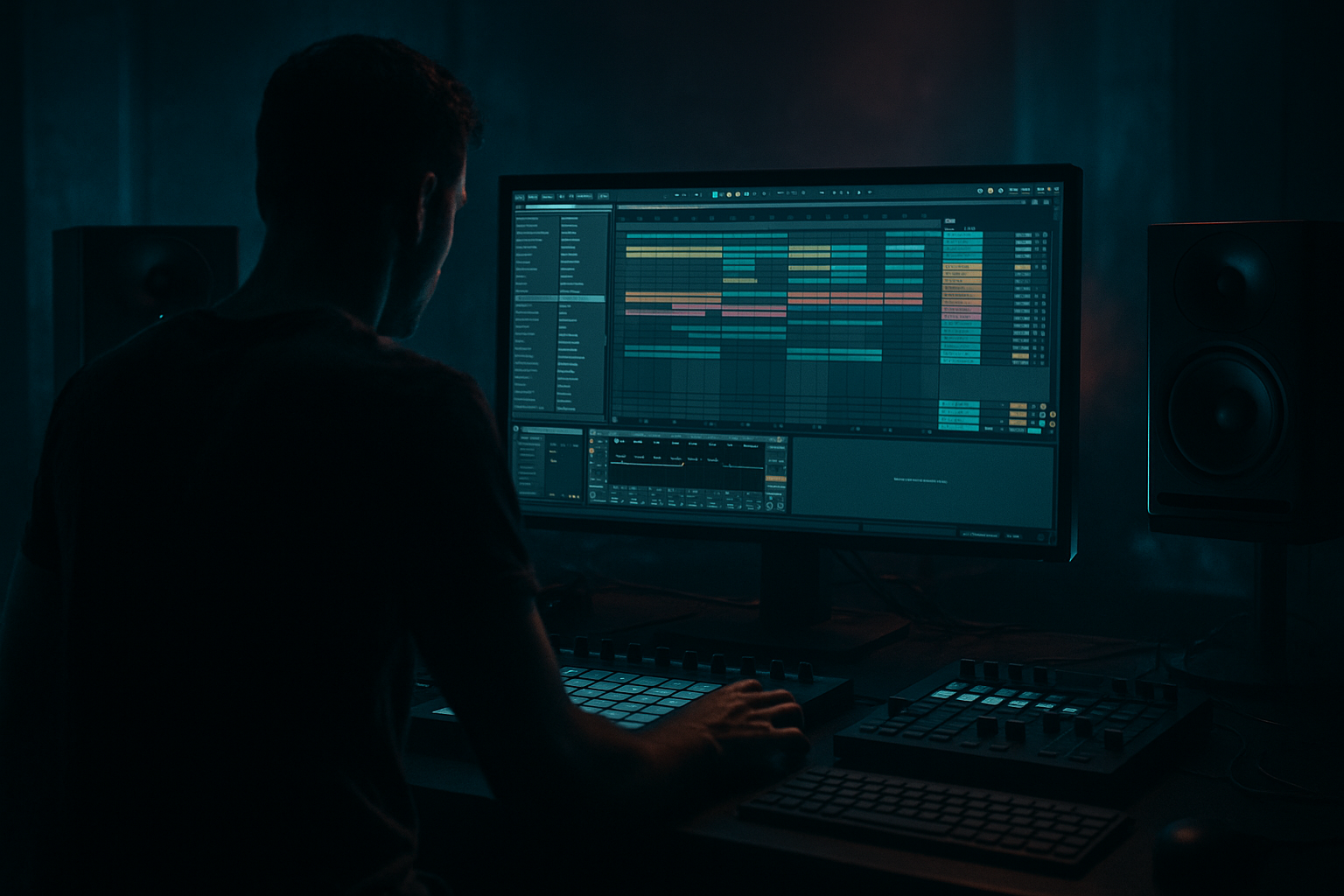
Main tutorial
```markdown
Approach for breakbeat for ragga-infused chaos in Ableton Live 12
1. Lesson overview
In this lesson, we’re building a ragga-infused breakbeat approach for drum and bass / jungle / rolling bass music in Ableton Live 12 — with a focus on controlled chaos.
This is not about random slicing and hoping for magic.
It’s about designing a breakbeat workflow that gives you:
- ragga energy from vocal chops, shuffle, and call-and-response phrasing
- breakbeat intensity from smart slicing and resampling
- DnB weight from punchy drums, tight transient control, and strong low-end management
- mastering-aware decisions so the groove stays loud, clean, and aggressive without collapsing
- transient consistency
- stereo discipline
- low-end stability
- headroom
- density without smear
- Simpler
- Drum Rack
- Slice to New MIDI Track
- Drum Buss
- Saturator
- EQ Eight
- Glue Compressor
- Transient Shaper (if available in your version/pack setup)
- Auto Filter
- Utility
- Roar or Pedal for dirt
- Limiter
- Spectrum
- Corpus or Resonators for texture if needed
- a ragga-style intro fill
- a chopped breakbeat drop groove
- a call-and-response vocal rhythm
- a heavier second phrase with variation
- a master-bus-safe drum/bass chain
- enough organization to resample or arrange into a full track
- classic jungle break pressure
- modern DnB low-end
- ragga vocal ad-libs
- chaotic but readable syncopation
- dark club energy ⚡
- master peak around -6 dBFS
- no clipping anywhere on the drum bus or master
- enough room for later compression/limiting
- a strong snare
- ghost hits
- hat movement
- some room tone or grit
- classic Amen-style breaks
- Think / Funky Drummer-style variations
- any dusty live break with natural swing
- Transient for natural break cuts
- 1/8 or 1/16 if you want stricter rhythmic control
- Slice to transient first
- then manually re-sequence in MIDI
- tight control over ghost notes
- the ability to repeat or mute specific hits
- faster variation building
- kick-ish hits to lower pads
- snare hits to center pads
- hats and ghost notes to upper pads
- Put your snare on 2 and 4
- Reinforce the kick with break hits, not just straight programming
- Leave room for the bass to breathe
- Bar 1: strong downbeat with ghost movement
- Bar 2: variation with extra hat chatter or a snare drag
- Repeat with subtle differences every 2 bars
- vocal stabs
- answer phrases
- syncopated repetition
- filter movement
- short, rude interruptions 😈
- “Come again”
- “Move!”
- “What you say?”
- “Badman style”
- chopped shouts, ad-libs, or toasting snippets
- Mode: Slice
- Play Mode: Classic or One-Shot
- Start with MIDI trigger slices
- Place vocal chops on the and of beats
- Use call-and-response with the break
- Repeat a short phrase, then cut it abruptly
- Bar 1: vocal hit on 1.3
- Bar 2: vocal response on 2.2
- Bar 3: two rapid chops on 3.4 and 4.1
- Bar 4: silence or a reverse FX hit
- EQ Eight
- Saturator
- Utility
- EQ Eight
- Transient Shaper or Drum Buss
- Saturator
- Sub Bass
- Reese / Low-Mid Bass
- Mono
- Low-pass clean
- Keep it simple
- Follow the kick/snare pocket, not the entire break
- Detune moderately for width
- Keep the lowest bass area carved out
- Use sidechain compression from kick/snare if needed
- light compression keyed from the kick
- additional dip from the snare if the bass masks the groove
- Sidechain: On
- Attack: 1–5 ms
- Release: 50–120 ms
- Ratio: 2:1 to 4:1
- Just enough to make room, not pump excessively unless that’s the aesthetic
- Auto Filter cutoff
- Echo feedback
- Saturator drive
- Utility width
- Drum Buss drive
- open hats
- reversed break slice
- ragga vocal stab
- pitch-shifted percussion
- a one-bar drum dropout
- filter sweep on the bass
- Break introduction
- Vocal teaser
- Minimal bass
- Filtered drums
- Full break groove
- Sub bass enters
- First vocal hook
- Light fill at end of bar 16
- Add a second break layer or percussion
- Bass becomes more active
- Vocal call-and-response intensifies
- Use a half-bar stop or snare roll
- Peak density
- Extra ghost notes
- More distortion or upper harmonics
- Short breakdown or switch-up at the end
- set input to Resampling
- record 4 or 8 bars of your drum/bass/vocal interaction
- chop the best moments
- reverse a hit here and there
- place a fill in front of a drop
- use the resampled audio as a new layer
- keep kick and snare punch intact
- do not over-broaden the sub
- control harshness around 3–6 kHz
- avoid smeared transients from excessive bus compression
- leave final loudness shaping for the actual mastering stage
- distort the mid bass
- add a little saturation to the snare
- use a touch of grit on vocal chops
- keep the sub cleaner than you think
- first 4 bars: groove and clarity
- second 4 bars: added hats, ghost notes, and grime
- keep pads, FX, and vocals filtered lower
- keep the drum attack bright enough to cut
- distorted radio vocal
- crunchy break top
- bit-reduced fill
- resonant hit
- broken cassette-like stab
- one chopped break
- one sub bassline
- one ragga vocal phrase
- one drum reinforce layer
- one automation movement
- Keep the master under -6 dB peak
- Use at least 3 stock Ableton devices
- Add at least one silence moment
- Make bar 4 different from bar 1
- Does the break still feel alive?
- Can you understand the vocal rhythm?
- Does the bass support the drums instead of masking them?
- Is the loop loud without flattening?
- Start with a characterful break
- Slice it intelligently in Ableton Live 12
- Build a groove that preserves swing
- Add ragga vocal energy as rhythmic punctuation
- Support the drums with clean kick/snare layers
- Design bass to leave space for the break
- Use bus processing for glue, not damage
- Resample for attitude and arrangement
- Keep mastering in mind from the start ⚡
Because this is an advanced mastering-oriented lesson, we’ll keep one eye on the final sonic result at every stage:
You’ll use a lot of stock Ableton Live 12 devices:
---
2. What you will build
By the end, you’ll have a short but fully working DnB section with:
Target sound
Think:
---
3. Step-by-step walkthrough
Step 1: Set the session foundation
Tempo:
Set your project to 170–174 BPM.
For this tutorial, use 172 BPM as a sweet spot.
Time signature:
Keep it at 4/4.
Headroom goal:
Before mastering, aim for:
Session layout suggestion:
Create these tracks:
1. Break Main
2. Break Layer
3. Kick Reinforce
4. Snare Top
5. Ragga Vox Chop
6. Sub Bass
7. Reese/Low Mid Bass
8. FX / Atmos
9. Drum Bus
10. Bass Bus
11. Master
This separation is key if you’re building something that needs to survive mastering cleanly.
---
Step 2: Choose a break with character
Pick a break that already has:
Good candidates:
If your break is too clean, it won’t give you enough jungle attitude.
If it’s too busy, you’ll need tighter surgical editing later.
#### In Ableton:
1. Drag the break into an audio track.
2. Warp it if needed, but don’t over-warp.
Use Complex Pro only if the break really needs it.
3. Keep warp markers minimal.
The goal is groove, not grid punishment.
---
Step 3: Slice the break into playable pieces
Right-click the audio clip and choose:
Slice to New MIDI Track
Use slicing by:
For ragga-infused chaos, I recommend:
This gives you:
#### In the new Drum Rack:
Map your slices logically:
---
Step 4: Build the core groove
Start with a 2-bar MIDI clip.
#### Basic jungle/drum & bass phrasing:
A good early pattern:
#### Practical sequencing approach:
1. Place the main snare slice on beat 2.
2. Add a second snare articulation or rim-like break hit on beat 4.
3. Add kick slices around 1.1, 1.3, and 3.1 depending on the break’s natural flow.
4. Fill gaps with ghost hits on offbeats.
The key is to preserve the break’s original bounce while making it feel composed.
---
Step 5: Add ragga-infused rhythmic chaos
This is where the personality comes in.
Ragga energy comes from:
#### Build a vocal chop track:
Use a ragga vocal sample or phrase like:
Load into Simpler:
#### Processing chain for vocal chops:
1. EQ Eight
- High-pass around 120–180 Hz
- Cut mud around 250–400 Hz if needed
2. Saturator
- Drive: 2–6 dB
- Soft Clip: On
3. Auto Filter
- Modulate cutoff for movement
4. Delay or Echo
- Use short dub-style throws
5. Utility
- Reduce width on low vocal material if it gets messy
#### Rhythmic placement:
Example:
Silence is part of the chaos. Use it.
---
Step 6: Tighten the break with Drum Buss and transient control
For DnB mastering, your drum bus needs impact without overshoot.
Create a Drum Bus group and route all break elements into it.
#### On the Drum Bus, try this chain:
1. EQ Eight
- HPF around 25–30 Hz
- Small cut around 250–350 Hz if the break is boxy
- Gentle shelf boost only if needed
2. Drum Buss
- Drive: 5–15%
- Crunch: subtle, around 5–20%
- Boom: use carefully; often off or very low for DnB
- Damp: adjust if cymbals get harsh
- Transients: small positive push if the break needs more bite
3. Glue Compressor
- Ratio: 2:1
- Attack: 10–30 ms
- Release: Auto or 0.1–0.3 s
- Aim for 1–2 dB of gain reduction max
4. Utility
- Check mono compatibility
- Narrow the bus slightly if the break is too wide
#### Why this matters:
You want the break to sound aggressive and glued, but not flattened.
For mastering, the drums must still have dynamic peaks that translate after final limiting.
---
Step 7: Reinforce the kick and snare
A chopped break sometimes needs support layers.
#### Kick reinforce:
Add a clean kick sample under the break if the low-end pulse is weak.
Kick chain:
- Boost fundamental if needed around 50–80 Hz
- cut mud around 200–400 Hz
- very light drive
- mono
Keep it short and punchy. Don’t let it fight the sub.
#### Snare reinforce:
Layer a snare with enough crack to cut through dense bass movement.
Snare chain:
- HPF around 120 Hz
- presence boost around 2–5 kHz
- add attack
- mild drive for aggression
For ragga-chaos DnB, the snare should feel like a warning shot.
It needs to hit hard even when the arrangement gets busy.
---
Step 8: Design the bass to leave space for the break
This is critical. In DnB, the drum/bass relationship is everything.
Use two bass layers:
#### Sub Bass:
Use Operator, Wavetable, or a simple Analog style sine/square hybrid.
Settings:
Use Utility to force mono and check phase.
#### Reese / Low-Mid Bass:
This is where you can get dirty.
Try this chain:
1. Wavetable or Analog
2. Roar or Saturator
3. Auto Filter
4. EQ Eight
5. Utility
Settings:
#### Sidechain strategy:
Instead of only sidechaining to kick, try:
Use Compressor:
---
Step 9: Add filtered chaos and motion
The “chaos” should be designed.
Use automation on:
#### Arrangement trick:
Every 4 or 8 bars, introduce one of these:
This creates the feeling of volatility while keeping the listener locked in.
---
Step 10: Build the drop arrangement
A strong ragga-infused DnB drop often works like this:
#### Bars 1–8:
#### Bars 9–16:
#### Bars 17–24:
#### Bars 25–32:
#### Important arrangement principle:
Don’t keep everything on all the time.
In heavy DnB, contrast makes the drop feel bigger.
---
Step 11: Resample for glue and attitude
Once the groove is working, resample sections.
Create an audio track:
Then:
This is one of the best ways to get that hybrid jungle sound where the groove feels both programmed and alive.
---
Step 12: Mastering-aware bus processing
Because this lesson is tied to mastering, the point is not to crush the track too early.
#### Master chain suggestion:
1. EQ Eight
- tiny corrective cuts only
2. Glue Compressor
- very light gain reduction
3. Saturator
- subtle harmonic density
4. Utility
- check mono and width
5. Limiter
- only for safe ceiling, not loudness solving
6. Spectrum
- for visual monitoring
#### Mastering targets for this style:
If the mix is already clipping the master before limiting, pull everything down.
DnB needs impact, not accidental distortion.
---
4. Common mistakes
1. Over-slicing the break
Too many slices can erase the original groove.
Use enough control to shape the rhythm, but preserve the break’s human momentum.
2. Too much low end in the break
Break samples often contain muddy low frequencies.
High-pass the break bus and let the sub do the low-end work.
3. Making the bass too wide
A wide bass sounds impressive solo, but it usually ruins club translation.
Keep sub mono and use width only in higher harmonics.
4. Overcompressing the drum bus
If the break loses snap, the track dies.
Leave transient life in the drums.
5. Vocal chops fighting the snare
Ragga vocal stabs need strategic placement.
If a chop lands on top of the snare transient, the groove can feel crowded.
6. Master bus processing too early
Don’t “master” the track while still composing.
You’ll make bad balance decisions and destroy headroom.
---
5. Pro tips for darker/heavier DnB
Use controlled distortion in layers
Instead of one massive distortion effect:
Push the second half of the break harder
A classic trick:
Low-pass the atmosphere, not the drums
For darker vibe:
Use empty bars like punctuation
A one-beat or half-bar dropout before the return can feel massive in DnB.
Check mono constantly
If the groove collapses in mono, the club mix will suffer.
Use Utility on groups to verify translation.
Add one “ugly” texture
A great dark track usually has one element that sounds slightly wrong:
That imperfection gives the chaos personality.
---
6. Mini practice exercise
Exercise: build a 4-bar ragga break loop
#### Your task:
Create a 4-bar loop at 172 BPM with:
#### Constraints:
#### Suggested workflow:
1. Slice a break to MIDI.
2. Program a 4-bar loop with snare emphasis.
3. Add a vocal chop on bars 2 and 4.
4. Reinforce kick/snare with clean samples.
5. Add a simple sub line that leaves room for drum transients.
6. Automate a filter or reverb throw.
7. Render it and listen in mono.
#### What to listen for:
---
7. Recap
Here’s the core idea:
If you do this well, you’ll get that beautiful DnB contradiction:
controlled structure with wild energy.
That’s the sweet spot for ragga-infused chaos.
Tight enough for the club, filthy enough to start trouble. 😎
```

