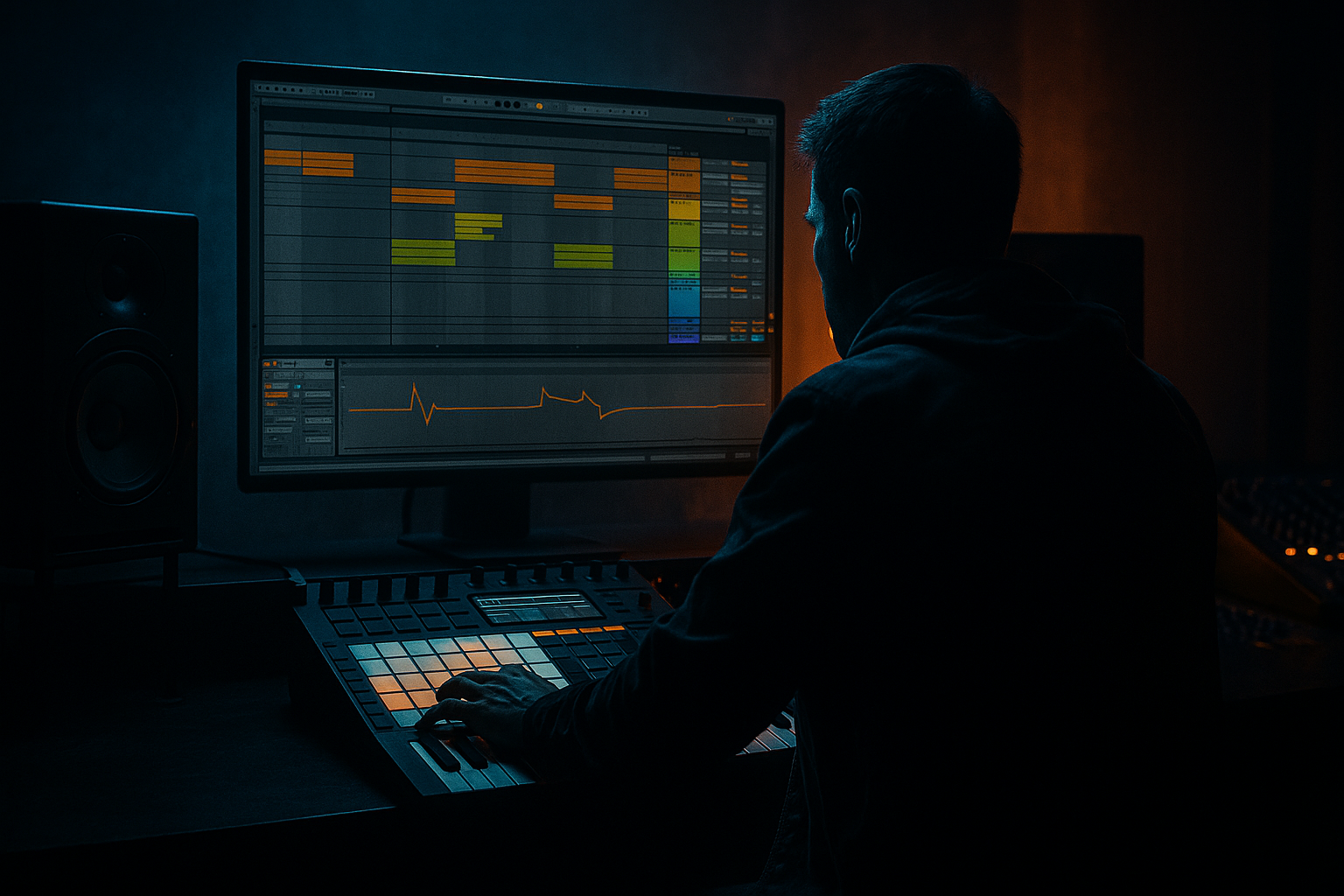
Main tutorial
Arrange an Amen-style fill with modern punch and vintage soul in Ableton Live 12
1. Lesson overview
In this lesson, you’ll build a short Amen-style drum fill that works in drum and bass, jungle, and rolling bass music. The goal is to combine:
- Vintage soul: chopped Amen energy, swing, grit, and a human feel
- Modern punch: tight transient control, weighty low end, clean arrangement impact
- Drum Rack
- Simpler
- Slice to New MIDI Track
- Glue Compressor
- Drum Buss
- EQ Eight
- Saturator
- Auto Filter
- Utility
- Reverb / Echo
- Bar starts with a chopped break phrase
- Snare hits get extra emphasis
- A quick drum fill movement builds tension
- Last hit is punchy and sets up the next section
- Before a drop
- At the end of an 8-bar drum loop
- As a transition between bass phrases
- In jungle-inspired intros or breakdowns
- Loose but controlled
- Dirty but not muddy
- Old-school but current
- Energetic, not overstuffed
- A Drum Rack
- A MIDI clip
- Slices mapped across pads
- Reorder hits
- Repeat ghost notes
- Pull out a snare for emphasis
- Add your own kick or rim for modern impact
- Beat 1: a strong kick or break hit
- Beat 2: snare accent
- Beat 3: extra ghost note movement
- Beat 4: fast lead-in into the next bar
- Keep the first half fairly close to the original break
- In the second half, add:
- Use 1/16 grid
- For faster rolls, temporarily switch to 1/32
- Keep some notes slightly off the grid for groove
- Leave breathing room so it doesn’t sound like a machine gun
- 1.1: break kick/snare hit
- 1.2: ghost snare
- 1.3: main snare
- 1.4: snare roll or tom-like slice
- 1.4.3: final hit before the drop
- Make main snare hits louder
- Lower ghost notes
- Give repeated notes a velocity curve, not the same level
- Main snare: 100–127 velocity
- Ghost notes: 35–80 velocity
- Pickup hats: 50–90 velocity
- Main backbeat hits: mostly tight
- Ghost notes: slightly late or early depending on feel
- Fill notes: tighten just enough to stay clear
- Use groove pool with a swing groove
- Slightly offset 16th notes manually
- Use break slices that already contain natural swing
- Start with MPC-style swing
- Keep timing subtle, around 54–58% feel
- Drive: 5–15%
- Transient: +10 to +25
- Boom: very light or off at first
- Crunch: small amount if needed
- Dry/Wet: 30–60%
- More snap on snares
- Slight dirt on the body
- Extra impact without flattening the break
- High-pass below 25–35 Hz
- Cut boxy mud around 200–400 Hz if needed
- Add a small presence boost around 2–5 kHz for snare snap
- If the cymbals are harsh, gently reduce around 7–10 kHz
- Cutting a little harsh upper-mid energy
- Softening the transient with Drum Buss
- Using saturation instead of brute force compression
- Ratio: 2:1 or 4:1
- Attack: 10–30 ms
- Release: Auto or 0.1–0.3 sec
- Aim for only 1–3 dB of gain reduction
- Bind slices together
- Keep the fill punchy
- Avoid a disconnected “sample pack” feel
- Drive: 1–4 dB
- Soft Clip: on
- Output level matched carefully
- More density
- Slight harmonic warmth
- Better audible presence on small speakers
- Redux very lightly for lo-fi edge
- Erosion for subtle texture on high hats or snare tails
- Reverb
- Echo
- Auto Filter
- Short decay: 0.3–0.8 sec
- Low dry/wet: 5–15%
- Use mostly on the last snare or fill hit
- Very short delay or ping-pong effect
- Low feedback
- Automate just the last hit for a tail
- Sweep a filter open across the last 1/2 bar
- Great for building tension into the drop
- End of every 8 bars for energy
- End of every 16 bars for bigger arrangement movement
- Final bar before a breakdown or drop
- Leave the bass active underneath, but duck or thin it slightly
- Let the fill answer the main drum loop
- Use a small automation move before and after the fill:
- Bars 1–7: standard rolling break + bass
- Bar 8: Amen fill with extra snare movement
- Last 1/2 bar: bass mute or filter sweep
- Next bar: drop back into full groove
- Tight snare
- Clicky kick
- Short rimshot
- Small clap layer, used lightly
- Drum Buss
- a small Saturator
- a tiny boost around 3–4 kHz
- short reverb
- little delay feedback
- tight gating or volume automation
- Saturator
- Compressor
- maybe a touch of Echo
- Use only the sliced Amen break
- Keep groove and ghost notes
- Minimal processing
- Aim for classic, natural movement
- Add Drum Buss
- Add light Glue Compression
- Layer a clean snare on the last accent
- Keep it tight and direct
- Use the break slices
- Add subtle Saturator
- Automate Auto Filter opening over the last half bar
- Add a short reverb only to the final hit
- Which feels most musical?
- Which cuts through the mix best?
- Which would work before a drop?
- Vintage breakbeat soul
- Modern drum impact
- Clear arrangement function
- a MIDI note-by-note example fill
- an Ableton rack chain preset recipe
- or a full 8-bar DnB drum arrangement template 🎛️
You’ll do this inside Ableton Live 12 using stock tools like:
By the end, you’ll have a fill that can land at the end of an 8-bar or 16-bar phrase and push the track back into the drop with style 🔥
---
2. What you will build
You are going to make a 1-bar Amen fill with this shape:
This kind of fill works well:
Sound character
The fill should feel:
---
3. Step-by-step walkthrough
Step 1: Find and import an Amen break
Start with a classic break sample. If you have an Amen break, great. If not, use any raw break with snare, ghost notes, and cymbal movement.
In Ableton Live 12:
1. Drag the break into an audio track
2. Set the project tempo to something DnB-friendly:
- 174 BPM for modern DnB
- 170–172 BPM for a slightly looser jungle feel
3. Turn on Warp
4. Choose warp mode:
- Beats for punchy drums
- Try Preserve Transients if the timing gets messy
Important
If the break is already tightly recorded, avoid over-warping it. Too much stretching can kill the snap and swing.
---
Step 2: Slice the break into MIDI
This is the easiest way to make a custom fill while keeping the original soul.
Do this:
1. Right-click the break clip
2. Choose Slice to New MIDI Track
3. In the slicing settings:
- Slice by: Transient
- Create one slice per transient
- Use Drum Rack as the target
Ableton will create:
Why this is useful
Now you can:
---
Step 3: Build the fill pattern
Open the MIDI clip and start editing the rhythm.
A strong beginner fill formula:
Use a 1-bar phrase with this structure:
Try this approach:
#### Example concept
- one extra snare ghost note
- one fast snare repeat
- a short cymbal or hat pickup
Practical MIDI tips
Good fill layout idea
A simple Jungle-style fill could be:
The final hit should feel like a launch button 🎯
---
Step 4: Tighten the groove with velocity and timing
This is where the fill becomes musical.
Velocity
In the MIDI editor:
A good starting range:
Timing
Don’t quantize everything perfectly.
Try:
Swing
You can add swing in a few ways:
If using groove:
---
Step 5: Add modern punch with Drum Buss
Now we make the fill hit harder without losing the character.
On the Drum Rack or group channel, add:
Drum Buss
Suggested starting settings:
What to listen for
Caution
Too much Boom can make the fill muddy, especially in DnB where the sub bass needs space.
---
Step 6: Shape the tone with EQ Eight
Use EQ Eight to clean up the fill so it sits in a dense mix.
Basic EQ moves:
Pro tip
If your fill is too aggressive, don’t just reduce volume. Try:
---
Step 7: Add glue without killing the break
The fill should feel unified, especially if you’ve chopped it into many slices.
Add Glue Compressor on the drum group
Suggested starting point:
Why
This helps:
Important
If the compressor starts pumping too much, back off. For DnB fills, too much compression can flatten the bounce.
---
Step 8: Add a little grit and age
To get vintage soul, use tasteful saturation.
Try Saturator
Put it before or after EQ depending on the result you want.
Starting point:
Result
You can also try:
Keep this subtle. The goal is “dusty and alive,” not broken.
---
Step 9: Create movement with short effects
A fill often feels bigger if it has a tiny bit of space on the final hit.
Use:
Smart setup ideas
#### Reverb
#### Echo
#### Auto Filter
Practical trick
Automate a high-pass filter on the fill so it starts slightly constrained and opens up right before the next section. That gives you classic transition energy.
---
Step 10: Arrange the fill in context
The fill must work inside the track, not just solo.
Best placement
Use it at the:
How to make it feel musical
- filter open
- snare reverb send up
- bass cut for half a bar
DnB arrangement idea
That contrast makes the fill hit much harder.
---
Step 11: Add a modern drum layer if needed
For extra punch, layer the break with one clean one-shot.
Good layer choices:
How to layer
1. Put a one-shot in a second Drum Rack pad
2. Place it only on key accent hits
3. Use Utility to manage stereo width if needed
Layering rule
The one-shot should reinforce the break, not replace it.
If the fill loses its soulful character, the layer is too loud.
---
4. Common mistakes
1. Over-quantizing the break
If every slice lands exactly on the grid, the fill loses jungle feel.
Fix: keep ghost notes loose and use groove lightly.
2. Too many notes
Beginners often stack too many hits, which makes the fill messy.
Fix: choose 3–5 important moments and let them breathe.
3. Too much low end
Amen fills don’t need huge bass energy in the drum layer.
Fix: high-pass the drum fill and leave sub weight to the bassline.
4. Over-processing
If you use heavy compression, saturation, reverb, and distortion all at once, the break can collapse.
Fix: make small moves and check the full mix often.
5. Weak last hit
If the fill doesn’t clearly lead into the next section, it feels unfinished.
Fix: make the final snare or hit louder, tighter, or wider than the rest.
6. Ignoring arrangement
A fill that sounds cool in solo may not work in context.
Fix: always audition it with bass, pads, and atmosphere playing.
---
5. Pro tips for darker/heavier DnB
If you want this fill to work in darker, heavier DnB, use these moves:
Tip 1: Thin the low mids
Dark DnB often has strong bass and atmosphere, so clear space around 250–500 Hz.
Tip 2: Make the snare more aggressive
Use:
This helps the fill cut through huge rewinds and bass movement.
Tip 3: Keep the tail controlled
Dark DnB fills should hit hard and stop cleanly.
Use:
Tip 4: Add tension with filtering
Automate a low-pass to open up over the fill, or use a band-pass moment for a gritty transition.
Tip 5: Use contrast
A dark track hits harder when the fill briefly exposes the drums or adds a solo snare moment before the drop.
Tip 6: Use parallel processing
Create a return track with:
Blend this quietly under the fill for extra size without destroying the original break.
---
6. Mini practice exercise
Let’s make this real. Build three versions of the same fill.
Exercise A: Clean jungle fill
Exercise B: Modern punch fill
Exercise C: Dark hybrid fill
Goal
Compare all three and ask:
This is how you train your ears fast 📈
---
7. Recap
You’ve now built an Amen-style DnB fill that blends:
Key workflow recap:
1. Import a break
2. Slice it to MIDI
3. Reorder hits into a 1-bar fill
4. Adjust velocity and timing
5. Add Drum Buss and EQ
6. Glue the group gently
7. Use saturation and small effects for character
8. Place the fill in arrangement context
Final mindset
A great DnB fill is not just a drum pattern — it’s a transition tool. It should push the track forward, keep the energy alive, and sound like it belongs in the full arrangement.
If you want, I can also give you:

