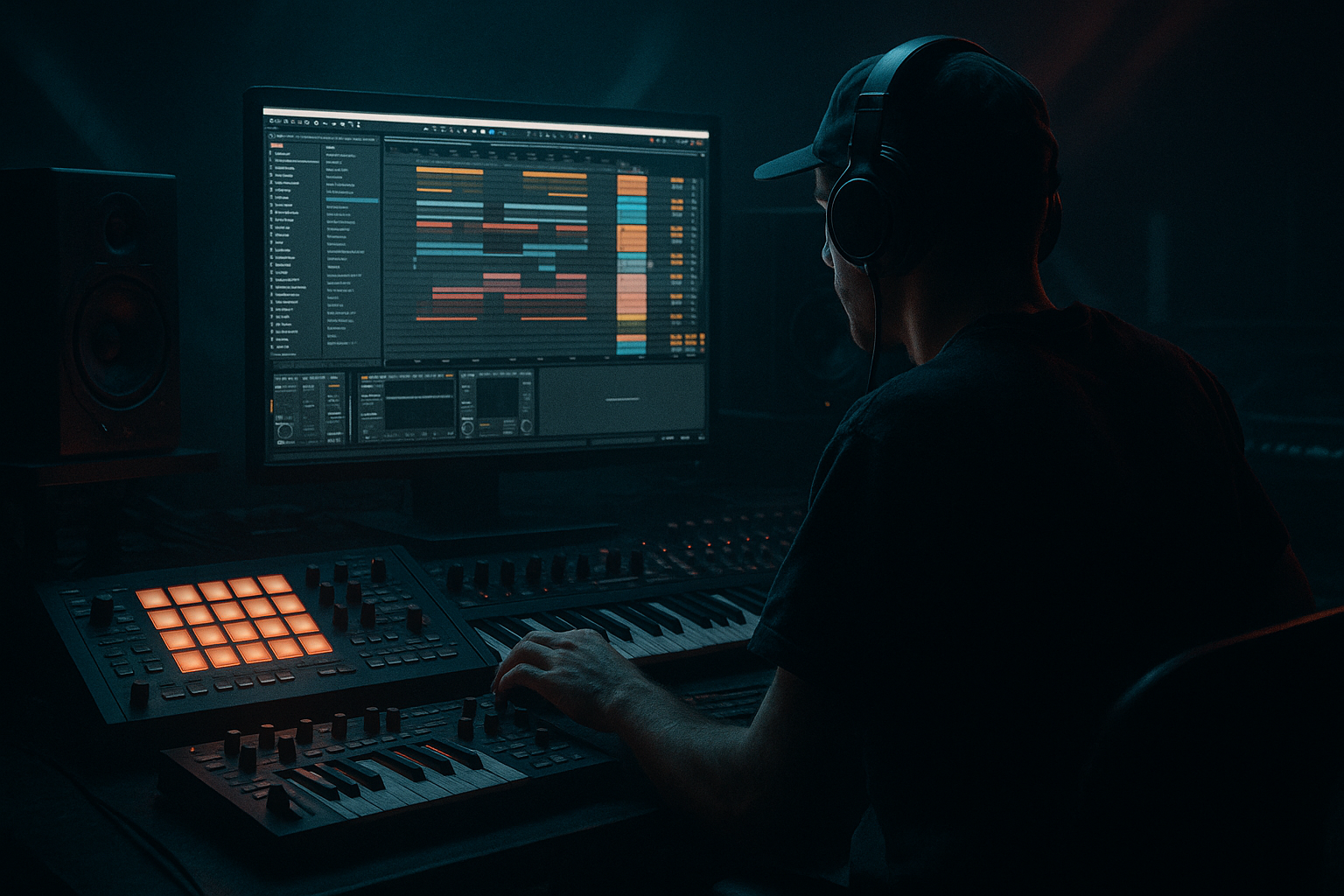
Main tutorial
1. Lesson overview
In a sunrise DnB set, the transition has to lift without screaming. The classic way is to borrow jungle language—Amen-style edits, accelerating energy, filtered brightness, and emotional space—then land cleanly into the next section. 🌅
In this lesson you’ll build a riser/transition built from Amen breaks, arranged for warm, euphoric “first light” emotion while staying firmly in rolling drum & bass.
Ableton Live 12 focus: Arrangement View workflows + stock devices (Warp, Simpler, Auto Filter, EQ Eight, Saturator, Glue Compressor, Hybrid Reverb, Echo, Utility, Limiter).
---
2. What you will build
A 16-bar Amen-based transition (you can scale to 8/32 bars) that:
- Starts soft + distant (filtered, reverby, airy)
- Gains movement via Amen micro-edits (stutters, chops, reverse hits)
- Builds tension with rising pitch/noise and tightening rhythm
- Creates a sunrise “open-up” moment right before the drop (or next tune)
- Lands with a clean downbeat (no messy low-end clashes)
- Add Wavetable (or Analog) with a soft pad
- Add Hybrid Reverb
- Add Auto Filter
- Use Noise (Operator or Wavetable noise osc) + Hybrid Reverb
- Use sparser hits: mostly hats/ghosts, fewer snares.
- Velocity: keep it low (around 50–80) for softness.
- Add a highpass filter on the Amen track:
- Add Hybrid Reverb lightly to the Amen:
- Introduce Amen signature snare placements more clearly.
- Add one 1/8-note stutter at the end of bar 8:
- Add Echo for space:
- On Simpler, automate Transpose from `0` to `+3 or +5 semitones` over bars 9–12.
- Add more 1/16 hats/ghost slices.
- Add a reverse hit into bar 12:
- Device: Saturator
- Auto Filter or EQ Eight on Amen:
- Audio track with White Noise (you can sample noise or use Operator)
- Add Auto Filter (Lowpass → automate opening)
- Add Glue Compressor (optional) to keep it steady:
- On your pad/air track, automate:
- On the Amen track, do the opposite right before the drop:
- Put Utility at the end of the Amen chain:
- If needed, add Limiter on the Amen bus to avoid transition peaks.
- Too much low end in the Amen during the transition
- Over-reverbing the break
- Pitch rising the Amen too far
- No clean “gap” before the drop
- Harsh 4–8 kHz buildup
- Swap “sunrise pad” for a minor drone + tense texture
- Parallel distortion on the Amen bus
- Half-time fakeout in bar 15
- Sub-rumble hint (careful!)
- You built an Amen-style riser transition by slicing the break into Simpler and arranging it in phases (distant → moving → rising → landing).
- The sunrise emotion comes from controlled brightness, subtle pitch lift, spacious pads/air, and a clean cut before the drop. 🌅
- Stock Ableton tools—EQ Eight, Auto Filter, Saturator, Glue Compressor, Hybrid Reverb, Echo, Utility—are more than enough to make it sound pro in a DnB context.
Think: rolling liquid/atmospheric energy, but still dancefloor functional. ✨
---
3. Step-by-step walkthrough
Step 0 — Session setup (so it hits like DnB)
1. Tempo: 170–174 BPM (use 172 as a neutral midpoint).
2. Key/tonal center: Pick the key of the next section (even if your Amen is atonal, your pads/noise should support it).
3. Transition length: Create a 16-bar loop region in Arrangement View (Cmd/Ctrl + L).
---
Step 1 — Get an Amen and warp it properly
1. Drag an Amen break audio file to an Audio Track.
2. In the Clip View:
- Warp: ON
- Warp Mode: `Complex Pro` (cleaner for full break textures)
- If you want more bite/transients: try `Beats` mode with Transients preserved.
- Set Seg. BPM correctly (use Ableton’s detection, then adjust by ear).
3. Consolidate a clean 1–2 bar Amen loop:
- Select the region → Cmd/Ctrl + J.
DnB tip: If the Amen feels late/loose, nudge Warp Markers so the main snare hits line up with 2 and 4 (or classic Amen placement), but keep a little human swing for warmth.
---
Step 2 — Convert to a playable “Amen riser instrument” (Simpler)
We want control for stutters, pitch rises, and reverse hits.
1. Right-click the consolidated Amen clip → Slice to New MIDI Track.
2. Settings:
- Slicing preset: `Built-in` (fine)
- Slice by: `Transient`
- Create one slice per: transient
3. You now have a MIDI track with Simpler (Slice mode).
Why this matters: You can program edits like a jungle drummer—without destructive audio chopping.
---
Step 3 — Build the emotional “sunrise” bed (pad/air) to support the Amen
Create a new MIDI track for atmosphere (this is what makes it sunrise rather than just a break edit).
Option A (fast + stock):
- Algorithm: `Hall`
- Decay: `6–10 s`
- Pre-delay: `15–30 ms`
- Mix: `20–35%`
- Type: `Lowpass 24 dB`
- Start cutoff around `500–1kHz` and automate open gradually to `6–10kHz` by the end of the riser.
Option B (super minimal):
This creates “air” without clashing harmonically.
---
Step 4 — Program the Amen transition (16 bars)
Open the MIDI clip created by Slice to MIDI. We’ll arrange it in 4 phases.
#### Phase 1 (Bars 1–4): “Distant break”
- EQ Eight: Highpass at `150–250 Hz`, 24 dB slope.
- Mix `10–18%`, Decay `2–4 s` (keep it controlled).
✅ Goal: The break feels like it’s “coming from far away,” not slamming yet.
#### Phase 2 (Bars 5–8): “Jungle logic starts”
- Duplicate a snare slice across 1/8 notes for one beat (or 1/16 for more urgency).
- Time: `1/8` or `1/4`
- Feedback: `15–25%`
- Filter: HP around `300 Hz`, LP around `6–8kHz`
- Mix: `8–15%`
✅ Goal: Movement increases, but still elegant.
#### Phase 3 (Bars 9–12): “Rise and tighten”
Now we start to build the riser effect using pitch + density.
Pitch lift (subtle sunrise, not cheesy):
- Keep it subtle—too much sounds like a cartoon.
Rhythmic density:
- Duplicate a snare slice → Right-click → Reverse (or resample and reverse audio)
- Place it so it sucks into the downbeat of bar 13.
Add controlled excitement (stock Saturator):
- Drive: `2–5 dB`
- Soft Clip: ON
- Output: adjust to match level (don’t just get louder)
✅ Goal: It’s lifting, brighter, and slightly more urgent.
#### Phase 4 (Bars 13–16): “Final push + clean cut”
This is where you make it feel like sunrise “opening,” then stop cleanly.
Open the filter:
- Gradually reduce the highpass (e.g., from `200 Hz` down to `80–120 Hz`) but still not full sub.
Add a noise riser layer (stock):
- Attack: `3 ms`
- Release: `Auto`
- Ratio: `2:1`
- Just 1–2 dB of GR
The sunrise “bloom” moment:
- Reverb Mix up slightly near bar 16 (e.g., +5–10%)
- Filter opens a bit more
- Add a reverb throw on the last snare (automate reverb mix briefly up)
- Then hard cut the Amen on beat 4 of bar 16 (or a 1/4 before bar 17)
Clean landing technique:
- Automate Mute (or Gain down to -inf) right before the drop.
✅ Goal: Big emotional lift, then a clean hole for the next section to punch through.
---
Step 5 — Suggested device chain (Amen track)
Here’s a solid stock chain that stays musical for sunrise vibes:
1. EQ Eight
- HP `150–250 Hz` early → automate down to `80–120 Hz` near the end
- Gentle dip if harsh: -2 to -4 dB around `3–6 kHz` (Q ~1.5)
2. Auto Filter
- Lowpass or bandpass automation for movement
- Add a touch of Drive if you want grit (1–3)
3. Saturator
- Drive `2–5 dB`, Soft Clip ON
4. Glue Compressor
- Attack `10 ms`, Release `Auto`, Ratio `2:1`
- Aim 1–3 dB GR when it gets dense
5. Hybrid Reverb (shorter than you think)
- Decay `2–4 s`, Mix `10–18%`
6. Utility
- Width: `90–120%` (careful with phase)
- Gain automation for the cut
Routing tip: Group the Amen + noise riser into a Transition Bus, then put a final EQ Eight on the group to keep low-end tidy.
---
4. Common mistakes
You’ll fight the bass/next drop. Highpass earlier; only reintroduce lows subtly near the end.
Long reverb on fast drums turns to mush. Keep drum reverbs short; use longer reverbs on pads/noise instead.
+12 semitones sounds like a chipmunk rave edit. For sunrise emotion, subtle is powerful (+3 to +5).
If everything plays through bar 16, the next section won’t feel like it arrives. Create a deliberate pocket.
Amens can get brittle when brightened. Use EQ Eight to control fizz while opening filters.
---
5. Pro tips for darker/heavier DnB 🖤 (still using Amen language)
Use Operator sine/triangle + subtle FM, then Hybrid Reverb. Keep it ominous but spacious.
- Create a Return track with Roar (if available) or Saturator + Overdrive
- Blend in quietly for weight without crushing clarity.
- Drop the Amen density and let a single snare + reverse pull lead into the drop. Creates huge contrast.
- Add a very low, filtered noise layer or tom hit, but highpass the Amen so the real sub owns the drop.
---
6. Mini practice exercise (15 minutes)
1. Build an 8-bar version of this transition at 172 BPM.
2. Use Slice to MIDI and create:
- One stutter fill (end of bar 4)
- One reverse snare pull (end of bar 8)
3. Automate one parameter over the whole 8 bars:
- Either Simpler Transpose (0 → +4), or Auto Filter cutoff (closed → open).
4. Bounce (Freeze/Flatten or Export) and listen on low volume:
- Does the energy rise without getting harsh?
- Is there a clean pocket before the next downbeat?
---
7. Recap
If you tell me the vibe (liquid, atmospheric, rollers, or jungle-forward) and the length (8/16/32 bars), I can suggest a specific MIDI slice pattern for your Amen transition.

