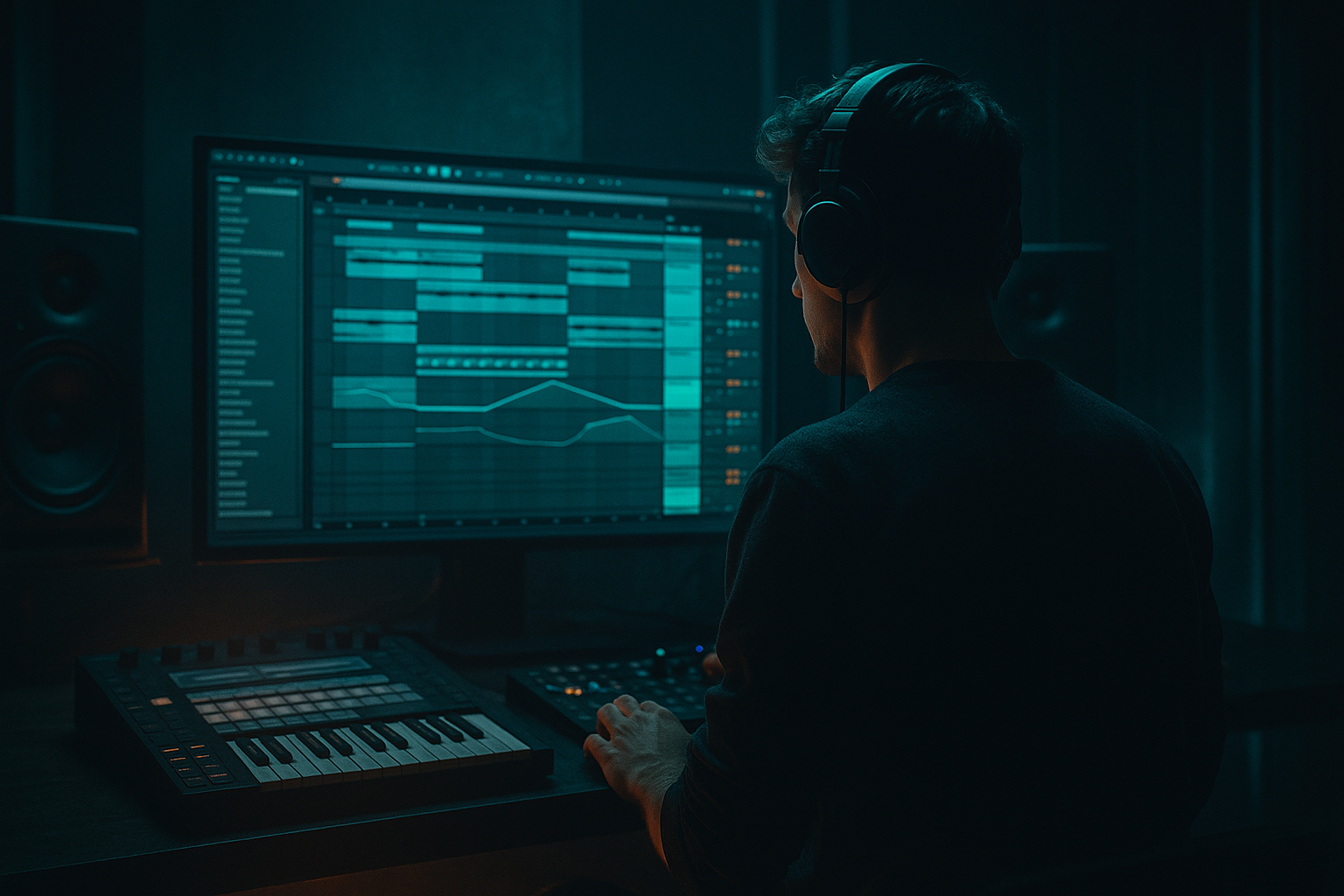
Main tutorial
```markdown
Atmosphere in Ableton Live 12: Slice It + Macro Controls for Oldskool Jungle DnB Vibes 🥁🌫️
1. Lesson overview
This lesson is about turning atmosphere into a playable, slice-able instrument and then performing/automating it with Macros in Ableton Live 12—specifically for jungle / oldskool DnB textures: dusty pads, rave stabs reverb tails, VHS air, field-recording wash, and “breakbeat fog”.
You’ll build an Atmos Rack that:
- Slices a long atmospheric recording into usable chunks
- Lets you morph vibe quickly with a few Macros (movement, dirt, width, ghost rhythms)
- Creates arrangement-ready variations that sit around breaks and bass without masking them
- Simpler (Slice mode) for slicing the atmosphere into rhythmic fragments
- A Macro-controlled FX chain: filter, reverb size, dub delay, chorus/widening, distortion, granular-ish motion via Warp/Repitch + pitch drift
- Parallel chains: “Clean Air”, “Dub Mist”, “Rave Ghost”
- A Resample + print workflow to commit variations into audio for arrangement
- A pad from an old rave record, stretched vocal smear, rain/traffic field recording, vinyl run-in, crowd noise, synth drone
- Bonus points: non-tonal or ambiguous pitch so it doesn’t fight your bassline
- Use sparse hits on offbeats, with occasional rolls
- Don’t fill every 16th—leave air
- Hit slices on 1, 1.2, 1.3.4, 2.2, 3, 3.3, 4.2, 4.4
- Then vary bar 2 with a small 1/16 roll before beat 4
- Auto Filter
- Utility
- Auto Filter (HP12)
- Echo
- Hybrid Reverb
- Saturator
- Frequency Shifter (subtle!)
- Redux (optional, light)
- Reverb (stock)
- Clean Air Auto Filter Freq: `12 kHz → 2.5 kHz`
- Dub Mist Hybrid Reverb Dry/Wet: `10% → 45%`
- Rave Ghost Reverb Dry/Wet: `5% → 25%`
- Simpler: Slice envelope Decay (shorter = choppier)
- Simpler: Gain small compensation
- Optional: add Gate (Audio Effect) after chains and map Threshold slightly (subtle pumping gate)
- Echo Feedback: `20% → 65%`
- Echo Dry/Wet: `5% → 35%`
- Echo Time (optional): `1/8D ↔ 1/4` (careful with automation jumps; consider mapping to Time with small range)
- Simpler Transpose: `0 → +7` (or `0 → -5` for darker)
- Rave Ghost Frequency Shifter Fine: small range tied to pitch movement
- Utility Width on Clean Air: `160% → 70%`
- Utility Width on Dub Mist: `140% → 90%`
- Saturator Drive: `2 dB → 12 dB`
- Redux Downsample: `0% → small amount`
- Optional: Drum Buss Drive (if you add it): `0 → 10`
- Echo Mod Amount: `0 → 25%`
- Hybrid Reverb Mod (if available): small increase
- Auto Filter LFO Amount (set LFO to slow rate like 1–4 bars)
- Sidechain from your Drum Bus or Kick/Snare group
- Map:
- A: Clean intro haze (high Fog, low Dirt, wide)
- B: Pre-drop tension (Ghost Pitch up, Motion up, slightly narrower)
- C: Drop support (sidechain stronger, HP filter higher)
- D: Breakdown dub-out (Dub Throw maxed, feedback rides)
- Bars 1–9 (Intro):
- Bars 9–17 (Break tease):
- Bars 17–33 (Drop 1):
- Bars 33–49 (Mid-break / switch):
- Bars 49–65 (Drop 2 darker):
- Too much low end in the atmos: your sub will feel weak. High-pass aggressively (often 200–600 Hz) depending on vibe.
- Over-widening: 160–200% width can vanish in mono and blur breaks. Use width as a section-based effect, not a constant.
- Reverb masking snares: long verbs are great, but filter them (low cut + high cut) and sidechain them.
- Random slicing with no groove: slices still need intent. Use groove, velocity shaping, and negative space.
- Macro ranges too extreme: map smart ranges so every knob position is usable, not chaos.
- Pitch down the entire rack (`-2` to `-7`) and compensate with a high shelf after—darker but still present.
- Use multiband control:
- Add roving resonances:
- Mid/Side discipline:
- Print + reverse:
- You sliced atmosphere like a break using Simpler (Slice mode) 🗡️
- You built a parallel-chain Atmos Rack for clean, dubby, and ghostly layers
- You mapped Macros with purpose (filter/reverb/width/dirt/motion/sidechain) 🎛️
- You performed and resampled variations to turn sound design into arrangement-ready material 🎚️
- You placed it in the arrangement like jungle: breathing around the breaks and bass, not fighting them 🥁
Advanced focus: Macro mapping strategy, modulation, resampling workflows, and arrangement tricks for rolling jungle.
---
2. What you will build
A single Audio Track containing an Instrument Rack (yes, for audio—via Simpler/Sampler) that behaves like an atmospheric “break”:
Core features
---
3. Step-by-step walkthrough
Step 0 — Choose the right source (this matters)
Pick a 10–40 second audio file with interesting tails and noise:
DnB context tip: If your tune is 165–174 BPM, pick audio with some transient information (tiny clicks, breaths, hits). It slices better and can “shuffle” like a break.
---
Step 1 — Put it into Simpler and Slice it 🗡️
1. Create a new MIDI Track
2. Drop your atmosphere audio onto the device area to create Simpler
3. In Simpler, switch to Slice mode
4. Set Slice By:
- Start with Transient
- If it’s too smooth (no transients), switch to Beat and set 1/8 or 1/16
5. Set Playback: `Trigger` (more controllable)
6. Set Voices: `8–16` (enough overlap for tails)
7. Turn Snap on (helps slices land cleanly)
Advanced move: If your sample is super washy, add a temporary Drum Buss (Drive 5–10) before resampling (or just transient-shape via saturation) to create micro-transients, then resample and slice the resample.
---
Step 2 — Make it “jungle rhythmic” with a MIDI pattern
Create a MIDI clip (1–2 bars), and program something that breathes like a break:
Example pattern idea (1 bar @ 170 BPM):
Human feel: Add Groove Pool groove like MPC 16 Swing lightly (3–8%), or extract groove from a break.
---
Step 3 — Wrap it in an Instrument Rack with 3 parallel chains 🎛️
Group Simpler into an Instrument Rack (`Cmd/Ctrl+G`).
Create three chains (Chain List):
1. Clean Air (wide, filtered, minimal rhythm)
2. Dub Mist (delay/reverb movement)
3. Rave Ghost (distorted, pitched, “haunted”)
#### Chain 1: Clean Air
Device chain (after Simpler):
- Mode: `LP24`
- Freq: start ~`4–8 kHz`
- Res: `0.5–1.2`
- Width: `120–160%` (careful)
- Bass Mono: On (if using Utility with that feature available)
Goal: airy bed that doesn’t bully the mix.
#### Chain 2: Dub Mist
Device chain:
- Freq: `200–600 Hz` (to keep low-end clean)
- Mode: `Dub`
- Time: `1/8D` or `1/4`
- Feedback: `25–45%`
- Filter inside Echo: keep it dark (LP ~`3–6 kHz`)
- Mod: small `5–15%`
- Algorithm: `Hall` or `Plate`
- Decay: `4–10s` (yes, long—this is atmosphere)
- Pre-delay: `10–30 ms`
- Low Cut: `250–500 Hz`
- High Cut: `6–10 kHz`
Goal: classic roomy haze with motion.
#### Chain 3: Rave Ghost
Device chain:
- Drive: `3–10 dB`
- Soft Clip: On
- Mode: `Ring` or `Single Sideband`
- Fine: `+10 to +80 Hz` (tiny metallic drift)
- Mix: `5–20%`
- Downsample: small amount (don’t obliterate)
- Size: `80–120%`
- Decay: `2–6s`
- Low Cut: `300–600 Hz`
Goal: grime, ghost tones, rave-era weirdness.
---
Step 4 — Map Macros like a producer (not like a demo) 🧠
You’ll get the most mileage by mapping Macros to multiple parameters across chains. Here’s a proven set of 8:
#### Macro 1: Fog (Filter + Reverb push) 🌫️
Map:
Use: pull down for darker sections, push up for breakdown haze.
#### Macro 2: Shuffle Slice (Start + Gate feel)
Map:
Use: turn ambience into “ghost break” rhythm.
#### Macro 3: Dub Throw 🌀
Map:
Use: automate at end of 2/4/8-bar phrases like a reggae engineer.
#### Macro 4: Ghost Pitch 👻
Map:
Use: pitch lifts into drops, or pitch down into menace.
#### Macro 5: Width / Collapse
Map:
Use: collapse width when the drop hits to make drums feel bigger.
#### Macro 6: Dirt
Map:
Use: turn “pretty” into “pirate radio tape.”
#### Macro 7: Motion (Mod + Drift)
Map:
Use: slow evolving movement so the bed doesn’t loop-stare.
#### Macro 8: Sidechain Space
Add Compressor (or Glue Compressor) after the rack on the track:
- Compressor Threshold: `0 → -25 dB` (range depends on levels)
- Or map Wet/Dry if using a parallel setup
Use: “carve” space so your breaks punch through while the haze breathes.
---
Step 5 — Turn it into arrangement fuel (resample + print) 🎚️
This is where it becomes production, not just sound design.
#### Workflow A: Resample a 16-bar performance
1. Create a new Audio Track named `ATM PRINT`
2. Set its input to Resampling
3. Arm it, then record while you:
- Switch MIDI patterns
- Ride Macros (Fog, Dub Throw, Dirt, Motion)
4. Consolidate the best 16–32 bars (`Cmd/Ctrl+J`)
Now you have a commit-ready atmos stem you can cut like a break.
#### Workflow B: Create 4 variations
Print four passes:
---
Step 6 — Place it like jungle: arrangement ideas
At 170 BPM, try this 64-bar skeleton:
Clean Air only, Fog ~60%, slow LFO movement, minimal slices (sparse MIDI)
Bring in Dub Mist chain, slight Shuffle Slice, automate Dub Throw at bar ends
High-pass the whole rack (Auto Filter HP @ ~250–450 Hz), heavy sidechain, Width reduced
Keep it rhythmic but not busy—let the Amen/Think break rule
Print a “tape stop” moment: quick pitch dip (Ghost Pitch), then re-open Fog
Dirt + Rave Ghost up, Motion moderate, less width, more midrange grit
Key DnB rule: atmosphere should frame the break, not smear the snare transient.
---
4. Common mistakes
---
5. Pro tips for darker/heavier DnB 🖤
Add Multiband Dynamics after the rack and lightly clamp the mids (don’t crush). This keeps haze dense without spikes.
Put Auto Filter in BP mode with a slow LFO (rate 2–8 bars). Map Macro “Motion” to LFO Amount.
Put Utility after reverb/delay and reduce low-mid width: keep <300–500 Hz mostly mono.
Take your printed atmos, reverse key moments into snare hits or drop points (classic jungle drama).
---
6. Mini practice exercise (15–25 min) ✅
1. Grab a 20–30s atmos source (field recording or pad).
2. Slice it in Simpler (Slice by Beat at 1/16).
3. Make a 2-bar MIDI clip with a swingy sparse rhythm.
4. Build the 3-chain rack (Clean Air / Dub Mist / Rave Ghost).
5. Map 8 Macros using the template above.
6. Record a 16-bar performance riding:
- Fog (section changes)
- Dub Throw (phrase ends)
- Width/Collapse (drop impact)
- Dirt (second 8 bars darker)
7. Place the printed audio under a break and adjust:
- High-pass
- Sidechain amount
- Width in drop
Deliverable: one 16-bar atmos stem that “moves” like a breakbeat layer.
---
7. Recap
If you want, tell me what kind of source you’re slicing (pad, vinyl noise, vocal wash, field recording) and your BPM/key, and I’ll suggest exact Macro ranges and a 32-bar automation plan tailored to your tune.
```

