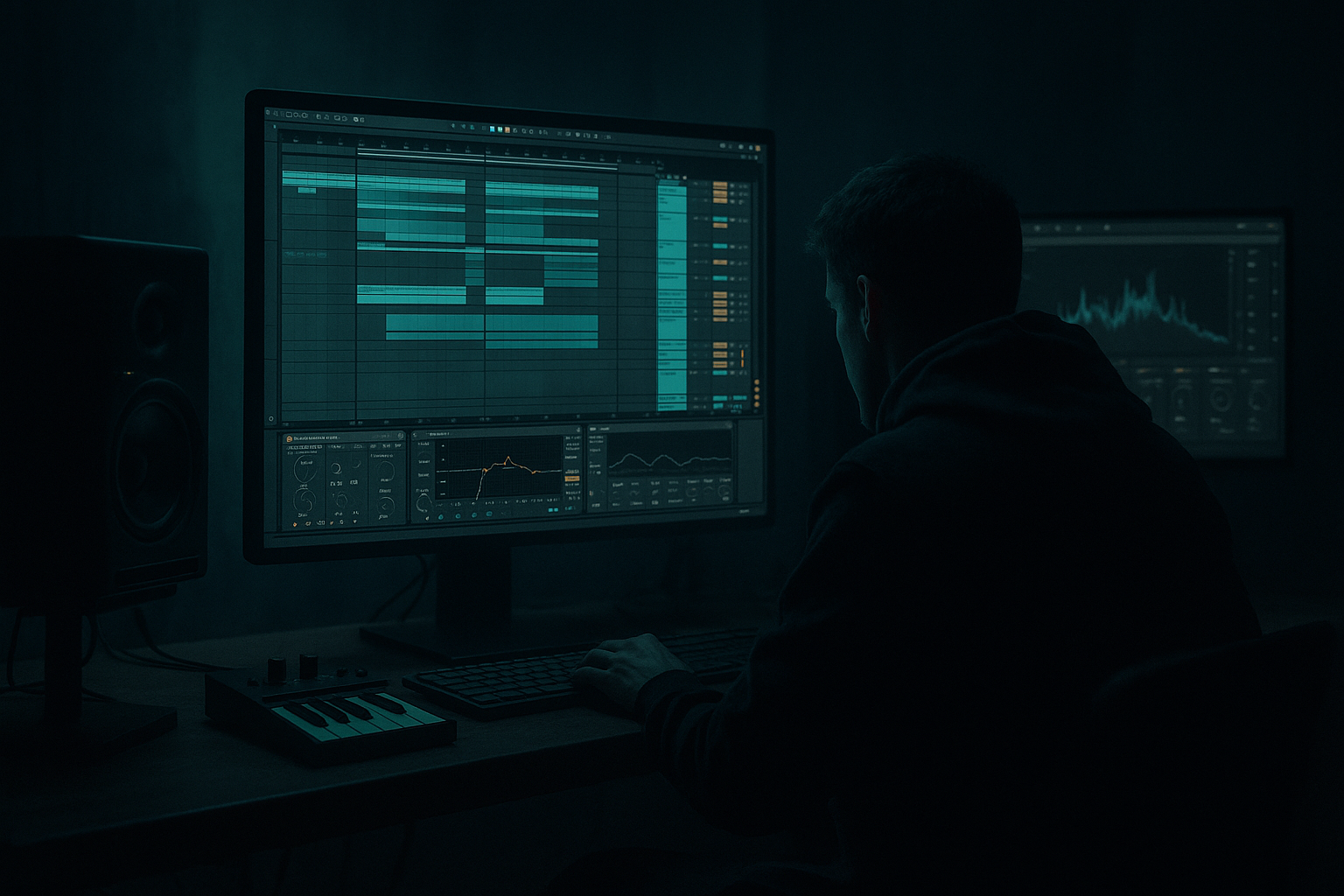
Main tutorial
Atmospheric Field Recording Processing — Advanced DnB Sound Design (Ableton Live)
Energetic, focused, and practical — this lesson teaches you how to turn raw field recordings into deep, rolling, atmospheric beds and percussive textures for drum & bass (174 BPM-ish) using Ableton Live’s stock tools. Expect real device chains, concrete settings, workflow tips, arrangement ideas, and advanced tricks geared toward darker/heavier DnB and jungle vibes. 🎧🔥
---
1) Lesson overview
Goal: transform one or more field recordings into a set of usable atmospheric elements for a drum & bass track: a long evolving pad/bass-bed, mid/high textured motion, and percussive/impact hits + risers. We'll focus on preserving character, maximizing stereo interest, avoiding low-end mud, and making elements sit with heavy sub-bass and fast drums.
Context: use Live (Suite recommended for Sampler + Hybrid Reverb), but everything can be done with Intro/Standard devices (Simpler, Reverb, Echo, Grain Delay, Saturator, EQ Eight, Compressor, Utility, Glue, Multiband Dynamics, Redux).
Tempo: 170–176 BPM (examples will reference 174 BPM).
Emoji: used sparingly to mark tips and notes. 🙂
---
2) What you will build
- A long, evolving atmospheric bed (stereo) for intros and breakdowns.
- A pitched/resampled low-bleed/rumble layer for sub reinforcement.
- Textured high-frequency motion (grains and delays) for fills and movement.
- Percussive “found-sound” hits and risers made from transients in the recording.
- Two return buses: Wide Reverb (long tails) and Modulated Echo/Granular bus for stereo motion.
- Bars 1–16: BED only, high-pass automation closed; TEXTURE filtered heavily; introduce HITS sparsely every 8 bars.
- Bars 16–32: Open TEXTURE Auto Filter; send to R2 Echo increases; start riser automation (reverse hit + Grain Delay pitch).
- Drop at 33: Lift HP on BED to reveal more highs, reduce REVERB send slightly to let drums/bass dominate, but keep R2 echoes for tails and fills.
- Use quick stutters (clip repeat, retrigger via Warp markers) on atmos in breaks to create jungle-style fills before the drop.
- Over-widening low frequencies — leads to phase cancellation and mud. Keep sub & low-mid mono.
- Excessive reverb on low end — always HP reverb sends (<300 Hz).
- Crushing character by too much denormalizing: don’t over-EQ and then resaturate to death; preserve original texture first.
- Forgetting to resample heavy chains — CPU meltdown and loss of editability. Commit to stems.
- Using Grain Delay/Echo unsynced to tempo when you need rhythmic cohesion (sync to 1/8 or 1/16 for rolling DnB feel).
- Not automating sends — static ambiances get boring. Automate send levels and filters for tension.
- Letting atmos occupy important mid frequencies (200–800 Hz) that clash with snares and bass. Use narrow cuts or multiband ducking.
- Sub-bass via pitch-shifted grains: duplicate a texture, pitch -24 to -36 semitones in Simpler/Sampler, send through low-pass at 400 Hz, compress and blend under the kick. Adds subterranean rumble without muddying mids.
- Use Frequency Shifter with slow LFO (0.01–0.1 Hz) to create very slow detuning on atmos for unsettling motion. Dry/Wet ~10–20% keeps it eerie.
- Parallel distortion: send to an aux with Saturator -> Overdrive -> Glue. Blend under main bed for grit but keep high-end intact.
- Resample long modulated echoes and reverse them for pre-drop crashes / reverse-reverb swells. Time-reverse and cut to ~1–4 bars for jungle tension.
- Duck atmos under kick and bass with Multiband Dynamics sidechained only on mid band (200–800 Hz) or use a dedicated split track for low vs. highs to rhythmically carve space.
- Use aggressive low-pass automation on atmosphere filter during drops to reveal only top texture — lets drums and bass take center while keeping the vibe.
- For more “vintage” jungle: add a vinyl noise layer (Subtle) at -30 to -40 dB; use high-frequency emphasis and narrow EQ notch to avoid masking.
- Start with surgical cleaning (HP cut, de-noise mentally), then preserve character.
- Build separate layers: long bed (Sampler), moving texture (Grain Delay/Echo), percussive hits (Simpler/Drum Rack).
- Use returns for heavy reverb/echo and resample those returns to create committed stems and reduce CPU.
- Guard your low end (HP on reverb, mono subs), and rhythmically sync granular/echo effects for rolling DnB feel.
- For darker/heavier tones: pitch down grains, parallel distortion, frequency shifting, downsampling, and multiband ducking.
- Automate sends, filters, and width to keep atmos evolving across intro → drop transitions.
- Give you a ready Ableton chain (.adg) with macros mapped for quick tweaking.
- Walk through one of your field recordings step-by-step (drop me an audio clip).
End result: a palette of stems (bed, mid texture, highs, hits) you can arrange into a DnB intro, drop, and transitions without clashing with drums/bass.
---
3) Step-by-step walkthrough
Assume a raw field recording clip imported to an Audio Track named FIELD_IN. Sample length ~15–60s. I'll give concrete device chains and settings. Work in Arrangement or Session view — I use Arrangement for linear builds.
A. Setup & cleanup (preserve character)
1. Set project tempo to ~174 BPM.
2. Duplicate FIELD_IN twice (three versions): BED, TEXTURE, HITS. Work non-destructively.
3. On each track, insert:
- Utility (initial): Gain 0 dB, Width 100% (we'll adjust later), Stereo Mode = Stereo.
- EQ Eight: Activate High-Pass (Filter 1) at ~40 Hz to remove inaudible rumble. For BED track set HP ~60–120 Hz (we’ll later restore sub content via low-pitched resampling). Use a notching sweep (Q ~2.5) to remove any annoying hum (e.g., 50/60 Hz).
- Normalize or use Clip Gain so the audio sits around -6 to -12 dBFS.
B. Create the long evolving BED (BED track)
1. Convert to Sampler (preferred) or Simpler (Slice/or full). In Sampler:
- Loop a long section: set loop points to a musically interesting slice with slight motion. Loop mode: Classic or Repitch.
- Pitch + Manual: Tune by ear ±0–12 semitones for harmonic fit with your bassline. For darker DnB often -2 to -7 semitones works well.
2. Device chain (in order):
- Utility: Width 85% (slightly narrower)
- EQ Eight: HP 80–200 Hz (sweep to taste) — a gentler shelf to leave space for sub.
- Saturator: Drive 2–5 dB, Mode “Analog Clip”/“Soft Sine” — add harmonic content.
- Hybrid Reverb (or Reverb): Size large, Decay 6–12 s for atmospheric tail, Predelay 30–50 ms, Diffusion 50–70%, High Cut ~6–8 kHz (tame highs). Dry/Wet ~20–30% as an insert; better to use as Return (see below).
- Frequency Shifter: Fine 10–40 Hz, Dry/Wet ~10–25% — creates slow stereo detune movement. Or use small modulated LFO automation on Fine.
- Grain Delay (subtle): Grain Size 30–60 ms, Spray 0–40%, Pitch 0–-12 semitones (for low rumble doubling), Sync off or to 1/8–1/16 for rhythmic grains, Dry/Wet 10–20%.
- Multiband Dynamics (optional): Apply gentle compression on low band to tame reverb feeding into subs.
3. Routing tip: Put the main long Reverb on a Return (R1) with very long decay and low high-cut. Send BED at 8–16%. Then use a parallel Insert Return chain for heavy processing and resampling (see resample later).
4. Automation: Slowly open a low-pass filter (Auto Filter) over 16–64 bars to reveal the high-end toward a drop. Automate Utility width to expand slightly on bars leading into drop.
C. Create TEXTURE/Movement (TEXTURE track)
1. Chop and slice: Use Simpler in Slice mode or “Slice to New MIDI Track” (right-click). Choose transient/beat/slices.
- For granular textures: place a clip into Simpler, set Warp mode to Complex Pro, or use Grain Delay/Echo.
2. Device chain:
- EQ Eight: HP 200–400 Hz to remove body
- Grain Delay (prominent here): Sync to 1/8 or 1/16 dotted. Feedback 25–45%, Grid Size 1/8, Grain Size 20–40 ms, Pitch +12 to -24 st (for octave shifts). Dry/Wet 30–60% for wild texture.
- Echo: Delay Time 1/16 or 1/8 dotted, Feedback 40–60%, Filter: Low-Pass 5–8 kHz, High-Pass 300–600 Hz. Modulation amount 10–20% for chorusiness.
- Auto Filter: Peak or LP with LFO synced to 1/4–1/16 for rhythmic opening/closing tied to drums.
- Utility: Width 120–140% to widen highs (beware phase).
3. Use a Send to Modulated Return (R2) with an Echo + Chorus/Mod setup for extra width.
4. MIDI approach: Trigger sliced Simpler via a MIDI clip with varying velocities to produce dynamic movement. Use velocity to feed a Velocity to Macro that controls Grain Delay pitch or Echo feedback.
D. Make percussive HITS (HITS track)
1. Find transient spikes in the FIELD_IN (door slams, metal clanks, steps). Consolidate or Slice to hit clips.
2. Use Drum Rack or Simpler for each hit, set each to one-shot, tune them to kit key (pitch +/- semitones) so they musically fit the track.
3. Device chain for each hit:
- EQ Eight: HP 120–250 Hz to remove low rumble.
- Transient Shaper / Compressor: (Use Glue Compressor with fast attack ~0.5–5 ms, release ~100–300 ms, ratio 4:1) — tighten hit.
- Saturator: Drive 3–8 dB, Type: Analog Clip for analog grit.
- Frequency Shifter (subtle): Dry/Wet 10–20% to create odd harmonic content for jungle textures.
- Send to R1 (Long Reverb) sparingly for tail → automatable pre/post drop.
4. Create risers: reverse a short hit, stretch with Warp mode “Beats” or use Grain Delay with long feedback and pitch automation to hand-craft risers.
E. Low/Sub reinforcement (RESAMPLE track)
1. Duplicate BED, heavy pitch down for sub:
- Set Sampler/Simpler to loop a low section, pitch -12 to -36 semitones.
- EQ: Low-pass ~300–500 Hz
- Saturator + Glue Compressor: gentle glue
- Multiband Dynamics: compress low band 2–4 dB to keep it controlled.
2. Optional: Sidechain the sub/resampled bed to the kick/bass using Compressor (Sidechain input). Attack 0.1–5 ms, Release 40–100 ms, Ratio 3–8:1 for pumping.
F. Return tracks & resampling workflow
1. Create Return R1 (WIDE REVERB): Hybrid Reverb (or Reverb) — Decay 8–14s, Predelay 30–60 ms, High Cut 6–10 kHz, Diffusion high, Dry/Wet = 100% (we’ll send signals). Put an EQ Eight after reverb to cut <300 Hz to avoid muddying low end.
2. Create Return R2 (MOD ECHO/GRANULAR): Echo -> Grain Delay -> Chorus (subtle) -> EQ. Echo Time sync 1/8 dotted, Feedback 40%, Filter LoCut 300 Hz.
3. Send BED, TEXTURE, HITS to these returns at varying levels. Use Send automation across arrangement to sculpt intensity.
4. Resample returns: create a new audio track armed to Resample. Record the returns while performing send automation to commit CPU-heavy long tails into stems. Use this to bounce complex processed atmos into single tracks you can further process and freeze for CPU relief.
G. Final glue & mix placement
1. Use Multiband Dynamics to carve the bed—keep the midrange clear for bass/basslines and drums.
2. Use Utility mid/side technique:
- Insert Utility near the end: set Width 100% for low band, 140% for highs (use EQ Eight to split bands, use two tracks if needed). Keep sub mono.
3. Add slight tape/bit reduction via Redux (downsample 12–20 kHz, 8–bit?) in parallel and blend to taste for gritty texture (darker DnB).
4. Final bus compression (Glue): Threshold set for 1–3 dB gain reduction, Attack medium-fast, Release auto. Use this sparingly to glue atmos together.
H. Arrangement ideas (short blueprint)
---
4) Common mistakes
---
5) Pro tips for darker/heavier DnB
🔥 Dark twist: resample the entire mix of BED+TEXTURE with Redux (sample rate down to 11–16 kHz) and then pitch it back up slightly — gritty, lo-fi atmos perfect for heavyweight DnB.
---
6) Mini practice exercise (30–60 minutes)
Objective: make three usable stems (BED_Long, TEXTURE_Motion, HIT_Riser) from a single field recording.
Steps:
1. Import a 30s city/street recording into FIELD_IN.
2. Duplicate into BED, TEXTURE, HITS tracks.
3. BED:
- Load into Sampler, loop a 6–12s section. Pitch -7 semitones. EQ HP 80 Hz. Hybrid Reverb: Decay 10s, Predelay 40 ms. Send 10% to R1.
4. TEXTURE:
- Put clip into Simpler (Slice mode). Use Grain Delay sync 1/8 dotted, Grain Size 30ms, Pitch -12 st on some grains. Echo after Grain Delay, Time 1/16, Feedback 35%. HP 250 Hz.
5. HITS:
- Find 3 transient hits. Load each into Drum Rack/Simpler. EQ HP 180 Hz. Saturator Drive 4 dB. Create a 4-bar MIDI clip: place hits on 2.2 and 3.4 to mimic jungle fills.
6. Create R1: Reverb (long), High Cut 7 kHz. R2: Echo (modulated).
7. Resample R1+R2 by recording them to a new audio track while moving send levels (0–40%). Save as stems.
8. Arrange:
- Bars 1–8: BED only, TEXTURE low pass.
- Bars 9–16: TEXTURE opens, HITS appear as fills.
- Bars 17–20: Reverse a hit recorded to R2 for a riser into a loop.
Deliverable: export the three stems and drop them into a DnB demo session at 174 BPM — layer with a rolling amen or break.
---
7) Recap
Final encouragement: experiment aggressively with pitch & grains, but always A/B the processed result against the original — keep the emotional core of the field recording while making it sit in the mix. You've got this — build atmospheres that breathe with the drums and make your drops feel earned. 🌫️⚡
If you want, I can:

