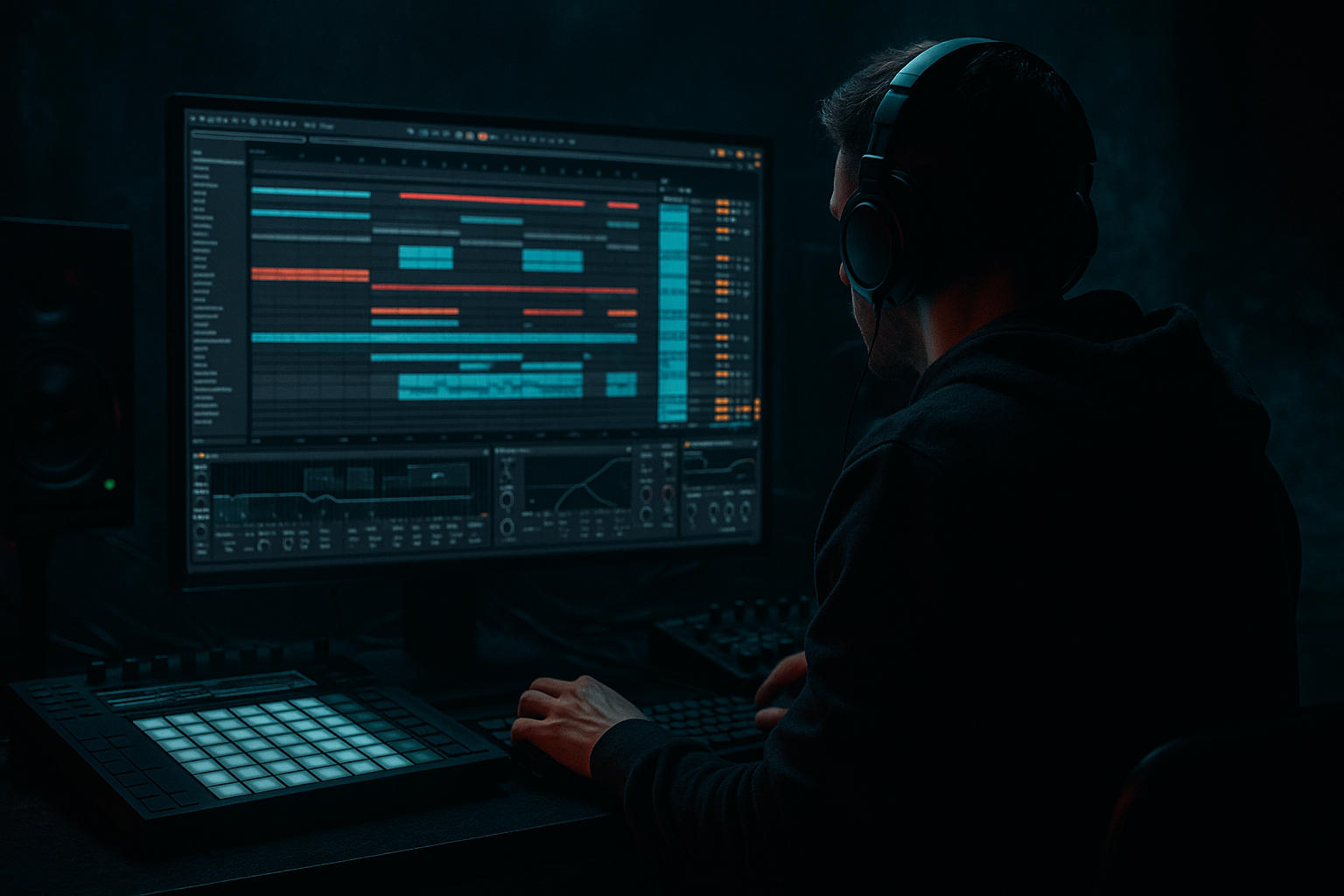
Main tutorial
```markdown
Atmospheric Intro Themes from Scratch (Oldskool DnB Vibes) — Ableton Live 🎛️🌫️
1. Lesson overview
In this lesson you’ll build an atmospheric, oldskool DnB/jungle-style intro theme from zero in Ableton Live, using mostly stock devices. The goal is that classic 90s vibe: moody pads, filmic stabs, dusty textures, distant breaks, and a clean handoff into the drop.
We’ll focus on:
- Writing a memorable but simple motif
- Making pads/textures feel wide, vintage, and “found”
- Using FX + automation to create movement without overwriting
- Arrangement tricks that scream oldskool / rolling DnB 🥁
- A pad bed (warm + detuned + wide)
- A minor-key motif (2–4 notes, emotional, repeatable)
- Atmospheric noise + vinyl/air
- A distant break teaser filtered in
- A reverb tail / riser moment that transitions into the drop
- a rolling Reese section
- a jungle break drop
- or a dark minimal DnB drop
- Osc 1: Basic Shapes → position around sine/triangle
- Osc 2: Saw (or another basic shape) low level for harmonics
- Voices: 6–8
- Unison Amount: 20–35%
- Detune: 10–18
- Filter: LP24
- Amp Envelope:
- i → VI (e.g., Fm → Db)
- i → VII (e.g., Fm → Eb)
- Automate filter cutoff slowly over 16 bars (e.g., 350 → 900 Hz).
- Automate reverb Decay or Mix slightly up approaching the drop.
- a minor-key stab
- a vocal-ish one-shot
- a thin synth lead with huge reverb
- Osc A: Sine
- Add a little harmonic: enable Osc B at low level (sine pitched +7 or +12 semitones)
- Filter: LP12 around 1–3 kHz
- Amp Env: Attack 10–40 ms, Release 1–3 s
- Use call-and-response across 2 bars.
- Example rhythm (half-time feel at 172):
- Create a new audio track
- Set input to “Resampling”
- Record a bar of your motif tail
- Reverse it, fade in → instant oldskool “suck-in” transition.
- Warp ON
- Mode: Complex Pro (safe) or Beats (more bite)
- Set loop length: 1 or 2 bars
- On your motif or pad, automate Hybrid Reverb Mix up briefly in the last 1–2 beats.
- Then cut everything (or low-pass it hard) right before the drop.
- Osc: Noise (or any bright wavetable)
- Filter LP24, automate cutoff rising
- Resample your intro bus to audio
- Use Warp → Repitch
- Automate clip transposition down quickly over 1/2 bar (subtle)
- Bars 1–8: Pad bed + vinyl/noise only
- Bars 9–16: Motif repeats with variation + filtered break teaser
- Bars 17–24: Add a second layer (string pad or subtle choir)
- Bars 25–32: Transition build
- Too many layers too early: oldskool intros feel deep, not crowded.
- Pads eating the low end: high-pass pads and textures (often 150–300 Hz).
- Reverb mud: huge reverbs need EQ. Cut lows in the reverb or after it.
- Motif is too complex: keep it hummable—2 to 4 notes can be enough.
- Break teaser too loud: it should feel like it’s in the distance until late intro.
- Go harmonic-minor or Phrygian flavor for menace (tastefully).
- Add a subtle dissonance note (like a minor 2nd) briefly in the motif for tension.
- Use Corpus (stock) on a stab quietly to add metallic resonance:
- Make space for the drop by automating a mid cut:
- Add very quiet distant impacts (one-shot booms) with long reverb tails—lowpassed.
- Start with a wide, filtered pad bed and keep it clean below ~200 Hz.
- Write a simple motif and let reverb + delay create atmosphere.
- Use texture + subtle movement (slow filter automation, gentle modulation).
- Tease the drop with a filtered break and a controlled transition moment.
- Keep it rooted in the same key and mood as the main section for authentic DnB flow.
---
2. What you will build
A 16–32 bar intro theme in 170–174 BPM with:
You’ll end with an intro that can lead into:
---
3. Step-by-step walkthrough
Step 0 — Set the session like a DnB producer
1. Tempo: 172 BPM (classic modern DnB tempo)
2. Time signature: 4/4
3. Key: choose a minor key that feels dark and oldskool:
- F minor, G minor, or A minor are common.
4. Create track groupings (helps workflow):
- `ATMOS` (pads, noise, ambience)
- `MOTIF` (lead/melody/stab)
- `BREAK TEASE` (filtered drums)
- `FX` (risers, impacts)
---
Step 1 — Build the pad bed (wide, detuned, 90s mood) 🌫️
Create a MIDI track → Instrument: Wavetable (stock)
Wavetable settings (starting point):
- Cutoff: 300–800 Hz
- Resonance: low (0.2–0.4)
- Attack: 250–800 ms
- Decay: 2–4 s
- Sustain: -6 to -12 dB
- Release: 3–8 s
Chord idea (oldskool-safe and emotional):
Try a 2-chord loop (8 bars total):
or
Keep voicings simple and mid-register. Don’t go too low—save low space for bass later.
Pad device chain (stock):
1. Wavetable
2. Chorus-Ensemble
- Mode: Chorus
- Amount: 20–35%
- Rate: slow (0.15–0.30 Hz)
3. Echo
- Time: 1/4 or 3/16
- Feedback: 25–40%
- Filter: HP around 300 Hz, LP around 5–7 kHz
- Mix: 10–20%
4. Hybrid Reverb
- Algorithm: Hall or Plate
- Decay: 4–8 s
- Pre-delay: 10–25 ms
- EQ inside: cut lows below 200–300 Hz
5. EQ Eight
- High-pass around 150–250 Hz
- Dip a bit around 300–500 Hz if muddy
6. Optional: Saturator
- Drive: 1–3 dB
- Soft Clip ON (subtle)
Automation for movement:
---
Step 2 — Add “air” and tape/vinyl texture (instant oldskool glue) 📼
Create an Audio track → load any vinyl/room/noise sample
(If you don’t have one, record a room tone with your phone and drop it in—seriously.)
Processing chain:
1. EQ Eight
- HP at 200–400 Hz (remove rumble)
- LP at 8–12 kHz (keep it soft)
2. Auto Filter
- LP12
- Slight LFO: Rate 0.05–0.12 Hz, Amount small (just gentle motion)
3. Redux (very subtle!)
- Bits: 10–12
- Downsample: tiny amount (start around 1.10–1.40)
4. Utility
- Width: 120–160% (if it feels narrow)
Keep this quiet: you should miss it when muted, not notice it when playing.
---
Step 3 — Write a simple motif (2–4 notes = memorable) 🎼
Create MIDI track → Instrument: Simpler (or Operator)
Oldskool intros often use:
#### Option A: Operator “distant lead”
Operator settings (quick):
Motif pattern:
- Bar 1: note on beat 1, short answer on “& of 2”
- Bar 2: single held note
Motif FX chain (classic washed vibe):
1. Echo
- 1/8 dotted or 1/4
- Feedback: 35–55%
- Wow/Flutter: moderate
2. Hybrid Reverb
- Big Hall, Decay 6–12 s
- Pre-delay 20–35 ms
- Mix 20–40% (don’t be scared; this is the intro)
3. EQ Eight
- HP at 200–400 Hz
- If harsh, dip 2–4 kHz
4. Optional: Ping Pong Delay (tiny mix) for stereo movement
DnB trick:
Freeze the vibe by resampling a reverb tail:
---
Step 4 — Add an “ambient break teaser” (filtered and distant) 🥁
You want the listener to feel drums coming, but not fully.
Create an Audio track → drop in a break loop (Amen, Think, etc.)
Warping:
Break-tease processing chain:
1. Auto Filter
- HP12 to remove sub: 120–200 Hz
- LP12: start low (300–800 Hz) and automate up to 3–6 kHz
2. Drum Buss
- Drive: 5–15%
- Crunch: 5–20%
- Boom: OFF (save sub for later)
3. Hybrid Reverb
- Shorter decay than pads: 1–2.5 s
- Mix low: 8–15%
4. Utility
- Width: 80–110% (keep it controlled)
Arrangement move:
Introduce the break teaser at bar 9 very low + heavily filtered.
By bar 15–16, open the filter so the top end hints at the upcoming drop energy.
---
Step 5 — Create a transition moment into the drop (classic DnB lift) 🚀
You need a “gate” that tells the listener: drop incoming.
#### Method 1: Reverb throw + hard cut
#### Method 2: Noise riser (stock)
MIDI track → Wavetable
Chain:
1. Auto Filter (automate cutoff up)
2. Reverb (Hybrid Reverb, 4–8s)
3. Utility (automate Width from 80% → 160%)
Place it in the final 1–2 bars.
#### Method 3: Classic tape stop feel (quick and dirty)
This can feel very oldskool when used lightly.
---
Step 6 — Arrangement blueprint (16 or 32 bars)
Here’s a reliable 32-bar intro layout:
- Motif appears once at bar 5 (don’t overplay it)
- Filter slowly opens, texture thickens
- Use one “special” ear-candy hit (reverse tail, distant vocal chop)
- Noise riser + reverb throw + last-bar tension
- Optional: remove pad low mids in the last 2 bars to “make room”
Important: the intro should feel like it belongs to the drop’s key and mood. It’s not a separate song.
---
4. Common mistakes
---
5. Pro tips for darker/heavier DnB 🖤
- Tune it to the key note, mix very low.
- On the pad bus, dip 250–500 Hz more as you approach the drop.
---
6. Mini practice exercise (15 minutes) ⏱️
1. Set tempo to 172 and key to G minor.
2. Create:
- 1 pad (Wavetable) with the chain above
- 1 motif (Operator) with Echo + Hybrid Reverb
- 1 noise/texture audio track
- 1 break teaser track (Auto Filter + Drum Buss)
3. Write:
- A 2-chord loop (Gm → Eb)
- A 2-bar motif using only 3 notes
4. Arrange 16 bars:
- Bars 1–8: pad + texture, motif once
- Bars 9–16: motif twice, break teaser fades in + filter opens
5. Add one transition:
- reverse reverb tail into bar 17 (even if you don’t have a drop yet)
Export and listen on headphones. If the intro feels like it’s “breathing,” you nailed it.
---
7. Recap
If you want, tell me your target subgenre (jungle, techstep, liquid, minimal rollers) and one reference track, and I’ll suggest a tighter chord/motif palette and an intro arrangement template that matches it.
```

