Main tutorial
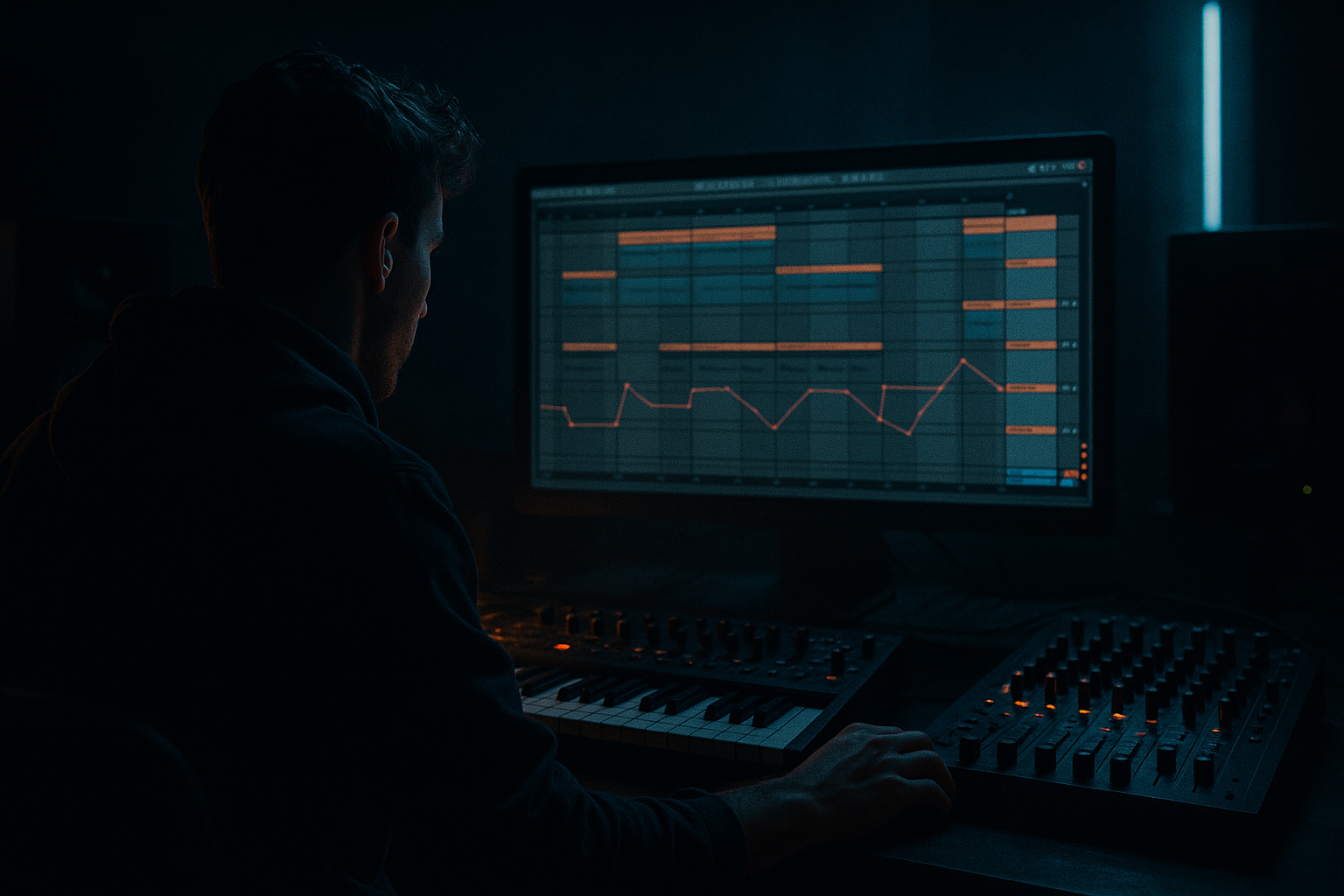
Atmospheric Jungle Drones From Scratch in Ableton Live 12 (Advanced Sound Design) 🌫️🥁
1. Lesson overview
Atmospheric drones are the glue in jungle and rolling DnB: they fill the negative space between breaks, reinforce mood, and make transitions feel cinematic without stealing attention from the drums and bass. In this lesson you’ll build drones from scratch using only Ableton Live 12 stock devices, then shape them to sit perfectly under fast breaks (160–174 BPM), with movement, grit, and “tape-rainforest” depth.
You’ll create:
- A harmonic drone (tonal bed)
- A noisy/air layer (texture + space)
- A resampled “print” for arrangement control and classic jungle “bed” behavior
- Stable pitch center (keyed to your track)
- Slow evolving movement via modulation
- Breath, hiss, rainforest grit
- Stereo width and motion
- Flattened, characterful drone audio
- Easy to automate + slice for fills and transitions
- Roar (character + saturation)
- Hybrid Reverb (space design)
- Auto Filter / EQ Eight (cleanup + movement)
- Utility (mono management below ~150 Hz)
- Sub (typically 40–90 Hz)
- Kick fundamental (often 50–70 Hz)
- Snare body (180–250 Hz)
- Break presence (2–6 kHz)
- Osc 1: Basic Shapes (or a smooth table like Sine/Saw blend)
- Osc 2: Off (for now) or very low level for subtle beating
- Unison: 2–4 voices, Amount low (10–20%), Width 120–160%
- Filter: MS2 or PRD (any character filter works)
- Attack: 1.5–4.0 s
- Decay: 8–15 s
- Sustain: -6 to -12 dB (or ~0.6–0.8)
- Release: 4–10 s
- Draw a long note: F1 or F2 (choose based on how low you want the harmonic center).
- If it clashes with sub, push it up an octave and let the sub handle the low.
- Add LFO (Ableton LFO device) mapped to:
- LFO settings:
- LFO → Osc Pitch (very small):
- Osc 1: Sine or Triangle (low level)
- Noise: ON, level ~15–35%
- Filter: Lowpass 12/24
- Amp Envelope similar to Layer A (slow attack/release)
- Add Chorus-Ensemble
- Add Auto Pan
- Add EQ Eight
- Blend: start 40% Convolution / 60% Algorithmic
- Convolution: pick something like Hall / Large Space / Dark Room
- Algorithmic: Hall
- Decay: 6–14 s
- Pre-delay: 20–45 ms (keeps breaks punchy)
- Low Cut: 250–450 Hz (important in DnB!)
- High Cut: 6–10 kHz (dark jungle vibe)
- Width: 120–160%
- Saturator
- Add Phaser-Flanger very subtle on the bus:
- Warp: Complex or Texture (try both)
- Add Echo
- Add Redux (optional)
- Add Auto Filter and automate cutoff for transitions
- Compressor (not Glue this time)
- Start with Drone Print only + filtered (HP up, LP down).
- Slowly open LP cutoff over 16 bars.
- Add small noise rises via automation on Hybrid Reverb send.
- Pull drone level down 1–3 dB at the drop.
- Narrow width slightly (Utility width from 120% → 100%) so breaks feel wider by contrast.
- Automate Roar drive slightly up
- Increase reverb send by 2–4 dB for “wash”
- Then hard cut reverb send right before the drop for impact
- At bar boundaries, mute Layer B (air) for 1 bar, then bring back—instant movement without changing notes.
- Too much low end in the drone: wrecks your sub clarity and makes mastering harder. High-pass aggressively (often 100–150 Hz).
- Over-widening: drones can smear mono compatibility and make breaks feel smaller. Keep width controlled; mono the low band.
- Reverb without filtering: long reverb + low mids = swamp. Always use Hybrid Reverb low cut and/or EQ on the return.
- Too much modulation range: slow is good, but huge sweeps scream “sound design demo,” not “rolling jungle bed.”
- Not printing/resampling: advanced producers commit. Printing gives you arrangement power and that “captured atmosphere” feel.
- Shift the drone’s emotional center: minor 2nds and tritones work well in darkside. Try layering F + Gb quietly (careful: keep it subtle).
- Saturate the midrange, not the lows: use EQ before Roar to focus drive around 300 Hz–2 kHz, then high-pass after.
- Make the space feel “abandoned”: Hybrid Reverb with darker IRs + high cut around 6–8 kHz.
- Add “distant machinery”: very quiet Corpus (resonator) tuned to the key, mixed low, can add industrial tone.
- Micro-edits = jungle authenticity: print the drone, then do 1/8-bar cuts, reverses, and fade-ins around fills.
- Contrast at the drop: automate drone reverb send down at the drop; let drums and bass feel closer and more violent.
- You built a layered jungle drone: tonal + air + printed audio for control.
- You used stock Live 12 tools: Wavetable/Analog, LFO, Roar, Hybrid Reverb, EQ Eight, Glue/Compressor, Utility.
- You shaped it specifically for DnB: filtered low end, controlled width, subtle sidechain, and resampling for authentic jungle arrangement workflow.
- You now have a drone system that can sit under rolling breaks and heavy bass without turning the mix into fog.
---
2. What you will build
A 3-layer drone rack that can go from deep atmospheric to darkside jungle:
Layer A — Tonal Drone (Wavetable / Operator)
Layer B — Noise + Air (Analog / Drift + noise)
Layer C — Resampled & Mangled Print
Final processing chain includes:
---
3. Step-by-step walkthrough
Step 0 — Set context for DnB/jungle workflow
1. Set tempo to 170 BPM.
2. Choose a key (example: F minor is a classic dark DnB home base).
3. Create a group track called DRONE BUS (Cmd/Ctrl+G later).
DnB mindset: your drone must leave space for:
---
Step 1 — Build the Tonal Drone (Layer A)
1. Create a MIDI track: Drone Tonal
2. Load Wavetable (stock).
Wavetable settings (starting point):
- Position: ~20–35%
- Cutoff: ~250–800 Hz (we’ll automate later)
- Drive: 3–8 dB
Amp Envelope (for drone behavior):
MIDI note:
Movement (critical for “alive” jungle atmos):
- Wavetable Filter Cutoff (small range)
- Wavetable Position (tiny range)
- Rate: 0.03–0.10 Hz (10–30 seconds per cycle)
- Shape: Sine or Random (Smoothed)
- Amount: subtle (think 2–10%, not sweeping like EDM)
Add subtle pitch drift (optional but vibey):
- Amount: ±3 to ±8 cents
- Rate: 0.05–0.12 Hz
This creates that “old sampler / tape room tone” instability.
---
Step 2 — Add Noise/Air Texture (Layer B)
1. Create a second MIDI track: Drone Air
2. Load Analog (or Drift if you prefer).
Analog quick setup:
- Cutoff ~2–6 kHz
- Resonance low
Make it stereo and moving:
- Mode: Chorus
- Rate: 0.15–0.35 Hz
- Amount: 20–45%
- Width: 150–200%
- Rate: 0.04–0.12 Hz
- Amount: 15–35%
- Phase: 120–180° (wide but not seasick)
High-pass to keep it out of the sub lane:
- HP at 180–350 Hz (12 or 24 dB/oct)
- Small dip around 2–4 kHz if it fights break transients
---
Step 3 — Create the “Jungle Space” (Shared reverb design)
Now we’ll create a consistent environment so it feels like one world.
1. Create a Return Track called ATMOS VERB
2. Load Hybrid Reverb (stock).
Hybrid Reverb (Return) settings:
Send both drone layers into this return (start around -18 to -10 dB sends depending on density).
DnB note: long verbs are fine if you filter the low end hard and keep pre-delay.
---
Step 4 — Add controlled grit and density (Roar + filtering)
Atmos drones often need harmonics to “read” on small speakers, without getting loud.
On Drone Tonal (Layer A), add:
1. Roar
- Type: Tube / Warm / Saturation modes (choose taste)
- Drive: 5–15% (or low dB drive)
- Tone/Filter: keep it darker; avoid too much fizz
- Mix: 20–50%
2. Auto Filter
- Filter: LP24
- Cutoff: ~400–2k (automate later)
- Envelope: tiny or off
3. EQ Eight
- HP: 90–150 Hz (unless it’s intentionally a mid drone)
- Dip: 200–350 Hz if boxy
- Dip: 2.5–5 kHz if it fights snare crack
On Drone Air (Layer B), add:
- Soft Clip: ON
- Drive: 2–6 dB
- Output: compensate
This makes the hiss/air more “present” without raising level too much.
---
Step 5 — Glue the layers into a Drone Bus (and make it mix-safe)
1. Group the two tracks (Layer A + B) → DRONE BUS
2. On DRONE BUS add:
Device chain (bus):
1. EQ Eight
- HP: 80–120 Hz (keep sub lane clean)
- Optional gentle shelf down from 10 kHz for darkness
2. Glue Compressor
- Attack: 10–30 ms
- Release: Auto or 0.3 s
- Ratio: 2:1
- Aim for 1–2 dB GR max (just “gel”)
3. Utility
- Bass Mono: ON
- Width: 90–130% (careful—don’t over-widen if breaks are already wide)
Optional movement (very jungle):
- Rate: 0.03–0.08 Hz
- Amount: low
- Feedback: low
This adds slow “tape head” motion.
---
Step 6 — Resample and print (Layer C: the classic move) 🎛️➡️🎚️
Old jungle atmos often feels like a recorded bed—a printed texture that you ride and chop.
Resampling workflow:
1. Create an Audio track named Drone Print
2. Set its input to Resampling (or “DRONE BUS” if you prefer).
3. Record 16–64 bars of your drone evolving.
4. Consolidate (Cmd/Ctrl+J) into a clean clip.
5. Now process the audio clip like a sampler texture:
On Drone Print audio track:
- Time: 1/4 or 1/8 dotted for jungle bounce
- Feedback: 10–25%
- Filter: dark
- Mix: 5–18%
- Downsample slightly for grit (don’t destroy it)
Arrangement trick: Slice the printed drone into 4-bar phrases and rearrange. Jungle is modular—tiny edits feel huge at 170 BPM.
---
Step 7 — Make it breathe with the drums (sidechain that stays classy)
You want the drone to move with breaks without obvious EDM pumping.
On DRONE BUS add:
- Sidechain: from your Break Bus (or full drums)
- Ratio: 2:1
- Attack: 15–40 ms (let transients snap)
- Release: 80–160 ms (tempo-feel)
- Threshold: aim for 1–3 dB GR
If you want more “ghost groove,” sidechain from a ghost kick pattern (classic DnB trick).
---
Step 8 — Arrangement ideas (DnB/jungle context)
Here are practical placements:
Intro (16–32 bars):
Drop support (main 32 bars):
Breakdown / second drop tension:
Classic jungle “air switch”:
---
4. Common mistakes
---
5. Pro tips for darker/heavier DnB 🖤
---
6. Mini practice exercise (15–25 minutes) ⏱️
1. Build Layer A in Wavetable and create a 32-bar drone note in F minor.
2. Build Layer B with noise, chorus, and slow auto-pan.
3. Create ATMOS VERB return with Hybrid Reverb and filter it properly.
4. Print a 16-bar resample to Drone Print.
5. Arrange a simple structure:
- 8 bars intro (filtered drone)
- 8 bars build (open filter + more send)
- 16 bars drop (sidechain drone to breaks, slightly lower level)
6. Export a 30–60 second bounce and check:
- Drone doesn’t mask snare
- Sub region is clean
- Mono compatibility is acceptable (Utility test: Width to 0%)
---
7. Recap
If you want, tell me the vibe (e.g., “90s atmospheric jungle,” “techstep darkness,” “modern 2020s rollers”) and your track key, and I’ll suggest exact chord tones + a modulation map that fits your bassline and break choice.

