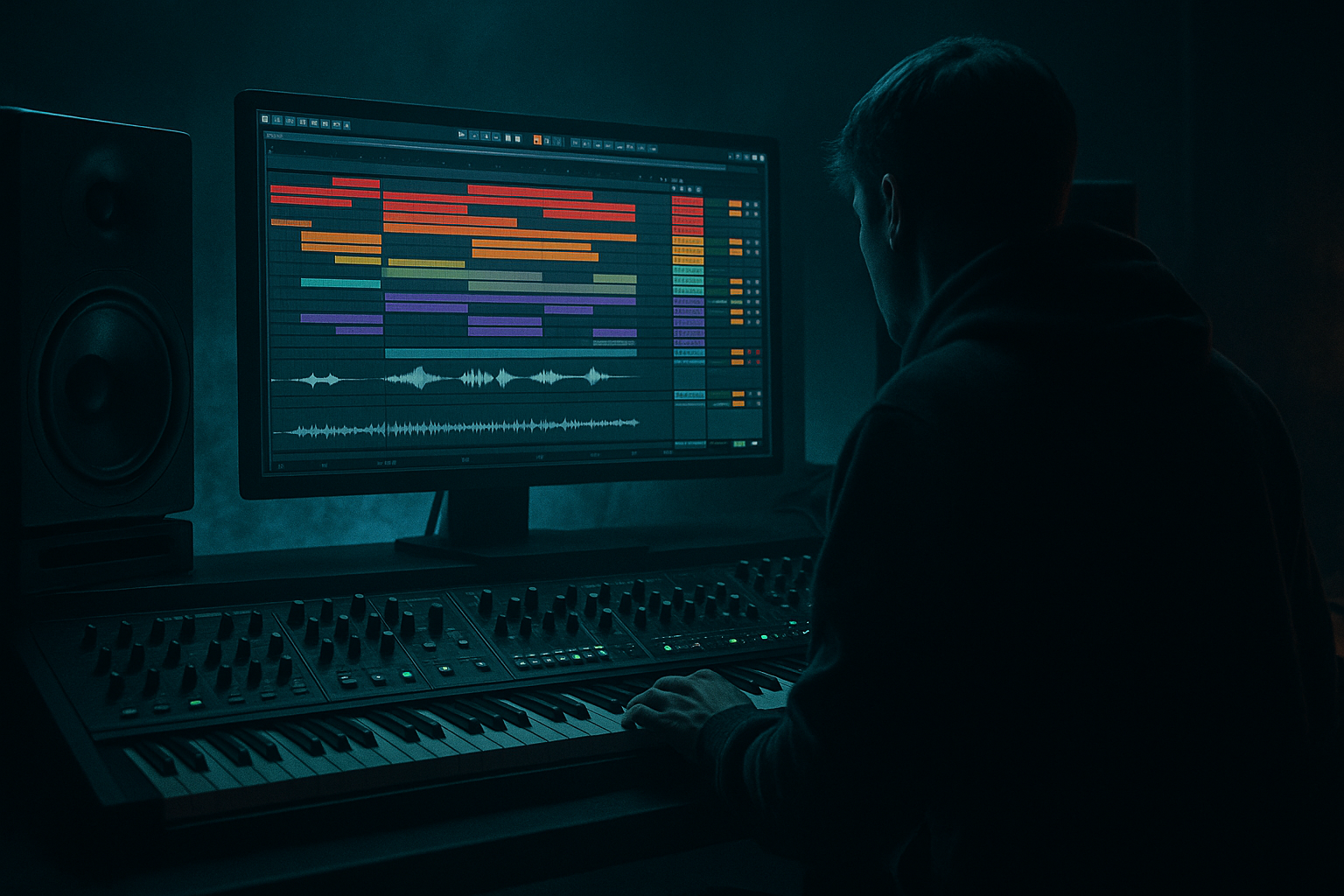
Main tutorial
Atmospheric Jungle Drones from Scratch (Resampling Only) — Ableton Live 🎛️🌫️
1. Lesson overview
You’re going to build classic jungle / DnB atmospheric drones using only stock Ableton devices and a resampling workflow—meaning we’ll print audio, then keep processing that audio until it becomes a deep, evolving texture.
This is a beginner-friendly method used constantly in real DnB production: commit early, resample often, and let happy accidents create vibe. 🧪
Key skills you’ll learn:
- Making a drone source from simple synth/noise
- Recording to audio via Resampling
- Turning short sounds into long atmospheres with stretching, reverb, filtering
- Creating movement (without needing complicated modulation)
- Fitting drones into a jungle / rolling DnB arrangement
- A 30–60 second atmospheric drone loop that feels like jungle intros/breakdowns
- 2–3 resampled “generations” of the same sound (each darker/more alive)
- A drone that sits behind breakbeats + subs without muddying the mix
- Add Wavetable
- Play a low note like F1–A1 (DnB-friendly fundamentals)
- Add Instrument Rack on the track.
- Chain 1: Wavetable (tone)
- Chain 2: Simpler with a short Noise sample OR use Wavetable’s Noise if available (depending on version).
- Add Auto Filter after Wavetable:
- Add Redux (subtle grit):
- Mode: Chorus
- Rate: 0.10–0.30 Hz
- Amount: 30–60%
- Mix: 25–40%
- Time: 1/8 (left) and 1/4 (right) or Sync Off with ~180–420 ms
- Feedback: 20–35%
- Filter: HP around 200 Hz, LP around 4–7 kHz
- Mix: 10–25%
- Algorithm: Hall or Shimmer (use Shimmer gently)
- Decay: 8–20 s
- Pre-delay: 10–30 ms
- Size: 80–100%
- Low Cut: 200–400 Hz
- High Cut: 6–10 kHz
- Mix: 25–45%
- Consolidate the clip first: select it → Cmd/Ctrl + J
- Then set the clip length longer by stretching the end out:
- Result: smeared time texture, very ambient.
- Find a nice moment in the audio (a sweet spot)
- Loop a tiny section:
- Reverse sections (Right-click clip → Reverse) for risers/ghostly swells
- Chop tiny pieces and scatter them for eerie details
- Stretch again for even deeper atmospheres
- Drone only + filtered top noise
- Automate Auto Filter cutoff slowly opening (e.g., 500 Hz → 2 kHz)
- Add distant breakbeat ghost (very low, high-passed)
- Drone gets darker: automate reverb mix down slightly, filter down
- Drone ducks behind drums and bass (see tip below)
- Keep drone mostly mid/high so sub + kick stay clean
- Sidechain: On
- Audio From: your Kick (or a drum buss)
- Ratio: 3:1
- Attack: 5–20 ms
- Release: 80–200 ms
- Threshold: adjust for 2–6 dB gain reduction
- Too much low end: drones feel huge solo but kill your sub. High-pass aggressively (often 150–400 Hz).
- Over-reverbing: long decay + high mix = undefined fog that masks breaks. Keep reverb mix controlled and resample instead.
- No movement: a static drone gets boring fast. Use automation (filter cutoff, reverb mix, utility width).
- Clipping during resampling: distortion + reverb can spike. Keep a Limiter on Master and watch meters.
- Too wide in the low-mids: wide 200–500 Hz mud is a DnB killer. Use Utility bass mono + EQ dips.
- Detune down after resampling: transpose the audio clip -3 to -12 semitones (Complex Pro) for instant darkness.
- Band-limit like old jungle: EQ Eight → low-pass around 6–10 kHz, slight bump around 1–2 kHz for presence.
- Add “air hiss” layer: duplicate drone, high-pass at 4–6 kHz, add light Chorus, keep it super quiet.
- Saturation before reverb: heavier, more metallic tails. Try Saturator drive 5–10 dB, then reverb.
- Reverb-to-audio trick: crank reverb to 60–80% on a pass, resample it, then blend that printed tail quietly under the main drone.
- You built an atmospheric jungle drone using simple synthesis, then made it cinematic through resampling-only processing.
- The core workflow: Generate → Print → Warp/Stretch → Process → Print again.
- You learned how to keep drones wide, evolving, and mix-safe for rolling DnB.
- Your next step is building a personal drone library: resample 10 minutes of experiments and keep the best 20 seconds.
---
2. What you will build
By the end you’ll have:
Think: rainy warehouse fog, tape-worn pads, distant sirens, humid low-mid wash. 🌧️🏭
---
3. Step-by-step walkthrough
A) Session setup (fast + DnB-ready)
1. Tempo: set to 165–174 BPM (pick 170).
2. Create three tracks:
- MIDI Track: `DRONE SOURCE`
- Audio Track: `RESAMPLE PRINT`
- Audio Track: `DRONE FINAL`
3. Set `RESAMPLE PRINT` input:
- In/Out section (I/O):
Audio From → Resampling
Monitor → Off (important to avoid feedback)
4. Drop a Limiter on your Master (stock device):
- Ceiling: -0.3 dB
- This protects you while doing heavy resampling.
---
B) Build a simple drone source (no fancy synth required)
You can do this with Wavetable (stock) or Operator. Let’s use Wavetable for ease.
#### 1) Create the tone
On `DRONE SOURCE` (MIDI):
- Osc 1: Sine or Basic Shapes
- Position: ~0% to 20% (more pure)
- Voices: 2
- Unison: On (Amount ~ 20–40%)
#### 2) Add noise/air (jungle vibe)
Add Operator after Wavetable (yes, as an effect source is weird—so instead do this:)*
Better beginner method:
If you want stock + fast:
- Type: LP24
- Freq: 600–2kHz (start ~1.2kHz)
- Resonance: 10–20%
- Downsample: 2.0
- Bit Reduction: 0 (leave)
- Dry/Wet: 10–20%
#### 3) Movement (without LFO complexity)
Add Chorus-Ensemble:
Add Echo (for dubby smear):
Now add Hybrid Reverb (this is the money 🫧):
Goal: It should already feel wide, hazy, and “bigger than the note.”
---
C) Resample (Print Generation 1) 🎙️
1. Arm `RESAMPLE PRINT`.
2. Create a MIDI clip on `DRONE SOURCE`:
- One long note (e.g., A1) for 8 bars
3. Hit record and capture 8–16 bars of the drone.
Now you have audio. This is where the jungle magic starts.
---
D) Make it atmospheric: stretch + warp tricks
Drag the recorded clip from `RESAMPLE PRINT` down into `DRONE FINAL`.
On the audio clip in `DRONE FINAL`:
1. Turn Warp ON
2. Warp Mode: Complex Pro
3. Formants: 0 to 20
4. Envelope: ~128
Now do one of these classic moves:
#### Option 1: Extreme stretching (instant drone)
- Turn off grid temporarily if needed (right-click → fixed grid off)
- Stretch 8 bars → 32 or 64 bars
#### Option 2: “Freeze-frame” drone
- Set Loop brace to something like 1/8 to 1/2 bar
- Add short crossfades (Clip view → Fades on) to avoid clicks
This makes a constant, eerie sustained tone.
---
E) Process the resampled audio (Generation 2)
On `DRONE FINAL`, build this device chain (all stock):
1. EQ Eight
- HP filter at 25–40 Hz (remove rumble)
- Dip 200–400 Hz by -2 to -5 dB if it’s boxy
- If it’s harsh, dip 2–5 kHz slightly
2. Auto Filter
- LP12 or LP24
- Freq: 300 Hz – 3 kHz (automate later)
- Resonance: 10–25%
- Drive: 2–6 dB (adds weight)
3. Saturator
- Mode: Analog Clip
- Drive: 2–8 dB
- Soft Clip: On
- This makes the drone feel “printed” and serious.
4. Hybrid Reverb (again, but different)
- Try Convolution with a “Room / Hall” style IR
- Decay: 4–12 s
- Low Cut: 300–600 Hz (important for DnB clarity)
- Mix: 10–25% (don’t drown it)
5. Utility
- Bass Mono: On (set around 120–200 Hz)
- Width: 80–120% (don’t overdo)
✅ At this point, your drone should feel like a background environment, not a lead pad.
---
F) Resample again (Generation 3) for “finished” texture 🔁
This is the secret: resampling bakes in reverb + distortion interactions.
1. Arm `RESAMPLE PRINT` again (still set to Resampling).
2. Solo `DRONE FINAL`.
3. Record 16–32 bars of it.
4. Drag that new audio back into `DRONE FINAL` (replace or layer quietly).
Now you can:
---
G) Arrangement ideas (rooted in jungle/DnB) 🥁
Here’s a super usable structure:
Intro (0–16 bars)
Drop tease (16–32 bars)
Drop (32+)
Optional: add a short 1-bar “drone stab” (chop + fade) before the drop for tension.
---
H) Make it sit in the mix (quick DnB sidechain feel)
Even for beginners, do this—it keeps your drone from smothering the drums.
On `DRONE FINAL` add Compressor:
This makes the drone “breathe” with the groove. 🔥
---
4. Common mistakes
---
5. Pro tips for darker/heavier DnB 🖤
---
6. Mini practice exercise (15 minutes) ⏱️
1. Make three drones from the same source note:
- Drone A: stretched (8 → 64 bars)
- Drone B: tiny loop (1/8–1/4 bar) with fades
- Drone C: reversed + pitched down -7 semitones
2. Put them in an intro:
- Bars 1–8: A only
- Bars 9–16: A + B quietly
- Bars 17–24: C fade-in + filter automation
3. Add a simple Amen break loop (even placeholder), and sidechain the drones to the kick.
Export a 30-second clip and listen on low volume: can you still hear the drums clearly?
---
7. Recap ✅
If you tell me your Ableton version (Live 10/11/12) and whether you have Suite, I can tailor the exact device choices and give you a couple of ready-to-copy racks.

