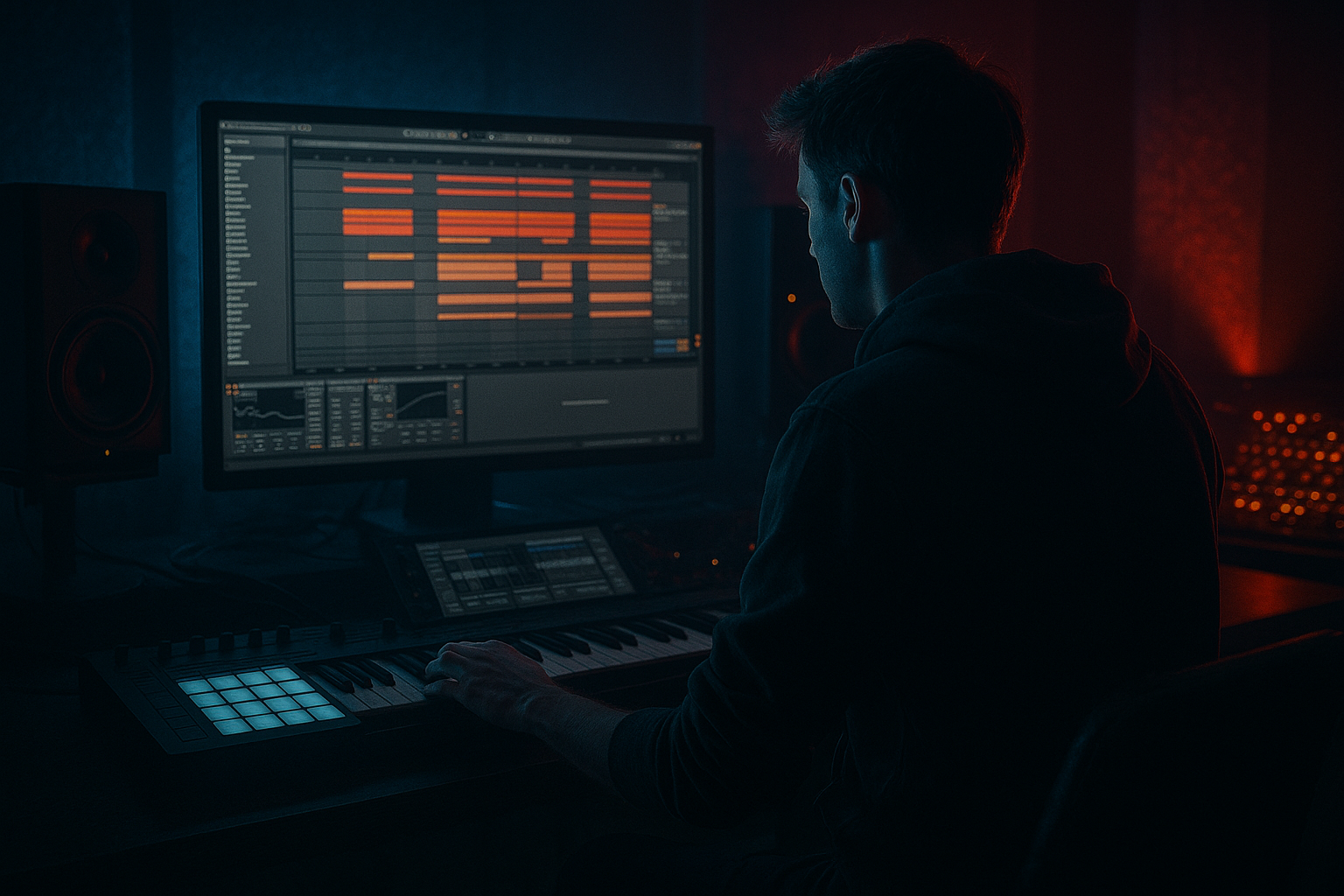
Main tutorial
```markdown
Atmospheric Transition Tails at 170 BPM (Ableton Live) 🌫️⚡
Skill level: Advanced
Category: FX
Context: Drum & Bass / Jungle / Rolling bass music in Ableton Live
---
1. Lesson overview
Atmospheric transition tails are those long, controlled “after-images” that glue sections together in DnB: the reverb/echo bloom after a snare fill, the ghostly wash after a vocal stab, the gritty smear after a bass hit—but timed and shaped so it doesn’t wreck the drop.
In this lesson you’ll learn how to build tempo-locked, mix-safe, dark-leaning transition tails at 170 BPM, using stock Ableton devices and arrangement techniques that work in real rolling DnB.
---
2. What you will build
You’ll create a reusable “Transition Tail Bus” workflow with:
- A Return track that generates huge atmospheric tails (reverb + delay + smear)
- Sidechained, EQ’d, and band-limited tails that stay out of the kick/snare/bass
- A “Freeze/Print Tail” method so tails are consistent and editable
- Arrangement moves for 16-bar, 8-bar, and 2-bar transitions typical in DnB
- HPF: 24 dB/oct at 180–300 Hz (start 220 Hz)
- Optional: small dip 2–4 kHz if it gets pokey (–2 to –4 dB, Q ~1.2)
- Optional: gentle shelf >10 kHz if too bright (–2 to –6 dB)
- Mode: Convolution + Algorithm (great for depth + size)
- Decay: 4.5–8.0 s (DnB tails often sound pro around 5–6.5s)
- Pre-Delay: 20–40 ms (lets the transient speak; helps groove)
- Size: 80–100% (taste)
- Low Cut: 200–350 Hz
- High Cut: 7–10 kHz
- Early Reflections: low-ish (10–25%) so it’s not “roomy”
- Wet: 100% (because it’s a Return)
- Enable Sidechain
- Sidechain input: Kick + Snare Bus (or full Drum Group if needed)
- Attack: 0.3–1 ms
- Release: 80–200 ms (time it to groove; try ~120 ms)
- Ratio: 4:1
- Lower Threshold until you get 3–6 dB gain reduction on hits
- Drive: 2–6 dB
- Soft Clip: ON
- Output: trim to avoid level jumps
- Filter type: LP24 or BP12
- Base cutoff: 6–12 kHz (LP) or 1.2–3 kHz (BP)
- Add slow modulation:
- Sync: ON
- Time: 1/4 or 1/8 dotted (DnB classic)
- Feedback: 25–45% (keep controlled)
- Filter: HP around 250 Hz, LP around 8–10 kHz
- Stereo: 80–120% width (don’t go crazy if drop is wide)
- Modulation: subtle (2–6) for smear
- Decay: 1.2–2.5 s
- Pre-delay: 10–25 ms
- Wet 100%
- Snare fills (especially last hit before drop)
- Perc stabs / rimshots / ghost snares
- Short vocal chops (“hey”, “go”, “run”)
- FX hits (impacts, cymbal chokes)
- Mid-bass stabs high-passed (important!)
- 16-bar to drop: do subtle sends during bar 13–16, big throw in last 1 bar.
- 8-bar switch: throw last 1/2 bar.
- 2-bar micro-fill: throw last 1/8–1/4 (tight and punchy).
- Fade in/out precisely
- Reverse a tail into the drop (classic jungle move)
- Slice it and re-trigger for fills
- Time-stretch to exaggerate the wash
- HPF 250–400 Hz (yes, again—printing can add extra lows)
- Notch any harshness 3–6 kHz if needed
- Gentle LP around 9–12 kHz if it’s too fizzy
- Bass Mono: turn on (if available in your Live version) and set around 120–200 Hz
- Or manually: keep low end removed, then Width 120–160%
- Use Gate to stop tails spilling into the drop
- Try:
- 1 bar (fast switch)
- 2 bars (standard)
- 4 bars (big breakdown-to-drop)
- Set Reverb decay so the tail is mostly gone by the drop, or
- Let it continue but duck it hard for the first 1–2 bars of the drop.
- Long decay (6s) but sidechain + filtering + gate/automation.
- Distorted tails = heavier transitions:
- Reese-friendly tail method:
- Predelay for punch:
- Serial filtering for “fog”:
- Automate return level into the drop:
- Jungle flavor:
- Build Return-based tail generators: TAIL VERB (space) + TAIL ECHO (tempo energy).
- Keep tails mix-safe with HPF, sidechain ducking, controlled width, and saturation.
- Use send automation throws right before transitions for that pro DnB movement.
- Print your tails to audio for maximum control: reverse, gate, fade, and place them like arrangement elements.
- For darker/heavier DnB: distort subtly, keep lows clean, and let the tail breathe around the drums—not over them.
End result: professional, cinematic transitions that still hit hard when the drop lands 💥
---
3. Step-by-step walkthrough
Step 0 — Session setup (170 BPM, routing mindset)
1. Set tempo to 170 BPM.
2. Group your drums: Kick, Snare, Tops, Break (if used).
3. Group your bass: Sub, Mid bass, Reese/Neuro layer.
4. Create a dedicated Return called:
A - TAIL VERB and optionally B - TAIL ECHO.
Why returns? You can send any source (snare fill, vocal stab, crash, bass stab) into the same “tail space” and keep it consistent across the track.
---
Step 1 — Build Return A: “TAIL VERB” (big but mix-safe) 🌫️
On Return A, add this chain (all stock devices):
#### 1) EQ Eight (Pre-shape)
Purpose: keep the tail out of sub/low-mid so your drop stays clean.
#### 2) Hybrid Reverb (or Reverb if you prefer)
Hybrid Reverb settings to start:
If you want jungle vibe: try a slightly grainier, brighter verb but clamp highs later with filtering.
#### 3) Glue Compressor (Sidechain)
This is critical: the tail ducks under your drums, then blooms in the gaps. Classic rolling DnB movement.
#### 4) Saturator (Texture)
Adds density so tails remain audible on smaller speakers without needing excess volume.
#### 5) Auto Filter (Movement / “wind”)
- LFO Amount: small (5–15%)
- Rate: 0.05–0.15 Hz (slow sweep)
- Phase: 0° (mono movement is fine for tails)
This makes the tail feel alive instead of static.
---
Step 2 — Build Return B: “TAIL ECHO” (tempo-locked rhythmic smear) ⏱️
On Return B, add:
#### 1) Echo
- At 170, 1/8D gives that skipping, forward push
#### 2) Reverb (small) or Hybrid Reverb (short algo)
#### 3) Compressor (Sidechain)
Same approach as Return A: duck under Kick/Snare.
Purpose: Echo return gives tempo-related tail energy, while Return A gives space.
---
Step 3 — Choosing sources to send (DnB-specific)
At 170 BPM, the most effective transition tails come from mid/high transient sources, not sub.
Best send candidates:
Avoid sending full sub. If you want “bass tail,” duplicate and high-pass the duplicate first (see Step 5).
---
Step 4 — Automate sends to “throw” the tail right before transitions 🎯
This is where the pro sound happens.
Pick a source (e.g., a snare fill audio track). Then:
1. Turn Send A (TAIL VERB) up briefly:
- Typical throw values: -12 dB to -3 dB (depending on source)
2. Automate only the last 1/8–1 bar before the transition.
3. Do the same with Send B for a rhythmic echo throw.
DnB arrangement placements:
Tip: Use clip automation for quick throws, then consolidate to arrangement automation later.
---
Step 5 — “Freeze/Print the tail” (ultimate control) 🧊➡️🎛️
Advanced workflow: print tails so you can edit, reverse, gate, and place them like audio FX.
Method A: Resample
1. Create a new audio track: TAIL PRINT.
2. Set its input to Resampling.
3. Solo the tail returns (or just the section) and record.
4. Trim and warp the audio as needed.
Method B: Record from Return
1. Create audio track: TAIL PRINT A.
2. Set input: Audio From → Return A.
3. Arm and record the transition.
Now you can:
Pro DnB edit trick:
Take the printed tail, reverse it, then add a short fade-in so it sucks into the drop.
---
Step 6 — Make the tail dark, wide, but not messy (mid/side + band control)
On your printed tail track (or on the return itself), add:
#### 1) EQ Eight
#### 2) Utility (mono low, controlled width)
(For dark DnB, too much width can feel cheap—controlled width feels expensive.)
#### 3) Gate (optional rhythmic control)
- Threshold: set so it closes after the swell
- Return: 150–300 ms (smooth closure)
- Release: 200–600 ms (musical fade)
This is great for a hard drop where you want atmosphere but zero mud.
---
Step 7 — Timing the tail to 170 BPM (musical targets)
At 170, transitions often feel best when tail energy resolves over:
Practical approach:
A good “drop-safe” combo:
---
4. Common mistakes 🚫
1. Sending sub bass into long reverb → low-end mud and weak drops.
2. No sidechain ducking → tails mask kick/snare transient impact.
3. Too bright tails → harshness fights hats, ride energy, distortion.
4. Over-wide reverb → phasey mono collapse and messy mix center.
5. Tails that don’t respect arrangement → atmosphere keeps going when the track needs to reset for the drop.
6. One tail for everything → use different throws (verb vs echo) for variety.
---
5. Pro tips for darker/heavier DnB 🖤🔧
Put Roar (if you have it) after reverb on the return, mix subtly (10–25%). If stock-only: Saturator + Overdrive lightly.
Duplicate mid-bass, HPF at 250–400 Hz, shorten the clip, then send that to TAIL VERB. You get “bass atmosphere” without sub chaos.
If the tail smears the fill, increase pre-delay to 35–60 ms.
Two gentle low-passes at different points sound smoother than one extreme LP.
Let the tail exist, but automate Return A/B fader down -3 to -8 dB for the first bar of the drop.
Use a short 1/8D Echo throw on an amen snare slice, then print and reverse it into the drop.
---
6. Mini practice exercise 🎓
Goal: Create a 2-bar transition into a drop with a dark, controlled tail.
1. Pick a snare fill (last 2 bars before drop).
2. Automate Send A:
- Bar -2: -18 dB
- Bar -1: ramp to -6 dB on the final snare hit
3. Automate Send B for one moment only:
- Last 1/8 note before drop: spike to -9 dB, then back down
4. Print the tail (Resampling or record Return A).
5. Reverse the printed tail and align it so it swells into beat 1 of the drop.
6. Add EQ on printed tail: HPF 300 Hz, LP 10 kHz.
7. Sidechain the printed tail to Kick/Snare for 4 dB ducking.
Deliverable: a clean drop with a cinematic inhale + tail that doesn’t mask the drums.
---
7. Recap ✅
If you tell me what kind of DnB you’re writing (liquid, rollers, jump-up, jungle, neuro), I can suggest a specific tail chain and timing approach that fits the vibe.
```

