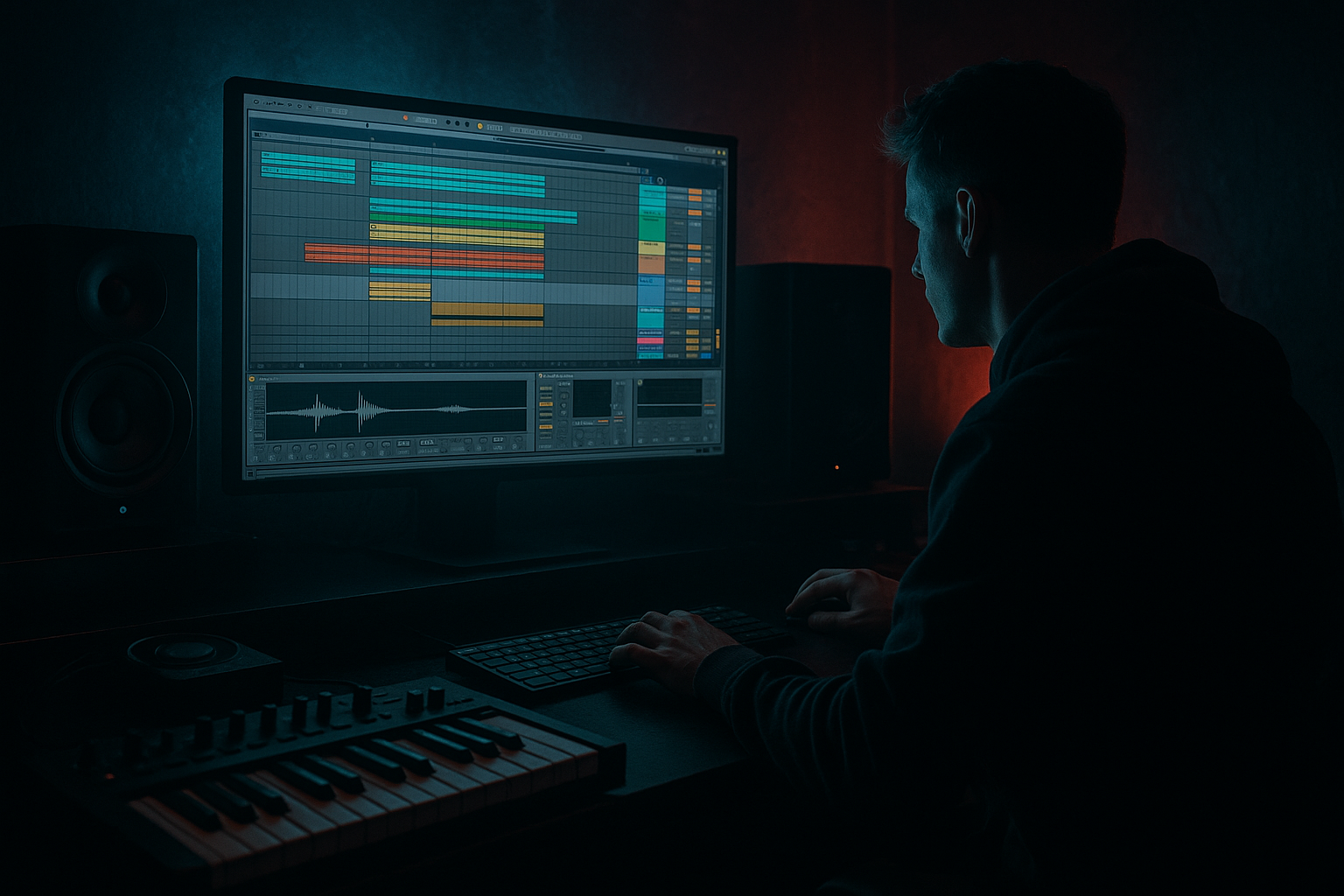
Main tutorial
```markdown
Auditioning Breaks Efficiently (for Jungle Rollers) — Ableton Live Workflow 🥁⚡
1) Lesson overview
Efficient break auditioning is a workflow superpower in jungle/roller production. You’re not just “finding a cool loop”—you’re rapidly testing how a break behaves against your bass, in your tempo pocket, and through your drum bus processing.
In this lesson, you’ll build a reusable Ableton Live audition system that lets you:
- Flip through dozens of breaks in time, in key vibe, and in context
- Auto-warp and normalize loudness differences so you’re judging groove, not volume
- A/B breaks quickly through your “real” processing chain (saturation, compression, transient shaping)
- Capture the best moments into an arrangement-ready palette
- A dedicated Break Audition track with:
- A scene-based audition system in Session View:
- A capture track that resamples processed breaks into clean 4–16 bar clips for arrangement
- Map the Device Activator buttons (top-left of each device) to a single Macro using an Audio Effect Rack:
- For each clip:
- Launch a scene with your bass playing.
- Swap breaks by launching different clips on `BREAK AUDITION`.
- Keep your kick/snare playing so you can hear if the break supports or fights the core groove.
- Color-code clips:
- A committed, processed loop aligned to your session
- Something you can chop without re-warp surprises
- Consolidate: select the recorded region → Cmd/Ctrl+J
- Right-click clip → Slice to New MIDI Track
- Now you can reprogram the break’s feel while keeping the character.
- Layered ghost energy: Keep your clean snare on 2 & 4, use the break for ghosts and shuffle.
- Call/response phrasing: Break becomes more complex every 8 bars (add a busier break for the last 2 bars).
- Drop control: First 16 bars = filtered/HP break; second 16 = full range; then add extra chops for fills.
- Auto Filter on the break group (HP sweep into drop)
- Utility for quick mute/width automation
- Redux lightly on fills for grit (be subtle)
- Control the low-mids (200–500 Hz): Dark rollers often need space for Reese movement. Use EQ Eight dips on the break bus.
- Transient shaping matters more than extra distortion: Push Drum Buss Transients before cranking saturation.
- Make breaks “lean” under the kick:
- Parallel grime channel (inside an Audio Effect Rack):
- Mono discipline:
- Build one consistent Break Audition Rack so every break is judged fairly.
- Audition in context with bass and core drums at 172 BPM.
- Use Session View + Follow Actions to scan breaks fast.
- Print winners immediately, then slice for control and roller-tight programming.
- For darker/heavier vibes: tighten low-mids, shape transients, and use parallel grime carefully.
Advanced, practical, and designed for jungle rollers: 165–175 BPM, weighty kick, snappy snare, fast hats, and forward motion.
---
2) What you will build
A “Break Audition Rack” in Ableton Live that includes:
- Warp setup optimized for breakbeats
- A consistent gain staging and quick A/B processing
- A Drum Bus chain (stock devices) tuned for rollers
- A resampling workflow to print winners fast
- Each break gets its own clip/scene
- Global quantization and follow actions (optional) for rapid cycling
---
3) Step-by-step walkthrough
Step 0 — Set the context first (don’t audition breaks in a vacuum) 🎯
1. Set your project tempo to 172 BPM (typical roller pocket).
2. Create (or load) a basic roller context:
- Bass: a placeholder Reese/sub (even a simple Operator sine sub is fine).
- Kick/Snare: either your go-to one-shots or a simple 2-step pattern.
3. Keep this minimal—just enough to judge whether the break pushes the groove.
Why: A break that sounds insane solo can fight your bass or smear your snare once the tune is real.
---
Step 1 — Create a dedicated Break Audition track (Audio Track)
1. Create an Audio Track named: `BREAK AUDITION`.
2. In the track’s Warp settings (Clip View, when you load audio):
- Warp: On
- Mode (start with): Complex Pro
- Formants: 0
- Envelope: 80–120 (adjust if it gets phasey)
- If the break is very percussive and you want tighter transient integrity, test Beats mode:
- Preserve: Transients
- Envelope: 50–80
3. Set Global Quantization (top bar) to 1 Bar.
4. Set the track fader to a sensible starting point and stay consistent (e.g., aim your drum bus around -10 to -6 dB peak before limiting).
Goal: You want every break to start on the grid and play back predictably at 172.
---
Step 2 — Build your “Roller Audition” processing chain (stock-only) 🔥
On `BREAK AUDITION`, add this device chain in order:
1. Utility
- Gain: start at -6 dB
- (Optional) Mono: Off for auditioning, On for sub-only checks later
- Use this as your level matching tool between breaks.
2. EQ Eight
- HP filter: 24 dB/oct at 25–35 Hz (remove rumble)
- Gentle dip: 200–350 Hz (often boxy in old breaks)
- Optional air shelf: 8–12 kHz +1 to +3 dB if it’s dull
Keep it subtle—you’re auditioning groove, not mixing to completion.
3. Drum Buss
- Drive: 5–15% (use ears—breaks distort fast)
- Crunch: 0–10% (light for old jungle breaks)
- Boom: 0–20% (careful—can conflict with your kick/sub)
- Damp: 5–20% (tames harshness)
- Transients: +5 to +25 (for snap and forward motion)
4. Glue Compressor
- Attack: 10 ms
- Release: Auto or 0.3 s
- Ratio: 2:1
- Threshold: aim 1–3 dB gain reduction while the break plays
- Make-Up: Off (level match with Utility instead)
5. Saturator
- Mode: Analog Clip or Soft Sine
- Drive: 1–4 dB
- Soft Clip: On
This helps breaks feel finished quickly without overthinking.
6. Limiter (optional for consistent audition loudness)
- Ceiling: -1.0 dB
- Only 1–2 dB of limiting—don’t crush.
Pro workflow: Group this track into a Drum Group later if you want shared processing with your kick/snare.
---
Step 3 — Make an A/B “Processing On/Off” macro (fast judgment) 🎛️
You need to decide if a break is good because it’s good—or because it’s loud/processed.
Method (simple):
1. Select your devices (Utility → Limiter) and Cmd/Ctrl+G to group into an Audio Effect Rack.
2. Click Map, then map each device’s Activator to Macro 1.
3. Rename Macro 1: `PROCESS A/B`.
4. Set Macro 1 min/max so:
- Min = devices off
- Max = devices on
Now you can audition the raw break vs “in-tune-with-your-bus” with one control. ✅
---
Step 4 — Session View auditioning system (rapid scanning) 🚀
1. Go to Session View.
2. Create a few scenes named:
- `HALF-TIME / STEPPER`
- `ROLLER / 2-STEP`
- `BUSY AMEN ENERGY`
3. Drag breaks from your browser into empty clip slots on `BREAK AUDITION`.
Warp quickly and consistently:
- Set 1.1.1 as the start (move warp marker so the downbeat hits properly)
- Set loop length to 4 or 8 bars (jungle breaks reveal themselves over phrasing)
- Turn Loop on
- If a break “swims,” add a warp marker at bar 5 and bar 9 to lock phrasing
Audition technique:
---
Step 5 — Use Follow Actions to auto-cycle breaks (advanced speed mode) ⏩
This is huge when you have 50+ breaks.
1. In Clip View, enable Follow Action.
2. Set:
- Action Time: 2 or 4 bars
- Follow Action: Next
- Chance: 100%
3. Put 10–20 breaks in consecutive slots.
4. Hit play and let Ableton cycle them while you focus on “keep / skip.”
Mark winners immediately:
- Green = instant yes
- Yellow = maybe / needs chopping
- Red = no (or delete)
---
Step 6 — Capture the best bits fast (resampling workflow) 🎚️✅
When you find a break that works, don’t “remember it.” Print it.
1. Create a new Audio Track named `BREAK PRINTS`.
2. Set its input to:
- Audio From: `BREAK AUDITION`
- Monitor: In
3. Arm `BREAK PRINTS`, record 8–16 bars while your favorite break plays.
Now you have:
Chop it for roller control:
- Slice by: Transient
- Slicing preset: Built-in (or none)
---
Step 7 — Arrangement ideas: “Roller-friendly break deployment” 🧠
In rollers, breaks are often supporting motion, not replacing the snare.
Try these patterns:
Stock devices for arrangement automation:
---
4) Common mistakes ❌
1. Auditioning breaks too loud
- Loudness bias is real. Level match with Utility before judging.
2. Warping sloppily
- If the first downbeat is off, everything feels wrong. Fix bar 1 before deciding.
3. Judging in solo
- A break’s job is to work with the bass and core drums. Always audition in context.
4. Overprocessing during audition
- Your audition chain should be consistent and moderate. If you crush everything, every break sounds “good.”
5. Not capturing winners
- If you don’t print, you’ll waste time later re-finding and re-warping.
---
5) Pro tips for darker/heavier DnB 🕶️🔊
- Sidechain Compressor on the break keyed from your kick (1–3 dB GR).
- Chain A: Clean (main)
- Chain B: Saturator (harder) → EQ Eight (band-limit 300–6k) → Drum Buss (Crunch)
Blend B at 5–20% for menace without losing punch.
- Keep sub clean and centered; if the break has wide low junk, use Utility (Bass Mono via a rack or use EQ Eight to cut lows in Side with Mid/Side mode).
---
6) Mini practice exercise (15 minutes) ⏱️
1. Load 20 breaks into `BREAK AUDITION` in Session View.
2. Set Follow Actions to cycle every 2 bars.
3. With bass + kick/snare playing, color-code:
- 3 greens (must use)
- 5 yellows (possible)
- delete the rest
4. Print your top 2 into `BREAK PRINTS` for 16 bars each.
5. Slice one printed break to MIDI and program:
- A tight 2-step roller groove for 8 bars
- A 2-bar fill using 3–5 slices (keep it jungle-fluent)
Deliverable: one 32-bar drum arrangement with a clear “lift” into bar 17.
---
7) Recap ✅
If you want, tell me your target sub/bass style (clean sub + reese, foghorn, neuro-ish, etc.) and I’ll suggest a break audition chain that complements it without masking.
```

