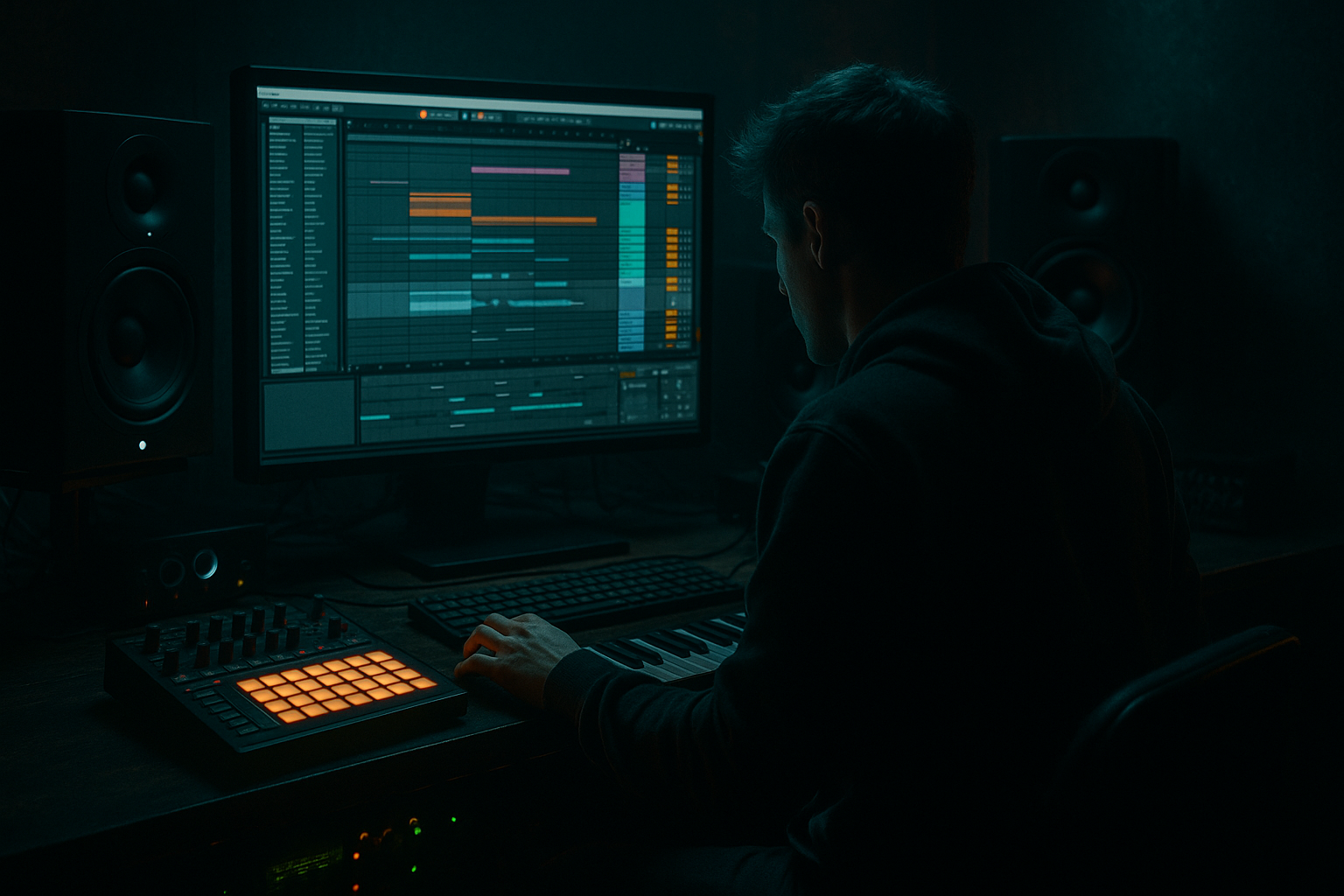
Main tutorial
```markdown
Automating Bass Growl Tone for Club Mixes (DnB in Ableton Live) 🔥
1. Lesson overview
In drum & bass, a “growl” bass isn’t just one sound—it’s a moving tone that evolves across phrases to keep energy high and translate on big club systems. In this lesson, you’ll learn a beginner-friendly automation workflow in Ableton Live to make your bass feel alive:
- Automating filter + distortion drive for movement
- Using Auto Filter, Saturator, Amp, Erosion, and EQ Eight (stock devices)
- Creating call/response bass phrasing like rolling DnB and jungle-influenced neuro vibes
- Keeping it club-safe (mono sub, controlled harshness, clean low end) ✅
- A clean mono sub layer (steady and loud)
- A mid “growl” layer (movement + aggression)
- Automation lanes that morph the growl tone every 2–8 bars (perfect for club arrangements)
- A 16-bar bass phrase with evolving tone
- A repeatable automation method you can apply to any bass patch
- Erosion (very small dose)
- Bar 1: Filter around 250–400 Hz
- Bar 2: ramp up to 800 Hz–1.5 kHz by end of bar
- Draw a quick up/down on filter frequency:
- Bar 1–2: darker (lower filter + less drive)
- Bar 3: introduce more presence
- Bar 4: peak intensity, then reset at bar 5
- Do not automate heavy distortion or filters on your sub track.
- If your growl feels like it’s stealing low end, increase growl high-pass to 100–140 Hz.
- If you want the illusion of bigger low end: automate mid harmonics, not sub.
- Automate distortion in stages:
- Use negative space:
- Erosion for “rust,” not fizz:
- Automate a narrow EQ notch for “talk”:
- Midrange ducking to the snare (optional):
- Split bass into Sub (stable) + Growl (automated) for club reliability.
- Build a clean chain using stock tools: Auto Filter → Saturator → Amp → EQ Eight → Utility.
- Automate a few meaningful parameters with phrase-based shapes (2/4/8/16 bars).
- Keep it mix-ready: mono low end, controlled highs, level-matched distortion.
---
2. What you will build
You’ll build a simple but powerful DnB bass rack setup:
By the end you’ll have:
---
3. Step-by-step walkthrough
Step 1 — Set up a DnB-friendly session 🥁
1. Set tempo: 172–175 BPM (start with 174).
2. Create a basic drum loop (or use a Drum Rack) so you can hear the bass in context:
- Kick on 1, snare on 2 and 4
- Add hats for roll (1/8 or 1/16)
Why: Automating bass tone without drums often leads to overdoing it—DnB is about how it sits with the break/step.
---
Step 2 — Create two MIDI tracks: Sub + Growl
#### A) Sub track (clean + mono)
1. Create MIDI Track → Instrument: Operator
2. Operator settings (simple solid sub):
- Algorithm: A only
- Osc A: Sine
- Envelope A:
- Attack: 0–5 ms
- Decay: short (optional)
- Sustain: -inf? (or sustain full if you want sustained notes)
- Release: 80–150 ms
3. Add EQ Eight after Operator:
- Low-pass gently around 120–180 Hz (so it stays “sub-only”)
4. Add Utility:
- Bass Mono: ON (if available) or set Width = 0%
- Gain: adjust so it’s solid but not clipping
✅ This track should stay stable—don’t automate the sub for club mixes.
#### B) Growl track (midrange movement)
1. Create another MIDI Track → Instrument: Wavetable (stock, perfect for growls)
2. Start simple:
- Osc 1: choose a harmonically rich wavetable (e.g., something “saw-ish”/complex)
- Unison: 2–4 voices, Amount low (keep it controlled)
3. In Wavetable:
- Enable Filter (Filter 1):
- Type: LP24 or MS2 style if available
- Drive: small amount if it sounds good
- Envelope 2 → Filter Frequency:
- Amount: +20 to +40
- Env 2 settings: fast attack, medium decay
Goal: A stable growl source that becomes exciting through automation + FX.
---
Step 3 — Build a club-ready growl processing chain (stock devices)
On the Growl track, add devices in this order:
1. Auto Filter
- Filter type: Lowpass 24
- Frequency start point: 200–600 Hz
- Resonance: 10–25% (don’t whistle)
- Drive: 0–6 dB (taste)
2. Saturator
- Mode: Analog Clip
- Drive: 2–8 dB
- Soft Clip: ON
- Output: reduce to match level (avoid “louder = better” trap)
3. Amp (yes, it’s great on bass mids) 🎛️
- Type: Rock or Bass
- Gain: 10–30%
- Presence: adjust for bite (start around 20–40%)
4. EQ Eight
- High-pass: ~80–120 Hz (to keep space for sub track)
- If harsh: dip 2–5 kHz slightly
- If you want more snarl: gentle boost 700 Hz–1.5 kHz (small moves!)
5. Utility
- Width: 0–50% (keep growl mostly centered for club)
- Gain: manage peaks
Optional (for texture):
- Mode: Noise
- Freq: 2–6 kHz
- Amount: 0.5–3%
This adds “hair,” great for darker DnB—just don’t shred ears.
---
Step 4 — Write a rolling DnB bass pattern (16 bars)
1. Create a MIDI clip on both Sub and Growl tracks (same notes to start).
2. Use a classic rolling rhythm:
- Long notes on the 1, with syncopated shorter notes before/after snare hits
- Keep space around the snare (especially bar 2/4 beats)
Tip: If you’re unsure, start with half-bar notes and add a few 1/8 pickups.
---
Step 5 — The core skill: automate “tone macros” instead of random knobs 🎯
You’ll automate 3–4 key controls that create the illusion of a talking/morphing bass:
#### Automation Targets (recommended)
1. Auto Filter Frequency (main motion)
2. Saturator Drive (intensity)
3. Amp Presence (bite / edge)
4. (Optional) Wavetable Position (source movement)
#### How to add automation in Arrangement View
1. Press Tab to go to Arrangement View.
2. Press A to show automation lanes.
3. On the Growl track, choose:
- Device: Auto Filter
- Parameter: Frequency
4. Draw automation with:
- B for Draw Mode (great for stepped DnB moves)
- Or normal mode for smooth curves
---
Step 6 — Automation shapes that work in club DnB 🚨
Use these proven shapes across a 16-bar phrase:
#### A) 2-bar “push” (energy lift)
This makes the bass “open up” into the next section.
#### B) 1-bar “yoy” (classic growl talk)
- Start: 300 Hz
- Peak: 1.2 kHz
- End: 500 Hz
Pair with a small Saturator Drive bump during the peak (+2–4 dB).
#### C) 4-bar progression (arrangement glue)
This keeps the drop moving without changing notes.
---
Step 7 — Keep the sub consistent while the growl moves (critical!)
---
Step 8 — Make it “mix-ready” for loud systems
1. Group Sub + Growl tracks into a Bass Group (Cmd/Ctrl+G).
2. On the Bass Group:
- Add Glue Compressor
- Attack: 3–10 ms
- Release: Auto
- Ratio: 2:1
- Aim: 1–3 dB gain reduction on peaks
- Add Limiter (light safety)
- Don’t crush—just catch spikes
Club rule: consistent bass level beats “cool” tone moves every time.
---
4. Common mistakes ❌
1. Automating the sub layer
Result: weak translation on big rigs, inconsistent weight.
2. Too much resonance on Auto Filter
Result: whistling tones that stab your ears at 2–4 kHz.
3. Confusing “louder” with “better”
Saturation adds gain—always level-match output.
4. Over-wide bass mids
Wide growl can vanish in mono club playback. Keep it centered.
5. Random automation with no phrasing
DnB works in 2/4/8/16 bar logic—automation should support that.
---
5. Pro tips for darker/heavier DnB 🖤
Instead of one huge Drive jump, do small boosts in 2-bar steps (feels intentional).
Make bars 1–2 darker so bars 3–4 feel heavier without actually getting louder.
Keep Amount tiny (often under 2%). If you clearly hear “noise,” it’s too much.
In EQ Eight, create a narrow bell boost (Q high) around 700 Hz–1.2 kHz and sweep it slightly—instant vocal-ish movement (keep it subtle).
Use Compressor sidechained from snare onto the Growl track (not sub). It makes space and adds bounce.
---
6. Mini practice exercise 🎯
Goal: Create a 16-bar rolling drop bass with 3 automation lanes.
1. Write a simple 1-bar bass pattern and duplicate it to 16 bars.
2. Automate on the Growl track:
- Auto Filter Frequency:
- Bars 1–4: low-ish
- Bars 5–8: slightly higher
- Bars 9–12: add 1-bar yoy every other bar
- Bars 13–16: highest intensity then reset
- Saturator Drive:
- Only boost on bars 8, 12, 16 (peak markers)
- Amp Presence:
- Gradually increase from bars 1 → 16
Check: Bounce to audio and listen quietly. If the bass still feels like it “moves,” your automation is doing real work.
---
7. Recap ✅
If you want, tell me what style you’re aiming for (rollers, neuro, jungle-tech, foghorn-ish, etc.) and I’ll suggest specific automation curves and a device rack macro layout you can reuse every project. 🎛️
```

