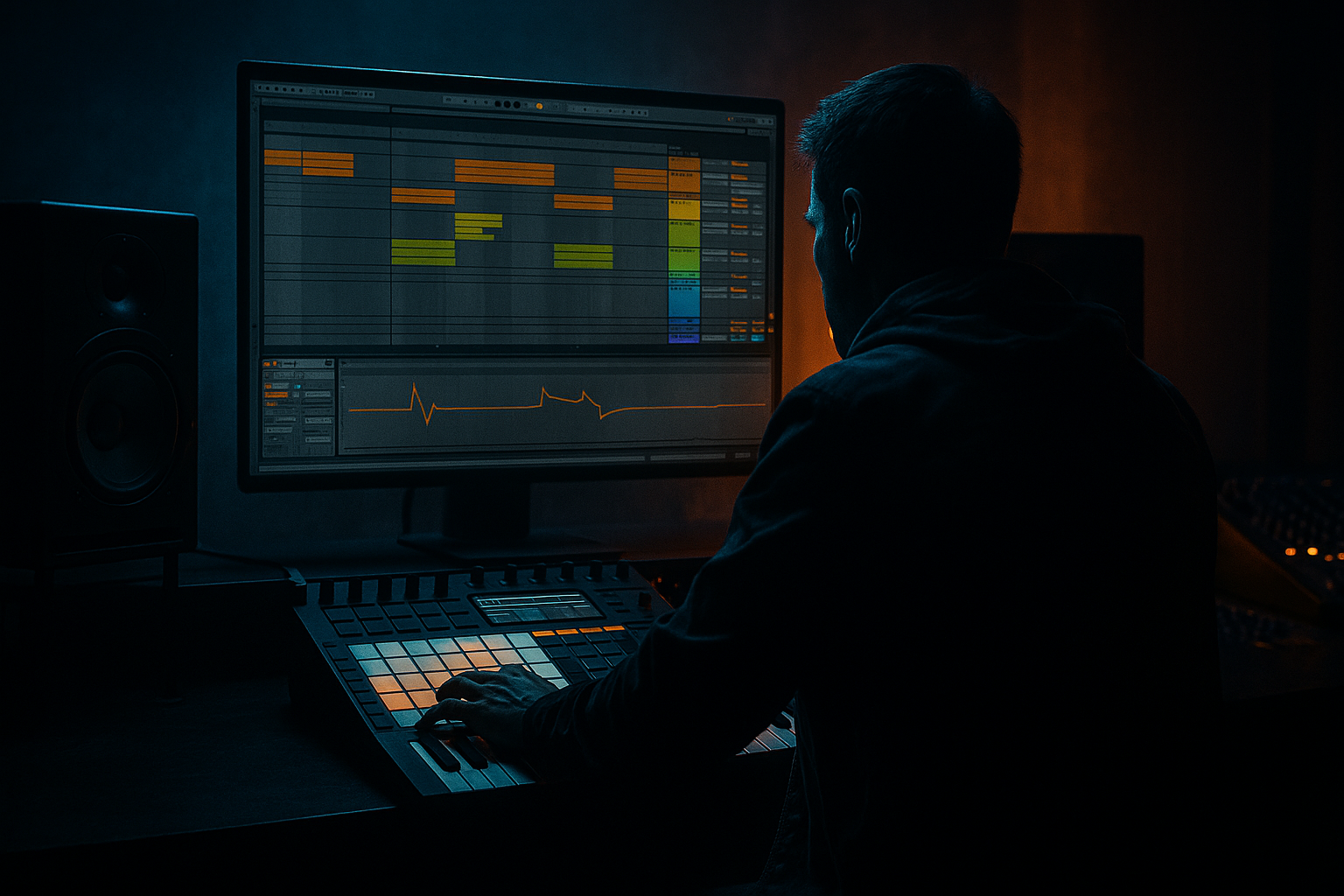
Main tutorial
```markdown
Automating Noise Floor for Transitions (DnB in Ableton Live) 🎛️🌫️
Skill level: Intermediate
Category: Automation
---
1. Lesson overview
In drum & bass, transitions live and die on momentum. One of the slickest pro techniques is automating a “noise floor”—a controlled layer of noise/room/air that you raise into a drop and pull down after impact. It makes sections feel glued, louder, and more “club-real” without just cranking reverb or adding cheesy risers.
In this lesson you’ll build a dedicated Noise Floor bus in Ableton Live and automate it like you would a DJ-style sweep: subtle in verses, rising into fills, then cutting clean at the drop. ✅
---
2. What you will build
You’ll create a Noise Floor Return Track that includes:
- Noise source (Operator noise or sample)
- Band-pass filtering + resonance (Auto Filter)
- Movement (Auto Pan or subtle Chorus-Ensemble)
- Glue + density (Glue Compressor / Saturator)
- Space + tail control (Hybrid Reverb)
- Automation lanes for:
- Drop in a vinyl crackle / tape hiss / room tone sample on an Audio track.
- Loop it.
- Send it to NOISE FLOOR.
- Mode: Band-Pass
- Slope: 24 dB
- Cutoff start: 250–500 Hz (during verses)
- Resonance: 0.60–0.85 (enough to “speak,” not whistle)
- Drive (if available): 2–6 dB
- Mode: Soft Clip ON
- Drive: 2–8 dB (automate later)
- Output: trim so the return doesn’t jump in level.
- Rate: 0.10–0.30 Hz (slow sway)
- Amount: 15–35%
- Phase: 180° (wide motion)
- Start with a Room or Small Hall
- Decay: 0.8–1.8 s (rolling DnB)
- Predelay: 10–25 ms
- High Cut: 6–10 kHz
- Dry/Wet: 10–25% (keep it controlled)
- Attack: 3 ms
- Release: Auto
- Ratio: 2:1
- Threshold: aim for 1–3 dB gain reduction during peaks
- Make-up: minimal
- Bars 1–8: very low (-30 to -24 dB feel)
- Bars 9–16: ramp up to around -18 to -12 dB
- Last 1 bar: quick push + slight “pump” feel
- At the drop: hard cut to -inf or near silent for impact
- Switch to Arrangement View
- Press `A` to show automation
- Choose Mixer → NOISE FLOOR → Volume (or automate send from your Drum Bus)
- Start: 300–600 Hz
- End (pre-drop): 3–8 kHz (depending on how bright your mix is)
- Add a tiny “bounce” in the last 1/2 bar (dip then rise) to create tension.
- Saturator Drive: +2 dB → +6 dB into the fill
- OR Reverb Decay: 1.0 s → 2.5 s right before drop
- At the drop: snap back to default (shorter decay, lower drive)
- Between phrases (every 8 bars): quick noise swell + cut to emphasize call/response.
- Pre-drop fakeout: ramp noise up, then mute everything for 1/8 or 1/4 bar → drop hits harder.
- Jungle edit: use noise floor + high-passed reverb tail to smooth brutal chop edits between breaks.
- Second drop upgrade: automate slightly higher cutoff + more saturation to make drop 2 feel “wider” without changing core drums.
- Make it “industrial” with Redux (subtle):
- Use band-limited noise for neuro tension:
- Stereo discipline:
- Mid/Side EQ for clean drops:
- Print it for control:
- A noise floor is a controlled ambience layer that adds momentum, glue, and perceived loudness in DnB transitions.
- Build it on a Return track for fast routing and arrangement control.
- The money automation lanes are Level + Filter Cutoff, plus optional Saturation/Reverb intensity.
- For rolling energy, sidechain it to the drums.
- Cut it clean at the drop to maximize impact.
- return send amount (or bus volume)
- filter cutoff
- noise “energy” (saturation/drive)
- optional reverb decay for transitions
This gives you a reusable “transition engine” for rolling DnB, jungle edits, and heavy halftime drops.
---
3. Step-by-step walkthrough
Step 1 — Create a dedicated Noise Floor bus (Return Track)
1. Create Return Track: `Create → Insert Return Track`
2. Rename it: “NOISE FLOOR”
3. Set the Return track fader to around -12 dB to start (you’ll fine-tune later).
Why Return?
You can feed it from drums, bass, FX—like a “glue atmosphere” that’s easy to automate per section.
---
Step 2 — Choose your noise source (2 solid options)
#### Option A: Operator (stock, clean, controllable)
1. Create a MIDI track named “Noise Source”
2. Add Operator
3. In Operator:
- Turn on Oscillator A
- Change waveform to Noise (White) (Operator has noise options)
- Set Sustain to full, Attack ~5–15 ms (avoid clicks), Release ~50–150 ms
4. Add a MIDI clip with a long note (whole section).
5. Route this track to the NOISE FLOOR Return by turning up its Send A (or whichever return).
#### Option B: Sample-based noise (grimy jungle vibe)
DnB-friendly choice: vinyl/tape noise for jungle rollers; clean white noise for modern neuro/tech.
---
Step 3 — Build the Noise Floor device chain (on the Return track)
On NOISE FLOOR, add this chain in order:
#### 1) Auto Filter (core shaping)
Why: Band-pass makes noise feel like “air moving” rather than harsh hiss.
#### 2) Saturator (weight + density)
Why: Saturated noise reads louder and thicker without needing volume.
#### 3) Auto Pan (movement)
Why: Gives life; feels like the room is “breathing.”
#### 4) Hybrid Reverb (tail + size)
Why: Adds depth so transitions feel like a space opening up.
#### 5) Glue Compressor (control)
Why: Keeps noise consistent and “glued” like a real ambience bed.
---
Step 4 — Decide what to automate (the “3-lane method”) ✍️
For DnB transitions, keep it simple and effective:
1. Return Track Volume (macro “Noise Level”)
2. Auto Filter Cutoff (macro “Sweep”)
3. Saturator Drive or Hybrid Reverb Decay (macro “Intensity”)
Workflow tip: Select the devices → `Cmd/Ctrl + G` to Group into an Audio Effect Rack. Map key parameters to Macros so you automate only 2–3 lanes.
---
Step 5 — Automate into a drop (classic 16-bar build) 🚀
Example scenario: 16-bar build → 1-bar fill → drop
#### A) Noise Level automation (Return Volume or Send Amount)
How:
#### B) Filter Sweep automation (Auto Filter Cutoff)
#### C) Intensity automation (Saturator Drive or Reverb Decay)
DnB-specific trick: cut the noise exactly on the drop transient (kick/snare). That silence makes the drop feel louder even at the same LUFS.
---
Step 6 — Glue the noise to your drums (sidechain pump) 🥁
To make the noise breathe with the groove:
1. Add Compressor after Glue Compressor (or instead of it)
2. Enable Sidechain
3. Input: your Drum Bus (or Kick + Snare group)
4. Settings:
- Ratio: 4:1
- Attack: 1–5 ms
- Release: 80–140 ms (match tempo)
- Threshold: aim for 2–5 dB GR
Now the noise pumps subtly with the 2-step or break—instant “rolling” energy.
---
Step 7 — Arrangement ideas that scream DnB/jungle
---
4. Common mistakes ⚠️
1. Too bright / hissy noise
- Fix: lower Auto Filter cutoff end point, add EQ Eight and shelf down above 10 kHz.
2. Noise fights cymbals and top breaks
- Fix: dynamic dip around 6–12 kHz with Multiband Dynamics (gentle) or keep cutoff lower.
3. Transition feels loud but messy
- Fix: reduce reverb wet, shorten decay, and rely more on filter movement + saturation.
4. Automation is overly complex
- Fix: use macros; automate Level + Cutoff first. Add Intensity only when needed.
5. Drop doesn’t hit (noise still present)
- Fix: hard mute noise at drop, or automate a fast volume dip (2–10 ms before the transient).
---
5. Pro tips for darker/heavier DnB 🖤🔩
Add Redux before reverb:
- Bit Reduction: 10–14 (light)
- Downsample: small amount (tasteful)
Automate it only in the last 1–2 bars for grit.
Auto Filter Band-Pass around 800 Hz–2.5 kHz with higher resonance. This creates a “pressure” tone without sizzling.
Add Utility at the end:
- Width: 80–120% (don’t go crazy)
- Bass Mono: turn on if your noise has low content (or just high-pass earlier).
Put EQ Eight in M/S mode:
- Side channel: high-pass 200–400 Hz
Keeps low-mids from smearing.
Once your automation is working, resample the NOISE FLOOR into audio and do micro-edits (mute on drops, reverse tail, quick fades).
---
6. Mini practice exercise 🎯
Goal: Create a 16-bar build into a 32-bar rolling drop using automated noise floor.
1. Load a basic DnB drum loop (kick/snare + hats) at 174 BPM.
2. Create the NOISE FLOOR Return using the chain above.
3. Automate:
- Volume rise over 16 bars
- Filter cutoff sweep into the fill
- Hard cut at drop
4. Add sidechain pumping from your drum group.
5. Listen in context and adjust until the noise is felt more than heard.
Success check:
If you mute the NOISE FLOOR and the transition suddenly feels flatter/less hyped—but the mix is cleaner with it on—you nailed it.
---
7. Recap ✅
If you want, tell me your subgenre (liquid / jungle / neuro / jump-up / halftime) and I’ll suggest a noise chain + automation curve that fits that vibe exactly.
```

