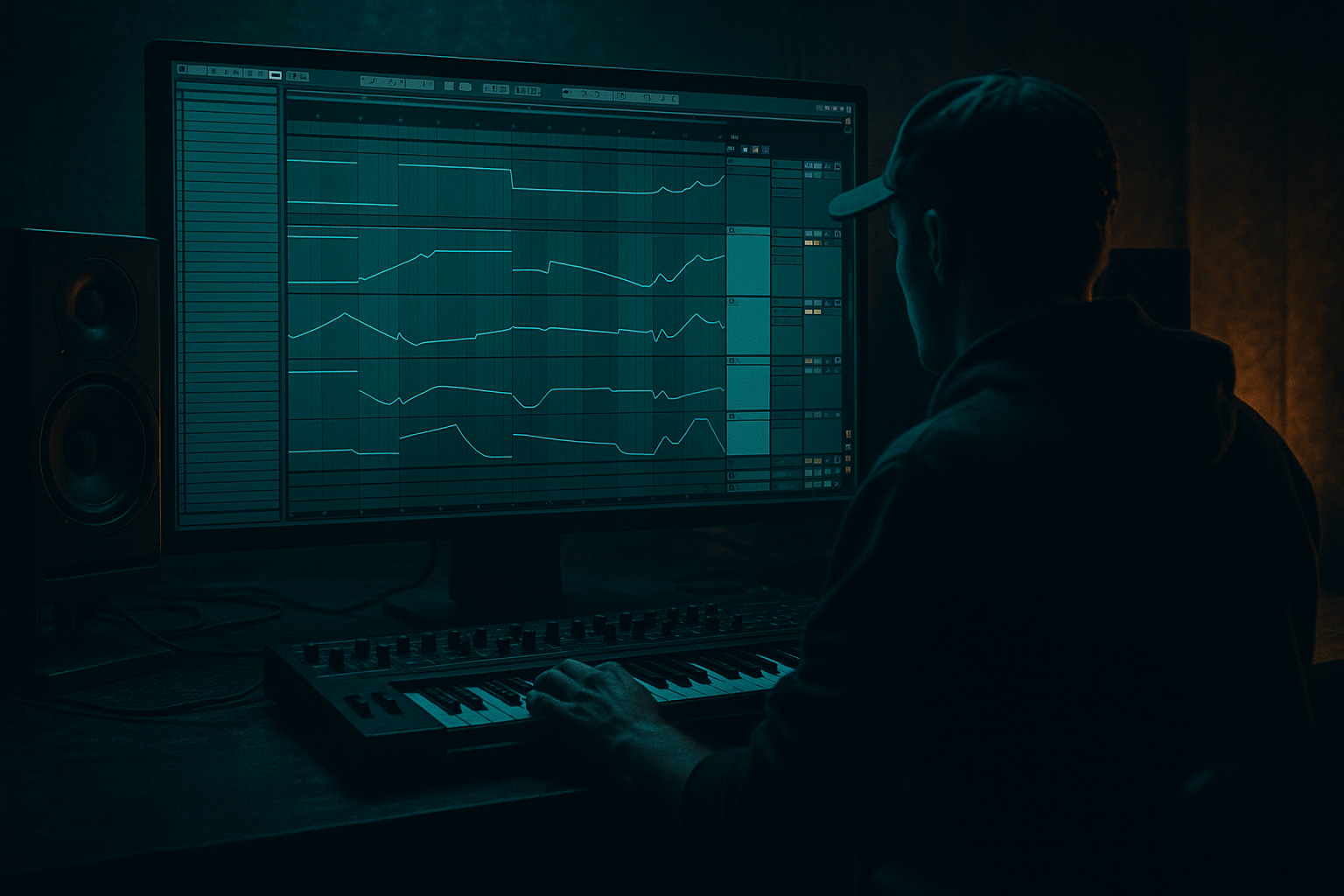
Main tutorial
Automation for Stereo Motion (Drum & Bass — Ableton Live)
Teacher tone: energetic, clear, professional — let’s move air. 🎛️⚡
This intermediate lesson focuses on using Ableton Live’s automation and stock devices to create convincing, dynamic stereo motion for drum & bass / jungle / rolling bass tracks. Everything below is practical: device chains, exact settings, workflows, and arrangement ideas specific to DnB.
---
1. Lesson overview
What this lesson teaches you:
- How to automate stereo movement in individual elements (hats, percussion, pads, vocals) and the mix-bus.
- How to build device chains and Racks that give controllable, musical stereo motion.
- How to keep the low-end tight & mono while making the rest wide and dynamic.
- Arrangement tactics: when to widen, when to mono, and how to use motion to push energy into drops, rollers, and breakdowns.
- Stereo motion adds excitement to fast grooves and helps create space for heavy sub-bass.
- Controlled automation keeps the track punchy and club-ready, while still sounding huge on headphones and systems.
- Hat/percussion chain with tempo-synced auto-panning and delay sends automated for increasing width in breakdowns.
- Pad/atmosphere Rack that morphs from narrow to wide via Macros (Auto-Pan, Grain Delay, Reverb).
- A “stereo spread” Rack for synths and wobbles using split chains, short delay (Haas), and Frequency Shifter detune.
- Master/Group automation workflow: send-automation, master-width automation via Utility, and M/S EQ automation to keep subs mono while widening highs.
- Grain Delay: Spray 7–10, Pitch 0, Grid 1/16 and choose random left/right offsets; Dry/Wet 25–35%.
- Reverb (stock): Size 70–90%, Decay 2–3s, Low Cut ~400 Hz, High Cut ~6–8kHz; Dry/Wet 20–30% per chain.
- Use super-short delay (5–20 ms) to create spatial spread. For wobbles try 7–12 ms for subtlety. Longer creates echo and phase problems.
- If you use Delay or Simple Delay: set feedback 0% and Dry/Wet 100% on chain, but ensure overall chain level is balanced.
- Automate Utility Width from 100 → 110–120% very subtly for “larger” drops. Be conservative: >140% on whole mix risks phase and mono compatibility. On stems, you can push higher because sub is dialed in as mono.
- Intro (8–16 bars): Narrow hats, sparse reverb tails. Keep bass mono.
- Pre-drop roller (8 bars): automate hat Auto Pan Amount + increase send to Ping-Pong Delay; open pad Macro to wide.
- Drop hit: enforce mono on kick & sub-bass (brief Utility Width = 100% on bass group) for maximum punch; widen melodic elements quickly after hit.
- Breakdown (16 bars): Automate pad chain to Wide2 with long Grain Delay tails and slowly move Macro to morph across the section.
- Fills/transition bars: automate extreme Auto Pan on small percussion and panning automation across multiple percussion tracks staggered by 1/16 to create rolling width.
- Widening the sub: automating Utility Width on full mix >120% or widening stems with sub content causes phase-cancellation and loses low end. Always HP the Side channel under ~120 Hz.
- Overusing long Haas delays: delays >20 ms act like distinct echoes and can smear transients in fast DnB drums.
- Applying wide reverb to everything: washes out clarity. Use high-cut filters on returns and pre-delay to keep transient punch.
- Forgetting mono-checks: always check in Mono periodically. If elements disappear or get thin, dial back the stereo trick.
- Too many independent automations: map common parameters to Macros and automate the macro to avoid automating multiple devices separately.
- Neglecting CPU: Grain Delay + long reverbs on multiple tracks kills CPU; use resampling/printing if frozen.
- Keep the low-end iron-tight: place Utility (Width 100%) on bass groups during drops, and use M/S EQ Eight to carve space for the kick/sub.
- Stereo motion in highs only: automate Utility Width on an aux/high-band split. Use Multiband Dynamics or EQ Eight in M/S to target only 300 Hz+ for widening.
- Use subtle distortion on side-channels: duplicate bass chain, apply light drive only to the Side chain (via M/S processing), then apply subtle pitch detune for grit without affecting the mono low end.
- Use Frequency Shifter subtly: apply ±2–10 Hz shifts on one side to create sense of movement without clear pitch variation. Map to a Macro and automate for build intensity.
- Automate reverb pre-delay and dry/wet: increasing pre-delay slightly during build keeps transients clear but makes reverb tails feel “big” — perfect for scary breakdowns.
- Use short, modulated Grain Delay on vocals and nicked samples to create metallic wide textures that cut through heavy mixes.
- Parallel processing: route a duplicate stem to an FX bus with heavier stereo spread, distortion, and reverb; automate the send so the heavy processing only appears in breaks or peaks.
- Keep sub frequencies mono (EQ Eight in M/S + Utility).
- Use Auto Pan, Grain Delay, Ping Pong Delay, Frequency Shifter, and short Haas delays to craft movement — but automate thoughtfully.
- Use Audio Effect Racks + Macros to morph multiple parameters with single automation lanes.
- Automate send levels to delay/reverb returns rather than wet/dry when you want natural tails and stereo bounce.
- Always check in mono and on multiple playback systems; DnB demands punchy, club-ready low end.
Why this matters for DnB:
---
2. What you will build
A small stereo-motion toolkit you can drop into tracks:
Result: a 16–32-bar arrangement example that goes narrow → explode-wide for the drop → tighten for impact, with clear automation lanes ready to copy into your projects. 🥁🌪️
---
3. Step-by-step walkthrough
A. Prep: keep the sub solid (non-negotiable)
1. On your bass/instrument group, place EQ Eight (stock).
- Switch EQ Eight to Mid/Side mode (top-right menu).
- On the Side channel, apply a high-pass at ~120 Hz (slope 12–24 dB/oct). This ensures only mids/sides above 120 Hz are widened.
- On the Mid channel, leave the low-end untouched and optionally add a small boost around 60–120 Hz for body.
2. Optional: place Utility after EQ Eight and set Width = 100% (default). We’ll automate this later on the group/master.
Why: widening sub frequencies creates phase issues and weakens the low end. Keep sub mono.
---
B. Hat/percussion chain (tight groove with motion)
1. Use an audio or drum rack clip for hi-hats/ride/percs.
2. Insert these devices (order matters):
- EQ Eight: High-pass at 300–500 Hz (cleans mud).
- Auto Pan (stock): Set Wave = Sine, Rate = 1/8 or 1/16 (tempo sync), Phase = 40–60%, Amount = 20–40%.
- For rolling hats: try Rate = 1/16 dotted or 1/32 for subtle fast motion.
- Utility: Width = 100% (automatable).
- Send(s) to Return tracks (Delay and Reverb).
3. Automation ideas:
- Automate Auto Pan Amount: raise from 0% → 40% across a 4-bar riser or pre-drop to create increasing side motion.
- Automate send send A (Ping Pong Delay) from 0 dB → -6 dB in the last 2 bars before the drop to create bouncing stereo tails.
4. Ping Pong Delay (Return A) settings:
- Delay Mode = Sync, Left = 1/16, Right = 1/16 dotted, Feedback = 20–35%, Dry/Wet = 20–30%, High cut ~6–8 kHz to avoid sibilance.
Tip: use a high-pass on the return (EQ Eight on the Return) to remove low frequencies being delayed.
---
C. Pad/Atmosphere Rack (Macro-controlled width)
1. Create an Audio Effect Rack on your pad/atmo channel.
2. Create 3 chains: Narrow, Wide1, Wide2.
- Narrow chain: EQ Eight (HP 200 Hz), Utility Width = 90%, Reverb send low, Grain Delay off.
- Wide1 chain: Auto Pan (Rate 1/8, Amount 30–50%, Phase 60%), Reverb (Decay 2–3s, High cut 6k), Utility Width = 130%.
- Wide2 chain: Grain Delay (Mode: Sync, Spray 0–15%, Delay 3–10 ms left/right different), Reverb with larger Pre-Delay.
3. Map Macro 1 to Chain Select (0–127) so Macro 1 morphs between Narrow → Wide1 → Wide2.
4. Map Macro 2 to a global utility Width (or set Utility on the rack mapped to Macro 2).
5. Automate Macro 1 in the arrangement: keep at 0 (Narrow) in intro, move towards 64 (Wide1) on pre-drop, and 127 (Wide2) for the drop build or breakdown.
Settings example:
Why use a Rack: you can automate one Macro to morph multiple parameters and chains, keeping lanes tidy and musical.
---
D. Stereo spread Rack for synths/wobbles (Haas + detune)
1. Create an Audio Effect Rack.
2. Duplicate chain into two chains: L and R.
- Chain L: Utility (Pan = -40), Delay (Simple Delay or Delay) — set Delay Left to 0 ms, Right to 8–12 ms (use Delay not Ping Pong; you’ll set different left-right).
- Chain R: Utility (Pan = +40), Delay with Right/Left swapped; slight pitch offset with Frequency Shifter or Pitch (±0.5–3 cents).
3. Map a Macro to the small pitch detune and to the delay time difference.
4. Automate Macro to increase delay offset and detune during ride/fore statements.
Haas settings (careful):
Phase check: toggle Rack Macro off/on and listen in mono to ensure important elements remain audible. If they disappear, reduce delay or detune.
---
E. Master/Bus automation (builds, drops, scene changes)
1. Create a Group for drums & percussion and another for melodic elements.
2. On the master or stem groups, use an Audio Effect Rack with:
- Chain A: Clean (Utility Width 100%)
- Chain B: Wide (Utility Width 140–160% + subtle Chorus or Frequency Shifter)
- Map Chain Selector to a Macro.
3. Automate the Macro to switch/stage width across the arrangement:
- Intro (bars 1–16): Chain A (narrow)
- Pre-drop (bars 17–24): blend towards Chain B (wider)
- Drop hit (bar 25): instantly narrow to 100% for impact, then open back to 140% over 2 bars.
4. Use a return track for Reverb/Delay and automate the return send levels (not just device Wet)—this is often more musical and easier to recall.
- Example: Automate Send A to Ping-Pong Delay from -6 dB → -2 dB in last bar of pre-drop to add bouncing width.
Utility on Master:
---
F. Workflow & Automation lanes
1. Use a dedicated “Automation” track color/label to remind you which macros you automate.
2. Right-click a device parameter (e.g., Auto Pan Amount) → Show Automation to create lanes. Keep automation lanes tidy: collapse envelopes you’re not editing.
3. Use “Punch Automation” (draw ramps) to create smooth opening/closing width shapes; use breakpoints for stepped motion.
4. Copy automation blocks between similar tracks (e.g., hats -> percussion) and vary the phase to create movement across the kit.
---
G. Arrangement ideas for DnB / Jungle
---
4. Common mistakes
---
5. Pro tips for darker/heavier DnB
---
6. Mini practice exercise (20–40 minutes) 🎯
Goal: Create a 16-bar loop that goes narrow → wide in pre-drop → tight drop with quick widening after the hit.
Steps:
1. Make a simple DnB drum loop (kick + snare + hats) and a rolling sub bass.
2. On hats:
- Place Auto Pan (1/16), Amount 25%, Phase 50%.
- Create a return with Ping Pong Delay (1/16 left, 1/16 dotted right, Feedback 25%).
- Automate Auto Pan Amount from 0% (bars 1–8) to 40% (bars 9–12), then back to 10% on the drop bar.
3. On a pad:
- Build an Audio Effect Rack with Narrow/Wide chains (as above).
- Map Chain Select to Macro 1.
- Automate Macro 1: 0 (bars 1–8), 127 (bars 9–12), 64 (drop onwards).
4. On the bass group:
- Insert EQ Eight in M/S mode and HP the Side channel at 120 Hz.
- Insert Utility after EQ and automate Width: 100% on the drop bar (instant), then 110% after 2 bars.
5. Arrange 16 bars: Intro 8 bars (narrow), Pre-drop 4 bars (automations rising), Drop 4 bars (mono bass hit then open elements).
Deliverable: Play the loop back and toggle Mono on the master. Adjust until transients remain strong in mono at the drop hit.
---
7. Recap
Now go make the mix spin and the rollers breathe — automate with intention, and let the stereo motion push your next drop into the room. Need a project file walkthrough or a preset Rack I use? I can share a downloadable Rack and example Ableton set next. 🚀

