Main tutorial
```markdown
Automation Lanes for Break Density (DnB in Ableton Live) 🔥🥁
Skill level: Intermediate
Category: Automation
---
1. Lesson overview
Break density is one of the fastest ways to make drum and bass feel like it’s rolling forward, switching from sparse groove to full jungle pressure without changing the core beat. In Ableton Live, automation lanes let you morph a break between “minimal” and “maximum chaos” by controlling:
- Slice playback probability
- Filter openness / tone
- Transient shaping
- Saturation / distortion
- Reverb tails (space vs punch)
- Micro-edits (stutters, repeats, fills)
- Simpler (Slice mode) for break manipulation
- Auto Filter (tone + movement)
- Drum Buss (knock + crunch)
- Saturator (harmonics + aggression)
- Gate (controlled “chop” density)
- Optional: Return reverb automation for space management
- Right-click Simpler → Slice to New MIDI Track if you want Live to build a Drum Rack automatically. For this lesson, staying inside Simpler is fine, but Drum Rack is great for later per-slice processing.
- Intro / breakdown: 4–7 kHz (darker, less busy)
- Drop: 10–16 kHz (open, more detail)
- Mid-drop variation: ramp up over 8 bars for tension
- Verse/low-energy: 5–10%
- Drop: 12–25%
- Fills (last 1/2 bar): quick spike up, then drop back
- Baseline: 2–4 dB
- Drop: 4–7 dB
- Short moments: +1–2 dB boosts for “push” moments
- Higher Threshold = more chopped/short = less smear (can feel tighter/cleaner)
- Lower Threshold = more tails allowed = more texture (denser/roomier)
- Drop: slightly lower threshold so the break breathes
- Busy bass sections: slightly higher threshold to keep drums from smearing into bass
- Bars 1–9 (intro):
- Bars 9–17 (build):
- Bars 17–33 (drop):
- Bars 33–41 (variation):
- Automating too many things at once: You’ll lose clarity. Start with 2–3 lanes (Filter + Drive + Fill tool).
- Over-saturating without gain staging: If you push drive but don’t manage output, you’ll get harshness and clipped peaks.
- Opening the filter too wide in the drop: Bright isn’t always better—too much top can mask hats and fatigue listeners.
- Overusing Beat Repeat: If it triggers constantly, it stops feeling special. Use it like punctuation.
- Forgetting the bass relationship: Dense breaks can fight reese mids. Automate density around bass phrases.
- Automate tone darker, not just louder: Keep the break intense using Drum Buss + Saturator, but keep Auto Filter slightly lower (e.g., 9–12 kHz) for a more menacing vibe.
- Parallel distortion on a return:
- Transient control = density control: If you have Live 12’s Roar or other tools, great—but stock-only: use Drum Buss Transients (if available in your version) or tighten via Gate + careful EQ.
- Micro-automation on the last 1/4 bar: A tiny ramp in saturation or a quick filter flick can signal “next phrase” without a full fill.
- Keep sub clean: Break density should live in 200 Hz and up; let the sub breathe.
- Break density in DnB is often an automation problem, not a “more samples” problem.
- Use Auto Filter for brightness density, Drum Buss/Saturator for harmonic density, and Gate for tail control.
- Add controlled chaos with Beat Repeat (automated chance) or Auto Pan (phase 0 gater).
- Map density over phrases (8/16/32 bars) so your track naturally evolves like a proper roller.
We’ll build a clean workflow where a few automation lanes act like a “density macro,” so your arrangement evolves naturally across 16/32/64 bars.
---
2. What you will build
A rolling DnB break track that can shift density across sections (intro → drop → mid-drop variation → outro) using automation on:
End result: one break can go from tight 2-step support to jungle-frenzy—by drawing automation lanes 🎛️.
---
3. Step-by-step walkthrough
Step 0 — Session setup (DnB defaults)
1. Set tempo to 174 BPM (or 172–176).
2. Create a MIDI track named BREAK MAIN.
3. Pick a break sample (Amen, Think, Funky Drummer, etc.)—preferably a clean 1-bar or 2-bar loop.
---
Step 1 — Slice the break in Simpler (the density foundation)
1. Drag the break audio onto Simpler (not Sampler).
2. In Simpler, choose Slice Mode.
3. Set Slice By:
- Start with Transient (good for breaks), or 1/16 if the break is super consistent.
4. Turn Warp OFF inside the sample view if it’s already tight; otherwise keep warp on and choose Beats mode with transient preservation (depends on the sample).
Goal: You now have a playable sliced break where MIDI notes trigger slices.
Quick workflow tip:
---
Step 2 — Create a “density pattern” with MIDI (base groove first)
1. Program a 1-bar or 2-bar MIDI clip that triggers slices in a rolling way.
2. Keep it moderately sparse (this is your “low density” baseline).
- For example: main hits on 1, 1.2, 1.3, 1.4 with a few ghost triggers.
DnB mindset: Let your kick/snare pattern remain stable; the break fills the motion between.
---
Step 3 — Build a device chain designed for density automation
On BREAK MAIN, load this chain in order:
1. EQ Eight
- HP filter around 30–45 Hz (remove sub rumble).
- Optional small dip: 250–400 Hz if boxy.
2. Auto Filter (for “open/closed” density)
- Type: LP24
- Frequency: start around 8–12 kHz
- Resonance: 0.70–1.20 (subtle bite)
3. Drum Buss (for impact and perceived busyness)
- Drive: 5–20% depending on sample
- Crunch: 0–20%
- Boom: OFF (usually unnecessary for breaks in DnB; keep low-end clean)
4. Saturator (for weight when dense)
- Mode: Analog Clip
- Drive: start 2–6 dB
- Soft Clip: ON
5. Gate (for controllable choppiness)
- This is a density trick: gating can reduce tails (less density) or let them through (more density).
- Threshold: start around -25 dB (adjust)
- Return: 80–200 ms
- Floor: -inf (for hard chops)
Optional (but useful):
6. Utility (gain staging / mono control)
- Keep break mostly mono below ~150 Hz (often handled elsewhere, but keep it in mind).
---
Step 4 — Set up automation lanes (the “density controls”) ✍️
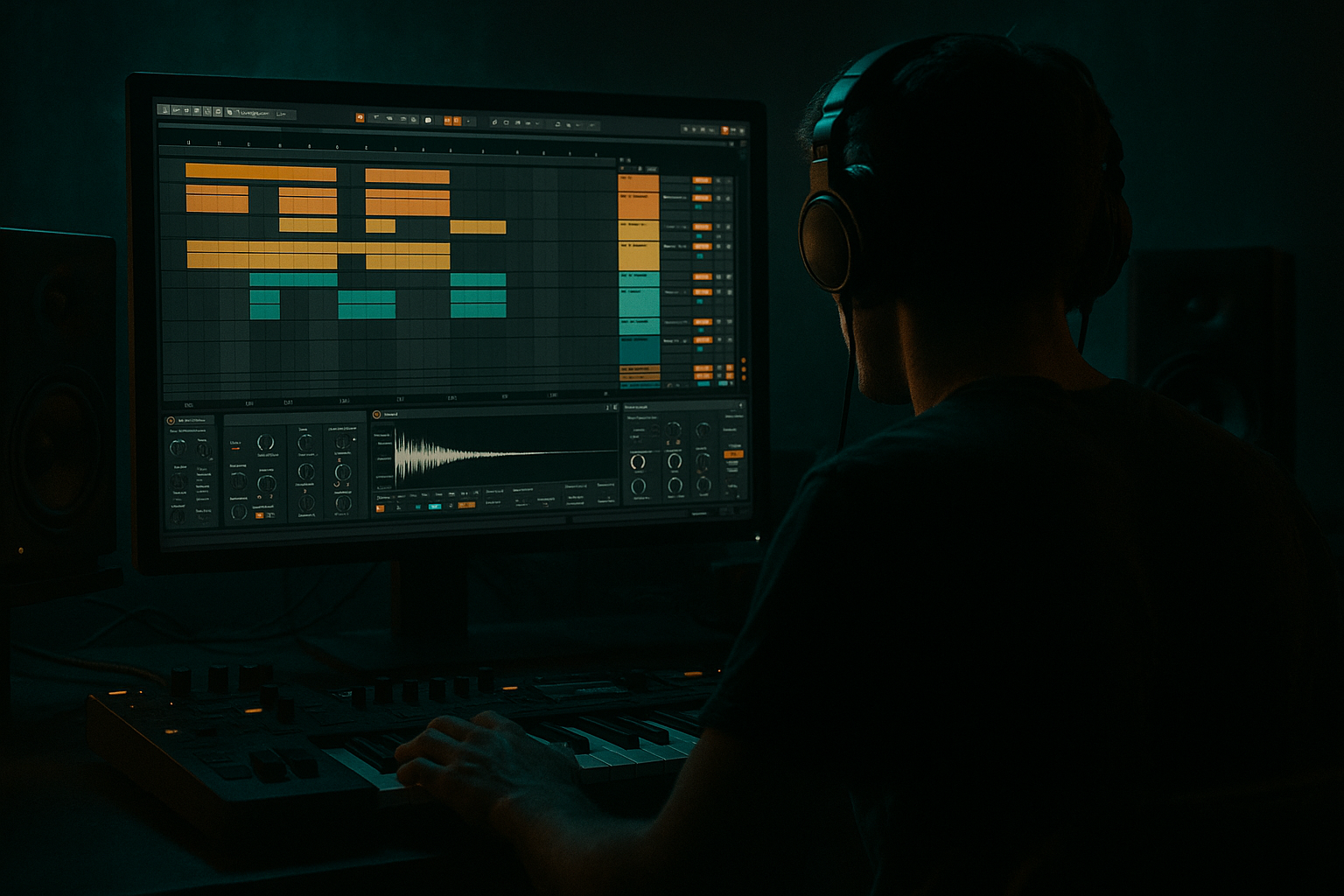
Go to Arrangement View (recommended for detailed density shaping).
Hit A to show automation lanes.
Create automation for these parameters:
#### A) Auto Filter Frequency = “Brightness Density”
Drawing tip: Use gentle ramps, not just on/off. DnB energy loves continuous evolution.
---
#### B) Drum Buss Drive = “Impact Density”
This increases perceived “activity” because transients and harmonics come forward.
---
#### C) Saturator Drive = “Harmonic Density”
Automate Drive in small moves:
Important: keep your output from clipping; use the Saturator output or Utility after.
---
#### D) Gate Threshold = “Tight vs Washy”
This one is sneaky and super effective:
Try automating:
---
Step 5 — Add density with automated “repeat/stutter fills” (stock tools) ⚡
Pick one method:
#### Method 1: Beat Repeat (classic DnB fill tool)
1. Add Beat Repeat at the end of the chain.
2. Set:
- Interval: 1 Bar
- Grid: 1/16 (or 1/32 for spice)
- Chance: 0% (we’ll automate)
- Variation: 0–20%
- Gate: ~50–80%
3. Automate Chance:
- Keep at 0% most of the time
- Raise to 15–35% on the last 1/2 bar of a phrase (bar 8, 16, 32 etc.)
This gives controlled chaos without rewriting MIDI.
#### Method 2: Auto Pan as a “gater” (clean and rhythmic)
1. Add Auto Pan (yes, even if you don’t want panning).
2. Turn Phase = 0 (so it becomes amplitude modulation).
3. Rate: 1/8 or 1/16
4. Amount: automate 0% → 30–70% in fills or high-energy sections
This creates rhythmic density while staying mix-friendly.
---
Step 6 — Arrangement idea: density mapping over 32 bars 🧭
Use automation like a DJ-friendly story:
- Filter ~5–8 kHz
- Low drive
- Little/no stutter
- Gradually open filter
- Slightly increase Drum Buss drive
- Add a few tiny Beat Repeat chance bumps at phrase ends
- Filter open 12–16 kHz
- Drum Buss drive up
- Saturator up slightly
- Controlled fills every 8 bars
- Pull filter down briefly (contrast!)
- Increase gate tightness if bass gets heavy
- One bigger stutter moment to signal change
This “density automation arc” makes one break feel like multiple layers.
---
4. Common mistakes 🚫
---
5. Pro tips for darker/heavier DnB 🕶️
- Create a Return track “BREAK CRUSH” with Saturator → Drum Buss → EQ Eight
- Send automation: low in verses, higher in drops
- EQ the return: cut lows below 150 Hz, control harshness around 6–10 kHz
---
6. Mini practice exercise 🎯
Goal: Make a 16-bar loop where the break gets noticeably denser every 4 bars—without changing the MIDI notes.
1. Use your break in Simpler Slice mode with a basic MIDI pattern.
2. Create automation lanes for:
- Auto Filter Frequency
- Drum Buss Drive
- Beat Repeat Chance (or Auto Pan Amount)
3. Bars 1–4: low density
4. Bars 5–8: medium density
5. Bars 9–12: high density
6. Bars 13–16: peak density + one fill on bar 16
Check yourself: If you mute automation, the groove should still work. Automation should feel like energy shaping, not damage control.
---
7. Recap ✅
If you want, tell me what subgenre you’re aiming for (liquid, neuro, jungle, minimal rollers), and I’ll suggest a density automation map that fits that style.
```

