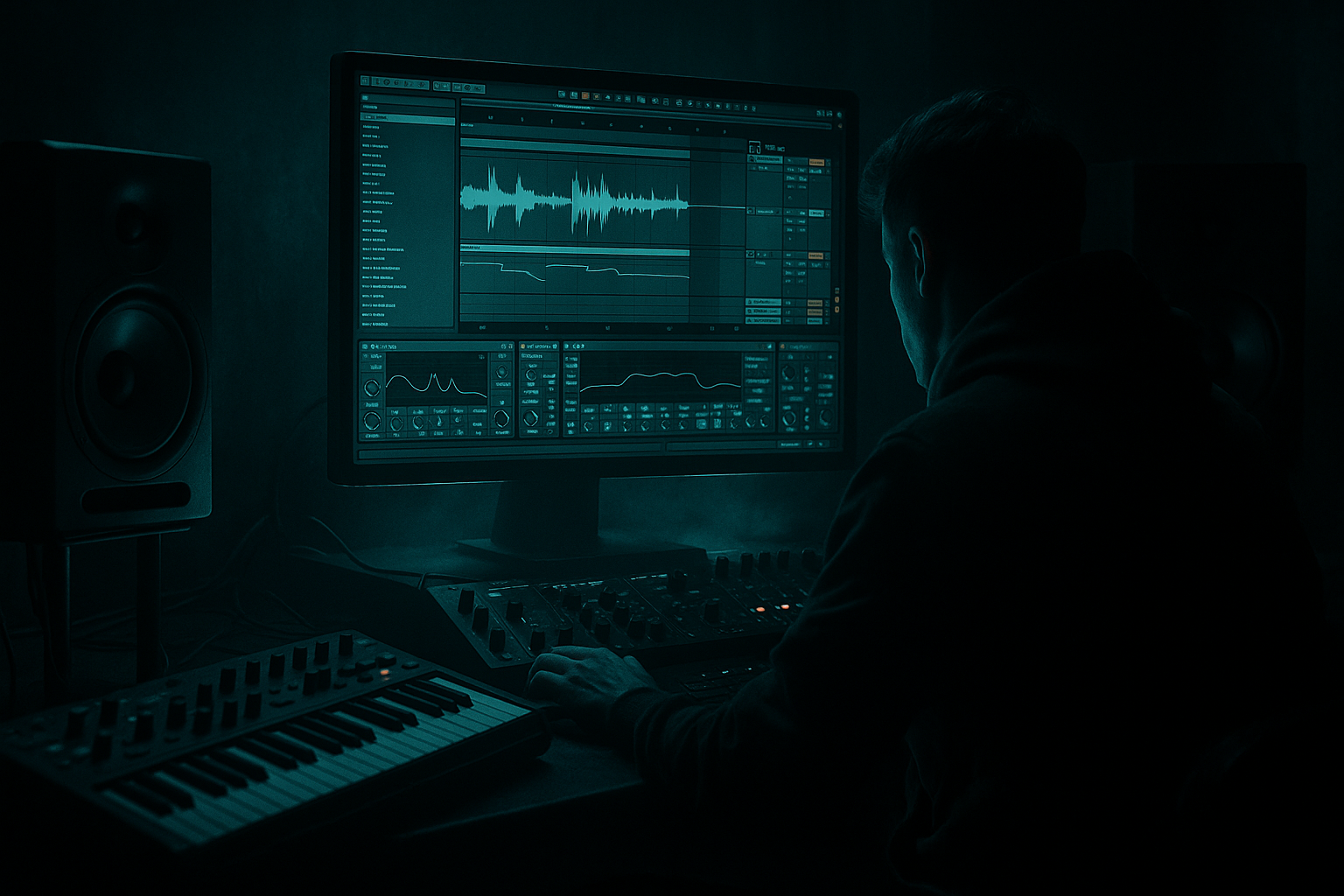
Main tutorial
```markdown
Automation of Crackle & Hiss Levels (DnB in Ableton Live) 🎛️🔥
1. Lesson overview
In drum & bass, crackle and hiss aren’t just “lo-fi flavor”—they’re arrangement tools. When automated correctly, they:
- Add movement to static loops
- Help transitions hit harder (drops feel bigger)
- Glue drums + bass with a subtle bed of texture
- Create tension and release without adding new musical elements
- Crackle layer (vinyl/noise burst feel)
- Hiss layer (air band / tape hiss vibe)
- Automation lanes for:
- Arrangement moves: intro → build → drop → breakdown → second drop, with texture intensity shifting like a proper DnB record 🚀
- Sidechain: ON
- Input: your DRUM BUS (or just the SNARE track for snare-led pumping)
- Settings (starting point):
- Sidechain: ON → input Hi-hats or Ghost percussion
- Threshold: set so crackle opens only during hat activity
- Release: 50–120 ms for rhythmic chatter
- Intro: -24 dB (barely there)
- Build: ramp to -16 dB
- Drop: pull back to -20 dB (let drums/bass dominate)
- Breakdown: back up to -14 dB (fills space)
- Second drop: automate micro-swells (±1–2 dB) every 8 bars
- Build-up sweep: move cutoff up (e.g., 4 kHz → 10 kHz) across 8–16 bars
- At drop: snap it slightly down (e.g., back to 6–8 kHz) to avoid harshness
- In breakdown or 16-bar intro:
- Pull resonance back before drop
- Intro: 140–160%
- Drop: 110–130%
- Very heavy sections: even 100% (more mono-compatible)
- Create a tiny dip right before the drop:
- Every 8 bars: small +1 dB swell on hiss for “forward motion”
- Every 16 bars: momentary crackle bump + filter flick for variation
- Pre-drop 2 bars: gradually brighten hiss, then mute for 1 beat
- Breakdown: push crackle louder + slightly darker (more low-mid filtered out so it doesn’t fight bass reintros)
- Band-limit the texture for that “tape/old rig” feel:
- Make texture react to bass gaps, not bass peaks:
- Add subtle distortion but control fizz:
- Use automation shapes:
- Micro-variation trick:
- Crackle and hiss are arrangement + groove tools in DnB, not just “lo-fi seasoning.”
- Build a Texture Bus with stock devices: Utility, Auto Filter, EQ Eight, Compressor/Gate.
- Automate Gain, Filter Cutoff, Width, and add ducking so texture moves with drums.
- Use pre-drop mutes and brightness sweeps to make drops hit harder and sections feel distinct.
In this lesson you’ll automate crackle/hiss levels, tone, stereo width, and gating using stock Ableton devices in a way that feels authentic to jungle/rolling DnB.
---
2. What you will build
A reusable “Texture Bus” setup that includes:
- Volume (Utility Gain)
- Filter cutoff (Auto Filter)
- Stereo width (Utility Width)
- Gate/duck behavior (Gate or sidechain compression)
---
3. Step-by-step walkthrough
Step 1 — Create your texture sources (two tracks)
You want separate control of crackle and hiss.
#### A) Crackle track
1. Create Audio Track → name it `CRACKLE`.
2. Drop in a crackle sample (vinyl crackle, record noise, Foley grit).
- If you don’t have one: grab any “vinyl crackle” sample from a pack.
3. Turn Warp OFF (for long steady beds) or keep Warp ON (for rhythmic texture).
- For constant beds: Warp OFF often sounds more natural.
#### B) Hiss track
1. Create Audio Track → name it `HISS`.
2. Use a hiss sample or generate noise:
- Quick method: use a long hiss sample (tape hiss / air noise).
- Alternative: if you have a noise recording, even room tone works.
DnB note: Keep the texture consistent and controlled—you want vibe, not “shhh” masking your cymbals.
---
Step 2 — Build a solid stock device chain (per track)
You’ll use Utility + Auto Filter + EQ Eight as your core.
#### Crackle chain (recommended)
1. Utility
- Gain: start at -18 to -24 dB
- Width: 60–100% (we’ll automate later)
2. Auto Filter
- Mode: High-Pass (12 dB or 24 dB)
- Cutoff: start around 250–600 Hz
- Resonance: 0.30–0.80 (tiny bite helps it read on small speakers)
3. EQ Eight
- Add a gentle dip around 2–5 kHz if it gets “spitty”
- Optional: small shelf boost at 8–12 kHz if you want brighter dust
#### Hiss chain (recommended)
1. Utility
- Gain: start at -20 to -30 dB
- Width: 120–160% (hiss can live wider than crackle)
2. Auto Filter
- Mode: High-Pass at 2–6 kHz (yes, high—this is “air”)
- If it’s too sharp, use Low-Pass at 10–14 kHz as well (via EQ Eight)
3. EQ Eight
- Notch any harsh band: often 7–9 kHz
- Keep it subtle—1–3 dB moves
---
Step 3 — Route both into a Texture Bus (clean workflow)
1. Create a Return Track or a Group Bus:
- Option A (common): Group `CRACKLE` + `HISS` into `TEXTURE BUS`
- Option B: Send both to a Return (`A: Texture`) and keep dry tracks low
I recommend Grouping for straightforward automation and freezing.
On the TEXTURE BUS, add:
1. Utility (this is your master texture fader)
2. Glue Compressor (optional, very light)
- Attack: 10 ms
- Release: Auto
- Ratio: 2:1
- Aim: 1–2 dB gain reduction at most
3. Saturator (optional, for darker grit)
- Drive: 1–4 dB
- Soft Clip: ON
---
Step 4 — Make the texture “breathe” with drums (DnB-style ducking)
Crackle/hiss should often duck on drum hits, especially the snare.
#### Option A: Sidechain compression (clean + common)
On `TEXTURE BUS` add Compressor:
- Ratio: 3:1
- Attack: 1–5 ms
- Release: 80–160 ms (match your groove)
- Threshold: adjust for 2–6 dB gain reduction on hits
This keeps texture present but out of the way when drums smack. 🥁
#### Option B: Gate for more “chopped” jungle vibe
On `CRACKLE` track add Gate:
This is great for 90s jungle-style movement.
---
Step 5 — Automation targets that matter (and how to do them)
Hit A to toggle Automation Mode in Arrangement View.
#### Automation Target #1: Overall Texture Intensity (Utility Gain)
On `TEXTURE BUS` → Utility Gain
Why: DnB drops feel bigger when texture reduces at the moment of impact.
#### Automation Target #2: Brightness (Auto Filter Cutoff on HISS)
On `HISS` → Auto Filter Cutoff:
This is a classic “air opening” transition without adding risers.
#### Automation Target #3: “Old record” moment (Crackle Filter + Resonance)
On `CRACKLE` → Auto Filter Cutoff + Resonance:
- Cutoff: 200 Hz → 800 Hz
- Resonance: 0.3 → 1.0 (briefly)
This makes crackle “poke” for a second—great for vibe.
#### Automation Target #4: Width (Utility Width on HISS)
On `HISS` → Utility Width:
Width automation is subtle but makes the mix feel like it “opens” and “tightens” intentionally.
#### Automation Target #5: Drop impact trick (1-beat texture mute)
On `TEXTURE BUS` → Utility Gain:
- Last 1/4 to 1 beat before drop: down to -inf or -30 dB
- At drop: return instantly to drop-level (e.g., -20 dB)
That silence makes the downbeat hit harder. 💥
---
Step 6 — Arrangement ideas rooted in rolling DnB
Use texture automation to mark sections without adding new drum fills every time:
---
4. Common mistakes
1. Too loud texture: If you notice hiss constantly, it’s likely too hot. Start lower than you think.
2. Masking cymbals: Hiss often clashes with hats at 8–12 kHz. EQ it.
3. No ducking: Texture that doesn’t move with drums can smear transients and reduce punch.
4. Over-widening: 200% width hiss can sound impressive solo but weird in mono clubs.
5. Automating only volume: The magic is in tone + width + rhythm (gate/sidechain).
---
5. Pro tips for darker/heavier DnB 🖤
On `TEXTURE BUS` add EQ Eight:
- High-pass: 200–400 Hz
- Low-pass: 10–12 kHz
Sidechain from snare or drum bus, not sub bass. Keeps low-end stable.
- `Saturator` Drive 2–6 dB → then EQ Eight notch 7–9 kHz if it gets gritty
Avoid perfectly linear ramps every time—use slight curves and short holds (feels more “performed”).
Automate `CRACKLE` Utility Gain ±0.5–1 dB over 4 bars. It stops feeling looped.
---
6. Mini practice exercise (15–25 minutes)
1. Build `CRACKLE`, `HISS`, and `TEXTURE BUS` exactly as above.
2. Loop an 8-bar rolling drum pattern + a reese or sub-heavy bassline.
3. Create a simple arrangement:
- 8 bars intro
- 8 bars build
- 16 bars drop
- 8 bars breakdown
4. Write these automations:
- `TEXTURE BUS Utility Gain`: intro -24 dB → build -16 dB → drop -20 dB
- `HISS Auto Filter Cutoff`: build sweep 5 kHz → 11 kHz, snap to 7 kHz at drop
- 1-beat mute of `TEXTURE BUS` right before drop
5. A/B test:
- Bypass `TEXTURE BUS` and re-enable it.
- Your goal: the track feels emptier without it, but not obviously noisy with it.
---
7. Recap
If you want, tell me your tempo + sub style (clean sub vs reese) and I’ll suggest exact ducking release times and automation ranges for your groove.
```

