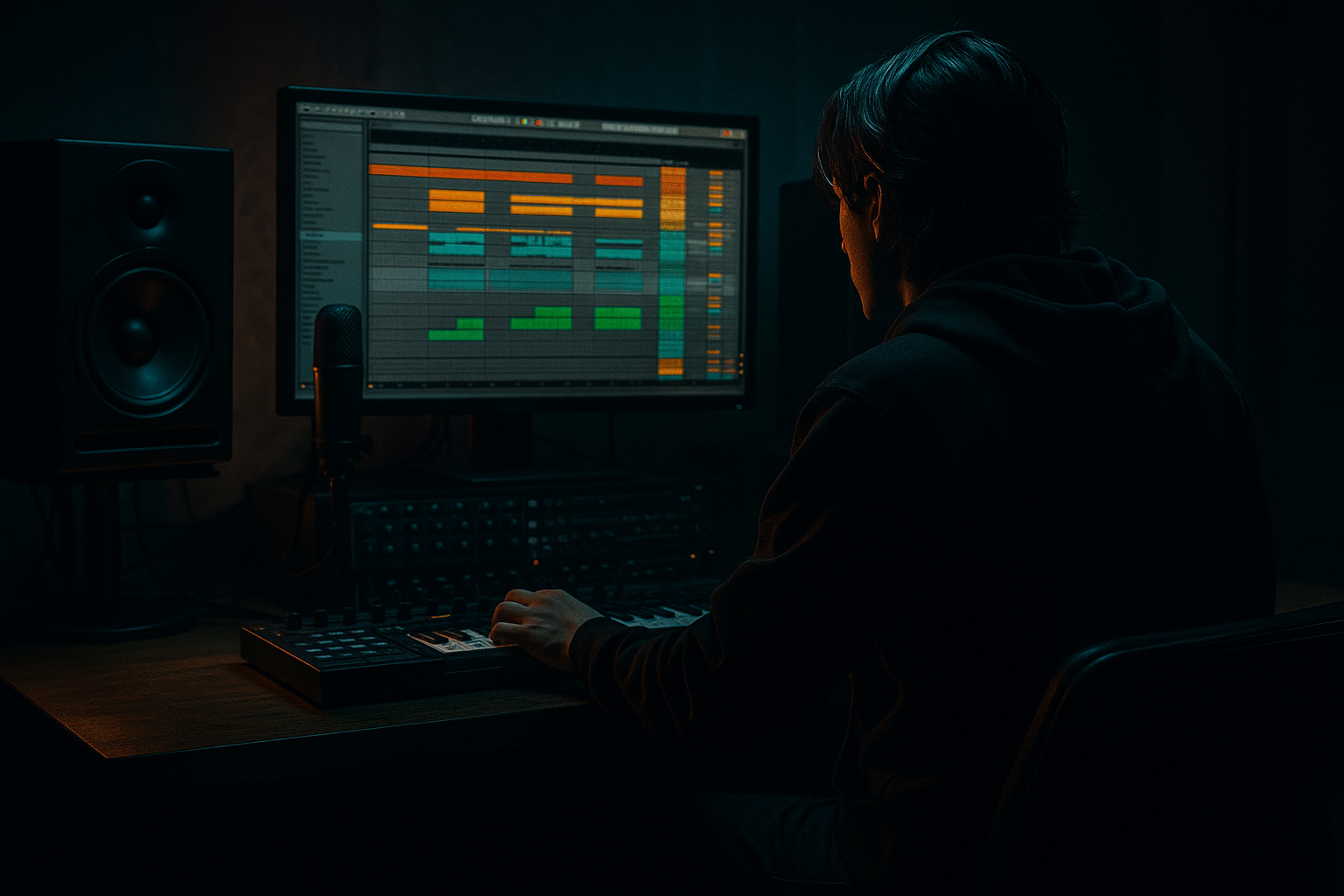
Main tutorial
```markdown
Automation Rehearsals for Live Resampling (DnB in Ableton Live) 🎛️🔥
1. Lesson overview
Live resampling is one of the fastest ways to generate unique drum and bass variations—fills, switch-ups, bass rewrites, and “one-off” ear-candy—without getting stuck drawing automation forever.
This lesson is about automation rehearsals: deliberately practicing your automation moves (like a performance) so you can record/resample them cleanly into audio and then arrange them like proper rolling DnB.
You’ll build a repeatable workflow to:
- rehearse automation moves in Session View
- record them into new audio clips via Resampling
- chop, re-sequence, and arrange into a drop-ready set of variations
- 4–8 resampled audio “takes” of your bass/drum bus with different automation performances
- A variation grid (A/B/C/D) you can trigger or arrange for:
- A clean routing + recording template you can reuse each session
- Audio From:
- Monitor: `Off` (prevents feedback / doubling)
- Arm: enable record arm when ready
- `PRINT FULL` (Resampling)
- `PRINT BASS` (BASS BUS Post FX)
- `PRINT DRUMS` (DRUM BUS Post FX)
- Filter Freq: don’t map 20 Hz–20 kHz. Map something like 80 Hz–4 kHz for bass, or 150 Hz–2 kHz for drums HP pull-outs. Tight mapping = controllable takes.
- Loop 8 bars.
- Move only one macro for the whole loop.
- Listen for:
- Add a second macro (e.g., Filter Freq + Saturator Drive).
- Aim for musical phrasing:
- Every 16 bars: swap in a new bass resample phrase for 2 bars.
- Bar 15–16 of a 16-bar block: use the most extreme take as a fill.
- Drop 2: reprint the bass with different automation (more saturation, narrower stereo, more mid focus) for progression.
- Drop (32 bars)
- Automate “dirt” in layers, not just one knob:
- Use Gate as a rhythm weapon:
- Resample into “fear edits”:
- Pitch automation for neuro-ish menace:
- Drum pull-outs that still hit:
- You built a performance-first automation workflow designed for DnB.
- You mapped a small set of high-impact parameters, rehearsed them like an instrument, and printed resamples.
- You chopped those takes into arrangement-ready phrases and used them for authentic rolling progression.
---
2. What you will build
A tight DnB production workflow that outputs:
- drop 1 → drop 2 evolution
- fills every 16/32 bars
- “call & response” bass phrases
---
3. Step-by-step walkthrough
Step 0 — Session setup (the “rehearsal room”) 🧱
1. Set BPM: 172–176 (classic DnB pocket).
2. Loop length: start with 8 bars (enough for groove + movement).
3. In Session View, create these tracks:
- DRUMS (Audio/MIDI depending on your setup)
- BASS (MIDI with your synth or Rack)
- MUSIC/FX (optional)
- PRINT (Audio) ← this is where we resample
4. Group your mix buses:
- Group DRUMS into DRUM BUS
- Group BASS into BASS BUS
- Optional: Group everything into PREMASTER
Why this matters: rehearsal is easier when you can print exactly what you’re performing (bass only, drums only, or the full premaster).
---
Step 1 — Build a “Resample Print” track correctly 🎙️
On PRINT (Audio):
- For full mix: `Resampling`
- For bass-only: choose `BASS BUS` → `Post FX`
- For drums-only: choose `DRUM BUS` → `Post FX`
Pro workflow suggestion:
Create 3 print tracks:
This lets you harvest variations quickly and mix later.
---
Step 2 — Make “automation targets” that sound like DnB, not EDM 🥁🧬
You want automation that creates rolling energy and threat. Use stock devices to keep it fast.
#### A) Bass chain (example device chain)
On BASS BUS (group):
1. Saturator
- Drive: 2–8 dB (map this!)
- Soft Clip: On
2. Auto Filter
- Mode: LP24 or BP12 depending on vibe
- Envelope: subtle or off
- Frequency: map for sweeps
3. Amp (stock!)
- Great for bite; map Gain / Dry/Wet
4. Glue Compressor
- Attack: 1–10 ms
- Release: Auto or 0.1–0.3s
- Soft Clip: On
5. Utility
- Width (map for mid-only moments)
- Gain (map for quick duck/boost moves)
#### B) Drum bus chain (example)
On DRUM BUS:
1. Drum Buss
- Drive: taste
- Boom: low, tuned to kick region
- Transients: +5 to +20 (map!)
2. EQ Eight
- Map a single bell at ~200–400 Hz (for “boxiness” dips)
3. Auto Filter
- HP12 for quick “DJ-style” pull-outs (map freq)
4. Redux (sparingly)
- Downsample 2–8 (map Dry/Wet for grime)
Rule: Choose 3–6 parameters total to rehearse. More than that = messy takes.
---
Step 3 — Map controls for performance (Macro + MIDI) 🎚️
1. Put your bus effects into an Audio Effect Rack (on BASS BUS and/or DRUM BUS).
2. Map the key parameters to 8 Macros:
- Macro 1: Filter Freq (bass)
- Macro 2: Saturator Drive (bass)
- Macro 3: Amp Dry/Wet (bass)
- Macro 4: Utility Width (bass)
- Macro 5: Drum Buss Transients
- Macro 6: Drum Filter Freq (HP pull)
- Macro 7: Redux Dry/Wet (drums)
- Macro 8: “Danger” (Glue threshold or parallel chain amount)
3. MIDI map Macros to 8 knobs/faders (or use Push).
Advanced tip: Keep ranges tight:
---
Step 4 — The actual “automation rehearsal” method (3-pass system) 🧠✅
You’re going to practice the automation like you’d practice a drop mix.
#### Pass 1: Silent rehearsal (no recording)
- clicks from fast filter jumps
- pumping that kills groove
- tonal changes that clash with your sub
Do 2–3 loops until your hand knows the motion.
#### Pass 2: Two-macro rehearsal (still no recording)
- bars 1–2: stable groove
- bars 3–4: slight open-up
- bars 5–7: tension
- bar 8: hard move (fill / chop moment)
#### Pass 3: Record takes (print audio!)
1. Arm PRINT track.
2. Hit Session Record (top transport) and then launch your loop/scene.
3. Perform your macro moves for 8 bars.
4. Stop. Rename the clip immediately:
- `BASS_take_A_filterpush`
- `FULL_take_C_darkpullout`
5. Record 4–8 takes, each with a clear intention:
- Take A: subtle movement
- Take B: aggressive saturation push
- Take C: “HP pull + slam back”
- Take D: glitchy redux moments
Key: Don’t chase perfection. You’re collecting usable moments.
---
Step 5 — Clean and slice your resample takes (audio wins in DnB) ✂️
Open a printed clip:
1. Warp mode: usually `Complex` off for bass resamples; try:
- `Beats` for drums (Preserve Transients)
- `Tones` for reese-ish bass
- or unwarped if you recorded perfectly in time
2. Consolidate the best 1–2 bars:
- Select → Cmd/Ctrl+J
Create micro-phrases (1 bar, 2 bars).
3. Create a Variation Scene:
- Scene 1: “Drop A”
- Scene 2: “Drop B”
- Scene 3: “Fill scene”
4. Optional but powerful: right-click clip → Slice to New MIDI Track
- Slice preset: `Transient` (drums) or `1/8` / `1/16` grid (bass)
- You now have a playable rack of your resample moments.
This is where jungle-style edits come alive—quick swaps, rewinds, stutters.
---
Step 6 — Arrangement ideas (rolling DnB structure) 🧱🚂
Use your resampled clips like arrangement bricks:
Try this template:
- Bars 1–8: Take A (subtle)
- Bars 9–16: Take B (more drive)
- Bars 17–24: Take A + occasional Take D stabs
- Bars 25–32: Take C (pull-out + slam) as pre-switch
---
4. Common mistakes ❌
1. Recording the master with limiter/clipping you can’t undo
Print from PREMASTER (no limiter) and keep final limiting for the end.
2. Too many automated parameters at once
You’ll get “random” instead of “designed.” Cap it at 2–4 per take.
3. Wide bass automation wrecking mono compatibility
Automate Utility Width carefully; keep sub mono (below ~120 Hz).
4. Filter sweeps that kill impact
In DnB, impact is everything—if you HP too much for too long, the drop feels empty.
5. Warp artifacts on resampled bass
If it sounds phasey, try turning Warp off or switching modes.
---
5. Pro tips for darker/heavier DnB 🖤⚙️
Use parallel chains in an Audio Effect Rack:
- Chain 1: Clean (no distortion)
- Chain 2: Mid-grit (Saturator + Amp)
- Chain 3: Top-fizz (Overdrive + EQ Eight high shelf)
Map chain volumes to one macro (“Grime Morph”).
Put Gate after distortion on a mid-bass layer.
Sidechain it from your ghost MIDI (or drum bus) for tight, talking movement.
Do one take where you intentionally overcook distortion for 1 bar only, then slam back clean. Perfect for 2nd half drop.
Resample a bass phrase, then use Clip Transpose automation or Shifter (stock) on the resample for quick dives.
Instead of HP filtering the whole drum bus, automate the Return reverb (Hybrid Reverb) wet amount for space, while keeping dry punch.
---
6. Mini practice exercise (15 minutes) ⏱️
1. Make an 8-bar loop: drums + bass (simple rolling pattern).
2. Choose 2 macros only:
- Bass Filter Freq
- Saturator Drive
3. Do:
- 2 loops rehearsal (no record)
- 4 recorded takes
4. From each take, cut one best bar and consolidate it.
5. Arrange a 16-bar drop section using:
- Bar 1–8: original loop
- Bar 9: resample bar (Take 1)
- Bar 13: resample bar (Take 2)
- Bar 16: most aggressive resample bar as fill
Goal: end with a drop that evolves without adding new MIDI notes.
---
7. Recap ✅
If you want, tell me your bass style (reese, foghorn, neuro mid, jungle sub) and whether you’re on Push or mouse—I'll suggest a tight 8-macro layout and a rehearsal plan tailored to it.
```

