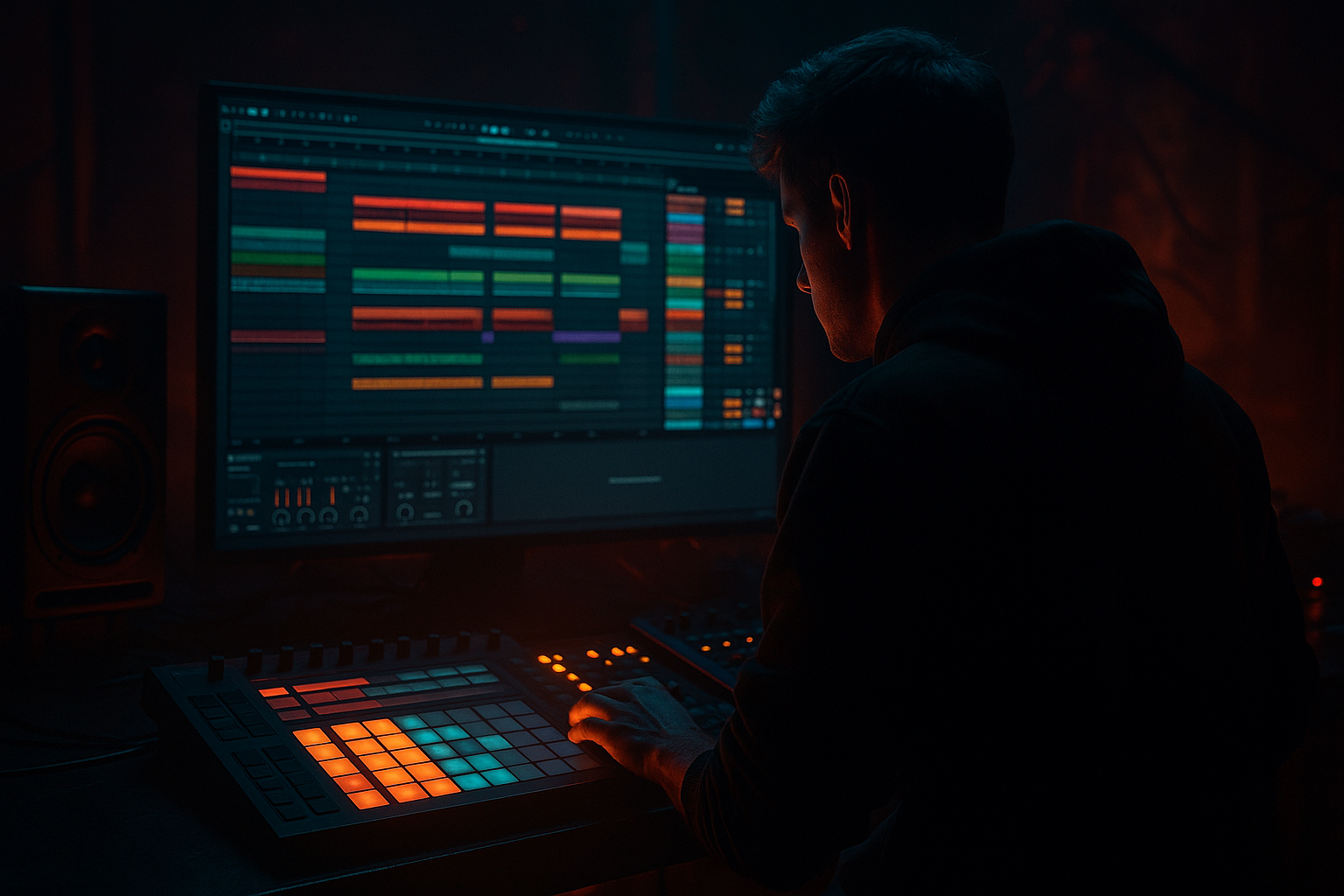
Main tutorial
```markdown
Automation Snapshots for Quick Arrangement Revisions (DnB in Ableton Live) 🎛️⚡
1) Lesson overview
In Drum & Bass, arrangements get revised constantly: “Drop hits too late,” “Bass needs more bite in bar 33,” “Build should feel tighter,” etc. If your automation is scattered across 20 lanes, revisions become slow and risky.
This lesson shows you a snapshot-based automation workflow in Ableton Live: you’ll create repeatable “states” (Intro / Build / Drop / Breakdown / Second Drop) and recall them quickly using:
- Macros (Instrument/Audio Effect Racks)
- Dummy clips in Session View (snapshot triggers)
- Arrangement View recording (to print clean automation)
- Locator + “snapshot scenes” for fast A/B revisions
- Hit one clip/scene and instantly switch the mix to Intro, Build, Drop, Break, etc.
- Record those changes into Arrangement as clean automation passes.
- Revise arrangement structure in minutes: move locators, re-trigger snapshots, re-print automation.
- A “MIX SNAPSHOT” rack on your Drum Buss group
- A “BASS SNAPSHOT” rack on your bass group
- A “MASTER SNAPSHOT” rack (subtle!) on pre-master
- A set of Session View dummy clips that recall snapshot states
- BPM: 172–174
- Groups:
- Intro/Break: tighter, filtered, controlled
- Drop: open filter, drive up, width slightly wider (but watch mono)
- EQ Eight
- Auto Filter
- Saturator
- Amp (or Overdrive)
- Utility
- Macro 1: Bass Bite → Saturator Drive (Soft Clip ON)
- Macro 2: Bass LP/Open → Auto Filter Frequency (LP 24 dB)
- Macro 3: Mid Focus → EQ Eight Band 4 Gain (e.g., ~1.2 kHz bell)
- Macro 4: Bass Width → Utility Width
- Macro 5: Drop Level → Utility Gain
- Build: filtered, less bite
- Drop: open, more bite, tighter mono compatibility
- Glue Compressor
- Limiter (very light, safety)
- Utility
- Macro 1: Glue Amount → Glue Compressor Threshold
- Macro 2: Master Tilt → Utility Gain (tiny) or EQ Eight tilt (if you prefer)
- Macro 3: Mono Check → Utility Width (100% to 0% momentary check)
- Drum LP: 1.2 kHz
- Drum Drive: 5%
- Drum Width: 90%
- Bass LP/Open: 250 Hz
- Bass Bite: +1 dB
- Drop Level: -3 dB
- Drum LP: 4–8 kHz (slowly rising if you want movement)
- Build Tension: 10–15%
- Bass LP/Open: 1–2 kHz
- Bass Bite: +3 dB
- Glue Amount: slightly more compression than intro
- Drum LP: 18 kHz
- Drum Drive: 15–25%
- Drum Crunch: +4 to +6 dB
- Bass LP/Open: 18 kHz
- Bass Bite: +6 to +10 dB
- Bass Width: 0–20%
- Drop Level: 0 dB
- Loop around bars 33–65, record automation while launching `DROP` and `BREAKDOWN`.
- Put each snapshot clip in the same Scene row as your musical clips.
- Scene launch triggers both the music and the macro snapshot together.
- Mapping too many parameters. If your snapshot rack has 24 macros, you’ll lose clarity. Keep it to the 6–10 most revision-sensitive controls.
- Overdriving the premaster. If your “MASTER SNAPSHOT” changes are heavy, your mix will shift unpredictably. Keep master macros subtle.
- Bass width automation. Widening bass in the drop can wreck mono compatibility and club translation. Keep sub mono; widen upper layers instead.
- Forgetting macro ranges. If the macro range is too wide, tiny envelope changes cause huge mix swings. Set ranges thoughtfully.
- Confusing Session automation vs Arrangement automation. Remember: launching clips affects parameters live; once you record into Arrangement, those lanes take over.
- Make “Impact” a macro: Map a macro to:
- Parallel filth snapshot: On the BASS group, create a parallel chain in an Audio Effect Rack:
- Neuro-style movement without chaos: Use Auto Filter or Phaser-Flanger subtly and snapshot its Dry/Wet higher in fills (last 2 bars of phrases).
- Dark room control: Map an EQ Eight high-shelf cut (like -0.5 to -2 dB at 8–10 kHz) to a macro called `DARKNESS`. Snapshot it slightly darker in second drop if cymbals get harsh.
- Jungle breaks “tightness” macro: Map Gate threshold (or Drum Buss Transients) on break channel to quickly tighten ghost notes for modern punch.
- You built a snapshot automation system using Rack Macros + Session dummy clips.
- You used snapshots to recall section states instantly (Intro/Build/Drop).
- You printed those changes into Arrangement for a clean, editable automation pass.
- You gained a revision workflow that’s perfect for DnB where drops, builds, and breakdown energy need quick iteration.
Advanced focus: fast iteration without losing mix stability—perfect for rolling bass music where micro-changes matter.
---
2) What you will build
A DnB project template that lets you:
You’ll build:
---
3) Step-by-step walkthrough
Step 0 — Project assumptions (DnB template)
- DRUMS (Kick, Snare, Hats/perc, Break)
- BASS (Sub, Reese, Mid, FX)
- MUSIC/ATMOS
- PREMASTER (your master processing lives here; Master stays mostly clean)
Create locators in Arrangement:
Intro (1), Build (17), Drop (33), Breakdown (65), Drop 2 (81), Outro (113)
(Adjust to your tune—this is a typical rolling layout.)
---
Step 1 — Create “Snapshot Macros” with Racks (the core idea)
We’re going to centralize the parameters you often automate into a few macro knobs. This makes automation portable and revision-friendly.
#### 1A) DRUMS: Build a “DRUM SNAPSHOT” Rack 🥁
1. Put an Audio Effect Rack on your DRUMS group.
2. Drop these devices inside (order matters):
- Auto Filter
- Drum Buss
- Saturator
- Utility
- (Optional) Frequency Shifter (for build tension)
3. Map these to Macros (Map Mode):
- Macro 1: Drum LP → Auto Filter Frequency
- Filter: Lowpass, 24 dB
- Set range: 200 Hz → 18 kHz
- Macro 2: Drum Drive → Drum Buss Drive
- Range: 0 → 25%
- Macro 3: Drum Crunch → Saturator Drive
- Mode: Soft Clip ON
- Range: 0 → +8 dB
- Macro 4: Drum Width → Utility Width
- Range: 80% → 130%
- Macro 5: Build Tension → Frequency Shifter Fine (or Auto Filter Resonance)
- If Frequency Shifter: 0 Hz → 25 Hz, Dry/Wet 0–15%
4. Rename the rack: DRUM SNAPSHOT
DnB use-case:
---
#### 1B) BASS: Build a “BASS SNAPSHOT” Rack 🔊
On your BASS group, add an Audio Effect Rack and place:
Map to macros:
- Range: 0 → +10 dB
- Range: 120 Hz → 18 kHz
- (Important: set resonance modestly: 0.70–1.10)
- Range: -3 dB → +3 dB
- Range: 0–40% (keep bass mostly mono!)
- Range: -3 dB → 0 dB
Rename rack: BASS SNAPSHOT
DnB use-case:
---
#### 1C) PREMASTER: Build a “MASTER SNAPSHOT” Rack (subtle) 🎚️
On a PREMASTER group (route all groups into it), add:
Macro mappings:
- Aim: 1–2 dB GR on drop max
- Keep it ±0.5 dB territory
- Range: 100% → 0% (don’t automate this in final—use for checking)
Rename: MASTER SNAPSHOT
---
Step 2 — Build Session View “Snapshot Trigger” clips 🎬
This is where you get instant recall.
1. Create a new MIDI track named SNAPSHOTS (DUMMY).
2. Set Monitor: In (so clips can fire without arming complications).
3. Create one MIDI clip per section, e.g.:
- `INTRO`
- `BUILD`
- `DROP`
- `BREAKDOWN`
- `DROP 2`
4. In each clip, automate the macros using Clip Envelopes:
- Open clip → Envelopes → choose the track/device → choose the Macro
- Set each macro value to the desired “state” (a snapshot).
Example snapshot values (starting point):
INTRO clip:
BUILD clip:
DROP clip:
🔥 Now you can click a single clip and the entire mix moves into that state.
DnB workflow note:
If you run both tight techy drums and a chopped break, add a second rack on the BREAK channel with its own macros (HP/LP, transient, saturation). Snapshot it too.
---
Step 3 — Print snapshots into Arrangement (clean automation pass)
The goal is: audition quickly in Session; then commit the best pass to Arrangement.
1. Go to Arrangement View.
2. Enable Automation Arm (top bar).
3. Hit Record.
4. While playing from the top (or from locators), launch your snapshot clips/scenes at section boundaries.
5. Stop recording.
Ableton will write the macro movements into Arrangement automation lanes.
Now you can edit structure: copy 8 bars, move the drop, etc., and your automation is much easier to manage because it’s mostly on macro lanes.
---
Step 4 — “Revision mode”: fast changes without breaking everything
When a revision request comes in (“Drop needs more impact, but build should stay restrained”):
1. Go back to Session View.
2. Adjust ONLY the `DROP` snapshot clip envelope values:
- e.g. Drum Drive from 18% → 24%
- Bass Bite from +7 dB → +9 dB
3. Record a new automation pass into Arrangement.
4. Compare against the previous pass using:
- Arrangement Undo History
- Duplicate the project / save as `v07`, `v08`
Tip: Use locators and re-record only the needed part:
---
Step 5 — Optional: “Scene-based” snapshots for full-arrangement recall 🧠
If you already perform your arrangement in Session:
This is killer for jungle-style edits where you’re trying different drop/bar combos quickly.
---
4) Common mistakes
---
5) Pro tips for darker/heavier DnB 🖤
- Drum Buss Boom (low-end thump) with tight range (e.g. 0–20%)
- Drum Buss Transient (small range)
- Saturator Drive (small range)
This gives you instant “drop hits harder” revisions.
- Chain A: Clean (EQ/Utility)
- Chain B: Distorted (Amp/Overdrive/Saturator + EQ)
Map Chain Volume or Dry/Wet blend to a macro called `FILTH`.
Snapshot: Build low FILTH, Drop higher FILTH.
---
6) Mini practice exercise (15–25 minutes) ⏱️
1. Take an existing rolling DnB loop (drums + bass).
2. Create DRUM SNAPSHOT and BASS SNAPSHOT racks with 5 macros each.
3. Make 3 snapshot clips:
- `INTRO` (filtered, restrained)
- `DROP` (open, driven)
- `DROP (ALT)` (slightly darker + more punch)
4. Record one automation pass into Arrangement:
- Intro 16 bars → Drop 32 bars → Breakdown 16 bars → Drop ALT 32 bars
5. Now do a revision:
- Increase drop impact only by editing the snapshot clip, not by drawing automation lanes.
- Re-record only the drop section.
Deliverable: Two versions of your drop automation within 5 minutes of each other.
---
7) Recap
If you want, tell me your sub/bass setup (Operator? Wavetable? Resample?) and I’ll suggest a macro mapping list tailored to your exact chain and style (roller vs neuro vs jungle). 🎚️
```

