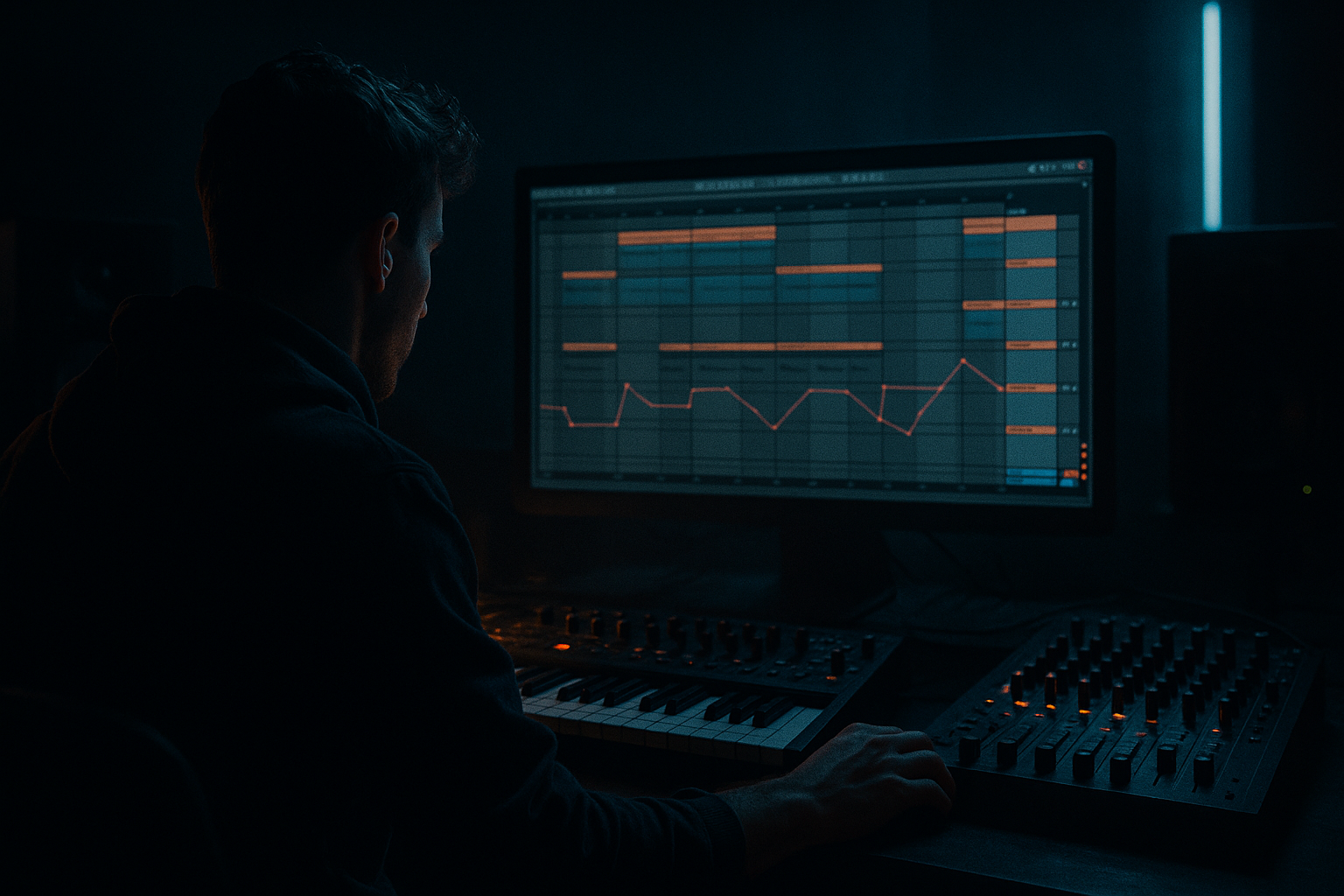
Main tutorial
```markdown
Automation to Fake Tape Slowdown (DnB in Ableton Live) 🎛️🌀
1. Lesson overview
Tape slowdown (a.k.a. “tape stop”) is that classic pitch-droop + time-smear you hear at the end of phrases, before drops, or as a momentary “rewind” effect. In drum & bass, it’s a wicked tool for:
- Drop setups (bar 33 → bar 34 impact)
- Phrase punctuation (every 16/32 bars)
- Fake “DJ deck power-down” vibes on breaks, amens, and bass shots
- A 4–8 beat tape slowdown on a drum bus, break loop, or bass group
- A clean return to grid right on the drop (no messy timing surprises)
- A reusable “Tape Stop Rack” concept using stock tools (optional but recommended)
- Slow down the break + atmos, then slam into a clean 2-step 🥁
- Slow down everything except the sub, so the drop still hits like a weapon 🔥
- Bars 31–32: tempo ramps down (break + pad + vox)
- Bar 33: hard return to 174 on the first kick of the drop
- This affects delays, LFO rates, sidechain timing, everything.
- Great for “everything melts” moments, but can be risky if your mix relies on tempo-synced modulation.
- Warp Mode: Re-Pitch (most tape-real)
- If transients get too smeary, try Complex Pro for certain musical layers (pads/vox), but keep drums on Re-Pitch for character.
- Add Utility after the print with:
- Automate Send amount into this return only for the last 1–2 beats of a phrase.
- Also automate Auto Filter cutoff down (e.g. 12 kHz → 300 Hz) during the “stop”.
- This doesn’t truly slow time like Re-Pitch, but it sells the tape-kill vibe in a mix, especially on jungle breaks.
- Keep the weight, slow the chaos
- Layer a “power-down thud”
- Add mechanical grime
- Automate reverb tail into the stop
- Mid/side control
- Tempo automation = authentic but global (great for full-track power-down).
- Resample + Re-Pitch warp stretching = best DnB method for slowing specific elements while keeping the drop tight.
- Split clips at the drop, fade edits, and protect your sub.
- For darker/heavier vibes, use contrast: smeared slowdown → brutally clean drop.
In this lesson you’ll build two reliable Ableton Live stock workflows:
1) A global slowdown using tempo automation (authentic, but affects everything)
2) A track/group-only slowdown using audio resampling + Warp tricks (more controllable for DnB)
You’ll also learn how to keep your sub tight and your drums punchy while still getting that gooey slowdown character.
---
2. What you will build
By the end, you’ll have:
Typical DnB use cases:
---
3. Step-by-step walkthrough
A) Method 1 — Tempo Automation (authentic, global, fast) ⏱️
Best when you want the whole track to power-down like a DJ killing the deck.
#### Steps
1. Set your project tempo (e.g. 174 BPM for rolling DnB).
2. Go to Arrangement View (press `Tab`).
3. Ensure Automation Mode is on (`A` key).
4. In the Master track automation chooser, select:
- Mixer → Song Tempo
5. Draw automation for a classic slowdown:
- Over 1 bar, automate from 174 → 90 BPM
- Or over 2 beats, automate from 174 → 110 for a tighter “stutter-stop”
6. Right before the drop, snap back:
- On the drop downbeat, set tempo back to 174 BPM instantly (a hard step works great)
#### DnB arrangement idea
#### Notes
---
B) Method 2 — Resample + Warp “Tape Stop” (track/group only, most practical for DnB) 🎚️
This is the go-to when you want the slowdown on drums only, or music group only, without wrecking your sub groove.
#### Overview of the workflow
You’ll print audio, then automate the clip’s playback speed using Warp mode + transposition/clip markers.
#### Steps (solid, repeatable)
1. Group the elements you want to slow
- Example: Select your Break, Top loop, Perc bus, right-click → Group Tracks (`Cmd/Ctrl + G`)
- Call it: `DRUMS (SLOWDOWN)`
2. Create an Audio Track named `PRINT DRUMS`.
3. Set `PRINT DRUMS` Audio From:
- `DRUMS (SLOWDOWN)` → Post FX (so it captures your bus processing)
4. Arm `PRINT DRUMS`, then resample:
- Record the section where you want the slowdown (e.g., 4 bars pre-drop)
5. Disable/Freeze the original group for that section
- Mute the original drum group during the printed region so only the print plays
6. On your printed audio clip:
- Turn Warp ON
- Set Warp mode to Re-Pitch (this is key for tape-style pitch drop)
7. Create the slowdown:
- Place a warp marker at the start of slowdown (e.g., beat 1 of bar 32)
- Place another warp marker at the end point (e.g., beat 1 of bar 33)
- Now drag the end marker to the right to stretch time
- Example: stretch 1 bar → 2 bars for a heavy power-down
- Because you’re in Re-Pitch, the pitch will droop naturally
8. Make the return to drop clean:
- Split the clip at the drop (`Cmd/Ctrl + E`)
- For the drop clip, ensure it starts exactly on-grid
- If needed, create a tiny crossfade (`Show Fades` then drag) to avoid clicks
#### Recommended settings for DnB punch
- Bass Mono ON (around 120 Hz) if the print includes low end
✅ Why this rules for DnB: you can slow breaks and tops while keeping sub + kick locked and aggressive.
---
C) Method 3 — “Tape Stop” on a Return/Bus (creative, controllable, great for fills) 🧪
This is a slick approach for momentary slowdown textures without fully committing your whole drum bus.
#### Device chain (stock)
On a Return Track (e.g., Return A named `TAPE STOP`):
1. Delay (set to very short, acts like smear)
- Time: 3–15 ms
- Feedback: 20–45%
- Filter: roll off highs a bit
2. Frequency Shifter (for motion/grime)
- Mode: Ring Mod or Frequency Shift
- Fine: subtle, e.g. -10 to -30 Hz
3. Auto Filter
- Type: LP24
- Drive: 2–6 dB
4. Saturator
- Drive: 2–6 dB, Soft Clip ON
#### Automation concept
---
4. Common mistakes 🚫
1. Slowing the sub too much
- The pitch drop will turn your sub into mud. Print/slow drum tops + breaks, keep sub clean (or high-pass the printed slowdown).
2. Using Beats warp mode for tape stop
- Beats mode keeps pitch stable—cool for other tricks, but not authentic tape slowdown.
3. Not splitting at the drop
- If you don’t split and re-align, you’ll often land late/early and ruin the impact.
4. Clicks at edits
- Use short fades, or cut at zero-crossings.
5. Tempo automation destroying synced effects
- If you use Method 1, watch out for tempo-synced delays/LFOs going weird.
---
5. Pro tips for darker/heavier DnB 🕶️🔊
- Slow down breaks, tops, atmos, but keep:
- Sub/bass sustained note stable
- Kick transient intact (or re-layer a clean kick on the drop)
- Add a low tom or impact that follows the slowdown and stops right before the drop.
- Use Drum Rack + Pitch Envelope for a quick downward thunk.
- On the printed slowdown clip, add Redux very subtly:
- Downsample: tiny amount (e.g. 1.0–2.0)
- Dry/Wet: 5–15%
- Put Hybrid Reverb on a return and automate send up during the slowdown.
- Then hard-cut the send on the drop for that “void → slam” contrast.
- Use Utility:
- During slowdown: widen slightly (110–130%) for drama
- On drop: snap back to 100% (or narrower) for punch
---
6. Mini practice exercise 🎯
Goal: Create a classic 1-bar tape slowdown on a jungle break, landing perfectly on the drop.
1. Load a crunchy amen-style loop (or any break) at 174 BPM.
2. Put it in a group called `BREAK BUS`.
3. Print/resample 4 bars into `PRINT BREAK`.
4. On the printed clip:
- Warp ON
- Warp mode: Re-Pitch
5. Stretch the last bar before the drop:
- Make bar 32 take 2 bars (drag end warp marker right)
6. Split at the drop, add a tiny crossfade, and make sure the drop starts on-grid.
7. Bonus: automate an Auto Filter LP24 on the print:
- Cutoff down over the slowdown: 8 kHz → 400 Hz
- Reso: 10–20%
Deliverable: bounce an 8-bar clip showing the slowdown + drop.
---
7. Recap ✅
If you tell me whether you want the slowdown on (a) drums only, (b) music group, or (c) whole track, I can suggest the cleanest routing and exact bar/beat automation shapes for your arrangement.
```

