Main tutorial
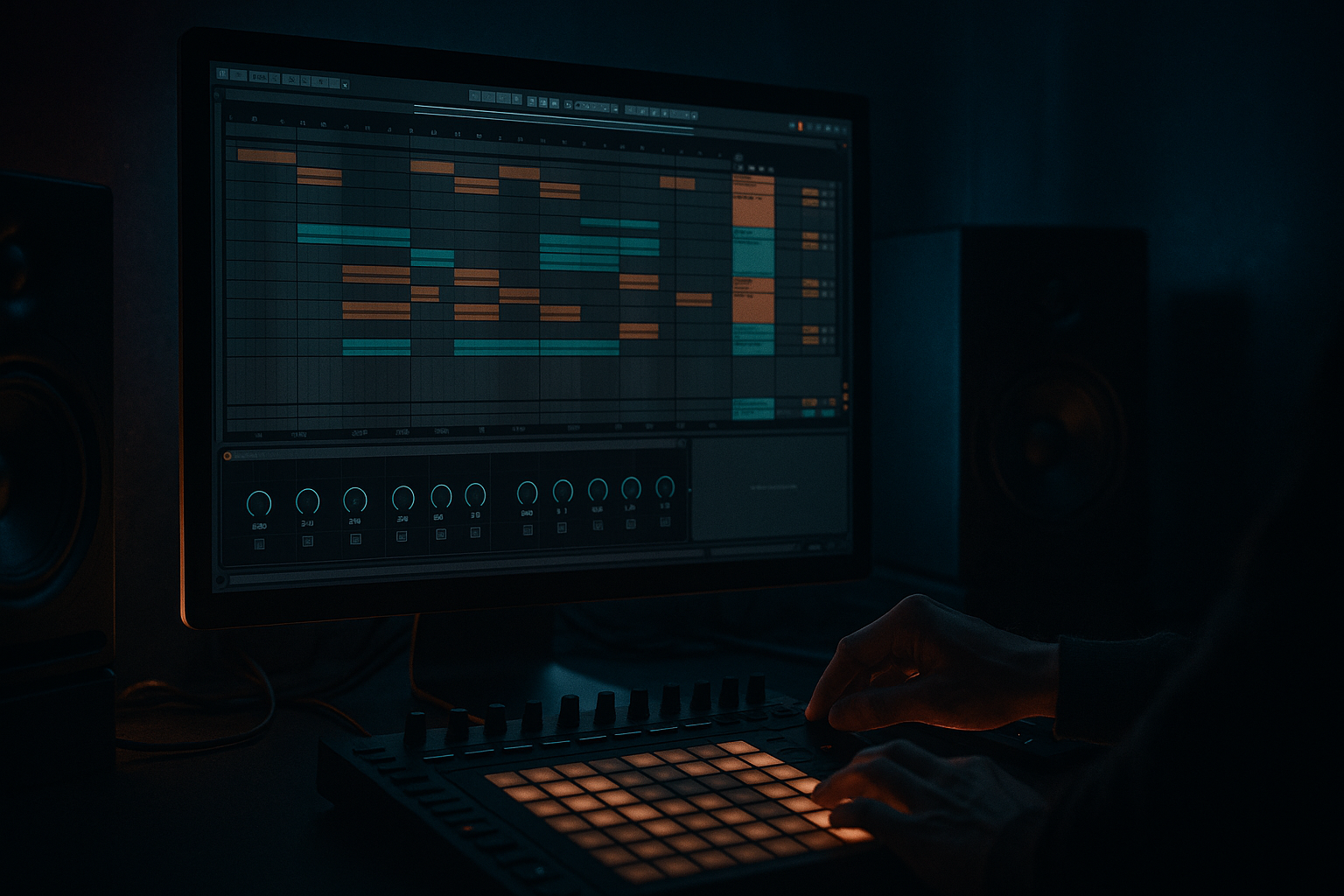
Balance an Amen-style transition for deep jungle atmosphere in Ableton Live 12
1. Lesson overview
In this lesson, you’ll learn how to balance an Amen-style transition so it lands with that deep jungle, foggy, pressure-heavy atmosphere without losing punch, groove, or low-end control.
We’re not just slapping an Amen loop over a breakdown — we’re building a transition that feels intentional, dark, and sonically glued inside Ableton Live 12. 🥁🌲
This is an advanced workflow lesson, so we’ll focus on:
- arranging a transition that feels like classic jungle / DnB momentum
- balancing drums, bass, atmos, and FX during the handoff
- using Ableton stock devices to sculpt tone and space
- making the Amen feel integrated, not pasted on top
- controlling low-end and stereo width so the drop stays huge
- starts with a rolling bass groove and dark pad/drone bed
- introduces an Amen-style break phrase with layered ghost hits
- uses filtering, reverb throws, and delay tails for tension
- creates a momentary breakdown of low-end density
- drops back into the main groove with the bass and drums hitting harder because the transition was balanced correctly
- Main drum loop: crisp DnB kick/snare pattern
- Amen layer: chopped break slices, resampled or MIDI-triggered
- Sub bass: mono, controlled, mostly hidden during the transition
- Mid bass / reese: filtered and automated
- Atmos pad / texture: dark vinyl noise, rain, room tone, jungle ambience
- FX: reverse cymbals, impact, dub delay, filter sweeps
- space opens up
- the break becomes the hook
- the bass ducks just enough to let the Amen breathe
- the drop returns with more impact than before
- Bars 1–4: tension build, bass thinning, drums partially exposed
- Bars 5–8: Amen phrase takes focus, FX rise, low-end reduced
- Bars 9–12: pre-drop pressure, snare rolls, reverse hits, sub re-entry
- Bars 13–16: drop release
- Drums
- Amen Break
- Bass
- Atmos / FX
- Risers / Impact
- kick/snare emphasis
- ghost notes
- rearranged fills
- selective stutters
- slightly behind the main snare
- above the sub
- in front of pad ambience
- not as loud as you think
- Amen track fader: around -10 to -14 dB
- Main drum bus: around -8 to -10 dB
- Bass bus during transition: often 2–5 dB lower than in the main groove
- HP filter at 120–180 Hz if the Amen is competing with your kick/sub
- Gentle dip around 250–400 Hz if the break feels boxy
- Small presence boost around 3–6 kHz if the snare needs bite
- Watch harshness around 7–10 kHz
- Drive: 3–8
- Crunch: use lightly, especially if the break is already gritty
- Boom: avoid too much unless you want the Amen to own the low-mid
- Transients: small boost if the break needs snap
- Soft Clip on
- Drive: 1–4 dB
- Use subtle saturation to make the break feel closer and denser
- Start with a low-pass around 12–16 kHz or slightly lower if needed
- Slowly open over the build
- Try a gentle resonance increase for tension
- Ratio: 2:1 or 4:1
- Attack: 3–10 ms
- Release: Auto or 0.1–0.3 s
- Aim for 1–3 dB gain reduction
- Sub bass: 35–70 Hz, mostly mono
- Kick fundamental: often 50–100 Hz depending on sample
- Amen body: 120–250 Hz
- Amen snap/crack: 2–6 kHz
- EQ Eight
- Utility
- Spectrum
- Compressor with sidechain
- Auto Filter
- Compressor sidechain input: Amen snare or main drum bus
- Ratio: 2:1 to 4:1
- Attack: 1–10 ms
- Release: 50–120 ms depending on tempo
- Gain reduction: 1–4 dB
- vinyl hiss
- rain ambience
- field recordings
- jungle canopy texture
- reverb-heavy ghost hits
- distant rewound tape noise
- filtered pad drones
- High-pass at 150–300 Hz
- Cut muddy low-mids around 250–500 Hz
- Keep the top airy but not fizzy
- Use a slowly opening low-pass or band-pass
- Automate cutoff over 4–8 bars
- Use a dark convolution or plate style
- Decay: 2.5–6 s
- Pre-delay: 10–30 ms
- Low-cut inside reverb: keep sub out
- High-cut: tame excessive brightness
- Sync: 1/4 or 1/8 dotted
- Feedback: 20–45%
- Filter the repeats so they sit behind the drums
- Bass volume down over 4 bars
- Amen filter opening gradually
- Pad reverb send up
- Drum bus saturation increasing slightly into the drop
- Low-cut automation on atmos so the low end clears
- Delay throws on snare fills or final hits
- track volume
- EQ Eight filter frequency
- Auto Filter cutoff
- reverb send amount
- Echo feedback / dry-wet
- Utility gain
- Panorama on FX hits
- Bass starts full, then drops 2–3 dB
- Amen enters filtered and tucked
- Atmos stays wide and dark
- Amen opens up in the mids
- Reverb throws increase
- Kick becomes less dominant
- Snare accents lead the ear
- Bass nearly absent or heavily filtered
- One-bar Amen fill with edits and ghost notes
- FX swell peaks
- Final impact cue
- Drop returns with full bass and dry drums
- Remove or shorten reverb tails immediately on the first kick/snare pair
- Glue Compressor
- Drum Buss
- EQ Eight
- Glue Compression: 1–2 dB GR
- Drum Buss Drive: mild
- EQ: small low-mid cleanup if needed
- EQ Eight
- Saturator
- Utility
- Hybrid Reverb
- Echo
- Auto Filter
- Utility
- lower FX bus by 1–2 dB
- reduce reverb send
- cut 200–400 Hz on the pad bus
- make room before adding more elements
- add ghost hits
- push delay throws
- add a filtered noise layer
- slightly raise the Amen body around 200–400 Hz
- print the combined vibe of the Amen + FX + bass movement
- edit the result as audio
- commit to a more musical, cohesive transition
- create a signature jungle texture
- low-pass at 8–12 kHz for darker sections
- open it gradually only when needed
- high-pass or low-pass aggressively
- automate it in and out
- keep it mono
- narrow the low-end with Utility
- keep pads wide
- keep bass mono
- leave percussion width to hats and FX
- one Amen break
- one sub bass
- one atmospheric texture
- one FX sweep
- one impact
- dark but not muddy
- energetic but not overcrowded
- spacious before the drop
- locked in with the groove
- use the Amen as a featured rhythmic voice, not just a loop
- control the low end so the transition creates space for the drop
- use EQ Eight, Drum Buss, Saturator, Auto Filter, Glue Compressor, Echo, and Hybrid Reverb strategically
- automate filter, volume, reverb, and delay to shape tension
- keep the atmosphere dark, wide, and low-mid controlled
- resample when you want glue, vibe, and faster editing
- a session template
- a bar-by-bar arrangement map
- or a device-chain preset recipe for Live 12.
By the end, you’ll know how to build a transition that moves from one section to another with Amen energy, deep atmosphere, and clean mix balance.
---
2. What you will build
You’ll build a transition section that does this:
Typical elements in the session
Goal of the transition
Your transition should feel like:
---
3. Step-by-step walkthrough
Step 1: Set up your transition zone in Arrangement View
In Ableton Live 12, go to Arrangement View and define an 8-bar or 16-bar transition area.
A solid advanced jungle transition often works best as:
Workflow tip
Color-code your groups:
This keeps the transition readable when you start automating aggressively.
---
Step 2: Build the Amen layer properly
Don’t just loop the Amen and hope it works. For deep jungle atmosphere, the Amen needs structure.
Option A: Slice to MIDI
1. Drag your Amen break into a new audio track.
2. Right-click and choose Slice to New MIDI Track.
3. Slice by Transient or 1/16, depending on how much control you want.
4. Use the resulting Drum Rack to reprogram a phrase.
This gives you total control over:
Option B: Keep it as audio and warp it
If the break has great swing and character:
1. Enable Warp
2. Use Complex Pro sparingly if pitch preservation matters
3. Adjust warp markers only where needed
4. Automate volume and filtering instead of over-editing the slices
Amen balance settings
For a deep jungle transition, the Amen should usually sit:
Try this starting balance:
The goal is not to make the Amen louder than everything else.
The goal is to make it feel like it’s driving the scene.
---
Step 3: Shape the Amen with a stock device chain
A practical stock chain for an Amen transition in Ableton Live 12:
On the Amen track:
1. EQ Eight
2. Drum Buss
3. Saturator
4. Auto Filter
5. Glue Compressor or Compressor
Suggested settings
#### EQ Eight
#### Drum Buss
#### Saturator
#### Auto Filter
Automate this for the transition:
#### Glue Compressor
This keeps the Amen moving as a unit without flattening its swing.
---
Step 4: Carve space for the bass and kick
A common mistake is letting the Amen, sub, and main kick all fight in the same region.
Use frequency roles
For a deep jungle transition:
In Ableton, use these tools:
Practical bass balancing workflow
1. Put Utility on the bass group.
2. Reduce bass width to 0% below the transition if needed.
3. Use EQ Eight to high-pass non-essential layers in the bass.
4. Sidechain the bass slightly to the Amen snare hits if you want the break to poke through.
Sidechain settings
On the bass:
You want the bass to make room, not disappear.
---
Step 5: Create the atmospheric bed
The deep jungle vibe lives in the background layer. This is where the transition becomes cinematic.
Good atmospheric ingredients
Stock chain for atmosphere
On a texture track:
1. EQ Eight
2. Auto Filter
3. Hybrid Reverb
4. Echo
5. Utility
#### EQ Eight
#### Auto Filter
#### Hybrid Reverb
#### Echo
This layer is what makes the Amen feel like it’s emerging from the jungle mist rather than sitting on a dry grid.
---
Step 6: Automate the transition like a DJ would mix it
Think of the transition like a pressure-controlled mixdown.
Key automation moves
Useful automation targets in Live
Example automation arc
Bars 1–4
Bars 5–8
Bars 9–12
Bars 13–16
---
Step 7: Balance the transition using group buses
Advanced jungle work in Ableton gets much easier when you mix into buses.
Suggested group processing
#### Drum Bus
Settings:
#### Bass Bus
Keep bass mono and stable.
#### FX Bus
This lets you automate the whole transition atmosphere from one place.
Bus balancing rule
If the Amen transition feels too busy:
If it feels too empty:
---
Step 8: Use resampling for glue and vibe
One of the best advanced workflows in Ableton Live is resampling your transition.
Why resample?
Because you can:
How to do it
1. Route your drum/FX group to a new audio track set to Resampling.
2. Record 4–8 bars of the transition.
3. Chop the rendered audio.
4. Reuse the tail of a snare or a reverb burst as a transitional accent.
5. Reverse small sections for tension.
This is especially effective in deep jungle where imperfection equals vibe.
---
4. Common mistakes
1. Making the Amen too loud
If the break dominates everything, you lose the sense of depth and the main groove disappears.
Fix: lower the Amen by 2–4 dB and shape it with EQ instead of volume.
2. Letting the sub run through the transition unchanged
That makes the arrangement feel flat and fights the break.
Fix: automate the sub down or filter it temporarily.
3. Overusing reverb on the break
Too much reverb turns the Amen into mush.
Fix: keep reverb on sends, not fully wet inserts, and high-pass the reverb return.
4. Ignoring midrange clutter
The 200–500 Hz area can get muddy fast when Amen, bass, pads, and FX overlap.
Fix: use EQ Eight on every bus to control this range.
5. No contrast between build and drop
If the transition never truly thins out, the drop won’t feel bigger.
Fix: remove energy before the drop. Make the drop earn its weight.
---
5. Pro tips for darker/heavier DnB
Tip 1: Let the snare tell the story
In jungle, the snare is often the emotional anchor.
Automate snare reverb, saturation, and slight level lifts in the final bars.
Tip 2: Use band-limited darkness
Try filtering the Amen and atmos so the transition sounds like it’s emerging from a tunnel.
Tip 3: Add movement with subtle timing variation
If the Amen is too rigid, manually shift a few slices by a few milliseconds.
That tiny offset adds tension and authenticity.
Tip 4: Put distortion before reverb on the return
For grimy jungle texture, a return chain like this works well:
1. Saturator
2. Hybrid Reverb
3. EQ Eight
This gives the reverb tail more character and less clean polish.
Tip 5: Use a ghost bass layer
A very low-level, filtered reese or sub murmur under the transition can keep weight without clutter.
Tip 6: Use M/S-style thinking with Utility and EQ
If the transition gets too wide and weak:
Tip 7: Resample the transition into a break fill
Sometimes the best move is to print the whole transition, slice it, and re-use pieces as fills later in the track. That’s very jungle, very efficient, and very effective. 🔥
---
6. Mini practice exercise
Build a 16-bar Amen transition at 170–174 BPM.
Constraints
Use only stock Ableton devices and these elements:
Task
1. Program an 8-bar lead-in where the bass is full and the Amen is filtered.
2. Over the next 4 bars, reduce the bass by 3 dB and open the Amen filter.
3. Add one Echo throw on the final snare of bar 12.
4. Use Hybrid Reverb on the atmosphere and automate its send upward.
5. Resample the last 4 bars and check whether the transition still feels punchy when printed.
Success criteria
Your transition should feel:
If the drop feels smaller after the transition, you have too much low-mid buildup or too much reverb tail.
---
7. Recap
To balance an Amen-style transition for deep jungle atmosphere in Ableton Live 12:
The best jungle transitions feel like they’re swinging between pressure and release.
If you balance the Amen correctly, your whole track suddenly feels deeper, nastier, and more alive. 🥁🌑
If you want, I can also turn this into:

