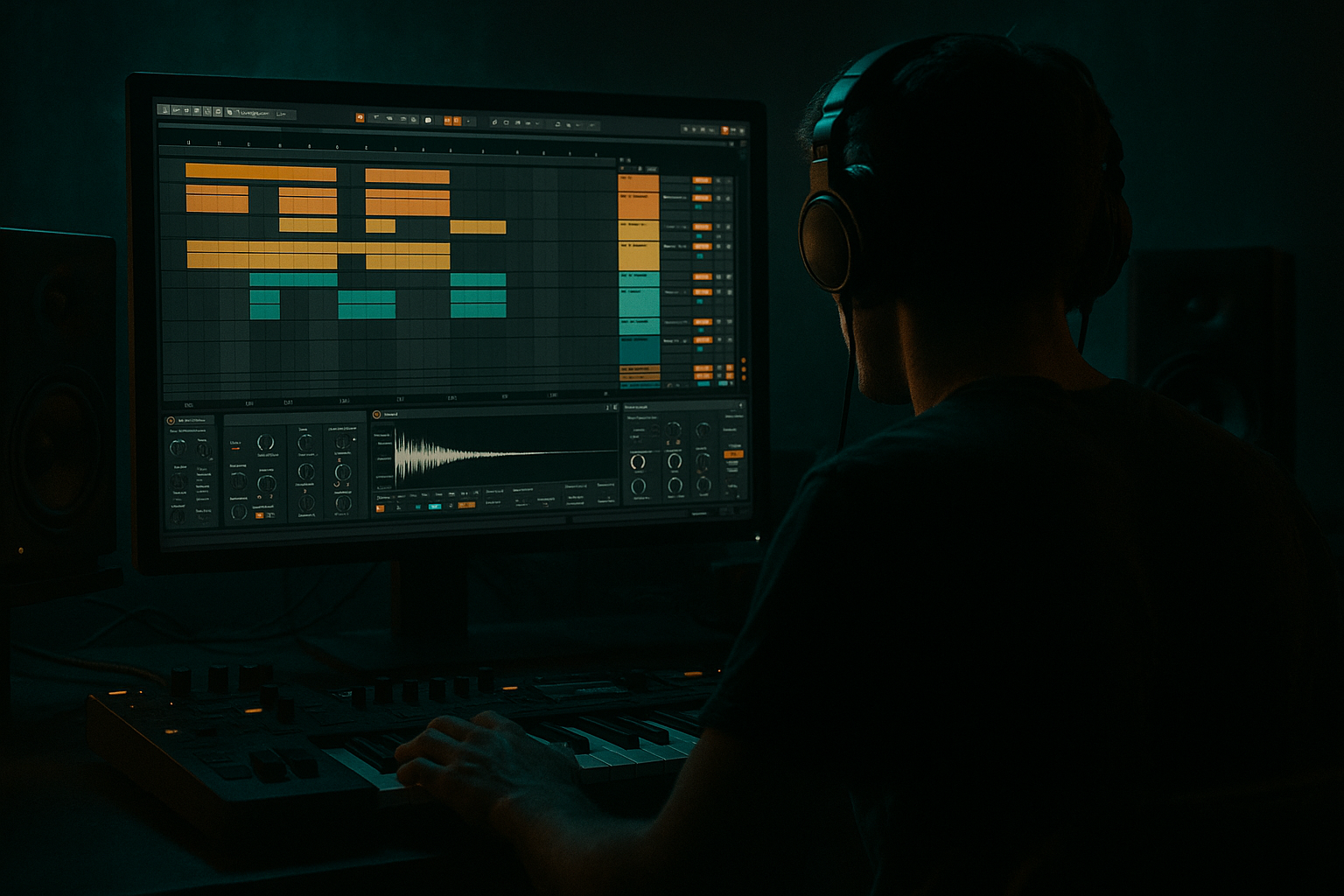
Main tutorial
```markdown
Balancing Sub and Kick (DnB in Ableton Live) 🔊🥁
Skill level: Beginner • Category: Mixing • DAW: Ableton Live (stock devices)
---
1. Lesson overview
In drum & bass, the kick and sub aren’t just “low end”—they’re the engine. If they clash, your mix loses punch, sounds quiet, or distorts on club systems. If they cooperate, your track instantly feels louder, tighter, and more professional.
In this lesson you’ll learn a repeatable Ableton workflow to:
- Choose the right kick + sub relationship (layer vs. separate roles)
- Tune kick/sub so they reinforce each other
- Control overlaps using EQ, sidechain compression, and phase checks
- Set up an Ableton low-end bus so your mix stays consistent across tracks
- A Kick track that hits hard without eating sub space
- A Sub track (sine/clean reese fundamental) that stays solid and readable on meters
- A Sidechain system that makes room for the kick while keeping the groove
- A Low End Group with basic glue + safety processing
- Sub (Bass) owns ~30–60 Hz
- Kick owns ~60–120 Hz + click/punch above
- Utility
- Sub usually sits on the root (or sometimes the fifth for specific vibes).
- Kick doesn’t have to be the same note, but should not strongly ring a clashing note.
- If the kick is masking the sub fundamental:
- If the sub is muddying the kick punch:
- Use Shaper in Live 12 (if available) or keep Compressor but increase release slightly.
- Zoom in and nudge the kick sample a tiny amount (like ±1–10 ms) if needed.
- Don’t destroy the groove—small moves only.
- Drop a reference DnB track into Ableton (Warp off or set correctly).
- Level-match roughly (turn the reference down, don’t smash your mix up).
- Compare: is your sub too loud? Is your kick too tubby?
- Bars 1–8: full kick + sub, keep it steady
- Bars 9–16: add variation (extra ghost kick, bass fill, or switch)
- Bars 17–32: small breaks where sub holds and kick pattern changes
- Give sub and kick separate jobs: sub = weight, kick = punch.
- Tune what’s tunable (Tuner + sample transpose).
- Use EQ Eight + Spectrum to find overlap, then make small, smart cuts.
- Add sidechain compression on the sub so the kick speaks clearly.
- Check mono + phase (Utility width/phase invert) to avoid cancellation.
- Group them into a Low End Bus with light glue and safety limiting.
---
2. What you will build
You’ll end with a clean, rolling DnB low-end setup:
Target vibe: rolling jungle/DnB, where the kick punches and the sub sustains with controlled movement.
---
3. Step-by-step walkthrough
Step 0 — Set up a typical DnB context (so you’re mixing realistically)
1. Set tempo to 172–176 BPM.
2. Create a basic drum pattern:
- Kick on 1
- Snare on 2 and 4 (classic DnB backbeat)
3. Add a subline that plays on offbeats or sustained notes (common in rollers).
> Mixing low end in solo is a trap—always do quick checks with drums + bass together.
---
Step 1 — Choose roles: who owns what frequency range?
In most modern DnB:
✅ Goal: Kick = punch, Sub = weight
If your kick sample is super subby and your bass is also subby, you’ll fight forever. Pick one “sub boss.”
---
Step 2 — Build a clean sub in Ableton (beginner-friendly)
Option A: Operator (best for clean sub)
1. Create a MIDI track → add Operator
2. Oscillator A: Sine
3. Turn off other oscillators (B/C/D)
4. Amp envelope:
- Attack: 0–5 ms
- Decay: ~300 ms (optional)
- Sustain: -inf if you want plucks, or keep sustain up for held notes
- Release: 50–120 ms (avoid clicks)
Add a utility chain (recommended):
- Bass Mono: ON (or Width 0% below 120 Hz via EQ Eight—see below)
- Gain: keep headroom (don’t crank)
---
Step 3 — Tune your kick (and/or sub) so they agree 🎯
Low-end tuning is huge in DnB.
Quick method:
1. Put Tuner (stock device) on your Sub track and play the root note of your tune (e.g., F, F#).
2. Put Tuner on your Kick track.
3. If the kick has a clear tone, tune it:
- If you use Simpler/Sampler, adjust Transpose (try ±1–3 semitones).
4. If the kick is very atonal, don’t force it—focus on frequency separation instead.
Rule of thumb:
---
Step 4 — Identify clashing frequencies with EQ Eight + Spectrum
1. Add Spectrum on the Master (or on a “Low End Group” later).
2. Loop a section with kick + sub together.
3. Add EQ Eight to the Kick:
- Enable HP filter at 20–30 Hz (24 or 48 dB/oct) to remove rumble
4. Add EQ Eight to the Sub:
- HP at 20–25 Hz (gentle cleanup)
- OPTIONAL: LP around 80–120 Hz if this is a pure sub layer and you have a mid-bass separate
DnB-friendly starting moves:
- Try a small dip in kick around 45–60 Hz (2–4 dB, Q ~1.0–1.5)
- Try a small dip in sub around 80–120 Hz (2–3 dB, Q ~1.0)
Don’t carve huge holes. You want cooperation, not a hollow low end.
---
Step 5 — Add sidechain: make space without killing the groove (the DnB way) ⚙️
Sidechain is standard in rollers because kicks can be short and bass can be continuous.
On the Sub track:
1. Add Compressor
2. Enable Sidechain
3. Audio From: Kick
4. Start with these settings (beginner-safe):
- Ratio: 4:1
- Attack: 3–10 ms (lets a tiny bit of bass transient through; adjust)
- Release: 60–120 ms (tempo dependent; shorter = tighter, longer = pumping)
- Threshold: lower until you get ~3–6 dB gain reduction on kick hits
If you want a more “drawn” duck shape:
DnB groove tip:
A release around 80–110 ms often works nicely at ~174 BPM for a controlled “breathing” low end.
---
Step 6 — Check phase and alignment (this is where pros win)
If kick + sub are out of phase, your low end can cancel even if levels look fine.
Easy checks:
1. Group Kick + Sub temporarily and listen in mono:
- Put Utility on the Master (or group)
- Set Width = 0%
2. Flip polarity to test:
- On either kick or sub track add Utility
- Click Phase Invert (L & R)
- Keep whichever setting gives more weight and punch, not just more volume
Micro-timing (advanced-ish but doable):
---
Step 7 — Leveling: a practical balance method that works
You don’t need perfect LUFS; you need reliable relationships.
Simple leveling workflow:
1. Start with Kick at a comfortable level (e.g., peaking around -10 to -6 dBFS on the track meter).
2. Bring the Sub up until it feels powerful, then back it off slightly.
3. A good beginner target is:
- Kick feels like the “hit”
- Sub feels like the “floor”
Reference check (highly recommended) 🎧
---
Step 8 — Create a Low End Group (clean bus = consistent results)
1. Select Kick + Sub tracks → Group (Cmd/Ctrl+G)
2. On the group, add:
- EQ Eight
- HP at 20 Hz (cleanup)
- OPTIONAL gentle dip if there’s a big resonance
- Glue Compressor (light!)
- Attack: 10 ms
- Release: Auto
- Ratio: 2:1
- Aim for 1–2 dB gain reduction max
- Limiter (safety, not loudness)
- Ceiling: -1 dB
- Only catching occasional peaks (if it’s working hard, fix levels earlier)
This group helps keep the low end controlled when you add more drums/bass layers later.
---
Step 9 — Arrangement idea: make kick/sub work across a DnB drop
Low end balance changes with density. Plan for it:
Typical roller drop structure:
Practical move:
Automate slightly more sidechain (lower threshold) when the bass gets busier, and slightly less when it’s simpler.
---
4. Common mistakes 🚫
1. Kick and sub both trying to dominate 40–60 Hz
→ Choose roles or carve gently with EQ.
2. Too much limiting on the low end bus
→ Fix levels/sidechain first; limiting is last-resort safety.
3. Stereo sub
→ Mono your sub (Utility Width 0% or keep sub layer strictly mono).
4. Ignoring tuning
→ A kick ringing at an awkward note can ruin perceived punch.
5. Sidechain release set wrong
→ Too fast = chattery/weak, too slow = obvious pumping (unless that’s the vibe).
6. Mixing low end too loud because you’re on small speakers
→ Check on headphones + use Spectrum; reference often.
---
5. Pro tips for darker/heavier DnB 🖤
1. Split bass into SUB + MID layers
- SUB: sine (30–90 Hz), clean, mono, minimal distortion
- MID: reese/growl (100 Hz–2 kHz), distortion + movement
- This keeps the floor stable while the mid layer does the nasty stuff.
2. Add harmonics to help the sub translate
- On SUB: try Saturator
- Drive: 1–4 dB
- Soft Clip: ON
- Keep it subtle—too much will blur the low end.
3. Use dynamic EQ-style moves with Multiband Dynamics (carefully)
- Light control on the low band can tame peaks in aggressive basslines.
- Avoid crushing; DnB needs punch.
4. Kick character: shorten the tail
- If your kick tail overlaps the sub, reduce it in Simpler:
- Use Fade Out or shorten Release
5. Don’t be afraid of a higher kick fundamental
- Many heavy DnB kicks punch around 80–110 Hz, letting the sub own below.
---
6. Mini practice exercise (10–15 minutes) ✅
1. Make a 4-bar loop at 174 BPM:
- Kick on 1
- Snare on 2 & 4
- Hi-hats rolling (16ths with swing if you like)
2. Create a sub in Operator playing F (or any root), sustained through the bar.
3. Balance:
- Add EQ Eight cleanup (HP at 20–30 Hz)
- Add sidechain Compressor on sub (aim 3–6 dB GR)
4. Do 3 quick A/B tests:
- Sidechain ON vs OFF
- Utility Width 0% vs normal
- Phase invert ON vs OFF on sub
5. Render a short clip and listen on:
- Headphones
- Small speakers / laptop (listen for harmonics/clarity)
- Phone (low end won’t be there—does the track still feel driven?)
---
7. Recap 🔁
If you want, tell me what style you’re making (liquid, jump-up, neuro, jungle) and what key your tune is in, and I’ll suggest kick/sub tuning ranges + a sidechain release that matches your groove.
```

