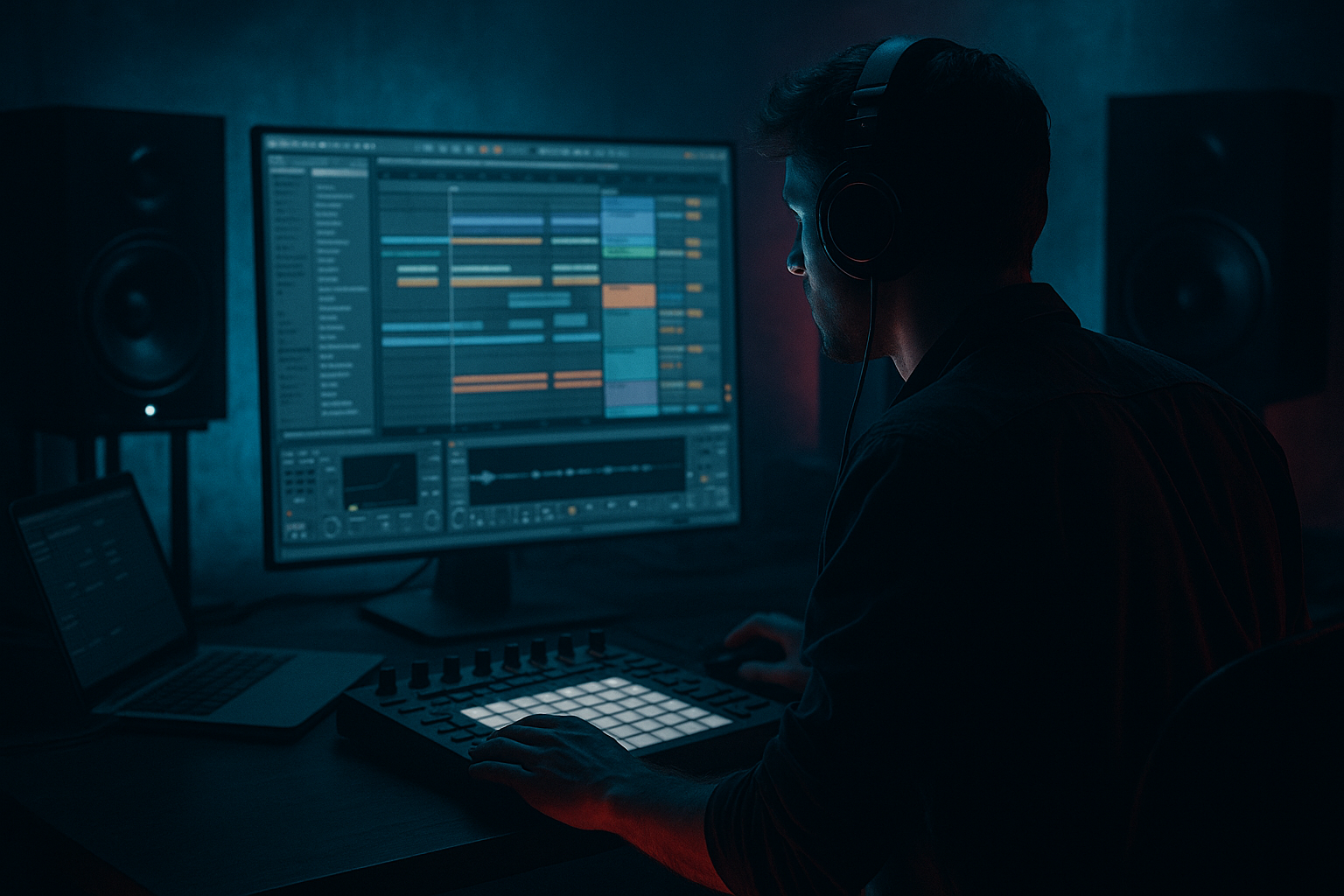
Main tutorial
```markdown
Basic Drum Fills (DnB) in Ableton Live 🥁⚡
Skill level: Beginner
Category: Drums
Focus: Drum & Bass / Jungle / Rolling music fills that actually work in a mix
---
1. Lesson overview 🎯
A drum fill in DnB is usually 1 beat or 1 bar of variation that:
- signals a transition (into a drop, new 16-bar section, breakdown, etc.)
- creates momentum without wrecking the groove
- adds personality (jungle-style snare rushes, classic Amen-style edits, tom runs, glitchy hat stutters)
- snare + ghost notes
- short kick moves
- 16th/32nd hat rolls
- one-shots + FX (reverse cymbals, impacts)
- EQ Eight
- Glue Compressor
- Saturator
- Optional: Limiter (only if your transients are wild)
- Kick: 1.1, 1.3
- Snare: 1.2, 1.4
- Hats: 8ths or 16ths (your choice)
- Closed hat on every 1/8 (1.1.3, 1.2.3, 1.3.3, 1.4.3 etc.)
- First hit: 90–105
- Middle hits: 60–80
- Final hit (the “landing”): 110–120
- Leave the very last hit on-grid.
- Nudge the earlier rush hits slightly late (1–5 ms) for weight (optional).
- Put Reverb on a return track (not on the snare directly).
- On the Kick pad (inside Drum Rack), add EQ Eight
- Add Drum Buss on the drum group:
- Every 4 bars: tiny 1-beat variation (hat stutter, ghost snare)
- Every 8 bars: more noticeable 1-beat or half-bar fill (snare rush)
- Every 16 bars: full 1-bar fill (kick variation + FX + cymbal)
- Use distortion selectively
- Make fills “mean” with pitch
- Layer a short foley hit
- Gate your reverb
- Tension with filtering
- DnB fills work best when they’re short, shaped, and purposeful.
- Start with three reliable types:
- Use Ableton stock tools to keep it pro:
In Ableton Live, the fastest way to write fills is to build them from:
…then control them with velocity, timing, and filtering.
We’ll keep everything rooted in the classic DnB grid: 174 BPM, 2-step/roller foundations, and fills at the end of 4/8/16 bars.
---
2. What you will build 🧱
You’ll create three beginner-proof fills you can reuse in your tracks:
1. 1-beat snare rush (classic DnB tension builder)
2. 1-bar “kick/snare variation” fill (keeps the groove but adds movement)
3. Hat stutter + crash pickup (modern rolling transition)
All of these will be programmed in MIDI (easy to edit), using Ableton stock devices for punch and control.
---
3. Step-by-step walkthrough ✅
Step 0 — Set up a clean DnB drum rack
1. Set tempo to 174 BPM.
2. Create a MIDI track: Cmd/Ctrl+Shift+T
3. Load: Drum Rack (from Instruments).
4. Add these core one-shots (any decent DnB pack works):
- Kick (tight, short)
- Snare (bright crack + short tail)
- Closed Hat
- Open Hat
- Optional: Ride, Crash, Tom, Perc
Suggested stock chain on the Drum Rack track (simple + effective):
- HP filter around 25–35 Hz (kick rumble control)
- small dip 250–400 Hz if boxy
- Attack: 3 ms
- Release: Auto
- Ratio: 2:1
- Aim for 1–3 dB gain reduction on peaks
- Drive: 1–3 dB
- Soft Clip: On
> Workflow tip: Keep fills in the same MIDI clip lane as your main drums at first. It’s easier to hear what’s happening.
---
Step 1 — Program a basic 2-step loop (so the fill has context)
In a 1-bar MIDI clip:
Classic starting point:
Loop it for 8 bars in Arrangement View (or duplicate clip in Session).
---
Fill A — The 1-beat snare rush (end of bar 8) 🚀
This is the most “DnB” fill you can learn first.
1. Go to bar 8, last beat (beat 4).
2. Add snare hits as 16th notes from 8.4.1 to 9.1.1:
- Place snare at: 8.4.1, 8.4.2, 8.4.3, 8.4.4
3. Make it feel like it accelerates:
- Change the last two hits to 32nds (optional beginner upgrade):
- Add extra snare between 8.4.3 and 8.4.4 (you can switch grid to 1/32).
Velocity shaping (this is the secret sauce):
Micro-timing:
- In Ableton: turn off grid temporarily or use the groove pool lightly.
Add a tiny bit of space (but keep it tight):
- Reverb settings:
- Decay: 0.6–1.2 s
- Pre-delay: 10–20 ms
- High Cut: 6–8 kHz
- Send the rush hits slightly more than the main snare.
Result: A clean, classic build into the next phrase.
---
Fill B — 1-bar kick/snare variation (end of bar 16) 🧨
This kind of fill works great in rollers because it doesn’t break the dance.
1. At the end of a 16-bar phrase, create a fill in bar 16.
2. Keep the snare on 2 and 4 (DnB relies on that anchor).
3. Add variation with kicks:
- Standard: kicks on 16.1 and 16.3
- Fill idea: add two extra kicks as pickups:
- add kick on 16.3.3 and 16.3.4 (two 16th pickups into snare on 16.4)
4. Add ghost snares before the main snare:
- Put quiet snare hits at 16.1.4 and/or 16.3.4
- Velocities: 25–55 (keep them subtle)
Keep it clean with EQ on the kick cell:
- If it’s fighting bass, try a small dip around 60–90 Hz OR shorten the kick sample tail.
Optional: transient control
- Drive: 2–6
- Crunch: 0–10 (tiny)
- Transients: +5 to +15 if your fill gets lost
- Boom: Off or very low for DnB precision
Result: A fill that feels “more intense,” but still like a proper roller.
---
Fill C — Hat stutter + crash pickup (modern transition) ✨
Perfect into a drop or switching sections.
1. In the last half bar (beats 3–4), create a hat stutter:
- Closed hat at 16th notes across beat 4
2. Make the stutter feel like it rises:
- Use Auto Filter on the hat chain (on the hat pad or on a hat group):
- Filter type: HP
- Frequency: automate from 300 Hz → 2–4 kHz over the fill
- Resonance: 10–20%
3. Add an open hat or crash on the first beat of the next bar (the landing):
- Crash at 17.1
4. Make room so the crash doesn’t smear:
- Put Utility after crash sample (if needed)
- Width: 120–150%
- Gain: adjust so it’s felt, not dominant
Result: A clean “lift” into the next section without messy low-end.
---
Arrangement placement (where fills go in DnB)
Use fills like punctuation marks:
> In rollers, less is more: one solid fill per 8/16 bars hits harder than constant busy edits.
---
4. Common mistakes 🚫
1. Fills too loud
- If your fill peaks higher than your main snare, it’ll feel accidental.
- Fix: lower fill note velocities and/or clip gain.
2. Too much low-end in the fill
- Extra kicks + bass = mud.
- Fix: shorten kick tails, EQ low-end, or reduce kick fill density.
3. Overcomplicated 32nd-note spam
- Fast doesn’t equal exciting if it’s not shaped.
- Fix: use velocity ramps and fewer notes.
4. No “landing”
- The fill builds tension but doesn’t resolve.
- Fix: emphasize the first kick/snare of the next bar and add a crash or sub drop (tastefully).
5. Reverb washing out the groove
- DnB needs speed + clarity.
- Fix: use return reverb with high-cut and short decay, send only the fill hits.
---
5. Pro tips for darker/heavier DnB 😈
Add Saturator or Pedal on just the fill layer (ghost snares / rush), not the whole kit.
- Pedal preset idea: start with OD mode, Drive low, tone slightly dark.
Pitch a snare fill down -1 to -3 semitones on the last hit only (automation or duplicate sample).
Creates a gritty, heavy “pull.”
Add a quiet metallic tick or stab on the last 16th before the drop.
Keep it subtle—more “texture” than “event.”
Classic darker vibe: reverb that cuts off fast.
- Put Gate after Reverb on the return.
- Fast release to keep it punchy.
Automate Auto Filter on the drum bus for the last half-bar:
- Slight low-pass sweep down to 6–10 kHz then open back up on the drop.
That “suck-in” effect is a modern weapon.
---
6. Mini practice exercise 🧪
1. Create an 8-bar drum loop (simple 2-step).
2. Add:
- Fill A (snare rush) at the end of bar 4
- Fill B (kick variation) at the end of bar 8
3. Now do three variations:
- Variation 1: remove half the notes (simplify)
- Variation 2: keep notes, but change only velocities
- Variation 3: keep notes/velocities, but automate Auto Filter on the fill
Goal: learn that the same pattern can feel totally different with dynamics and tone control.
---
7. Recap 🔁
- Snare rush (1 beat) for tension
- Kick/snare variation (1 bar) for energy without losing the groove
- Hat stutter + crash for modern transitions
- EQ Eight for cleanup
- Glue Compressor / Drum Buss for glue + punch
- Saturator for density
- Auto Filter for movement
- Reverb on returns for controlled space
If you want, tell me what subgenre you’re aiming for (liquid, neuro, jump-up, jungle) and I’ll give you 3 fill MIDI patterns tailored to that vibe at 174 BPM.
```

