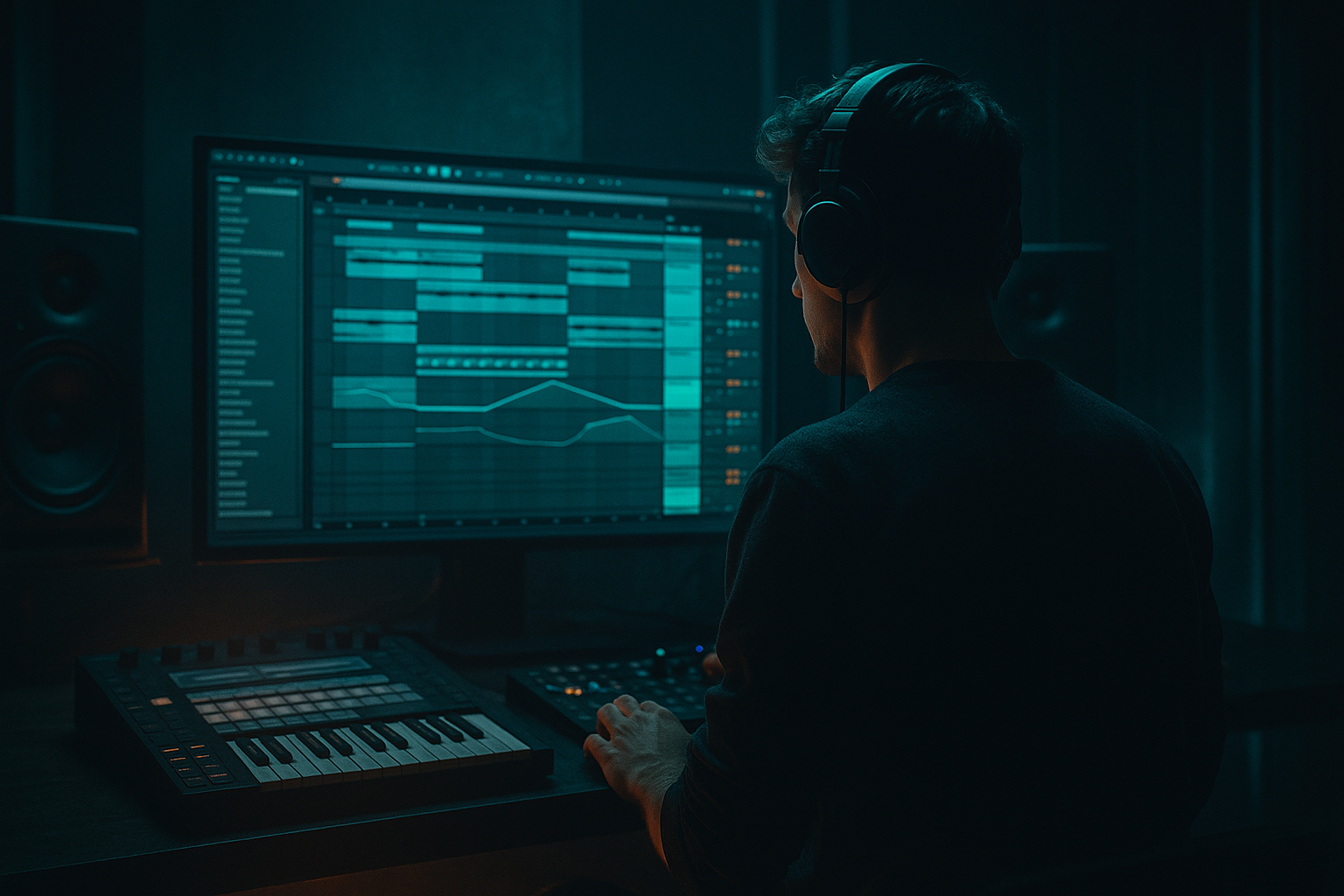
Main tutorial
Basic Riser Design in Ableton (DnB-focused) 🚀
Skill level: Beginner | Category: Sound Design | DAW: Ableton Live (stock devices)
---
1. Lesson overview
Risers are the “tension builders” that pull listeners into the drop—especially in drum & bass where energy shifts happen fast (8/16/32-bar builds). In this lesson you’ll learn simple, reliable ways to design risers using Ableton stock devices, and how to place them so they actually work in a rolling/jungle/DnB arrangement.
You’ll build risers from:
- Noise (classic “air” riser)
- A synth tone (Reese-ish/tonal lift)
- Resampling + processing (for heavier builds)
- How to automate filter cutoff, pitch, reverb size, and volume
- A simple DnB build arrangement pattern (drums + riser + impact)
- In the MIDI clip, open Envelopes → choose Clip → Pitch Bend
- Draw a rise from 0 up to around +3 to +12 semitones over 8 bars
- Automate Wavetable’s Transpose or Pitch parameter upward.
- EQ Eight: Highpass 200–400 Hz, small dip where it’s painful (often 2–5 kHz)
- Saturator: Drive 4–10 dB, Soft Clip ON (for controlled grind)
- Redux:
- Auto Filter: automate a slight resonant sweep near the end for intensity
- Reverb: shorter and darker than the clean riser
- Bars 1–4: Noise riser starts quiet + hats rolling
- Bars 5–7: Add tonal riser + automate drum fill energy (snare builds)
- Last 1 bar: Small pause or downlift + impact into drop
- Snare build (every 1/2 then 1/4 then 1/8 notes)
- Short reverse crash right before drop
- Impact on drop (a punchy hit + sub drop)
- 4-bar riser only
- Tight automation, less reverb, more midrange aggression
- Let breaks do the hype (fills + edits) instead of long FX
- Make it smaller and nastier, not just bigger: shorter reverbs + more distortion often feels heavier than huge verb washes.
- Use controlled distortion:
- Add rhythmic gating for “rolling” tension:
- Create “anti-drop space”:
- Layer with a short reverse reese tail:
- Use noise risers for fast, clean tension (Operator → Auto Filter → Reverb → Utility).
- Use tonal risers for musical energy (Wavetable/Operator + filter + pitch automation).
- For darker DnB, resample and push texture using Saturator/Redux with disciplined EQ and automation.
- In DnB, risers work best when they increase tension but leave space right before the drop.
All techniques are beginner-friendly and 100% practical.
---
2. What you will build
By the end you’ll have 3 usable risers, each 8 or 16 bars long, ready to drop into a DnB build:
1. Noise Riser: clean, wide, “whoosh” that ramps into the drop
2. Tonal Riser: pitch or filter-lifted synth riser that feels musical
3. Heavy Riser FX: resampled, distorted, and compressed riser for dark/techy DnB
You’ll also learn:
---
3. Step-by-step walkthrough
Setup (DnB context first) 🎛️
1. Set tempo to 174 BPM (typical DnB).
2. Create an 8-bar build leading into a drop (common: 8 or 16).
3. In Arrangement View, mark the drop with a locator:
- Example: Build starts at bar 17, drop hits at bar 25.
---
A) Noise Riser (fastest, most useful) 🌪️
This is your bread-and-butter riser.
#### 1) Create the source
1. Create a MIDI Track → load Operator (stock).
2. In Operator, choose a noise source:
- Click Oscillator A → set Waveform to White Noise (or Noise if available in your version).
3. Set Amp Envelope:
- Attack: 10–50 ms (avoid clicks)
- Decay: 0
- Sustain: -inf or low (doesn’t matter if you draw a long note)
- Release: 200–600 ms (helps tail feel smooth)
#### 2) Add a filter sweep (essential)
1. After Operator, add Auto Filter.
2. Set:
- Filter Type: Highpass 12 dB (HP12)
- Cutoff start: ~ 150–300 Hz (keeps lows clean)
- Resonance: 10–25% (a bit of bite, not whistly)
3. Automate the Cutoff over 8 bars:
- Start around 200 Hz
- End around 8–12 kHz
- Use an automation curve that ramps faster near the end (more excitement)
#### 3) Add space + width
1. Add Reverb after Auto Filter:
- Decay Time: 2.5–6.0 s
- Size: 80–120%
- Pre-delay: 10–25 ms
- Dry/Wet: 15–35%
2. Add Utility at the end:
- Automate Width from 0–30% at start → 120–140% near the drop (wider = bigger)
#### 4) Gain control (so it doesn’t explode)
1. Add Glue Compressor (optional but useful):
- Attack: 3 ms
- Release: Auto
- Aim for 1–3 dB of gain reduction near the peak
2. Automate the track volume slightly up into the drop (e.g., +2 to +4 dB over 8 bars).
- Keep it subtle—DnB drops hit harder when builds aren’t too loud.
#### 5) MIDI clip
1. Create an 8-bar MIDI clip.
2. Draw a single note (any pitch works with noise) lasting the full 8 bars.
✅ You now have a clean DnB-ready noise riser.
---
B) Tonal Riser (musical tension) 🎹
This one adds “pitch energy” and works great before rolling drops.
#### 1) Create the source
1. New MIDI Track → load Wavetable (stock) or Operator if you prefer.
2. For Wavetable:
- Choose a basic wavetable (e.g., Basic Shapes)
- Set Unison: 2–4 voices (don’t go crazy)
- Slight Detune: low (just a bit of movement)
#### 2) Filter + envelope movement
1. Add Auto Filter:
- Type: Lowpass 24 dB (LP24) for a classic “opening up” feel
- Start cutoff low: 200–600 Hz
- End cutoff: 6–10 kHz
- Resonance: 5–15%
2. Automate cutoff to open steadily across 8 bars.
#### 3) Pitch rise (DnB classic)
You’ve got two easy options:
Option 1: Clip Pitch Automation (simple)
- For subtle tension: +3 to +5
- For obvious lift: +7 to +12
Option 2: Use “Pitch” in Wavetable
#### 4) Make it sit in a DnB mix
1. Add EQ Eight:
- Highpass around 150–300 Hz (don’t fight the bass)
- If it’s harsh, dip 3–6 kHz slightly
2. Add Saturator (optional):
- Drive: 1–4 dB
- Keep output level matched (avoid volume tricking you)
---
C) Heavy Riser FX (dark/techy energy) 😈
This is where you get that “industrial lift” common in darker DnB.
#### 1) Start from your noise riser (A) or tonal riser (B)
Duplicate the track so you keep the clean original.
#### 2) Resample it (quick and pro workflow)
1. Create a new Audio Track called `RESAMPLE RISER`.
2. In its input, choose Resampling.
3. Arm the track and record the 8-bar riser.
4. Now you can warp, reverse, stretch, and process without worrying about MIDI automation complexity.
#### 3) Add aggression
On the resampled audio track, try this device chain:
EQ Eight → Saturator → Redux → Auto Filter → Reverb
Suggested settings:
- Downsample: try 2.0–6.0 (adds crisp grit)
- Bit Reduction: subtle (start around 10–12 bits, don’t destroy it)
- Decay 1.2–2.5 s, Dry/Wet 10–25%
#### 4) Add the “suck into drop” moment
1. Add Utility at the end.
2. Automate Gain DOWN quickly in the last 1/4 bar before the drop (like a mini mute).
- This makes the drop feel bigger because the build “gets out of the way.”
---
Arrangement ideas (DnB build that works) 🧱
Here are two reliable build patterns:
#### Pattern 1: Classic 8-bar DnB build
Add these extra elements if you want:
#### Pattern 2: Jungle-style quicker transitions
---
4. Common mistakes ⚠️
1. Too much low end in the riser
- Fix: Highpass (EQ Eight or Auto Filter) around 150–400 Hz.
2. Riser is louder than the drop
- Fix: keep build controlled; drops should win in perceived loudness.
3. Over-wide low frequencies
- Fix: Utility Width automation is cool, but keep low end mono (highpass before widening).
4. Harsh resonant whistle at the end
- Fix: reduce filter resonance, or EQ dip 3–8 kHz.
5. Riser doesn’t “move”
- Fix: automate 2–3 parameters (filter + reverb wet + volume), not just one.
---
5. Pro tips for darker/heavier DnB 🖤
- Saturator + Soft Clip gives that modern techy edge without destroying your mix.
- Put Auto Pan on the riser, set Amount 100%, Rate 1/8 or 1/16, Phase 0° (acts like a tremolo).
- Automate riser gain down in the last beat and/or reduce width right before the drop—contrast makes the drop slam.
- Resample a bass note, reverse it, highpass it, and tuck it under the main riser for a menacing pull.
---
6. Mini practice exercise 🧪
Do this in 15–20 minutes:
1. Build an 8-bar section at 174 BPM.
2. Create two risers:
- One Noise Riser (Operator noise + HP filter sweep)
- One Tonal Riser (Wavetable + LP sweep + pitch rise)
3. Automate at least 3 of these across 8 bars:
- Filter cutoff
- Reverb Dry/Wet
- Utility Width
- Track Volume
4. In the last 1/2 bar, automate:
- A quick volume dip or reverb cut to create a “suck” effect.
5. Drop into a basic DnB loop and check:
- Does the drop feel bigger?
- Is the riser clean (no muddy lows)?
- Is it exciting without being painfully bright?
---
7. Recap ✅
If you want, tell me the vibe (liquid, jump-up, neuro, jungle) and I’ll suggest a specific riser chain + automation curve that fits that substyle.

