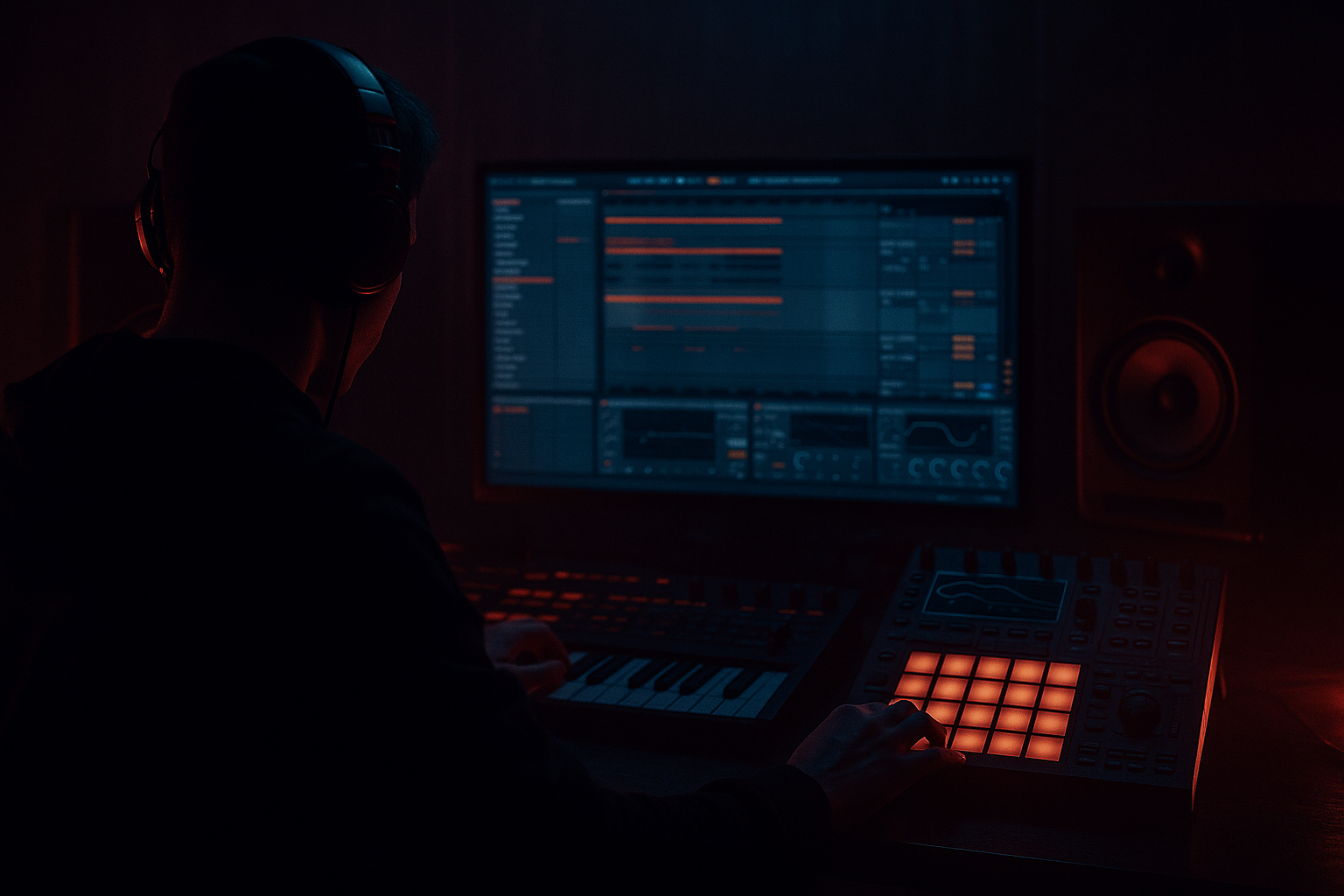
Main tutorial
```markdown
Bass Note Gaps for Break Emphasis (DnB in Ableton Live) 🎛️🥁
1) Lesson overview
In drum & bass, space is part of the groove. One of the easiest “pro-sounding” tricks is using intentional bass note gaps to make your break/amen/rolling drums hit harder, read clearer, and feel more rhythmic.
In this lesson you’ll learn how to:
- Create micro-gaps (10–80 ms) that increase drum punch
- Make bar-level gaps that spotlight fills and edits
- Control gaps with MIDI, sidechain, gate, and automation
- Keep the bass feeling continuous without masking the break
- A sub + mid bass (two-layer or rack) playing a repeating pattern
- A breakbeat (Amen-ish or chopped break) + kick/snare layer
- Bass note gaps timed around the snare and key drum moments so the break pops ✨
- Drop an Amen or jungle break into Drums.
- Warp mode: Beats
- Kick on 1 and 3 (or 1 and the “and” before 3 depending on style).
- Snare on 2 and 4 (classic DnB backbeat).
- Notes on offbeats and a couple of 1/16 pushes.
- Keep it simple: 1–3 notes (root + maybe 5th/octave).
- In the MIDI clip, overlap notes slightly or use longer notes then we’ll create gaps intentionally.
- ~180–250 Hz (body)
- 2–6 kHz (crack)
- Plus a lot of “busy” midrange from the break
- Start with gaps of 20–40 ms before the snare transient.
- If it’s still muddy, increase to 50–80 ms.
- Zoom in (use `+`).
- Drag note end earlier.
- Keep the next note starting after the snare, or even slightly late for swing.
- Reduce Release (in Operator’s Amp envelope):
- At the end of bar 8 or 16:
- How:
- Every 4 bars, remove bass just on beat 4 right before the next bar hits.
- Creates that “breathing” momentum into the downbeat.
- Bars 1–2: bass plays full
- Bars 3–4: bass has more gaps (especially around snares)
- Repeat and vary slightly every 8 bars
- Sub: fewer/lighter gaps (or shorter dips)
- Mid bass: more obvious gaps (so drums cut through)
- Gaps too long → bassline feels broken and loses roll. Start micro (20–40 ms).
- Sidechain release too slow → you get a lazy pump and lose DnB urgency. Try 40–90 ms.
- Gapping the sub too aggressively → the tune loses weight. Gap mid more than sub.
- Not aligning gaps to the actual snare transient → zoom in; breaks can have slight offset transients.
- Fixing masking with volume only → gaps often beat EQ boosts (cleaner + louder perception).
- Use distortion before the gap tool on mid bass:
- Add a “ghost snare trigger”:
- Make the break feel louder without turning it up:
- Use EQ Eight Mid/Side on the bass buss:
- Automate gap intensity across phrases:
- Bass note gaps are a rhythmic mixing tool in DnB: they make breaks hit harder and clearer 🥁
- Start with micro-gaps (20–80 ms) around snare transients
- Use MIDI note length, amp envelope, sidechain compression, or Gate for controlled space
- For heavy/rolling results: gap mid bass more than sub
- Add macro-gaps at phrase points (every 4/8/16 bars) to make the arrangement feel alive
We’ll do everything with Ableton Live stock devices.
---
2) What you will build
A simple, rolling DnB loop featuring:
Target vibe: rolling/jungle-influenced DnB (170–175 BPM).
---
3) Step-by-step walkthrough
Step 0 — Set up a clean DnB starter session
1. Set tempo to 174 BPM.
2. Create tracks:
- Drums (Audio): your break loop or chops
- Kick/Snare (Audio or Drum Rack): optional layering
- Bass (Sub) (MIDI)
- Bass (Mid) (MIDI) or combine as an Instrument Rack
3. Put a Limiter on the Master (temporary safety):
- Ceiling: -0.8 dB, Lookahead: 1 ms
---
Step 1 — Program a basic rolling drum backbone
Option A: Using a break loop
- Preserve: 1/16
- Transients: default
- This keeps it crunchy and rhythmic.
Option B: Layer kick/snare
Goal: You want a clear snare on 2 and 4—this is what the bass gaps will highlight.
---
Step 2 — Build a simple rolling bassline (MIDI)
On Bass (Sub) track:
1. Load Operator (stock).
2. Set it to a clean sine:
- Osc A: Sine
- Level: around -12 dB to start
3. Add Saturator after Operator:
- Drive: 2–6 dB
- Soft Clip: On
- This helps the sub read on smaller speakers.
Now write a 1-bar MIDI pattern (in a minor key, e.g. F minor):
Important: Turn on Legato behavior if you want smooth subs:
---
Step 3 — The core concept: “gaps” are timed breathing points 🫁
In DnB, the snare and break transients often live around:
Your bass (especially mid bass) masks these if it’s constant.
So we create gaps where the drum transient needs to speak.
You’ll do this in two layers:
1. Micro-gaps (tiny note releases) to reveal transients
2. Macro-gaps (longer dropouts) for phrase emphasis/fills
---
Step 4 — Micro-gaps with MIDI note length (fast + musical)
1. Open your sub bass MIDI clip.
2. Find notes that overlap the snare hits (beat 2 and 4).
3. Shorten the note so it stops slightly before the snare.
Starter timing targets (at 174 BPM):
How to do it in Ableton:
Listen for: snare feels louder and cleaner without actually raising snare volume.
---
Step 5 — Micro-gaps using an amplitude shaper (more consistent)
If you don’t want to edit MIDI constantly, shape the bass envelope.
On Bass (Sub) Operator:
- Attack: 0–5 ms
- Decay: short/medium
- Sustain: full
- Release: 30–80 ms (adjust)
Then do tiny note separations with MIDI (or even leave slight overlaps).
This helps ensure the bass actually drops out cleanly when notes end.
---
Step 6 — Micro-gaps using sidechain (classic DnB pump, but tighter)
Sidechain is often used for “pumping,” but for break emphasis we want a quick, tight dip, not a huge house-style duck.
1. Add Compressor (stock) on the bass (sub and/or mid).
2. Enable Sidechain.
3. Input: your snare or the break track (choose snare if you have one).
4. Settings starting point:
- Ratio: 4:1
- Attack: 0.3–2 ms
- Release: 40–90 ms
- Threshold: lower until you get 2–5 dB gain reduction on snare hits
Tip: Sidechain the mid bass more than the sub. Keep sub steadier so the track doesn’t lose weight.
---
Step 7 — Make “intentional silence” with a Gate (for aggressive clean cuts)
This is great for darker/techy DnB where you want the bass to feel chopped around drums.
1. Put a Gate on the bass (usually mid bass first).
2. Turn on Sidechain in the Gate.
3. Sidechain input: snare or break.
4. Adjust so the Gate closes briefly during snare hits:
- Threshold: set until it reacts to snare hits
- Return: fast
- Hold: 0–20 ms
- Release: 30–80 ms
This can be extreme—use subtly unless you want that “ripped” rhythmic effect.
---
Step 8 — Macro-gaps: emphasize edits, fills, and phrase turns (arrangement!)
This is where tracks start sounding arranged instead of looped.
Common DnB phrasing: 16 bars (or 8).
Do one of these:
A) 1/8 or 1/4 gap before a fill
- Mute bass for 1/8–1/4 note
- Let the break fill speak
- Automate Utility → Gain down to `-inf` briefly
- Or delete the bass note(s) in that spot
B) “Snare spotlight” gap
C) Jungle call-and-response
---
Step 9 — Keep low-end solid while making gaps (sub vs mid strategy)
A very usable DnB approach:
Quick Ableton method:
1. Duplicate your bass MIDI to Sub and Mid tracks.
2. On Mid track, use:
- Auto Filter (HP) at 120–180 Hz to keep it out of sub region
3. On Sub track, use:
- Auto Filter (LP) around 80–120 Hz so it’s pure
Now you can gap the mid bass harder without thinning the track.
---
4) Common mistakes
---
5) Pro tips for darker/heavier DnB 😈
- Chain: `Instrument → Saturator/Overdrive → EQ Eight → (Sidechain/Gate)`
- Distorted bass fills space—so gapping after distortion keeps drums audible.
- Create a MIDI track with a short click/snare transient exactly on 2 and 4.
- Use it only as sidechain input for super-consistent dips.
- Tiny bass gaps + a touch of Drum Buss on break (Drive 2–10, Crunch to taste).
- Cut a little 200–300 Hz in Mid channel if break body is getting masked.
- Less gapping in the first 8 bars of drop, more gapping later to increase movement.
---
6) Mini practice exercise (15 minutes) ⏱️
1. Load any break loop and set to 174 BPM (Warp: Beats).
2. Make a 1-bar sub pattern with Operator (root note only is fine).
3. Create three versions of the same loop:
- Version 1: No gaps (baseline)
- Version 2: MIDI micro-gaps before snares (20–50 ms)
- Version 3: Sidechain compressor dips (2–5 dB GR, fast attack, 50–80 ms release)
4. Bounce each to audio and A/B:
- Which one makes the snare feel most “up front”?
- Which one keeps the roll best?
---
7) Recap
If you want, tell me what sub style you’re aiming for (liquid roll, jump-up wobble, techy neuro, jungle) and I’ll suggest a specific gap pattern + device chain that fits.
```

