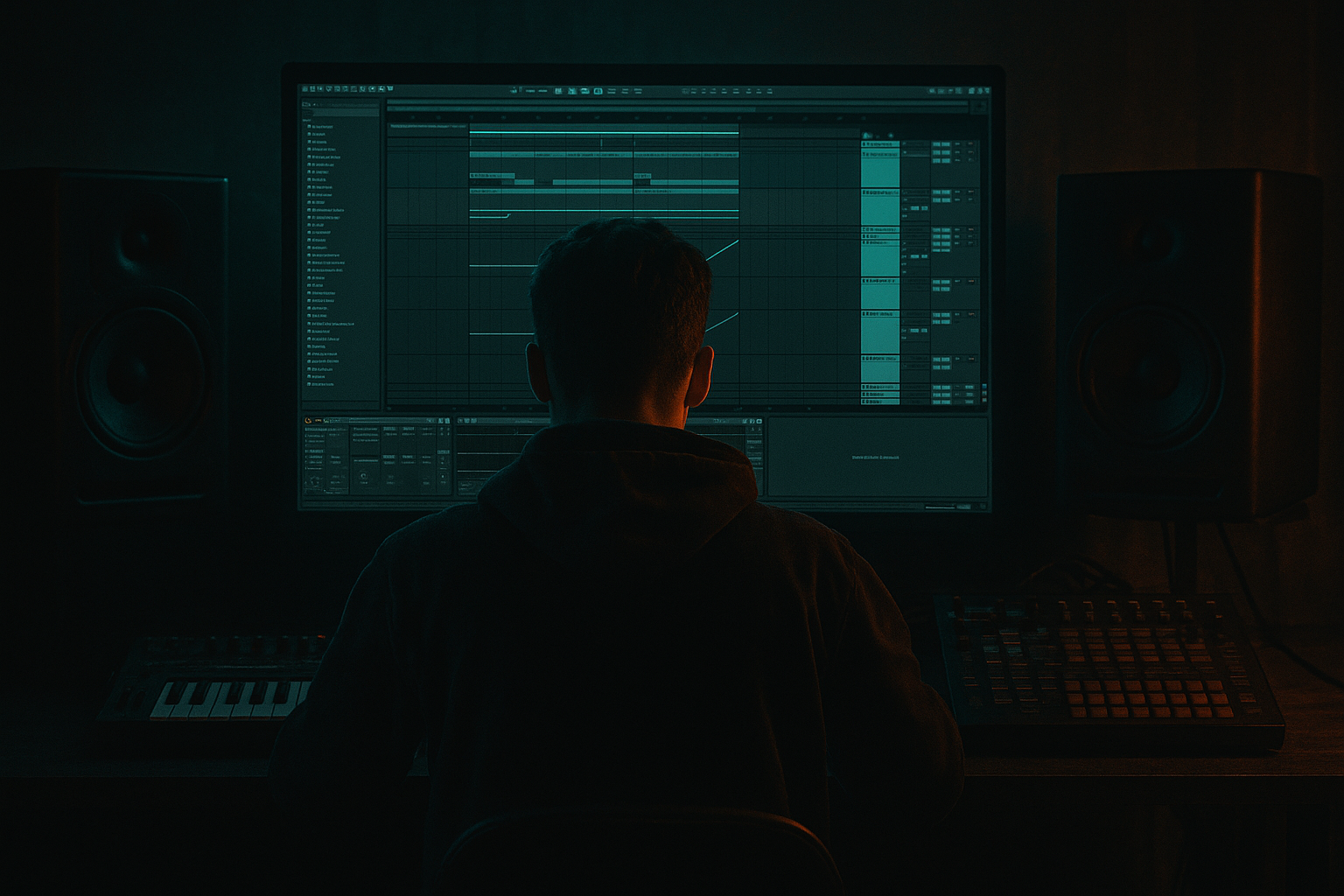
Main tutorial
Bass Wobble in Ableton Live 12 (Resampling): Arrange It for Rewind‑Worthy Drops (Jungle / Oldskool DnB) 🔥
1) Lesson overview
In this lesson you’ll build a classic wobble/rewese-style bass in Ableton Live 12, then use resampling to turn it into tight, drop-ready audio you can slice, rearrange, and automate like a proper jungle/DnB producer.
The goal is not just “make a wobble,” but make a wobble that lands—with call/response, space for drums, and arrangement tricks that trigger rewinds. 🎛️
---
2) What you will build
You’ll end up with:
- A simple, solid bass synth patch (stock devices)
- A wobble movement system (LFO + automation)
- A resampled audio bass you can:
- A 16-bar drop arrangement with oldskool jungle vibes (think: rolling drums + cheeky bass phrases)
- Osc 1: Basic Shapes → choose Square or Saw
- Osc 2: Off (for now) or add a subtle sine for weight
- Filter: LP24 (24dB low-pass)
- Amp Envelope (Env 1):
- Voices: 1 (mono) if you want oldskool tightness
- Portamento/Glide: 30–80 ms (optional, very vibey for slides)
- Drive: 3–8 dB
- Soft Clip: ON
- Output: trim so you’re not slamming the channel (aim peaks around -6 dB)
- HP filter at 25–35 Hz (steep-ish)
- If it’s boxy: small dip 200–350 Hz
- If it’s harsh later: small dip 2–5 kHz
- 1/4 = big slow “waaah” (good for drop statements)
- 1/8 = rolling wob (great under breaks)
- 1/16 = aggressive (use as a fill, not constant)
- In Wavetable, use LFO 1 → Filter Cutoff
- Sync rate 1/8 (start)
- Amount to taste
- Bar 1: Root note (F) on beat 1, then a couple short stabs
- Bar 2: Root + b7 movement (F → Eb) for that oldskool pull
- Beat 1: long note (1/2 bar)
- Beat 3 “and”: short stab
- Beat 4: short stab
- Trim the recorded clip.
- Consolidate: select the region → Ctrl/Cmd + J
- Name it: `Wobble_Print_172_Fm`
- Bass: slower wob (1/4), fewer notes
- Drums: full break + kick emphasis
- Add: quick crash or ride on bar 1
- Bass: switch to 1/8, add one extra slice hit
- Add: subtle dub delay throw on the last bass hit of bar 8
- Bass: introduce 1/16 bursts at the end of every 2nd bar
- Optional: add a second resampled layer (high-mid) quietly
- Pull bass back for 1 bar (space)
- Then bring a signature bass phrase back on bar 15–16
- Wobbling constantly: if everything moves, nothing feels special. Use phrasing.
- Too much sub movement: wobble the mids; keep sub more stable (or split bands).
- Printing too hot: resampling clipped audio locks in distortion you can’t undo.
- No mono sub: if your low end is wide, it’ll feel weak on big systems.
- Ignoring drum space: jungle drums need room in the 100–250 Hz zone.
- Multiband the wobble:
- Add “reese hair” on top:
- Texture with Redux (carefully):
- Stereo control:
- Dark movement:
- Built a classic wobble bass using Ableton stock devices ✅
- Created movement with LFO and automation ✅
- Resampled to audio for tight jungle-style editing ✅
- Sliced and rearranged into hooky, rewindable phrases ✅
- Used sidechain + arrangement contrast to make the drop hit harder ✅
- slice into hits
- rearrange into rhythmic “talking” phrases
- pitch, reverse, gate, and stutter for drop energy
---
3) Step-by-step walkthrough
Step 0 — Set the DnB foundation (tempo + grid)
1. Set tempo to 170–174 BPM (try 172).
2. In Preferences → Record/Warp/Launch, keep Warp on (default is fine).
3. Create tracks:
- MIDI Track: “Bass Synth”
- Audio Track: “Bass Resample”
- (Optional) Group your drums separately so your bass resampling doesn’t capture the whole mix.
DnB tip: A bass that rewinds well usually has space + punctuation. Don’t fill every 16th.
---
Step 1 — Build a beginner-proof wobble bass patch (stock only)
On Bass Synth (MIDI track), load:
#### Device chain
1. Instrument: Wavetable
2. Audio Effect: Saturator
3. Audio Effect: EQ Eight
4. Audio Effect: Compressor (or Glue Compressor)
5. (Optional) Utility for mono + gain staging
#### Wavetable settings (clean but heavyweight)
- Cutoff: ~ 200–600 Hz (we’ll modulate)
- Resonance: 10–25%
- Drive: 2–6 dB (if available)
- Attack: 0–5 ms
- Decay: 200–400 ms
- Sustain: -inf to -6 dB (shorter if you want plucks)
- Release: 80–150 ms
#### Saturator (for jungle grit)
#### EQ Eight (clean the mud)
---
Step 2 — Make it wobble (LFO + mapping)
There are two easy routes in Live 12:
#### Route A (simple): Auto Filter + LFO tool
1. Add Auto Filter after Wavetable (before Saturator is also fine).
2. Set Auto Filter:
- Type: Lowpass (LP24)
- Cutoff: ~ 150–500 Hz
- Resonance: 15–30%
- Drive: 2–8 dB (this adds bite)
3. Add LFO (MIDI Modulation device) after Auto Filter.
4. In LFO device:
- Map LFO to Auto Filter Cutoff
- Shape: Sine or Triangle for classic wob
- Rate: start at 1/8 or 1/4 (Sync ON)
- Amount: adjust until it “talks” but doesn’t disappear
Oldskool wob timing:
#### Route B (more “synthy”): Wavetable’s internal LFO
---
Step 3 — Write a bassline that fits jungle drums (simple pattern)
Create a 1–2 bar MIDI clip (then loop it). Use a minor scale (e.g., F minor / G minor).
Beginner bass notes (classic DnB move):
Example rhythm (in 1 bar of 4/4 at 172):
Keep it sparse—your breaks need air. 🥁
---
Step 4 — Automate wobble “phrases” (this is where rewinds happen)
A rewind-worthy drop usually has phrases, not constant motion.
1. In Arrangement View, duplicate your bass loop across 16 bars.
2. Automate LFO Rate (or cutoff) so it changes by section:
- Bars 1–4: 1/4 rate (big statement)
- Bars 5–8: 1/8 rate (rolling)
- Bars 9–12: 1/8 with occasional 1/16 bursts (fills)
- Bars 13–16: “answer phrase” + space (less notes, more impact)
Quick trick: Turn LFO Amount down briefly before a drum fill, then slam it back in on the next downbeat. That contrast feels huge. 💥
---
Step 5 — Resampling: turn the wobble into audio (the secret weapon) 🎧
Now we print it and start treating it like a sample.
#### Option 1: Resampling via Audio Track (fastest)
1. Create Audio Track: “Bass Resample”
2. In “Bass Resample” track:
- Audio From: choose Resampling
- Monitor: Off (to avoid feedback)
3. Arm “Bass Resample.”
4. Solo your bass track (so you capture only bass).
5. Hit record and record 8–16 bars of your bass performance.
#### Clean-up
Why this is gold: audio gives you tight control—micro-edits, reverses, pitch drops, hard gating—classic jungle craftsmanship.
---
Step 6 — Slice and rearrange into “talking” drop phrases
1. Right-click your resampled clip → Slice to New MIDI Track
2. Slicing preset:
- Slice by: Transients (try it)
- If transients are messy, slice by 1/8 notes instead
3. You’ll get a Drum Rack of slices.
4. Program a new pattern using the slices:
- Use call/response every 2 bars:
- Bar 1–2: bass says “WAH-WAH”
- Bar 3–4: bass answers with a different slice rhythm
- Leave occasional full beats empty so breaks hit harder.
Oldskool vibe move: repeat a signature slice like a “hook” every 4 bars. That’s what crowds remember.
---
Step 7 — Make it pump with the drums (sidechain like a DnB producer)
1. On your bass audio (or sliced rack), add Compressor.
2. Enable Sidechain.
3. Input: your Kick (or a “ghost kick” track)
4. Settings:
- Ratio: 4:1
- Attack: 3–10 ms
- Release: 60–120 ms (tune to tempo)
- Threshold: reduce until you feel the drums snap through
DnB rule: the bass doesn’t have to be louder—just out of the way.
---
Step 8 — Arrange a rewind-ready 16-bar drop (simple template)
Here’s a practical layout:
Bars 1–4 (Drop statement):
Bars 5–8 (Rolling):
Bars 9–12 (Variation / pressure):
Bars 13–16 (Hook + space):
Rewind moment:
Do a hard stop (silence or filtered tail) on the last beat of bar 16, then slam back into the hook. Classic. 🛑➡️💥
---
4) Common mistakes
---
5) Pro tips for darker/heavier DnB 🌑
Use Multiband Dynamics (or EQ + parallel chains) so:
- Sub (below ~90 Hz) stays steady
- Mids wobble hard (150–800 Hz)
Duplicate bass, high-pass at 200–300 Hz, add Chorus-Ensemble lightly, saturate, then resample again.
A tiny bit of Redux (downsample subtly) adds that old digital grit.
Use Utility:
- Bass group: Bass Mono ON (or Width 0–30% for lows)
Modulate filter resonance slightly while wobbling cutoff—more sinister “pew” tones.
---
6) Mini practice exercise (15 minutes) ⏱️
1. Create a wobble bass using Wavetable + Auto Filter + LFO.
2. Write a 2-bar bassline with at least one full beat of silence.
3. Resample 8 bars of it.
4. Slice to Drum Rack and make a new 4-bar phrase using slices only.
5. Arrange a quick 8-bar mini-drop:
- Bars 1–4: simple
- Bars 5–8: add 1/16 stutter fill at the end of bar 8
Export a quick bounce and listen on headphones + phone speaker (if it still grooves, you’re winning).
---
7) Recap
If you want, tell me your target vibe (e.g., “1994 jungle”, “Valve/2-step era”, “dark rollers”) and I’ll give you a matching 16-bar drop blueprint and exact wobble rate/automation ideas.

