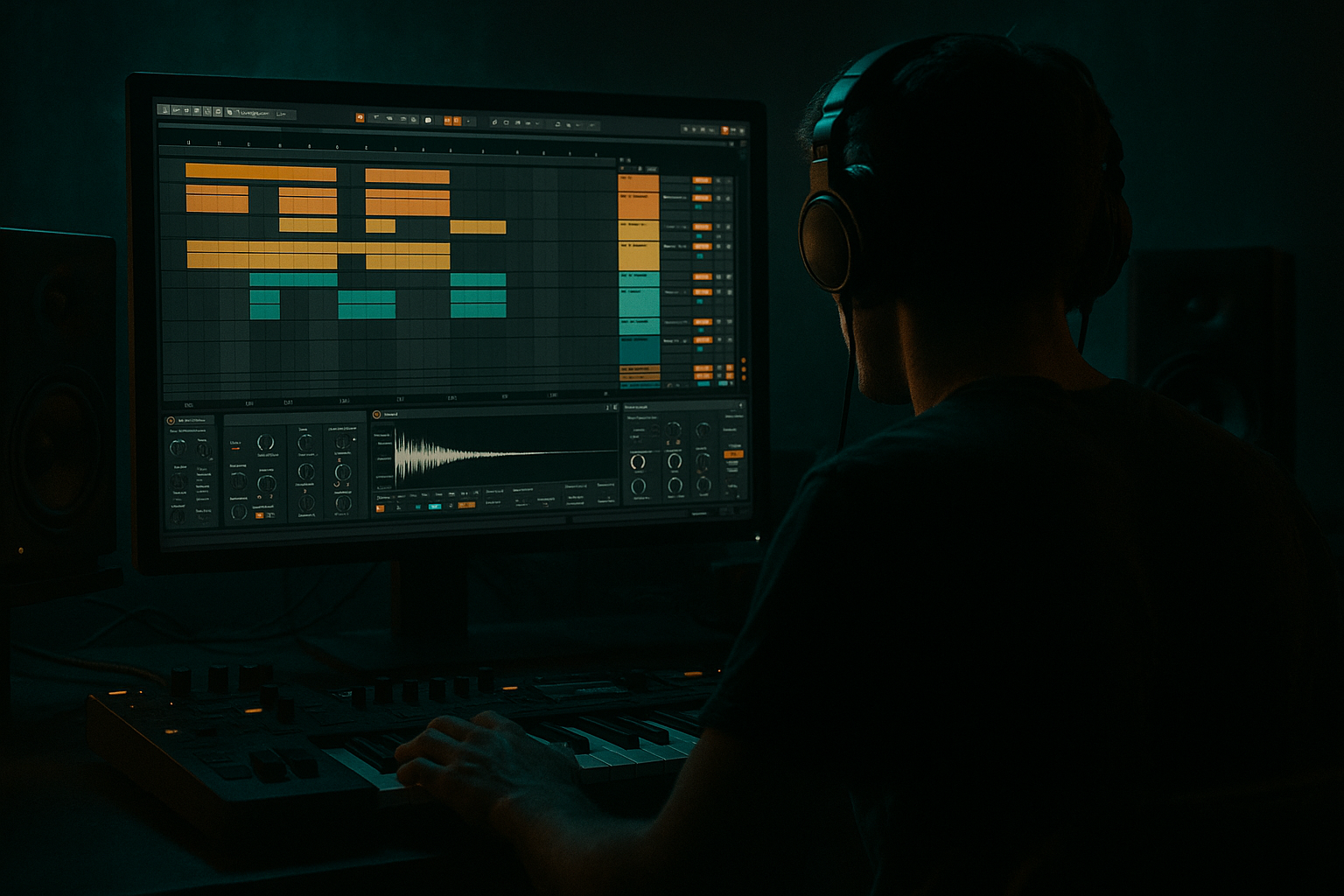
Main tutorial
Lesson Overview
A rewind-worthy DnB drop lives or dies on the relationship between the bassline, breakbeat, and arrangement tension. In oldskool jungle and modern darker rollers, the bass isn’t just “low end” — it’s the lead voice that answers the drums, pushes the groove, and makes the drop feel dangerous 😈
In this lesson, you’ll build a carved, performance-ready bassline in Ableton Live 12 that works for jungle, oldskool DnB, rollers, and darker half-step-inflected sections. The focus is not on making a giant “one-note sub” or an overdesigned neuro patch. It’s about shaping a bass that:
- leaves space for breakbeats to breathe,
- hits hard on systems,
- has movement and call-and-response phrasing,
- and creates that “rewind this” pressure in the drop.
- a drop phrasing pattern with call-and-response space,
- an intro tension version of the bass,
- a switch-up for bar 9 or 17,
- and a carved arrangement that works with break edits and DJ-friendly structure.
- Making the sub too wide
- Letting the mid-bass own the low end
- Using too much sustain over a busy break
- Overdistorting before you carve
- Ignoring the break’s groove
- Too much automation everywhere
- Use harmonic contrast
- Automate filter movement in phrases
- Make room for snare impact
- Resample the “best 8 bars”
- Use tiny pitch or octave switches
- Add controlled grime with Saturator before EQ
- Keep the top of the bass useful, not fizzy
- Think in response patterns
- Build the bass in two layers: clean mono sub plus controlled mid-bass character.
- Carve the bass around the breakbeat, especially the snare and groove accents.
- Use Utility, EQ Eight, Saturator, Auto Filter, Glue Compressor, and resampling as your core Ableton tools.
- Keep the bass rhythmically intentional: call-and-response and space are what make it feel rewinds-worthy.
- Arrange for impact with drops, switch-ups, and DJ-friendly phrasing.
- In DnB, the best bass isn’t just heavy — it’s focused, carved, and groove-aware.
We’ll use Ableton stock devices and practical routing: Operator or Wavetable, Drum Buss, Saturator, EQ Eight, Auto Filter, Utility, Compressor / Glue Compressor, Redux, Resonators if needed, and resampling for character. The lesson is advanced because we’ll be working with layer discipline, mono control, frequency carving, transient shaping, and arrangement choices rather than basic sound design.
Why this matters in DnB: the genre depends on precision in the low end. A bassline that’s too wide, too long, or too harmonically crowded will clash with the break. A bassline that’s too clean will disappear on smaller systems. The sweet spot is a bass that is focused, gritty, rhythmically intentional, and dynamically carved around the drums.
What You Will Build
By the end, you’ll have a two-layer bass system designed for a DnB drop:
1. Sub layer
- Clean mono foundation
- Simple note movement with long sustain or carefully gated notes
- Strong fundamental energy around roughly 40–60 Hz depending on key
2. Mid-bass / character layer
- Reese-style movement or grimy harmonic layer
- Filtered, distorted, and rhythmically carved to answer the break
- Stereo-controlled so the low end stays centered
You’ll also create:
Musically, think of a 174 BPM jungle/DnB drop where the break is chopping hard, the bass answers on the offbeats and syncopated hits, and the transition into the drop is so tight it begs for a rewind.
Step-by-Step Walkthrough
1. Set the project up for DnB phrasing and bass control
Start at 172–176 BPM; 174 is the classic sweet spot for this workflow. In Ableton Live 12, build a simple arrangement around:
- 8-bar intro
- 16-bar drop
- 8-bar switch-up
- 8-bar outro
Put your breakbeat on one audio track and slice it or loop it with edits. If you’re working with a classic break, use Warp carefully and keep the groove natural. For more control, slice the break to a Drum Rack or use Simpler > Slice to trigger key hits manually.
On your master, leave headroom early: aim for peaks around -6 dB while sketching. That makes it easier to judge whether the bass is actually working against the drums, not just getting louder.
Why this works in DnB: the drop has to feel energetic without collapsing the low end. Good headroom lets you hear the bass/drum relationship clearly, which is essential when the break is already busy.
2. Build the sub first: keep it simple, centered, and disciplined
Create a MIDI track with Operator. Use a sine wave on Oscillator A. Set:
- Glide/Portamento: subtle or off for oldskool accuracy; if used, keep it very short
- Voices: 1
- Filter: off or gently low-passed if needed
- Level: controlled, not maxed
Write a bass pattern that supports the break rather than fighting it. For an oldskool/jungle feel, try short phrases with space between notes:
- hit on the 1
- answer on the “&” of 2
- leave a gap for the snare
- repeat with variation on bar 2
Good starting note lengths:
- 1/8 to 1/4 notes for punchier phrasing
- longer holds only if the break has enough negative space
Add Utility after Operator and set Width = 0% to force mono. Keep the sub dead center. If the patch feels too clean, add a tiny bit of Saturator with:
- Drive: 1.5–4 dB
- Soft Clip: on
- Output: compensate so the level stays consistent
This gives the sub some audibility on smaller speakers without turning it into a distorted bass mess.
3. Create the mid-bass character layer with movement, not clutter
Duplicate the MIDI to a second track and use Wavetable or a second Operator instance. This layer should provide the personality: reese, growl, or rough harmonic texture.
A strong oldskool DnB starting point:
- two detuned saws or a saw + square blend
- very slight phase drift
- low-pass filter movement
- saturation after filtering
Suggested Wavetable settings:
- Oscillator 1: Saw
- Oscillator 2: Saw, slightly detuned
- Unison: 2–4 voices max
- Filter: low-pass, around 120–300 Hz as a starting movement zone
- Envelope amount: just enough to punch the attack, not bass-drop EDM style
After the synth, use:
- Saturator with Drive around 3–8 dB
- EQ Eight to cut unnecessary low end below 80–120 Hz on this layer
- Utility if you need to narrow it further
The goal is not a huge stereo bass. The goal is a mid-bass that animates the groove while the sub remains clean underneath.
For darker, more neuro-leaning energy, modulate the wavetable position or filter with a slow LFO, but keep the motion musical. Advanced tip: map a subtle amount of Macro-controlled filter cutoff so you can automate phrases cleanly in arrangement view.
4. Carve the bass around the breakbeat using frequency and rhythm
This is the heart of the lesson. Your bass should sound strong alone, but it must be carved to let the break speak.
On the bass bus, place:
- EQ Eight
- Compressor or Glue Compressor
- optional Drum Buss very lightly
Start with EQ Eight:
- On the mid-bass layer, high-pass around 80–120 Hz
- If the break’s snare lives around the upper mids, look for harsh bass harmonics near 1.5–4 kHz and tame them by 1–3 dB
- If the bass feels boxy, dip 200–400 Hz slightly
Then shape rhythm with envelope logic:
- Make bass notes shorter when the break is dense
- Leave gaps directly around snare accents
- Use call-and-response: bass hit, drum fill, bass answer
If the break is doing a busy top loop, use the bass as the “weight anchor” by placing notes on the quieter spaces. If the break has strong kick/snare punches, avoid doubling those exact moments too hard. A good DnB bassline often feels like it’s leaning into the drum swing, not sitting on top of it.
Advanced routing move: group your sub and mid-bass into a Bass Group and put a very light Glue Compressor on it with:
- Attack: 10–30 ms
- Release: Auto or 0.1–0.3 s
- Ratio: 2:1
- Aim for only 1–2 dB gain reduction
This helps the layers behave like one instrument while preserving punch.
5. Add movement with automation and filters for rewind tension
This is where the drop starts feeling alive. Create automation lanes on the mid-bass filter cutoff, saturation drive, or volume so the bass develops across the phrase.
Practical movement ideas:
- Bars 1–4 of drop: more open filter, louder bass response
- Bars 5–8: tighten the filter slightly and add extra syncopation
- Bars 9–16: introduce a switch-up with a new rhythm or octave jump
Use Auto Filter for a simple, performable motion layer:
- Mode: low-pass
- Frequency movement: roughly 150 Hz to 1.2 kHz depending on the sound
- Resonance: keep modest, around 0.4–1.5 so it doesn’t whistle uncontrollably
- Drive: small amount if you want extra bite
For a jungle-style rewind moment, automate a brief breakdown before the drop:
- cut the bass for 1/2 bar or 1 bar
- leave the break with a fill or snare roll
- bring the bass back with a filter snap-open or a sudden reese hit
That contrast is what makes the return feel huge.
6. Use resampling to lock in character and create performance-ready edits
Once the bass layers feel good, resample the character layer to audio. This is a classic advanced DnB move because it lets you commit to a sound and then edit it like part of the drums.
Record 1–2 bars of the bass on an audio track. Then:
- chop the audio to create stutters, reverse tails, and pickup hits
- use Warp only where needed
- keep the key transients aligned with the break
Now you can:
- reverse a short bass hit before a snare
- duplicate a tail into the next bar as a fill
- use Redux lightly for grit if the resampled tone feels too smooth
Suggested Redux settings for texture:
- Downsample: subtle, not extreme
- Bit Reduction: minimal, often enough at low values
- Use it more as a texture accent than a permanent tone shaper
Resampling is especially useful in oldskool-inspired DnB because many of the best bass phrases feel like edited performance moments, not purely static synth loops.
7. Shape the bass/drum bus balance and control transients
In DnB, the bass should hit hard but not flatten the break. On the drum bus, you may want a separate Drum Buss or gentle compression to keep the break punchy. On the bass bus, your job is to avoid masking.
Use these checks:
- Mono check the bass group with Utility
- Reduce bass level until the kick/break transients feel crisp again
- Compare with and without the mid-bass layer
On the bass group, Drum Buss can add attitude if used lightly:
- Drive: low to moderate
- Boom: very careful; often avoid or keep subtle
- Transient: slightly down if the bass is too clicky
- Crunch: subtle if you want a rougher tone
For darker roller energy, a small amount of transient softening can help the bass sit behind the break instead of fighting it. For harder jungle energy, keep the attack more defined so the bass phrases punch like an instrument.
8. Arrange the drop like a DJ-friendly performance, not just a loop
Build the tune around phrasing that makes sense for mixing and for crowd impact:
- Intro: drums, atmos, and bass hints without full weight
- Drop 1: full bass phrase with clear call-and-response
- Switch-up: new rhythm, octave change, or filter variation
- Outro: reduce bass density for mix-out
A strong arrangement example:
- Bars 1–8 intro: filtered break + ghost bass tease
- Bars 9–16 drop: full sub + reese layer, sparse first 4 bars, busier second 4 bars
- Bars 17–24 switch-up: halve the bass rhythm, add a higher octave stab, open the filter
- Bars 25–32 outro: strip out the mid-bass, leave sub and drums for DJ mixing
For rewind-worthy impact, place your biggest bass phrase at the end of an 8-bar section, then cut to silence or a drum fill. That little gap can create huge crowd tension when the drop returns.
Common Mistakes
- Fix: Put the sub in mono with Utility and keep stereo processing off the low layer.
- Fix: High-pass the character layer around 80–120 Hz so the sub remains clean and dominant.
- Fix: Shorten bass notes and leave more gaps around snares and fill points.
- Fix: EQ and balance first, then add saturation in moderation. Distortion should enhance the tone, not bury the kick and snare.
- Fix: Program the bass to answer the break’s accents. If the break swings, the bass should breathe with it rather than grid-locking the bar.
- Fix: Automate only the parameters that create phrasing: filter cutoff, note density, and occasional volume or distortion pushes.
Pro Tips for Darker / Heavier DnB
- Keep the sub clean and the mid-bass dirty. That contrast makes the drop sound bigger without becoming mushy.
- A small cutoff push every 2 or 4 bars can create motion without adding more notes.
- If the bass hits on the same moment as the snare, reduce the bass transient or shorten the note length.
- Once a phrase hits, print it. Audio editing often gives more character than endlessly tweaking the synth.
- Dropping the bass down an octave for one bar, then snapping back, can create a proper jungle-style shock.
- Sometimes a touch of drive before corrective EQ creates a more believable DnB bass presence.
- If the upper harmonics are harsh, tame them around 2–5 kHz. That’s often where DnB bass becomes fatiguing.
- Bass phrase A asks a question, drum fill answers, bass phrase B returns heavier. That conversational structure is a hallmark of great breakbeat-driven DnB.
Mini Practice Exercise
Spend 15 minutes creating a 2-bar bass phrase for a 174 BPM jungle/DnB drop.
1. Build a mono sub in Operator with 4–6 notes max.
2. Add a mid-bass layer in Wavetable or Operator with a detuned tone.
3. Program the bass to answer the break:
- one note on the downbeat
- one syncopated note later in the bar
- one gap for the snare
4. Add Saturator and EQ Eight to carve the mid-bass.
5. Automate a filter open on bar 2.
6. Resample the phrase and make one audio edit:
- reverse a short hit
- or remove one note to create tension
7. Loop it against your break and listen in mono.
Goal: make the bass feel like it is dancing with the break, not just sitting under it.

