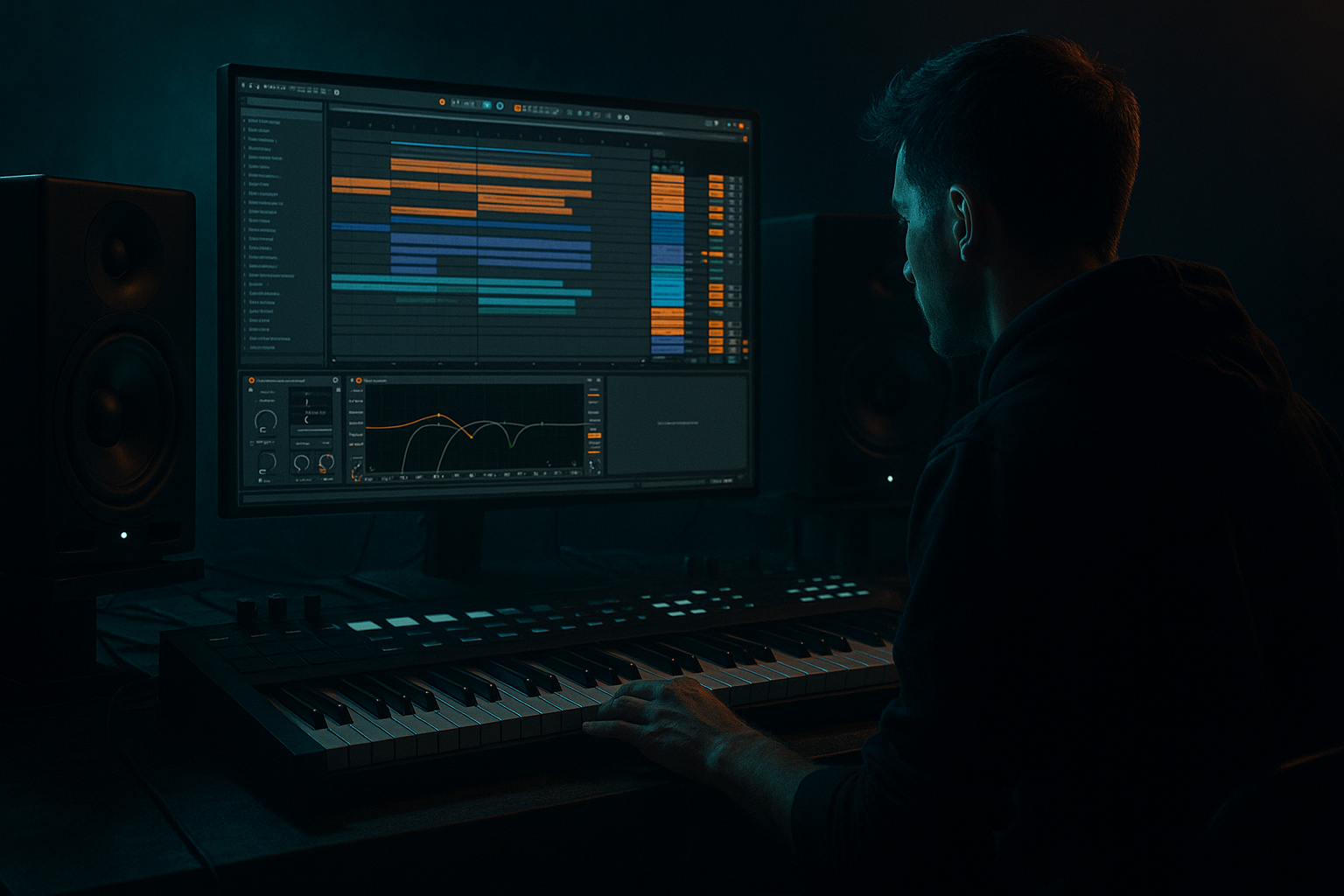
Main tutorial
Lesson Overview
In this lesson, you’ll learn how to stack and arrange a Drum & Bass bassline in Ableton Live 12 using a beginner-friendly, sampling-first workflow. The goal is to build a bass section that feels like a real DnB drop: tight sub weight, a moving mid bass layer, and clear arrangement shapes that support the drums instead of fighting them.
This matters because in Drum & Bass, the bassline is not just one sound. It’s usually a system of parts:
- a sub for clean low-end pressure,
- a mid bass / reese / sampled layer for character and motion,
- and often a texture or top layer for grit, buzz, or attack.
- a clean mono sub track following the root notes
- a sampled mid-bass layer with movement and bite
- a stacked bass group routed for easy control
- a 8-bar drop arrangement with call-and-response phrasing
- basic automation for filter, volume, and reverb throws
- a bassline that works with a breakbeat / kick-snare groove, not against it
- Bar 1: bass hits after the snare, leaving space for the break
- Bar 2: bass answers with a longer note or a quick fill
- Bars 3–4: variation with a small pause, filter change, or extra sampled stab
- Using one bass sound for everything
- Making the bass too busy
- Letting the sub go stereo
- Not leaving room for the snare and break
- Too much distortion too early
- Arranging only a loop, not a section
- Ignoring the sampled material’s start/end points
- Keep the sub simple and let the mids do the aggression. That separation makes heavy bass feel cleaner and bigger.
- Use sampled bass stabs as punctuation. A short resampled hit after a snare can be more effective than a long note.
- Automate filters, not just volume. Small cutoff moves create tension without obvious EDM-style transitions.
- Add a tiny bit of noise or top texture to the mid layer. This helps the bass cut through dense breakbeats.
- Try call-and-response across 2 bars. One bar answers the drums; the next bar changes the rhythm slightly.
- Use reverse audio as a transition tool. Reversing a bass tail before a drop can create underground-style pull.
- Check the bass against the drum bus, not in solo. In DnB, the bass should work with the break, not sound impressive alone.
- If it feels flat, resample and re-chop. Sampling is often the fastest route to character.
- Build DnB bass as a stack: sub, mid layer, optional texture.
- Keep the sub mono and clean.
- Use sampling in Simpler to create bass stabs, chops, and movement.
- Arrange bass like DnB: space, response, variation, and tension.
- Use stock Ableton tools like Operator, Simpler, EQ Eight, Saturator, Utility, Drum Buss.
- Always check drum balance, mono compatibility, and low-end clarity.
When these parts are arranged properly, your track gets that classic DnB push-and-pull: the drums hit, the bass answers, then the energy shifts again. That’s the foundation of rollers, darker dancefloor cuts, jungle-inspired edits, and neuro-influenced bass music. 💥
We’ll keep this practical and rooted in Ableton stock tools, with a focus on sampling: slicing, resampling, warping, and arranging bass elements so they feel intentional and club-ready.
What You Will Build
By the end of this lesson, you’ll have a simple but effective DnB bass section in Ableton Live 12:
Musically, think of a dark 174 BPM roller with a 2-bar phrase:
This is the kind of arrangement that sounds simple in theory but feels pro when it’s done right.
Step-by-Step Walkthrough
1. Start with a drum + bass-friendly layout
In Ableton Live, create a new project and set the tempo to 174 BPM. If you want a more jungle-flavored feel, anywhere from 170–176 BPM works well.
Build a basic drum loop first:
- Load a breakbeat sample into a Simpler track or audio track
- Add a kick and snare pattern if needed
- Keep the groove loose enough for bass movement
Why start with drums? Because in DnB, the bassline usually reacts to the drums. If the rhythm section already has a strong pocket, your bass arrangement will lock in much faster.
Helpful stock devices:
- Simpler for break slicing or one-shot bass samples
- Drum Rack for drum hits and fill sounds
- EQ Eight for quick cleanup
2. Build the sub as a separate mono layer
Create a new MIDI track for the sub. Use a simple stock instrument like Operator or Wavetable:
- Operator: choose a sine wave
- Wavetable: choose a basic sine or triangle-style wavetable
Keep it simple:
- Mono: turn on one-note priority if needed
- No stereo widening
- No heavy reverb or delay
- Low-pass filter if there’s any unwanted upper tone
Suggested settings:
- Oscillator level: moderate, don’t slam it
- Filter cutoff: around 80–120 Hz if you need extra purity
- Glide/portamento: 50–120 ms for a smooth bass slide feel
Program a short bass pattern using root notes of the scale. For a beginner DnB roller, start with just 2 notes per bar. The point is not complexity yet — it’s groove and weight.
Why this works in DnB: the sub is the anchor. In club systems, DnB depends on a strong low-end foundation, and a clean mono sub lets the kick and snare stay punchy while the bass still feels huge.
3. Create a sampled mid-bass layer using Simpler
Now we’ll add the character layer. This is where sampling becomes powerful. Find or record a short bass sample, a reese snippet, a rebased synth hit, or even a resampled sound from your own track. Drop it into Simpler on a new MIDI track.
In Simpler:
- Set playback mode to Classic or Slice if the sample has movement
- If it’s a one-shot bass stab, use Classic
- If it’s a longer bass phrase, use Slice and trigger parts of it with MIDI
Useful starting moves:
- Turn on Warp only if needed for timing
- Use Filter in Simpler to tame harsh highs
- Adjust Start to trim silence
- Shorten Fade if clicks appear
Suggested parameter ideas:
- Filter cutoff: 200–800 Hz for mid-bass focus
- Resonance: keep it low to moderate, around 5–20%
- Volume envelope: short decay for punchy stabs, longer release for rolling notes
Try recording or resampling a bass sound with movement, then chop it into a few useful hits. A short “ahh” bass, a growling note, or a detuned reese stab can become your mid layer.
4. Stack the sub and mid bass together in a Group
Select your sub track and mid-bass track, then group them with Cmd/Ctrl + G. This gives you one place to manage the bass system.
Inside the group, keep the roles clear:
- Sub track = only low fundamentals
- Mid layer = character and movement
- Optional top texture = airy grit or noise
On the bass group, add:
- EQ Eight to check overlap
- Saturator for gentle density
- Utility for mono checking or width control
Suggested group processing:
- EQ Eight: small cut around 200–400 Hz if the bass feels muddy
- Saturator: Drive around 1–4 dB
- Utility: Width at 0% on the low end if you want strict mono discipline
Keep the sub clean and let the mid layer do the talking. If both layers are loud in the same range, the bass becomes blurry fast.
5. Program the bassline with drum space in mind
Now write a simple bass MIDI clip that works with the drums. Start with a 2-bar loop. Don’t fill every gap.
A classic beginner DnB phrasing idea:
- Beat 1: leave space for the kick or break hit
- After the snare: place a bass note or short stab
- Beat 3: longer note or slide
- Last half of bar 2: a quick answer note or small variation
Think call-and-response:
- drums ask a question
- bass answers
- then both breathe
For a darker roller, keep notes short and syncopated. For a jungle-influenced feel, use more off-grid movement and slightly busier note placements, but still leave room for the break.
Practical beginner rule:
- If the drums feel busy, use fewer bass notes
- If the drums are minimal, you can add more bass rhythm
6. Add movement with automation and small changes
DnB basslines rarely stay identical for long. Add movement over 4 or 8 bars so the loop feels alive.
Good beginner automation targets in Ableton:
- Filter cutoff on the mid layer
- Saturator Drive
- Utility gain
- Send amount to reverb or delay for occasional throws
Example:
- Bars 1–2: darker, filtered bass
- Bars 3–4: open the filter slightly
- Bar 4 end: quick reverb throw or volume dip
- Bars 5–8: change one note, one octave, or one rhythm
Keep automation subtle:
- Filter cutoff moves of 10–30% are often enough
- Reverb sends should be short and intentional
- Avoid making the bass wash out the drop
In Ableton, draw automation clips or use clip envelopes for quick ideas. This is especially useful when you’re learning because it keeps the arrangement visible and easy to edit.
7. Use Ableton’s stock effects to shape impact and clarity
Once the bass is playing well, add light shaping:
- EQ Eight: carve out unnecessary low-mid buildup
- Saturator: add harmonics so the bass reads on small speakers
- Drum Buss: use carefully on the bass group if you want extra punch and harmonics, but keep the drive modest
- Glue Compressor: only if the bass group needs gentle control, not heavy squeezing
Useful starting ranges:
- Saturator Drive: 1–5 dB
- Drum Buss Drive: very light, around 5–15%
- EQ cut for mud: often around 250–500 Hz depending on the sample
If you’re using sampled bass stabs, a touch of saturation helps them sit like a real DnB production tool instead of sounding flat and disconnected.
8. Arrange the bass into a real drop section
Now turn the loop into a track section. For a beginner-friendly arrangement, build an 8-bar drop:
- Bars 1–2: main bass phrase
- Bars 3–4: repeat with a small variation
- Bar 5: pause or half-time-feel gap
- Bars 6–7: heavier response phrase
- Bar 8: fill, stop, or transition out
Add arrangement logic:
- Use a full bar of drums alone before the drop for tension
- Bring the bass in right after a snare or break accent
- Leave a small hole before the next section to create lift
Example arrangement context:
- Intro: filtered drums and atmosphere
- Build: snare roll or rising energy
- Drop: bass and break hit together
- Switch-up: remove the sub for 1 bar, then bring it back harder
This is where DnB really lives: not just in sound design, but in phrasing. If the bass has tension and release built into the arrangement, it instantly feels more authentic.
9. Resample your bass movement for extra control
Once you like the layer combo, resample it. Create an audio track, set the input to resample or route the bass group to it, and record a pass.
Why do this?
- You can chop the audio more easily
- You can reverse, slice, or mute parts
- You can make the bass feel more “written” and less looped
After resampling:
- Cut the best hits into new clips
- Rearrange a few notes
- Reverse one tail for a transition
- Trim the audio to create stop-start energy
This is a very useful sampling workflow in DnB because many great bass ideas come from turning one sound into multiple arrangement tools.
10. Do a quick mix check: low end, mono, and drum balance
Before calling it done, check the balance:
- Put Utility on the bass group and test mono
- Make sure the sub still feels strong without stereo width
- Compare bass loudness against kick and snare
- Lower bass if the drums lose impact
Simple checks:
- The kick should hit clearly
- The snare should stay sharp
- The bass should feel heavy but not smear the groove
- The whole low end should remain controlled at lower volume
If the bass disappears on small speakers, add a bit more harmonic content with Saturator rather than just turning it up.
Common Mistakes
Fix: split sub and mid layers so each part has a job.
Fix: reduce note density. In DnB, space often sounds heavier than clutter.
Fix: keep the sub mono and use width only on higher bass layers.
Fix: remove bass notes from key drum accents, especially in the 1–2 and 3–4 relationship.
Fix: add saturation gradually. You want density, not fuzz overload.
Fix: build at least 8 bars with one or two changes. DnB needs movement.
Fix: trim samples carefully in Simpler and use fades to avoid clicks.
Pro Tips for Darker / Heavier DnB
Mini Practice Exercise
Set a timer for 15 minutes and do this:
1. Create a 174 BPM project.
2. Load a drum loop or breakbeat.
3. Build a mono sub in Operator with just 2 notes per bar.
4. Load a bass sample into Simpler and make a short mid-bass layer.
5. Group the layers and add EQ Eight + Saturator.
6. Write a 2-bar bass phrase with clear gaps for the drums.
7. Duplicate it into 8 bars and change one detail every 2 bars.
8. Add one automation move: filter cutoff, Drive, or send to reverb.
9. Resample one pass and chop it into one extra transition hit.
10. Listen once in mono and fix the biggest low-end problem you hear.
Goal: finish with a basic DnB drop sketch that has sub, character, space, and movement.
Recap
If you can make one bass idea feel strong over 8 bars, you’re already thinking like a DnB producer.

