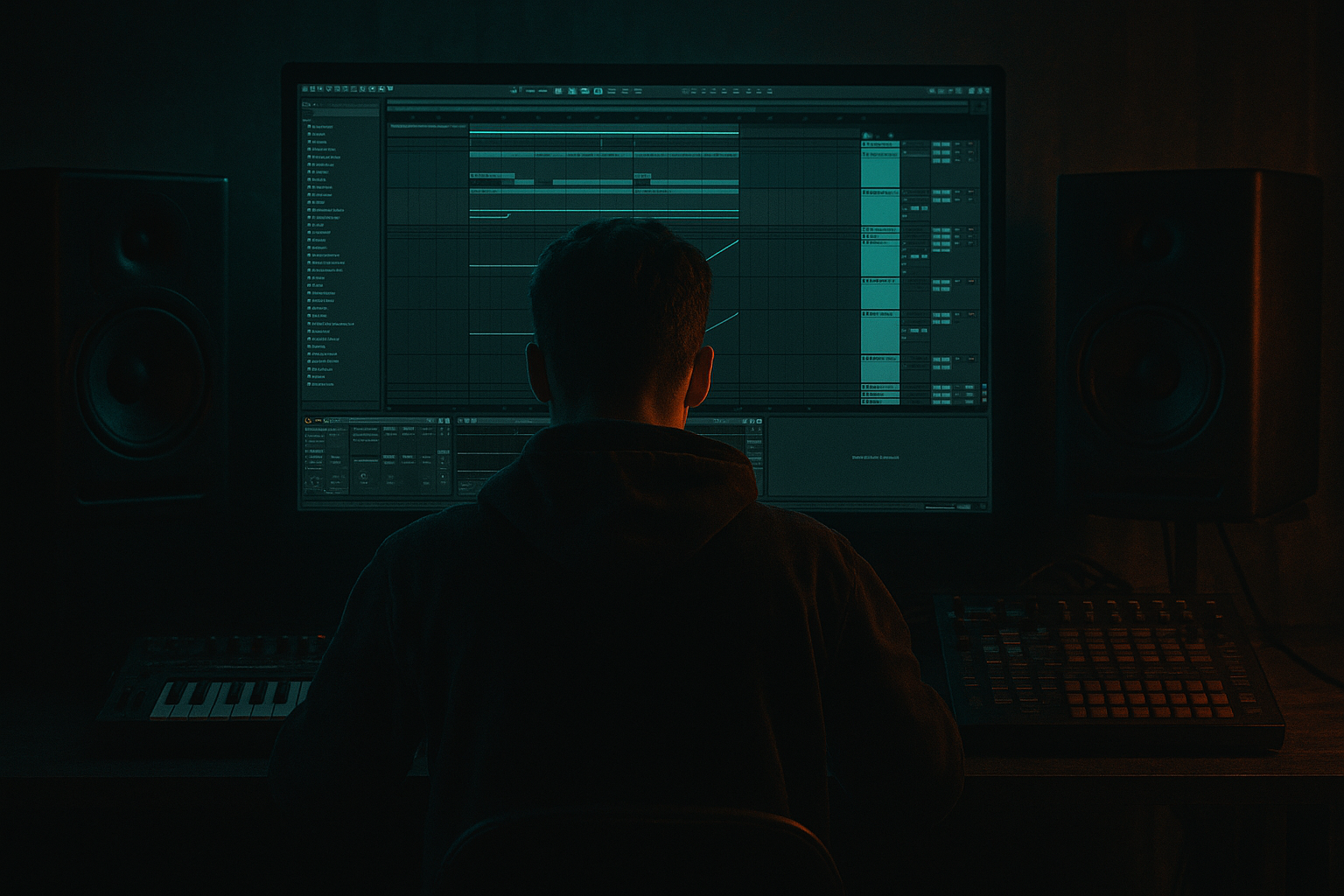
Main tutorial
Bassline Theory (Beginner) — Ableton Live 12 Deep Dive
Session View ➜ Arrangement View for Jungle / Oldskool DnB Atmospheres 🌫️🔊
---
1) Lesson overview
In oldskool jungle + early DnB, the bassline isn’t just “low notes”—it’s the hook, the groove glue, and the mood. In this lesson you’ll learn:
- Bassline theory basics that work in jungle/rolling DnB (root notes, minor keys, call/response, movement)
- How to sketch bass ideas fast in Session View (clips + scenes)
- How to perform your clips into Arrangement View (real DnB workflow)
- How to shape bass with Ableton Live 12 stock devices (Operator/Wavetable/Sampler, Saturator, EQ Eight, Auto Filter, Compressor/Glue, etc.)
- How to make the bass sit with breakbeats and atmospheres without turning into mud
- Atmospheric pad/texture (moody, slightly noisy)
- Oldskool-style bassline (sub + mid layer vibe, simple but rolling)
- Breakbeat (basic chopped loop or Drum Rack groove)
- A Session View “jam layout” (scenes for Intro / Drop / Switch / Outro)
- A recorded Arrangement with structure and movement
- Most jungle basslines lean on root note + 5th + b7 movement in minor keys.
- In F minor, the key notes are:
- Super common DnB motion:
- Keep it minimal: try Fm (F–Ab–C) held, maybe change to Db (Db–F–Ab) for mood.
- Scale: F Minor
- This prevents random wrong notes while you’re learning.
- Grid: 1/8 to begin, then add 1/16 later.
- Try a pattern like this (example notes, 2 bars):
- Adjust note lengths so some are short (pluck) and one is longer (anchor).
- Use Velocity: slightly vary (but keep sub fairly consistent).
- Intro: automate a low-pass on the break (Auto Filter) opening over 8 bars
- Pre-drop gap: mute drums for 1/2 bar, leave a reverb tail
- Drop: ensure bassline is clean and consistent
- Switch: change bass notes or rhythm slightly (same key) to refresh energy
- Keep the same rhythm
- Change one note to Ab or Db in bar 2
- Or jump up to F (octave) for one hit
- Darker note choices: lean on b6 and b7 movement in minor (in F minor, that’s Db and Eb). Even one note can change the whole mood.
- Rumble control: use EQ Eight with a narrow cut around 40–60 Hz only if needed. Don’t over-EQ the sub.
- Aggression without losing sub: distort the MID layer, not the SUB.
- Atmos fear factor: add a layer of noise texture:
- Mono-check: put Utility on the Master temporarily:
- You picked a key (F minor) and used a small note set to stay musical.
- You built a 2-layer bass: clean SUB (Operator) + character MID (Wavetable + Saturator).
- You sketched ideas in Session View using clips/scenes (fast and creative).
- You performed your scenes into Arrangement View (authentic DnB workflow).
- You controlled mud with EQ and improved punch with subtle sidechain.
- You added atmos that supports the vibe without stealing low-end space.
We’ll keep it beginner-friendly, but the workflow is legit.
---
2) What you will build
A short jungle/DnB idea with:
Target tempo: 165–170 BPM (classic jungle range).
---
3) Step-by-step walkthrough
Step 0 — Set up the project (tempo, routing, clean template)
1. Set tempo to 168 BPM.
2. In Live 12, create 4 tracks:
- Audio: `Break`
- MIDI: `Bass SUB`
- MIDI: `Bass MID`
- MIDI: `Atmos Pad`
3. Optional but recommended: create a Return track:
- `A - Dub Reverb` (Hybrid Reverb)
- `B - Delay` (Echo)
DnB habit: keep bass layers on separate tracks early. It makes mixing easier.
---
Step 1 — Choose a key + understand the “DnB bassline job”
Pick a beginner-friendly jungle key: F minor (works great for dark vibes, easy on sub notes).
Theory you actually need:
F – G – Ab – Bb – C – Db – Eb
- Root (F) = stability
- 5th (C) = power
- b7 (Eb) = “rolling / moody pull”
- Octave (F) = lift
You can get a full vibe using only F, C, Eb, Ab to start.
---
Step 2 — Build an atmosphere bed (so bass has context) 🌫️
On `Atmos Pad` (MIDI track):
1. Load Wavetable (or Analog if you want simpler).
2. Pick an init/smooth wavetable preset, then do this quick patch:
- Amp Envelope: Attack 250–600 ms, Release 2–4 s
- Add slight Unison (2–4 voices, low amount)
3. Add device chain:
- EQ Eight:
- High-pass around 150–250 Hz (steep-ish). Atmos should not fight bass.
- Hybrid Reverb:
- Algorithm: Hall or Shimmer-ish
- Decay: 4–8 s
- Wet: 15–35% (don’t drown it)
- Auto Filter:
- Low-pass, add subtle movement with LFO
- Rate: 1/8 or 1/4, Amount small
Write a simple 2-bar chord/pad clip in Session View:
---
Step 3 — Create the SUB bass (clean and solid) 🔥
On `Bass SUB` (MIDI track):
1. Load Operator.
2. Use a pure sine-ish sub:
- Algorithm: A only
- Osc A: Sine
- Amp Envelope:
- Attack 0–5 ms
- Decay short/medium (optional)
- Sustain -inf to -6 dB (depends on note length)
- Release 80–200 ms (avoid clicks but keep tight)
3. Add EQ Eight (basic safety):
- Low-cut off (don’t cut your sub)
- Gentle dip around 200–350 Hz if it gets boxy (often not needed on sine)
4. Add Utility:
- Bass Mono ON
- Gain: adjust later (start at -6 dB to leave headroom)
Bassline theory tip: sub should usually be the simplest layer. The groove comes from rhythm + note choice, not distortion.
---
Step 4 — Create the MID bass layer (character + audible pitch) 🧱
On `Bass MID` (MIDI track):
1. Load Wavetable (or Operator with more harmonics).
2. Quick “oldskool mid” approach:
- Osc 1: Saw (or a richer wavetable)
- Low-pass filter around 200–800 Hz depending on aggression
3. Device chain (stock, practical):
1. Auto Filter (Low-pass):
- Drive: small amount
- Envelope: subtle (optional)
2. Saturator:
- Mode: Analog Clip (good for DnB)
- Drive: 2–6 dB
- Soft Clip: On
3. EQ Eight:
- High-pass at 90–120 Hz (IMPORTANT: leave sub for SUB track)
- Tame harshness around 2–5 kHz if needed
4. Compressor (optional for consistency):
- Ratio: 2:1
- Attack: 10–30 ms
- Release: 60–120 ms
- Aim for 2–4 dB gain reduction on peaks
Layer rule: SUB = below ~90 Hz. MID = mostly above ~100 Hz.
---
Step 5 — Write a classic 2-bar jungle bass clip in Session View 🎛️
Create a 2-bar MIDI clip on `Bass SUB`. Turn on Scale in the piano roll:
Rhythm first: DnB basslines often “talk” with the drums. Start with offbeats and syncopation.
- Bar 1: F (short) → rest → F (short) → Eb (short) → F (short)
- Bar 2: C (short) → Eb (short) → F (hold a bit longer)
Now duplicate that clip to `Bass MID`, so both layers play the same notes.
Make it roll:
---
Step 6 — Add a breakbeat (quick and functional) 🥁
On `Break` (Audio track):
1. Drag in a break loop (Amen-ish, Think, or any break you have).
2. In Clip View:
- Warp: On
- Warp Mode: Beats
- Preserve: Transient
- Set the loop to 2 bars
3. Add Drum Buss (stock, great for jungle):
- Drive: 5–15%
- Boom: 0–20% (careful—can fight the sub)
- Damp: adjust to taste
4. Add EQ Eight:
- If your break has too much low end, high-pass around 80–120 Hz
(Oldskool breaks often carry low rumble that destroys bass clarity.)
Key mixing idea: break low end is usually trimmed so the bass owns the subs.
---
Step 7 — Session View scene layout (Intro / Drop / Switch) 🎬
Make Scenes (rows) in Session View:
1. Scene 1: Intro (8 bars)
- Atmos Pad: ON
- Break: maybe filtered or OFF
- Bass: OFF
2. Scene 2: Tease (8 bars)
- Add Break (filtered)
- Bass MID very low or OFF
3. Scene 3: Drop (16 bars)
- Break full
- Bass SUB + MID full
- Atmos subtle
4. Scene 4: Switch (16 bars)
- Change bass clip (make a variation)
- Add a different break slice or add a crash/reverb stab
Tip: name scenes and set scene launch quantization to 1 bar (top left) for clean performance.
---
Step 8 — Record your Session jam into Arrangement View (the real magic) 🎥
1. Hit Global Record (top transport).
2. Launch Scenes in order like a DJ:
- Intro → Tease → Drop → Switch → Drop (again) → Outro
3. Stop recording.
4. Hit Tab to go to Arrangement View.
Now you have a performance-based arrangement, which is extremely jungle-friendly.
---
Step 9 — Tighten the arrangement like a DnB track
In Arrangement View, do quick structure moves:
Easy bass variation technique (beginner-safe):
---
Step 10 — Sidechain (simple and effective) 🧲
If your kick/snare are inside the break, sidechain can still help (sub ducking a touch adds punch).
On `Bass SUB`:
1. Add Compressor
2. Turn on Sidechain
3. Sidechain input: `Break` (or kick track if you have a separate kick)
4. Settings to start:
- Ratio: 4:1
- Attack: 2–10 ms
- Release: 80–140 ms
- Threshold: lower until you see 2–5 dB gain reduction on drum hits
Keep it subtle for jungle—too much pumping can feel modern EDM unless that’s your goal.
---
4) Common mistakes
1. Bassline too busy (especially the sub)
The sub should be simple. Let breaks + atmos bring complexity.
2. MID bass overlapping the sub
If your MID layer has lots of energy below ~100 Hz, you’ll get phase issues and mud. High-pass the MID.
3. Not choosing a key / using random notes
Use the Scale feature (F minor) until your ear learns the vocabulary.
4. Break has too much low end
Break rumble + sub = messy. High-pass the break.
5. No arrangement movement
Jungle feels alive because of small variations: mutes, fills, filter moves, and switch-ups.
---
5) Pro tips for darker/heavier DnB 🕶️
Try: Saturator (Analog Clip) → Roar (if you want extra bite) → EQ.
- Vinyl Distortion lightly on atmos return
- Or Corpus very subtly for metallic tone (tiny mix %)
- Width 0% to check mono compatibility (bass should remain strong)
---
6) Mini practice exercise (15–20 min)
1. Set key to F minor and tempo 168.
2. Write 3 different 2-bar bass clips in Session View:
- Clip A: mostly F + Eb
- Clip B: add C (5th)
- Clip C: add Ab or Db for darker color
3. Keep the same rhythm, only change notes.
4. Create 3 scenes:
- Drop A, Drop B, Drop C
5. Record a 1-minute Arrangement by launching A → B → C.
Goal: hear how note choice changes mood without changing the groove.
---
7) Recap ✅
If you want, tell me what bass style you’re aiming for next—pure oldskool sine/rewese, modern roller, or neuro-ish dark mid movement—and I’ll adapt a next lesson with a ready-to-build Ableton rack chain.

