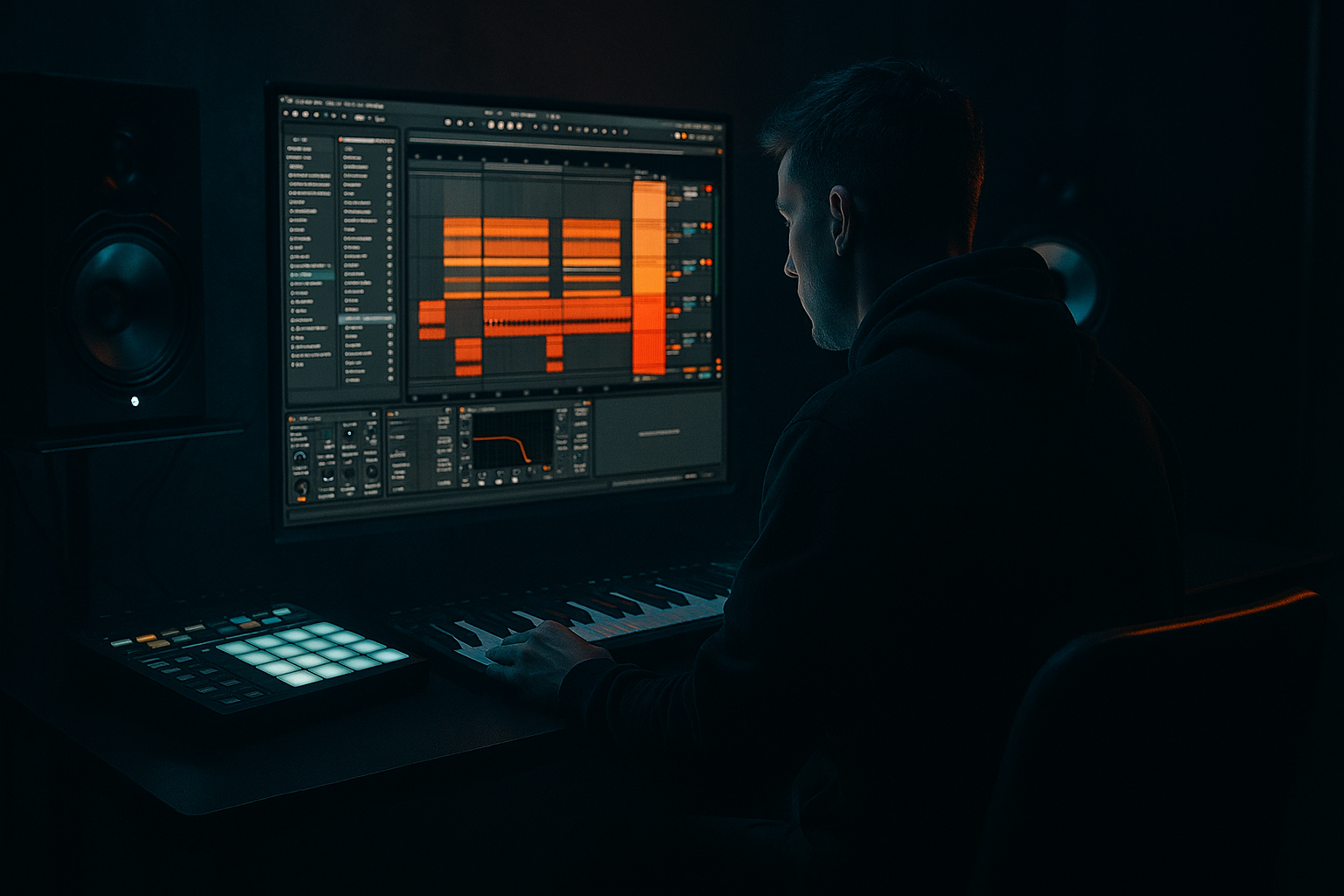
Main tutorial
Bassline Theory: Air Horn Hit Pitch for Rewind-Worthy Drops in Ableton Live 12
Jungle / oldskool DnB atmospheres tutorial 🎛️🔊
1. Lesson overview
In jungle and oldskool drum & bass, the air horn is more than a sound effect — it’s a signal. It tells the crowd: something heavy is about to happen. The pitch of that horn hit can make or break the tension before a drop, especially if you want that rewind-worthy, soundsystem-ready reaction.
In this lesson, you’ll learn how to:
- choose the right air horn pitch for a bassline-led DnB drop
- tune the horn so it sits musically with your track
- process it to sound bold, nasty, and authentic
- automate it for maximum impact before the drop
- build a simple Ableton Live 12 chain for classic jungle energy
- a pitched air horn hit
- a rewind-style answer phrase
- a sub and bassline that locks to the horn
- simple drum arrangement with classic break energy
- a mix chain that makes the horn cut through without destroying the low end
- F minor
- G minor
- A minor
- D minor
- E minor
- match F exactly
- sit on the root + octave
- or use a strong tension tone like A♭ or C depending on the vibe
- root note = safest
- 5th = powerful and stable
- minor 3rd = darker, emotional
- flat 2nd / tritone = dangerous, aggressive
- Load Tuner on the horn track
- Trigger the sample
- Read the detected note
- Or use your ear and compare it against a MIDI piano
- a clean, classic DJ signal
- strong musical unity with the bassline
- a direct, anthemic drop
- a bigger, more open sound
- a less obvious but still stable pitch
- a “crowd lift” before the bass slams in
- the bass is very dense
- the mix is dark and crowded
- you want the horn to cut through the mids
- ♭2
- tritone
- minor 2nd above the root
- adjust Transpose in semitones
- fine-tune with Detune if needed
- use the Transpose control in the Clip View
- adjust in semitones until the horn locks to the key
- you can compose the horn like an instrument
- you can automate different horn notes across the arrangement
- you can create a call-and-response phrase
- Hit 1: root note
- Hit 2: fifth or octave
- Pause
- Drop
- Hit 1: F
- Hit 2: C
- then the bassline drops in
- High-pass around 120–180 Hz
- cut any harsh buildup around 2.5–4.5 kHz if it stings too much
- boost gently around 800 Hz–1.5 kHz if it needs more honk/body
- Drive: 2–6 dB
- Output compensated so it doesn’t jump too loud
- Ratio: 2:1 or 4:1
- Attack: 10–30 ms
- Release: Auto or 50–120 ms
- Echo time: 1/8 or 1/4
- Filter the delay so it doesn’t clutter the drop
- Reverb decay: 0.8–1.8 s
- High-cut the reverb for a vintage feel
- narrow the horn if it’s too wide
- or slightly widen it if you want a ravey feel
- volume
- filter cutoff
- reverb send
- pitch bend
- reverb freeze or delay feedback for effect
- Start with a low-pass filter on the horn
- Open it rapidly in the last half-bar before the drop
- Add a tiny volume swell
- Let the reverb tail dip into the gap before the drums slam
- using a pedal tone in the bass
- landing the bass on the horn’s pitch at the drop point
- or having the horn imply the key while the bassline uses passing notes
- F
- F
- E♭
- C
- F
- F
- C
- Bars 1–4: drums, atmos, filtered bass tease
- Bars 5–6: remove some low end
- Bar 7: horn hit 1
- Bar 8: horn hit 2 + fill
- Bar 9: drop
- Bar 10: let the bassline answer the horn
- cut the drums for a beat
- throw in a short horn
- add a vinyl stop or tape stop
- then slam the full break and bass
- layer 1: original horn
- layer 2: octave-up version, low in the mix
- layer 3: short noise burst or air hit
- layer 4: sub hit underneath only if it doesn’t clutter
- with the kick and snare
- with the sub and mid-bass
- with the breakbeat
- at lower listening volumes
- add midrange saturation
- boost a narrow band around 1 kHz
- reduce reverb
- shorten the decay
- reduce 2–4 kHz
- high-pass more aggressively
- lower the clip gain
- dark jungle rollers
- ragga-influenced drops
- tribal / warehouse atmosphere
- “rewind!”
- “pull up!”
- “wheel up!”
- just enough to let the kick through
- don’t make the horn pump too obviously
- gritty transients
- unexpected texture
- a more oldskool, sampler-based feel
- breakbeat
- kick
- snare on 2 and 4
- light ride or hat
- keep it sparse
- F
- then C on the second hit
- EQ Eight
- Saturator
- Utility
- light Reverb send
- horn on the last beat of bar 3
- second horn on beat 1 of bar 4
- full drop right after
- in headphones
- on small speakers
- with the full low end
- choose a key first
- tune the horn to the root, fifth, or octave
- high-pass it so it doesn’t fight the sub
- use saturation and light compression for presence
- automate filter, volume, or reverb to build tension
- place it strategically before the drop
- always test in the full mix
We’ll focus on practical bassline theory: how the horn pitch interacts with the key, bass root, and tension notes in your arrangement.
---
2. What you will build
You’ll build a short 8-bar pre-drop and drop transition featuring:
By the end, you’ll know how to make the horn feel like part of the tune, not just a random rave sample.
---
3. Step-by-step walkthrough
Step 1: Pick the tonal center of your tune
Before you choose an air horn pitch, decide what key or tonal center your drop is in.
For jungle / DnB, common roots include:
If your bassline is built around F, then your horn should either:
Practical rule
For a rewind-style horn:
If you want the horn to feel like it’s announcing the drop, root or 5th usually works best.
---
Step 2: Load or record your air horn sample
In Ableton Live 12:
1. Drag your air horn sample into an Audio Track
2. Double-click the clip
3. In the sample view, turn on Warp if needed
4. Set Warp mode to:
- Complex Pro if the horn is long and tonal
- Beats if it’s more of a short transient hit
- Texture if you want a smeared rave atmosphere
Tip
If your sample already has a pitch baked in, fine. But for proper musical control, use a sample that can be repitched cleanly.
---
Step 3: Find the horn’s original pitch
You need to know what note the air horn is already at before tuning it.
Fast method in Live:
If the sample is not clearly pitched, use Simpler:
1. Drop the horn into Simpler
2. Play it chromatically from a MIDI keyboard
3. Find the note where it sounds strongest and least warped
This gives you the sample’s natural “home” pitch.
---
Step 4: Choose the target pitch based on the drop
Here’s the core theory.
Option A: Root note horn
If your tune is in F minor, tune the horn to F.
This works when you want:
Option B: Fifth above root
If your tune is in F minor, tune the horn to C.
This is great when you want:
Option C: Octave root
If root feels too low or too muddy, push the horn up an octave.
This helps when:
Option D: Dissonant tension pitch
For darker oldskool pressure, try:
Use this sparingly. It creates tension, but if overused, it can sound random instead of intentional.
---
Step 5: Tune the horn in Ableton
If the sample is not already in key, you have several ways to tune it.
Method 1: Transpose in Simpler
If you’re using Simpler:
Method 2: Clip transposition
If it’s in an audio clip:
Method 3: Pitch MIDI note
If the horn is in Sampler or mapped in Simpler, trigger it from MIDI and play the exact note.
This is often the best method because:
---
Step 6: Build a two-hit horn phrase
A single horn hit is powerful, but a two-hit phrase usually sounds more intentional in jungle and DnB.
Try this structure:
Example in F minor:
This creates a classic “warning” shape:
1. establishes the key
2. opens the energy
3. leaves space for the drop
Arrangement idea
Put the first horn on the last beat of bar 7, then the second horn on beat 1 of bar 8, and let the drop hit on bar 9.
That extra half-bar of anticipation can make the rewind moment feel huge.
---
Step 7: Design the horn chain
Here’s a solid stock Ableton chain for a punchy DnB horn:
Basic chain
1. EQ Eight
2. Saturator
3. Compressor or Glue Compressor
4. Echo or Reverb (send or light insert)
5. Utility
EQ Eight starting points
- keep the horn out of the sub zone
Saturator
Use Soft Clip or mild drive:
This gives the horn more attitude and helps it read on smaller speakers.
Compressor / Glue Compressor
Use light control, not full squashing:
Goal: keep the horn steady and bold.
Echo or Reverb
For jungle atmospheres, a short, dark space works well:
Utility
Use Utility to:
For a heavy drop, often keep the horn center-focused.
---
Step 8: Add movement with automation
The rewind-worthy feeling often comes from automation, not just the sample.
Automate:
Simple automation idea
This creates a “pull” into the drop.
---
Step 9: Make the horn interact with the bassline
This is where bassline theory matters.
If the horn sits on the root, make sure the bassline supports that note or lands on it at the same time.
If the bassline is moving, you can still make the horn feel right by:
Example in F minor
Bassline notes:
Horn notes:
That gives you stability plus movement.
---
Step 10: Place it in a classic DnB arrangement
A good oldskool-style shape:
8-bar pre-drop
Rewind-style trick
Right before the drop:
This is very effective for jungle energy and crowd reaction 🎚️
---
Step 11: Layer the horn for bigger impact
For a more aggressive sound, layer:
Keep the layers tight.
Important
If you layer an octave horn, make sure it doesn’t fight the lead vocal, break cymbals, or the snare crack.
---
Step 12: Check the horn in context, not solo
A horn that sounds huge solo may be too much in the track.
Always check:
If the horn disappears:
If the horn dominates:
---
4. Common mistakes
1. Choosing a pitch without checking the key
If the horn is not related to the tune’s tonal center, it can sound random instead of hype.
2. Leaving too much low end on the horn
Air horns don’t need sub. High-pass them so they don’t clash with the bassline.
3. Over-widening the horn
Too much stereo width can make the hit feel weak in mono and less focused on systems.
4. Using too much reverb
A massive wash can blur the drop transition and bury the impact.
5. Pitching the horn too far
Extreme transposition can turn a raw rave horn into a thin or cartoonish sound.
6. Not considering the bassline rhythm
If the horn lands in the same space as the bass groove without intention, it can feel messy.
7. Soloing too much
A horn that works in solo may still fail in the full arrangement. Always test in context.
---
5. Pro tips for darker/heavier DnB
Use the flat 2nd for menace
If your tune is in F minor, try a horn pitch around G♭ to create immediate tension.
This works well for:
Pair the horn with a pitched rewind vocal
A short vocal like:
tuned to the same key can make the horn feel part of the musical identity.
Sidechain the horn lightly to the kick
Use Compressor with sidechain from the kick if needed:
Use resampling for attitude
Render the horn with effects, then re-import it and chop it like a break sample.
That can create:
Darken with filtering
A small high-cut or low-pass on the delay/reverb return can make the horn feel more vintage and sinister.
Try "wrong" pitches intentionally
Sometimes the best rewind moment is not the exact root, but the minor 7th or flat 5. If it still supports the bassline and sounds powerful, trust the vibe.
---
6. Mini practice exercise
Exercise: Build a 4-bar horn-to-drop transition in F minor
#### Step A
Create a simple 4-bar drum loop:
#### Step B
Add a bass note pattern centered on F minor
#### Step C
Load an air horn sample and tune it to:
#### Step D
Process it with:
#### Step E
Arrange:
#### Step F
Export or bounce the horn and listen:
Goal
Make the horn feel like it is calling the drop into existence 😈
---
7. Recap
A rewind-worthy air horn in jungle / oldskool DnB works best when it is musically tuned and arranged with purpose.
Remember:
If the bassline is the engine, the air horn is the shout from the crowd before the wheels roll back in 🚀
If you want, I can also give you:
1. a specific Ableton rack preset chain for the horn, or
2. a MIDI example in F minor / G minor for a classic jungle drop.

