Main tutorial
Lesson Overview
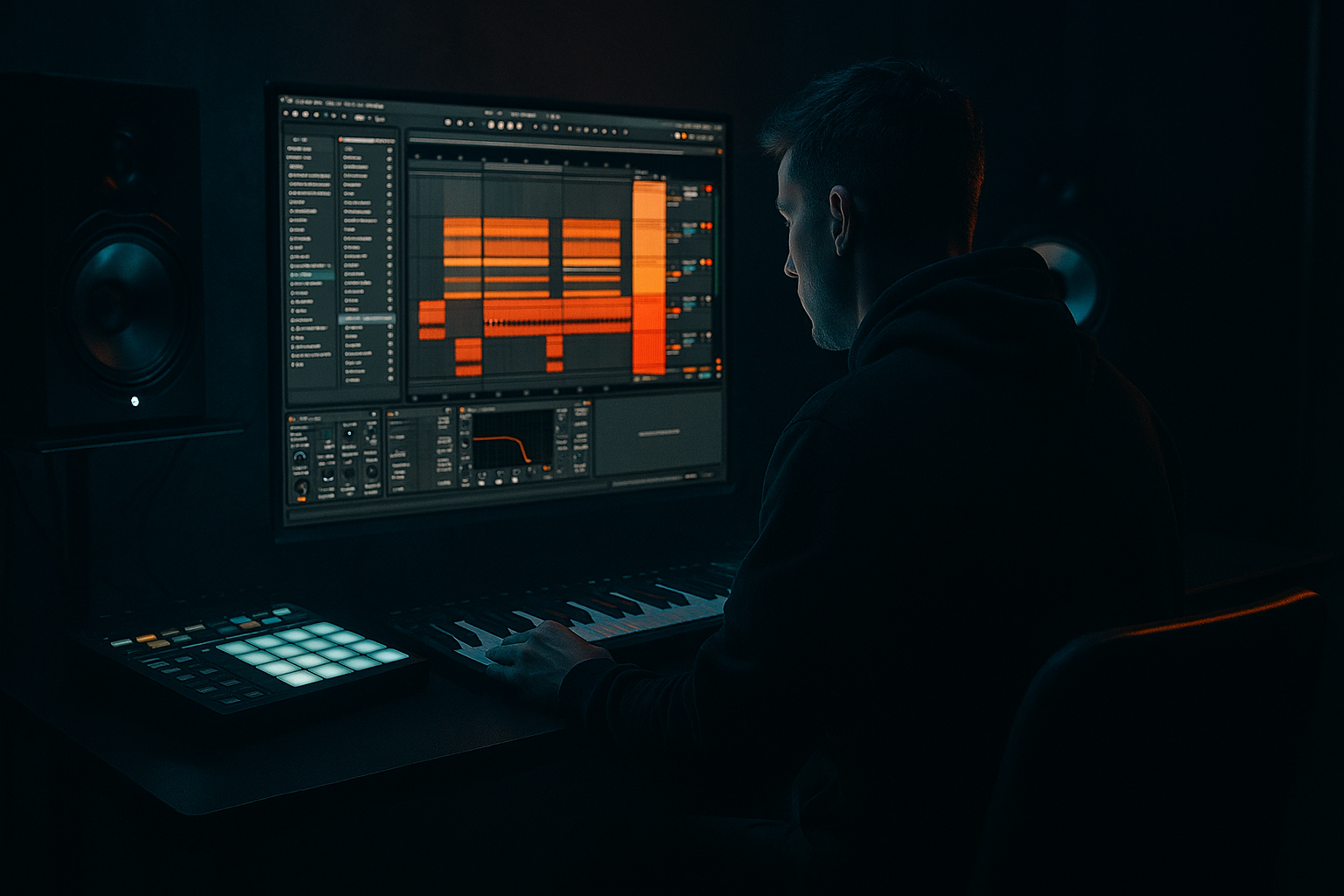
This lesson is about rebuilding a jungle-style fill into a DJ-tool-ready bassline moment inside Ableton Live 12, using oldskool DnB language but with a modern production mindset. The goal is not to make a full track from scratch — it’s to create a loopable, mix-friendly, high-energy bassline section that can drop into a set, extend a breakdown, or act as a switch-up tool in your arrangement.
In DnB, jungle fills are more than decoration. They’re often the moment where the track resets its tension, hints at the next section, and gives DJs something clean to work with before the drop. A great fill rebuild can do all of that while still feeling raw, rolling, and unmistakably oldskool. It should have:
- sub weight
- breakbeat energy
- call-and-response phrasing
- clear arrangement purpose
- enough space for the DJ to mix through it
- a pre-drop tension builder
- a post-drop reset
- a DJ tool section for mixing or looping
- a bassline switch-up inside an arrangement
- a tight break edit with ghost notes and chopped rhythm
- a sub bass layer following a simple but effective phrase
- a mid-bass/reese accent that answers the drums
- filter and distortion automation for movement
- a final hit or turnaround that makes the section land cleanly
- loop for 8 or 16 bars in a DJ intro
- drop as a breakdown rebuild
- use as a transition into a heavier main section
- Making the bass too busy
- Letting the sub get stereo or too effected
- Over-chopping the break
- Using too much distortion on both layers
- No real phrase ending
- Too much reverb in a DJ tool section
- Ignoring mono compatibility
- Use small pitch moves on the bass phrase
- Parallel crush the break, not the full mix
- Automate filter and drive together
- Let one frequency zone breathe
- Use short silences as impact
- Resample your best fill
- Keep your DJ intro/outro utilitarian
- A jungle fill rebuild works best when it behaves like a phrase, not just a loop.
- Keep the bassline simple, rhythmic, and responsive to the break.
- Separate sub weight from mid-bass character for clean low-end control.
- Use Ableton stock tools like Simpler, Operator, Wavetable, Drum Buss, Saturator, Auto Filter, Utility, and EQ Eight to shape the section.
- Make the rebuild DJ-friendly with clear phrasing, controlled tension, and a solid turnaround.
- In DnB, the best fills don’t just decorate the track — they move the arrangement forward while keeping the groove alive.
Why this matters: a lot of intermediate producers can make a heavy bass or a decent break, but the track still feels flat because the fill doesn’t function musically. In jungle and early DnB, fills often bridge two worlds: the drum edit language of breaks and the bassline theory of tension, movement, and release. That balance is what makes the section feel alive.
We’ll build this in Ableton Live 12 using stock devices and a practical workflow that favors speed, repeatability, and clean decisions. Think of this as a template for oldskool jungle tension rebuilds, roller switch-ups, and DJ-friendly fill moments that can be recycled across tracks. 🔥
What You Will Build
By the end, you’ll have a short but powerful 2-bar jungle fill rebuild that can function as:
Musically, it will include:
The vibe target is oldskool jungle / early DnB, but with enough control to fit into darker rollers or neuro-adjacent arrangements. The result should feel like something you could:
Step-by-Step Walkthrough
1. Set up a 2-bar DJ-friendly loop zone first
Before sound design, define the job of the section. In Ableton Live, create a 2-bar loop in Arrangement View or a 2-bar clip in Session View. This length matters because jungle fills often work best when they resolve quickly but leave enough space for the next phrase.
Set your project around 160–174 BPM for authentic jungle/DnB energy. If your track is more oldskool, 164–168 BPM is a strong sweet spot.
Put a marker at the start and end of the rebuild so you can audition it in loop mode. If this is for DJ tools, also think ahead:
- keep the intro/outro clean
- leave room for beatmatching
- avoid overloading every bar with fills
Why this works in DnB: the listener and the DJ both need clear phrase boundaries. A 2-bar cell is fast enough to feel urgent and long enough to create a tension arc.
2. Build the breakbeat foundation from stock samples or your own resample
Start with a classic break structure using Ableton’s Simpler, Drum Rack, or plain audio clips. A classic move is to layer:
- a chopped amen-style break
- a secondary kick/snare layer for weight
- a few ghost hits or hats for swing
If you’re using an audio break:
- warp lightly, don’t over-stretch
- keep transient timing tight
- nudge key hits to lock with the grid while preserving groove
If you’re using Simpler:
- use Slice mode
- slice by transients
- assign kicks, snares, and hats across pads or keys
- shorten tails on messy slices with Fade and clip envelopes
Add Drum Buss on the break group:
- Drive: 5–15%
- Crunch: 10–25%
- Boom: subtle, around 0–15% if the break already has enough low end
- Damp: adjust to keep hats from getting harsh
Then add Glue Compressor on the break bus if needed:
- Ratio: 2:1
- Attack: 3–10 ms
- Release: Auto or 0.1–0.3 s
- Aim for only 1–3 dB of gain reduction
Keep the break lively but not over-processed. You want the chopped rhythm to breathe.
3. Program the bassline as a phrase, not just a loop
This is the theory part. A good jungle fill rebuild bassline usually behaves like a response to the drums rather than a constant wall of notes. Think:
- short notes for punctuation
- one longer note for grounding
- a gap where the break can speak
- a final move that hands off to the drop
In MIDI, create a simple bass phrase with only 2–4 notes across the 2 bars. Try a pattern like:
- bar 1: root note on beat 1, short pickup on the “and” of 2
- bar 2: answer note on beat 1 or 1.3, then a turnaround note before bar 3
For oldskool jungle flavor, stick to a minor tonal center and use notes that reinforce the root and fifth, with occasional b2, b3, or b7 movement for darker color. Keep it simple: the energy comes from rhythm and tone, not complex harmony.
For the sub layer, use Operator or Analog:
- sine or very soft triangle base
- mono mode on
- portamento/glide: 20–80 ms if you want a liquid connection between notes
- low-pass filter mostly closed if the sub is meant to stay clean
For the mid-bass/reese layer, use Wavetable or Analog:
- two detuned oscillators
- unison kept modest so it doesn’t smear the groove
- filter cutoff around 200 Hz to 1.5 kHz depending on how aggressive you want it
- add slight movement with LFO to filter or wavetable position
The bassline should “answer” the break, not fight it. Leave pockets of space.
4. Shape the bass with saturation and stereo discipline
Route sub and mid-bass to separate tracks or separate chains in an Instrument Rack. This gives you control over clarity, especially in DnB where low-end discipline is everything.
Suggested workflow:
- Sub track: keep it mono, clean, and simple
- Mid-bass track: add character, harmonics, and width only above the sub region
On the mid-bass, try:
- Saturator: Drive 2–8 dB, Soft Clip on if needed
- Overdrive: Filter around the bass fundamental and add just enough edge
- Auto Filter: automate cutoff for phrase movement
On the sub:
- keep effects minimal
- use EQ Eight to remove anything above roughly 100–150 Hz if it’s getting cloudy
- check phase alignment if you layered sources
For stereo, keep the low end centered:
- use Utility on the sub: Width 0%
- keep bass below about 120 Hz mono
- if your mid layer gets wide, high-pass it so the width lives above the core low end
Why this works in DnB: the kick/break and bass need to occupy the same genre space without stepping on each other. Mono sub + harmonically rich mid = weight without mud.
5. Edit the drums like a call-and-response machine
Oldskool jungle feels alive because the break is constantly reacting. In your 2-bar rebuild, make the drums and bass talk to each other.
Use ghost notes, tiny snares, and chopped hats to create motion. A practical structure:
- bar 1: strong break hit on 1, snare emphasis on 2 and 4-ish feel
- bar 2: extra ghost snare before the main snare
- final 1/8 or 1/16 pickup: a tiny drum fill that sets the handoff
In Ableton:
- use Clip Envelopes to reduce velocity on ghost hits
- use Groove Pool with a subtle swing if the pattern feels too rigid
- use Extract Groove from a classic break if you want authentic timing
If you’re layering drums:
- low-pass or transient-shape the top layer so it doesn’t clutter the break
- keep the snare transient clean
- use Drum Buss Transients if the break feels too soft
For a DJ tool, make sure the drums still read clearly on smaller systems. The break can be busy, but the core pulse must stay obvious.
6. Automate a filter rise and a controlled tension release
This is where the fill becomes a real arrangement moment. Add automation to create the sense that the section is rebuilding energy instead of just repeating a loop.
Useful automation targets:
- Auto Filter cutoff on the bass or break bus
- Saturator drive on the mid-bass
- Reverb send for the last snare or fill hit
- Delay throw on the final bass accent
Example automation arc:
- Start bar 1 slightly filtered down
- Open the cutoff gradually across the 2 bars
- Increase saturation lightly on the last half-bar
- Add a short reverb wash on the last snare or impact
- Cut everything sharply at the loop point for DJ-friendly clarity
Suggested settings:
- Auto Filter resonance: low to moderate; too much resonance can make the fill whistle
- Reverb decay on throws: 0.8–1.8 s
- Delay feedback on short throws: 10–30%
If you want a more oldskool feel, automate the filter on the break return rather than the bass. If you want a darker modern hybrid, automate the mid-bass cutoff and distortion together for a rising threat effect.
7. Create a turnaround hit that locks the phrase
A jungle fill rebuild feels finished when it has a recognizable ending gesture. This could be:
- a snare flam
- a reversed crash
- a bass stab with a short tail
- a final break chop that lands exactly on the loop return
In Ableton, stack a few elements:
- Reverse audio crash or cymbal swell
- a snare hit with slight reverb
- a bass stab with a fast release
- maybe a vinyl stop-style moment if it suits the vibe
Keep the turnaround compact. For DJ tools, the best endings are often the ones that don’t over-explain themselves. They just tell the listener: “next phrase now.”
If needed, use Simpler on the turnaround hit and pitch it subtly for extra tension. A small downward pitch automation on the last 1/8 note can make the section feel like it’s folding into the drop.
8. Mix the rebuild as a functional DJ tool
Now test the section like a DJ, not just like a producer. Loop it and ask:
- Can the kick/snare/break still read clearly?
- Is the sub too long?
- Does the bass phrase leave enough room?
- Would this loop help or hinder a mix transition?
Mix checks in Ableton:
- use Utility to mono-check the bass
- use Spectrum to confirm the sub is not overhanging
- trim unnecessary lows from the break with EQ Eight
- tame harshness around 2–6 kHz if the snare or reese gets aggressive
Headroom matters. Keep the section comfortable, not slammed. A DJ tool needs space so it can be integrated into a larger track or a set without choking the master.
A solid practical target:
- leave the channel peaks below clipping
- don’t over-limit the section during writing
- let arrangement contrast do the loudness work later
Musical context example: if your main drop is a rolling 2-step with a heavy reese, this rebuild can sit 8 bars before the drop as a tension-reset moment, then loop for 4 bars while the DJ blends into the next record.
Common Mistakes
- Fix: reduce the phrase to 2–4 notes and let the drums carry more of the motion.
- Fix: keep the sub mono with Utility 0% Width and avoid wide chorus-type effects down low.
- Fix: preserve a few anchor hits so the groove still feels like a breakbeat, not a random sample grid.
- Fix: distort the mid-bass, not the sub. If the low end gets fuzzy, clean it before adding more drive.
- Fix: add a turnaround hit, riser, or final drum accent so the loop resolves clearly.
- Fix: use short throws only. Keep the loop mixable and avoid washing out the transient detail.
- Fix: regularly check the section in mono. Jungle/DnB club systems will expose phase problems fast.
Pro Tips for Darker / Heavier DnB
- A tiny downward slide at the end of the fill can make the section feel more menacing without changing the riff.
- Duplicate the drum group, smash one copy with Saturator or Drum Buss, then blend it underneath the clean break for density.
- A cutoff opening plus a small drive increase creates the feeling of pressure building, especially on reese-style mid layers.
- If the bass is heavy in the 100–250 Hz area, keep the snare brighter and the sub cleaner. Clarity often comes from deliberate imbalance.
- A 1/16 or 1/8 gap before the turnaround can make the next hit feel much larger in dark rollers.
- Once the rebuild works, bounce it to audio and re-edit it. Resampling is huge in jungle because it encourages texture, commitment, and faster arrangement decisions.
- For underground sets, a clean 16-bar intro with break-only or filtered bass elements makes your track easier to mix and more usable.
Mini Practice Exercise
Spend 10–20 minutes making one 2-bar jungle fill rebuild using this exact framework:
1. Choose a key center and program a simple 3-note bass phrase.
2. Build a chopped break pattern with at least one ghost note and one turnaround hit.
3. Layer a mono sub and a mid-bass with saturation.
4. Automate one filter move across the 2 bars.
5. Add one final impact or reverse swell at the loop point.
6. Test the loop in mono and make one fix for clarity.
Goal: by the end, you should have a loop that feels like a real DJ tool section — something you could drop into a set, loop under a mix, or use as the backbone of an oldskool jungle transition.

